Short answer: the Westone W10, though neither ranks well in its class. It ranks #435 of 450 in-ear headphones by sound quality, rated 1.8/5, at $199.99; the Oriolus Finschi Hifi ranks #442, rated 1.6/5, at $199. The price gap is small enough that the sound-quality ranking should decide it. Both are rated below 3.0/5 among the 450 in-ear headphones, and the Truthear Nova, ranked #2 at $169.99, is a better place to start if sound quality matters.
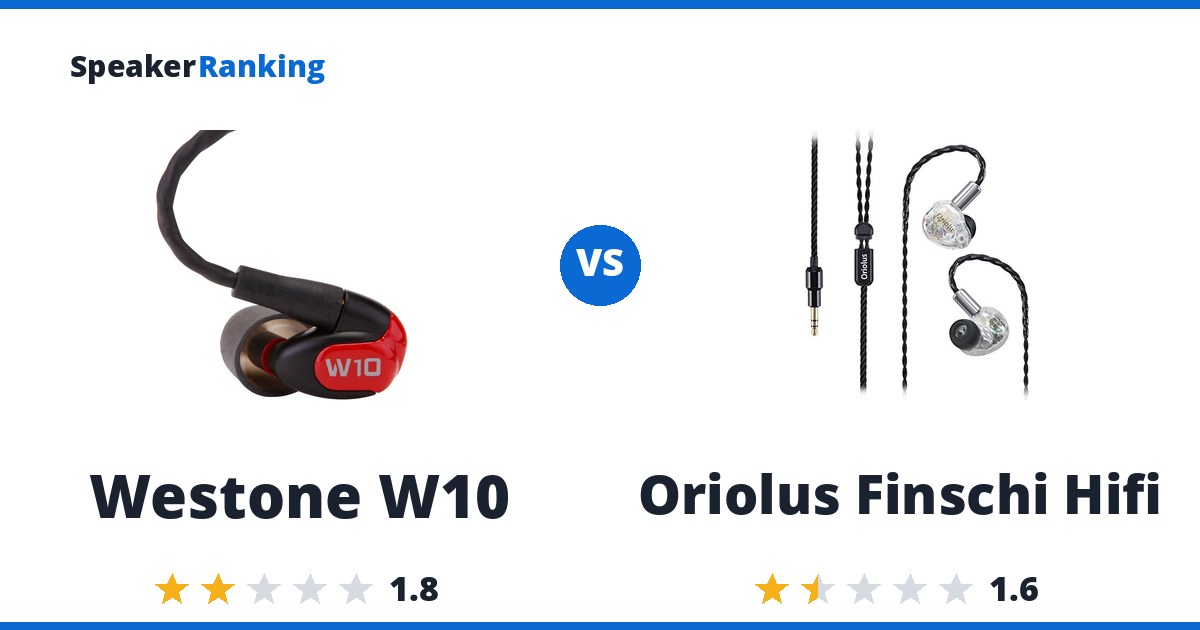
What the Westone W10 does well: Its 122 dB SPL/mW sensitivity means a phone drives it to loud levels with no effort, and the cable includes a built-in microphone for calls. The tradeoff: Oratory1990’s measurement shows heavy treble loss, with an 11.5 dB dip near 6 kHz and the air band almost 18 dB below target, so cymbals, string texture and spatial cues are badly muted.
What the Oriolus Finschi Hifi does well: A hybrid design pairs a 10mm dynamic driver with a balanced armature, and the 18 ohm impedance suits phones and dongles. The tradeoff: A preference score of 44 in crinacle’s measurement places it far from the response most listeners prefer, so expect obvious coloration.
Buy the Westone W10. It is rated higher for sound quality, and saving $0.99 with the Oriolus Finschi Hifi does not make up for the sound-quality gap.
Looking for alternatives? See the complete Headphones rankings.
Specifications Side By Side
| Westone W10 | Oriolus Finschi Hifi | |
|---|---|---|
| Price | $199.99 | $199.00 |
| Ranked | #435 of 450 in In-Ear Headphones | #442 of 450 in In-Ear Headphones |
| Form Factor | In-ear | In-ear |
| Back | Closed | Closed |
| Harman Preference Score | 47 (measured by oratory1990, via AutoEQ) | 44 (measured by crinacle, via AutoEQ) |
| Deviation From Target | 4.06 dB standard deviation | 3.95 dB standard deviation |
| Tonal Tilt | -0.45 (negative is warmer, positive brighter) | -1.76 (negative is warmer, positive brighter) |
| Sub-bass Extension | Falls 6 dB below target at 56 Hz (-8.0 dB at 30 Hz) | - |
| Connection | Wired | Wired |
| Driver Type | Balanced armature | Hybrid (1 dynamic + 1 balanced armature) |
| Drivers | 1 x balanced armature | 1 x 10mm dynamic + 1 x balanced armature |
| Sensitivity | 122 dB SPL/mW | 112 dB/mW |
| Frequency Response | 20Hz - 16kHz (Manufacturer specified) | 10Hz - 40kHz (Manufacturer specified) |
| Built-in Microphone | Yes | - |
| Impedance | - | 18 ohms |
Related Headphone Comparisons
How Westone W10 compares with other leading options:
- Shure SE425 vs Westone W10
- Westone W10 vs Shozy B2
- Westone W10 vs Sennheiser Momentum True Wireless 2
- Shozy B2 vs Oriolus Finschi Hifi
- Oriolus Finschi Hifi vs Sennheiser Momentum True Wireless 2
Prices on this page were last checked October 11, 2026 at 4:59 PM UTC. Product prices and availability are accurate as of that date/time and are subject to change; the price and availability shown on Amazon at the time of purchase will apply to the purchase of this product.
As an eBay Partner, we may be compensated if you make a purchase.
The Two Headphones In Full
 Westone W10: $199.99 Amazon eBay

Pros: Its 122 dB SPL/mW sensitivity means a phone drives it to loud levels with no effort, and the cable includes a built-in microphone for calls. The single balanced armature design suits listeners who want a dark, laid-back sound with no treble glare.
Cons: Oratory1990’s measurement shows heavy treble loss, with an 11.5 dB dip near 6 kHz and the air band almost 18 dB below target, so cymbals, string texture and spatial cues are badly muted. Sub-bass falls 6 dB short by 56 Hz, leaving little low end rumble. The cheaper Etymotic ER3SE and KZ ASX both rate higher.
Full Westone W10 review and specifications →
| Released | Oct 2013 (13 years ago) |
|---|---|
| Back | Closed |
| Built-in Microphone | Yes |
| Connection | Wired |
| Deviation From Target | 4.06 dB standard deviation |
| Driver Type | Balanced armature |
| Drivers | 1 x balanced armature |
| Form Factor | In-ear |
| Frequency Response | 20Hz - 16kHz (Manufacturer specified) |
| Harman Preference Score | 47 (measured by oratory1990, via AutoEQ) |
| Sensitivity | 122 dB SPL/mW |
| Sub-bass Extension | Falls 6 dB below target at 56 Hz (-8.0 dB at 30 Hz) |
| Tonal Tilt | -0.45 (negative is warmer, positive brighter) |
EQ preset to match the Harman target
Set a preamp of -6.2 dB, then add these filters in any parametric equalizer (Wavelet, Equalizer APO, Peace, or a player with parametric EQ). Calculated by AutoEQ from its measured frequency response.
| Filter | Frequency | Gain | Q |
|---|---|---|---|
| Low shelf | 105 Hz | +4.1 dB | 0.70 |
| Peak | 237 Hz | -4.0 dB | 0.18 |
| Peak | 5,987 Hz | +5.9 dB | 0.63 |
| Peak | 2,493 Hz | +2.9 dB | 2.11 |
| Peak | 59 Hz | +1.7 dB | 0.82 |
| High shelf | 10,000 Hz | +5.6 dB | 0.70 |
| Peak | 8,139 Hz | -2.8 dB | 3.70 |
| Peak | 713 Hz | +0.7 dB | 1.13 |
| Peak | 1,201 Hz | -1.0 dB | 2.41 |
| Peak | 237 Hz | -0.4 dB | 1.54 |
- Reviews, Comparisons and Sound Samples
- Head-to-Head Comparisons
 Oriolus Finschi Hifi: $199.00 Amazon eBay

Pros: A hybrid design pairs a 10mm dynamic driver with a balanced armature, and the 18 ohm impedance suits phones and dongles. Its rating matches the Sennheiser Momentum True Wireless 2.
Cons: A preference score of 44 in crinacle’s measurement places it far from the response most listeners prefer, so expect obvious coloration. The Westone W10 rates a bit higher at about the same price, and the 1MORE Quad Driver rates higher for less.
Full Oriolus Finschi Hifi review and specifications →
| Released | Sep 2019 (7 years ago) |
|---|---|
| Back | Closed |
| Connection | Wired |
| Deviation From Target | 3.95 dB standard deviation |
| Driver Type | Hybrid (1 dynamic + 1 balanced armature) |
| Drivers | 1 x 10mm dynamic + 1 x balanced armature |
| Form Factor | In-ear |
| Frequency Response | 10Hz - 40kHz (Manufacturer specified) |
| Harman Preference Score | 44 (measured by crinacle, via AutoEQ) |
| Impedance | 18 ohms |
| Sensitivity | 112 dB/mW |
| Tonal Tilt | -1.76 (negative is warmer, positive brighter) |
EQ preset to match the Harman target
Set a preamp of -6.4 dB, then add these filters in any parametric equalizer (Wavelet, Equalizer APO, Peace, or a player with parametric EQ). Calculated by AutoEQ from its measured frequency response.
| Filter | Frequency | Gain | Q |
|---|---|---|---|
| Low shelf | 105 Hz | -4.2 dB | 0.70 |
| Peak | 181 Hz | -4.4 dB | 0.85 |
| Peak | 3,216 Hz | +6.4 dB | 0.54 |
| Peak | 1,721 Hz | -5.4 dB | 1.04 |
| Peak | 808 Hz | +1.7 dB | 1.99 |
| High shelf | 10,000 Hz | +6.4 dB | 0.70 |
| Peak | 6,153 Hz | -4.9 dB | 4.24 |
| Peak | 5,239 Hz | +2.0 dB | 6.00 |
| Peak | 66 Hz | +0.4 dB | 2.03 |
| Peak | 3,460 Hz | +0.8 dB | 3.69 |
- Reviews, Comparisons and Sound Samples
- Head-to-Head Comparisons