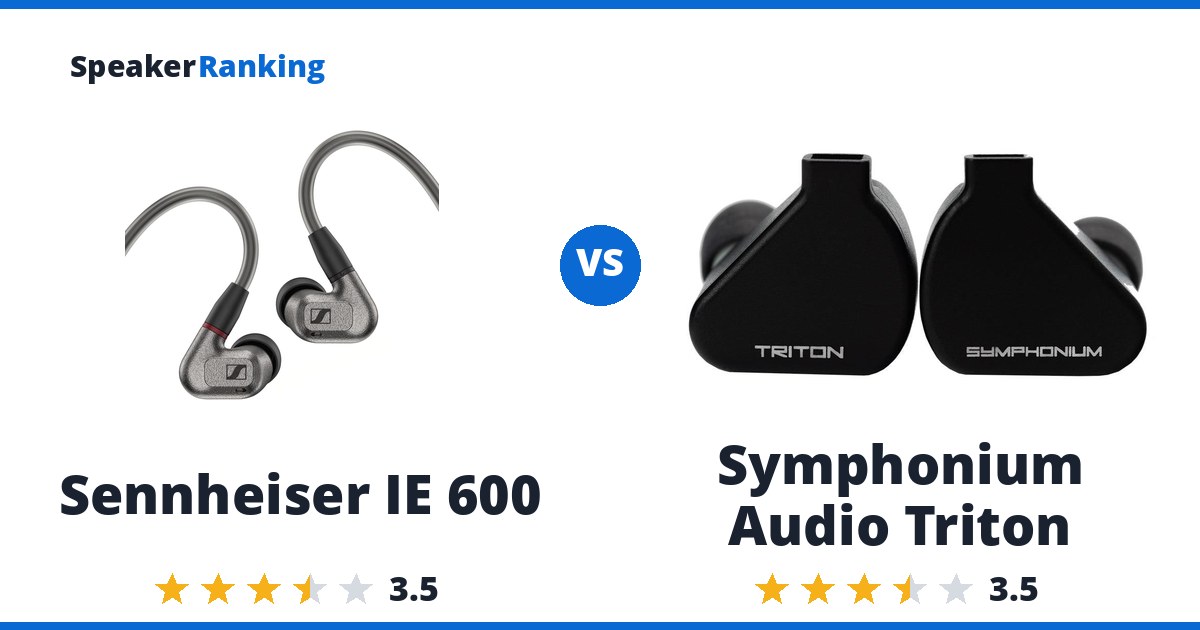
Short answer: the Sennheiser IE 600. Both are rated 3.5/5 for sound quality (#357 and #352 of 450 in-ear headphones), and the Sennheiser IE 600 costs $699.95 against $899 for the Symphonium Audio Triton, with sound quality a draw, the lower price decides it.
What the Sennheiser IE 600 does well: Sub-bass extends to 20 Hz with a slight 1.7 dB lift, and bass, low mids and upper mids all sit within about 1.3 dB of target, so the core of most music sounds full and natural. The tradeoff: In oratory1990’s measurement a 7.6 dB dip near 5.9 kHz and a presence band 5.5 dB under target take bite out of vocals and guitars, while a 4.7 dB peak near 9.7 kHz can sound sharp.
What the Symphonium Audio Triton does well: The hybrid of one dynamic driver and two balanced armatures keeps the bass and midrange close to target, with the bass band within 0.5 dB and the upper mids within 0.9 dB in squig.link measurements. The catch: Across hobbyist measurements the presence band sits 5.1 dB low with a 6.6 dB dip near 6.3 kHz, which dulls vocal edge, cymbals and fine detail.
Buy the Sennheiser IE 600. Both are rated the same for sound quality, and it costs $199.05 less than the Symphonium Audio Triton.
Looking for alternatives? See the complete Headphones rankings.
Specifications Side By Side
| Sennheiser IE 600 | Symphonium Audio Triton | |
|---|---|---|
| Price | $699.95 | $899.00 |
| Ranked | #357 of 450 in In-Ear Headphones | #352 of 450 in In-Ear Headphones |
| Form Factor | In-ear | In-ear |
| Back | Closed | Closed |
| Harman Preference Score | 67 (measured by oratory1990, via AutoEQ) | 68 (measured by crinacle, via AutoEQ) |
| Deviation From Target | 2.46 dB standard deviation | 2.43 dB standard deviation |
| Tonal Tilt | -0.80 (negative is warmer, positive brighter) | -0.55 (negative is warmer, positive brighter) |
| Sub-bass Extension | Within 6 dB of target down to 20 Hz (+2.3 dB at 30 Hz) | Within 6 dB of target down to 20 Hz (-2.3 dB at 30 Hz) |
| Connection | Wired | Wired |
| Driver Type | Dynamic | Hybrid (1 dynamic + 2 balanced armature) |
| Drivers | 1 x 7mm dynamic | 1 x dynamic + 2 x balanced armature |
| Impedance | 18 ohms | 8.3 ohms |
| Sensitivity | 118 dB SPL/V | 107 dB SPL/V |
| Frequency Response | 4Hz - 46.5kHz (Manufacturer specified) | 11Hz - 21kHz (Manufacturer specified) |
| Built-in Microphone | No | No |
| Weight | 0 lbs (6 g) per earbud | - |
Related Headphone Comparisons
More top alternatives to Symphonium Audio Triton:
- SoftEars Twilight vs Symphonium Audio Triton
- HIFIMAN RE2000 vs Symphonium Audio Triton
- Symphonium Audio Triton vs JVC HA-FW1500
- Symphonium Audio Triton vs SeeAudio Neo
- Symphonium Audio Triton vs DUNU Zen Pro
Prices on this page were last checked October 11, 2026 at 4:59 PM UTC. Product prices and availability are accurate as of that date/time and are subject to change; the price and availability shown on Amazon at the time of purchase will apply to the purchase of this product.
As an eBay Partner, we may be compensated if you make a purchase.
The Two Headphones In Full
 Sennheiser IE 600: $699.95 B&H Photo Video eBay

Pros: Sub-bass extends to 20 Hz with a slight 1.7 dB lift, and bass, low mids and upper mids all sit within about 1.3 dB of target, so the core of most music sounds full and natural. Air above 10 kHz is lifted about 5.6 dB, adding sparkle to cymbals and room sound. At 118 dB/V it is easy to drive from a phone, and it suits listeners who like a bassy or warm tilt.
Cons: In oratory1990’s measurement a 7.6 dB dip near 5.9 kHz and a presence band 5.5 dB under target take bite out of vocals and guitars, while a 4.7 dB peak near 9.7 kHz can sound sharp. The FiiO FD5 and iBasso IT04 both carry higher ratings for considerably less money.
Full Sennheiser IE 600 review and specifications →
| Released | Mar 2022 (4 years ago) |
|---|---|
| Back | Closed |
| Built-in Microphone | No |
| Connection | Wired |
| Deviation From Target | 2.46 dB standard deviation |
| Driver Type | Dynamic |
| Drivers | 1 x 7mm dynamic |
| Form Factor | In-ear |
| Frequency Response | 4Hz - 46.5kHz (Manufacturer specified) |
| Harman Preference Score | 67 (measured by oratory1990, via AutoEQ) |
| Impedance | 18 ohms |
| Sensitivity | 118 dB SPL/V |
| Sub-bass Extension | Within 6 dB of target down to 20 Hz (+2.3 dB at 30 Hz) |
| Tonal Tilt | -0.80 (negative is warmer, positive brighter) |
| Weight | 0 lbs (6 g) per earbud |
EQ preset to match the Harman target
Set a preamp of -5.3 dB, then add these filters in any parametric equalizer (Wavelet, Equalizer APO, Peace, or a player with parametric EQ). Calculated by AutoEQ from its measured frequency response.
| Filter | Frequency | Gain | Q |
|---|---|---|---|
| Low shelf | 105 Hz | -2.7 dB | 0.70 |
| Peak | 4,374 Hz | +5.0 dB | 1.28 |
| Peak | 196 Hz | -1.9 dB | 1.50 |
| Peak | 1,727 Hz | -2.8 dB | 1.16 |
| Peak | 798 Hz | +1.5 dB | 1.45 |
| High shelf | 10,000 Hz | -7.6 dB | 0.70 |
| Peak | 72 Hz | +1.4 dB | 1.93 |
| Peak | 5,857 Hz | +3.3 dB | 5.80 |
| Peak | 143 Hz | -0.7 dB | 3.18 |
| Peak | 4,796 Hz | -0.6 dB | 4.12 |
- Reviews, Comparisons and Sound Samples
- Head-to-Head Comparisons
 Symphonium Audio Triton: $899.00 Headphones.com eBay

Pros: The hybrid of one dynamic driver and two balanced armatures keeps the bass and midrange close to target, with the bass band within 0.5 dB and the upper mids within 0.9 dB in squig.link measurements. Sub-bass still reaches 20 Hz within 6 dB of target, sitting 2.3 dB low at 30 Hz. At 107 dB/V and 8.3 ohms it plays loud from a phone.
Cons: Across hobbyist measurements the presence band sits 5.1 dB low with a 6.6 dB dip near 6.3 kHz, which dulls vocal edge, cymbals and fine detail. Crinacle’s preference score of 68 is middling, and the SoftEars Twilight rates higher at a similar price.
Full Symphonium Audio Triton review and specifications →
| Back | Closed |
|---|---|
| Built-in Microphone | No |
| Connection | Wired |
| Deviation From Target | 2.43 dB standard deviation |
| Driver Type | Hybrid (1 dynamic + 2 balanced armature) |
| Drivers | 1 x dynamic + 2 x balanced armature |
| Form Factor | In-ear |
| Frequency Response | 11Hz - 21kHz (Manufacturer specified) |
| Harman Preference Score | 68 (measured by crinacle, via AutoEQ) |
| Impedance | 8.3 ohms |
| Sensitivity | 107 dB SPL/V |
| Sub-bass Extension | Within 6 dB of target down to 20 Hz (-2.3 dB at 30 Hz) |
| Tonal Tilt | -0.55 (negative is warmer, positive brighter) |
EQ preset to match the Harman target
Set a preamp of -4.7 dB, then add these filters in any parametric equalizer (Wavelet, Equalizer APO, Peace, or a player with parametric EQ). Calculated by AutoEQ from its measured frequency response.
| Filter | Frequency | Gain | Q |
|---|---|---|---|
| Low shelf | 105 Hz | -1.5 dB | 0.70 |
| Peak | 206 Hz | -2.9 dB | 0.48 |
| Peak | 3,027 Hz | +5.8 dB | 0.38 |
| Peak | 1,713 Hz | -6.4 dB | 0.95 |
| Peak | 70 Hz | +3.1 dB | 0.69 |
| High shelf | 10,000 Hz | -3.9 dB | 0.70 |
| Peak | 3,424 Hz | +1.1 dB | 3.91 |
| Peak | 5,290 Hz | -1.6 dB | 5.99 |
| Peak | 6,437 Hz | +1.9 dB | 6.00 |
| Peak | 2,469 Hz | -0.7 dB | 4.04 |
- Reviews, Comparisons and Sound Samples
- Head-to-Head Comparisons