Short answer: the SeeAudio Neo. It ranks #365 of 450 in-ear headphones by sound quality, rated 3.4/5, at $1,099; the qdc Anole V6 ranks #369, rated 3.3/5, and costs $1,298, so there is not much of a tradeoff to weigh.
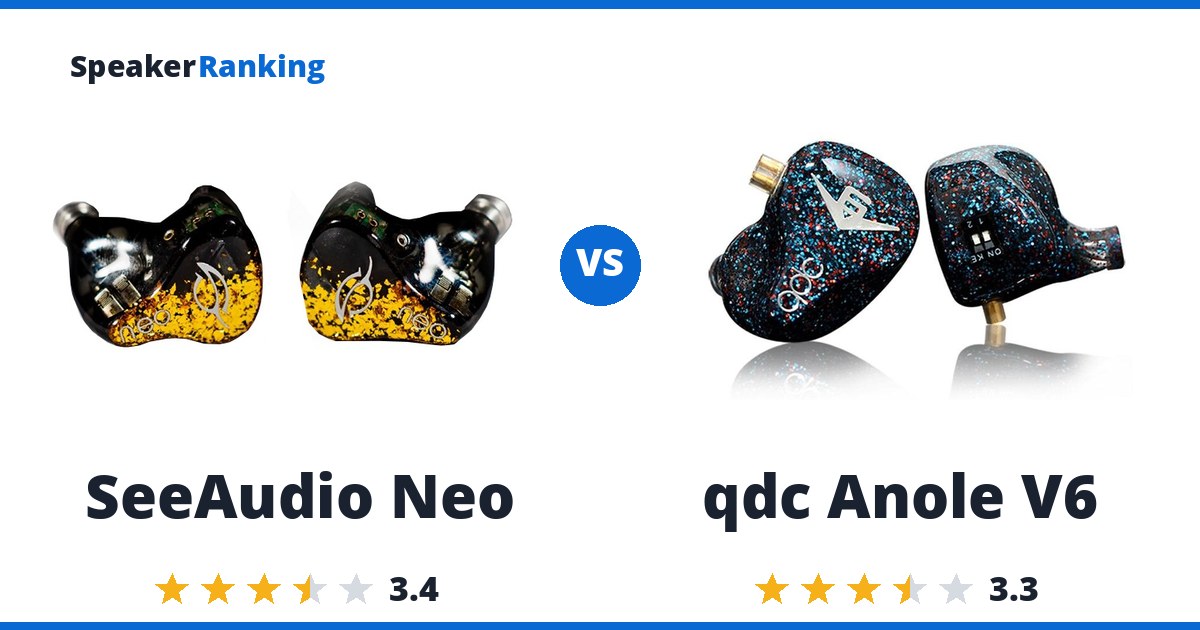
Why pick the SeeAudio Neo: Bass and sub-bass sit within a decibel of target down to 20 Hz, giving a clean, controlled low end without boom. The tradeoff: Squig.link measurements show the 3 to 6 kHz presence band about 5.4 dB below target with a 9.2 dB dip near 5.5 kHz, so vocals lose clarity and instruments sound recessed.
Why pick the qdc Anole V6: Six balanced armature drivers per side earn a preference score of 65 in crinacle’s measurement with a warm leaning balance. The tradeoff: An average deviation of about 2.9 dB from target makes the tuning uneven, with some bands noticeably louder or quieter than others.
Buy the SeeAudio Neo. It is rated higher for sound quality than the qdc Anole V6 and costs less, so it is the default pick unless a specific strength of the other one matters more to you.
Want more options? Browse the full Headphones rankings.
Specifications Side By Side
| SeeAudio Neo | qdc Anole V6 | |
|---|---|---|
| Price | $1,099.00 | $1,298.00 |
| Ranked | #365 of 450 in In-Ear Headphones | #369 of 450 in In-Ear Headphones |
| Form Factor | In-ear | In-ear |
| Back | Closed | Closed |
| Harman Preference Score | 66 (measured by crinacle, via AutoEQ) | 65 (measured by crinacle, via AutoEQ) |
| Deviation From Target | 2.51 dB standard deviation | 2.85 dB standard deviation |
| Tonal Tilt | -0.80 (negative is warmer, positive brighter) | -0.62 (negative is warmer, positive brighter) |
| Connection | Wired | Wired |
| Driver Type | Balanced armature | Balanced armature |
| Drivers | 10 x balanced armature | 6 x balanced armature |
| Impedance | 28 ohms | - |
| Sensitivity | 116 dB/mW | 106 - 109 dB SPL/mW |
| Frequency Response | 20Hz - 20kHz (Manufacturer specified) | 10Hz - 20kHz (Manufacturer specified) |
| Built-in Microphone | No | No |
| Sub-bass Extension | Within 6 dB of target down to 20 Hz (+0.6 dB at 30 Hz) | - |
Related Headphone Comparisons
More worthwhile head-to-heads for SeeAudio Neo:
- Symphonium Audio Triton vs SeeAudio Neo
- SeeAudio Neo vs Unique Melody MEST Mk2
- DUNU Zen Pro vs SeeAudio Neo
- qdc Anole V6 vs Sennheiser IE 900
- Unique Melody MEST Mk2 vs qdc Anole V6
Prices on this page were last checked October 11, 2026 at 4:59 PM UTC. Product prices and availability are accurate as of that date/time and are subject to change; the price and availability shown on Amazon at the time of purchase will apply to the purchase of this product.
As an eBay Partner, we may be compensated if you make a purchase.
The Two Headphones In Full
 SeeAudio Neo: $1,099.00 Linsoul eBay

Pros: Bass and sub-bass sit within a decibel of target down to 20 Hz, giving a clean, controlled low end without boom. Ten balanced armatures add about 3.8 dB of air above 10 kHz for some sparkle. At 116 dB/mW it gets loud from any phone or dongle. It rates higher than the qdc Anole V6 while costing less.
Cons: Squig.link measurements show the 3 to 6 kHz presence band about 5.4 dB below target with a 9.2 dB dip near 5.5 kHz, so vocals lose clarity and instruments sound recessed. Such high sensitivity can reveal background hiss from noisy sources. The DUNU Zen Pro and JVC HA-FW1500 earn the same rating for less money.
Full SeeAudio Neo review and specifications →
| Released | Jan 2021 (5 years ago) |
|---|---|
| Back | Closed |
| Built-in Microphone | No |
| Connection | Wired |
| Deviation From Target | 2.51 dB standard deviation |
| Driver Type | Balanced armature |
| Drivers | 10 x balanced armature |
| Form Factor | In-ear |
| Frequency Response | 20Hz - 20kHz (Manufacturer specified) |
| Harman Preference Score | 66 (measured by crinacle, via AutoEQ) |
| Impedance | 28 ohms |
| Sensitivity | 116 dB/mW |
| Sub-bass Extension | Within 6 dB of target down to 20 Hz (+0.6 dB at 30 Hz) |
| Tonal Tilt | -0.80 (negative is warmer, positive brighter) |
EQ preset to match the Harman target
Set a preamp of -5.6 dB, then add these filters in any parametric equalizer (Wavelet, Equalizer APO, Peace, or a player with parametric EQ). Calculated by AutoEQ from its measured frequency response.
| Filter | Frequency | Gain | Q |
|---|---|---|---|
| Low shelf | 105 Hz | -1.5 dB | 0.70 |
| Peak | 5,931 Hz | +3.8 dB | 0.43 |
| Peak | 164 Hz | -2.6 dB | 1.07 |
| Peak | 1,573 Hz | -5.0 dB | 1.52 |
| Peak | 675 Hz | +1.6 dB | 1.31 |
| High shelf | 10,000 Hz | -5.1 dB | 0.70 |
| Peak | 3,085 Hz | +1.2 dB | 2.87 |
| Peak | 4,400 Hz | -3.5 dB | 5.82 |
| Peak | 5,545 Hz | +2.3 dB | 6.00 |
| Peak | 8,098 Hz | +1.7 dB | 2.84 |
- Reviews, Comparisons and Sound Samples
- Head-to-Head Comparisons
 qdc Anole V6: $1,298.00 Shenzhenaudio eBay

Pros: Six balanced armature drivers per side earn a preference score of 65 in crinacle’s measurement with a warm leaning balance. It matches the rating of the 64 Audio A12t for considerably less money, and its 106 to 109 dB/mW sensitivity makes it easy to drive from a phone.
Cons: An average deviation of about 2.9 dB from target makes the tuning uneven, with some bands noticeably louder or quieter than others. Better rated in-ears are available for far less money.
Full qdc Anole V6 review and specifications →
| Back | Closed |
|---|---|
| Built-in Microphone | No |
| Connection | Wired |
| Deviation From Target | 2.85 dB standard deviation |
| Driver Type | Balanced armature |
| Drivers | 6 x balanced armature |
| Form Factor | In-ear |
| Frequency Response | 10Hz - 20kHz (Manufacturer specified) |
| Harman Preference Score | 65 (measured by crinacle, via AutoEQ) |
| Sensitivity | 106 - 109 dB SPL/mW |
| Tonal Tilt | -0.62 (negative is warmer, positive brighter) |
EQ preset to match the Harman target
Set a preamp of -6.0 dB, then add these filters in any parametric equalizer (Wavelet, Equalizer APO, Peace, or a player with parametric EQ). Calculated by AutoEQ from its measured frequency response.
| Filter | Frequency | Gain | Q |
|---|---|---|---|
| Low shelf | 105 Hz | -0.2 dB | 0.70 |
| Peak | 5,865 Hz | +5.5 dB | 1.25 |
| Peak | 167 Hz | -2.7 dB | 0.91 |
| Peak | 1,494 Hz | -2.8 dB | 1.71 |
| Peak | 761 Hz | +0.9 dB | 1.13 |
| High shelf | 10,000 Hz | -8.1 dB | 0.70 |
| Peak | 9,096 Hz | +3.7 dB | 0.91 |
| Peak | 4,218 Hz | -2.5 dB | 5.80 |
| Peak | 3,087 Hz | +0.7 dB | 3.79 |
| Peak | 6,799 Hz | -3.0 dB | 5.99 |
- Reviews, Comparisons and Sound Samples
- Head-to-Head Comparisons