Short answer: the DUNU Zen Pro. Both are rated 3.4/5 for sound quality (#366 and #365 of 450 in-ear headphones), and the DUNU Zen Pro costs $899.99 against $1,099 for the SeeAudio Neo, with sound quality a draw, the lower price decides it.
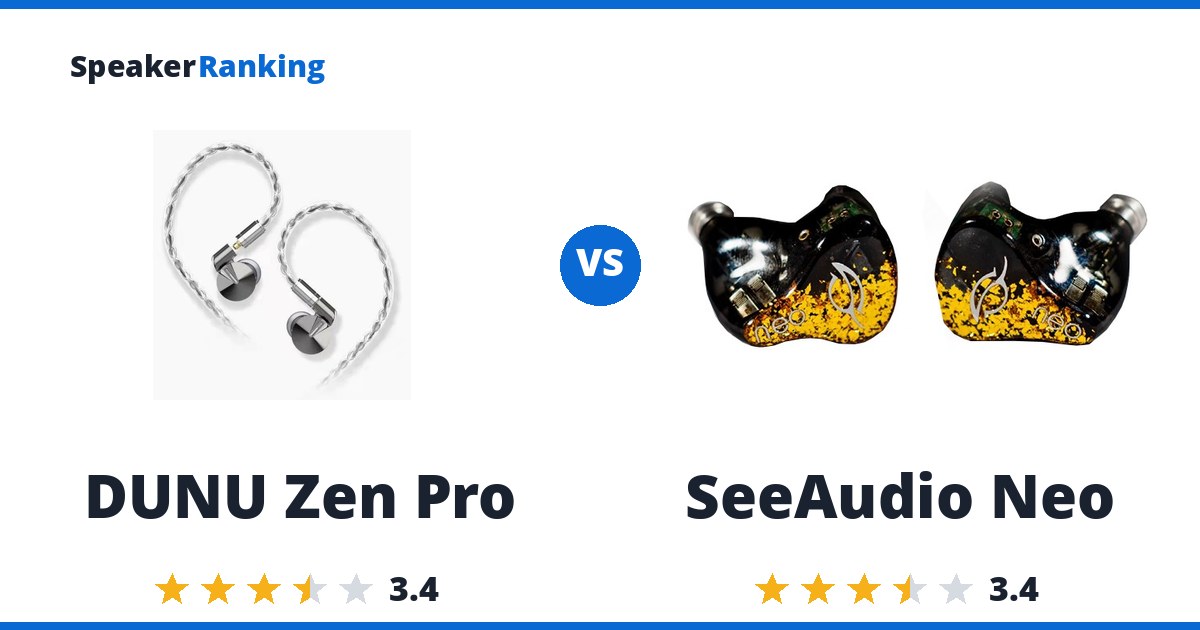
What the DUNU Zen Pro does well: A single dynamic driver with bass, low mids and upper mids all within half a dB of target in squig.link’s hobbyist measurements, so voices and instruments keep a natural, even body. The tradeoff: An 8.3 dB dip near 6.4 kHz and a 4 dB shortfall across 3 to 10 kHz dull cymbals and blunt the edge of vocals, while a 4.6 dB peak near 11.5 kHz adds a little uneven sparkle.
What the SeeAudio Neo does well: Bass and sub-bass sit within a decibel of target down to 20 Hz, giving a clean, controlled low end without boom. The catch: Squig.link measurements show the 3 to 6 kHz presence band about 5.4 dB below target with a 9.2 dB dip near 5.5 kHz, so vocals lose clarity and instruments sound recessed.
Buy the DUNU Zen Pro. Both are rated the same for sound quality, and it costs $199.01 less than the SeeAudio Neo.
Looking for alternatives? See the complete Headphones rankings.
Specifications Side By Side
| DUNU Zen Pro | SeeAudio Neo | |
|---|---|---|
| Price | $899.99 | $1,099.00 |
| Ranked | #366 of 450 in In-Ear Headphones | #365 of 450 in In-Ear Headphones |
| Form Factor | In-ear | In-ear |
| Back | Closed | Closed |
| Harman Preference Score | 66 (measured by crinacle, via AutoEQ) | 66 (measured by crinacle, via AutoEQ) |
| Deviation From Target | 3.11 dB standard deviation | 2.51 dB standard deviation |
| Tonal Tilt | -0.11 (negative is warmer, positive brighter) | -0.80 (negative is warmer, positive brighter) |
| Connection | Wired | Wired |
| Driver Type | Dynamic | Balanced armature |
| Impedance | 16 ohms | 28 ohms |
| Sensitivity | 112 dB | 116 dB/mW |
| Frequency Response | 5Hz - 40kHz (Manufacturer specified) | 20Hz - 20kHz (Manufacturer specified) |
| Built-in Microphone | No | No |
| Sub-bass Extension | Within 6 dB of target down to 20 Hz (-3.7 dB at 30 Hz) | Within 6 dB of target down to 20 Hz (+0.6 dB at 30 Hz) |
| Drivers | - | 10 x balanced armature |
Related Headphone Comparisons
More top alternatives to SeeAudio Neo:
- Symphonium Audio Triton vs SeeAudio Neo
- SeeAudio Neo vs Unique Melody MEST Mk2
- SeeAudio Neo vs qdc Anole V6
- Symphonium Audio Triton vs DUNU Zen Pro
- DUNU Zen Pro vs JVC HA-FW1500
Prices on this page were last checked October 11, 2026 at 4:59 PM UTC. Product prices and availability are accurate as of that date/time and are subject to change; the price and availability shown on Amazon at the time of purchase will apply to the purchase of this product.
As an eBay Partner, we may be compensated if you make a purchase.
The Two Headphones In Full
 DUNU Zen Pro: $899.99 HiFiGo eBay

Pros: A single dynamic driver with bass, low mids and upper mids all within half a dB of target in squig.link’s hobbyist measurements, so voices and instruments keep a natural, even body. It matches the rating of the Unique Melody MEST Mk2 at a much lower price. At 16 ohms and 112 dB sensitivity it is easy to drive from a phone.
Cons: An 8.3 dB dip near 6.4 kHz and a 4 dB shortfall across 3 to 10 kHz dull cymbals and blunt the edge of vocals, while a 4.6 dB peak near 11.5 kHz adds a little uneven sparkle. Sub-bass sits about 3.5 dB below target, so the deepest rumble is lighter than the midbass suggests, and its 3.1 dB deviation makes it one of the less even tunings at this level.
Full DUNU Zen Pro review and specifications →
| Back | Closed |
|---|---|
| Built-in Microphone | No |
| Connection | Wired |
| Deviation From Target | 3.11 dB standard deviation |
| Driver Type | Dynamic |
| Form Factor | In-ear |
| Frequency Response | 5Hz - 40kHz (Manufacturer specified) |
| Harman Preference Score | 66 (measured by crinacle, via AutoEQ) |
| Impedance | 16 ohms |
| Sensitivity | 112 dB |
| Sub-bass Extension | Within 6 dB of target down to 20 Hz (-3.7 dB at 30 Hz) |
| Tonal Tilt | -0.11 (negative is warmer, positive brighter) |
EQ preset to match the Harman target
Set a preamp of -6.5 dB, then add these filters in any parametric equalizer (Wavelet, Equalizer APO, Peace, or a player with parametric EQ). Calculated by AutoEQ from its measured frequency response.
| Filter | Frequency | Gain | Q |
|---|---|---|---|
| Low shelf | 105 Hz | +8.7 dB | 0.70 |
| Peak | 58 Hz | -6.7 dB | 0.39 |
| Peak | 7,366 Hz | +4.8 dB | 0.84 |
| Peak | 2,185 Hz | -3.8 dB | 1.50 |
| Peak | 5,792 Hz | +2.4 dB | 2.90 |
| High shelf | 10,000 Hz | +3.7 dB | 0.70 |
| Peak | 821 Hz | +1.1 dB | 1.20 |
| Peak | 1,358 Hz | -1.0 dB | 2.21 |
| Peak | 207 Hz | -0.3 dB | 1.05 |
| Peak | 503 Hz | +0.3 dB | 1.77 |
- Reviews, Comparisons and Sound Samples
- Head-to-Head Comparisons
 SeeAudio Neo: $1,099.00 Linsoul eBay

Pros: Bass and sub-bass sit within a decibel of target down to 20 Hz, giving a clean, controlled low end without boom. Ten balanced armatures add about 3.8 dB of air above 10 kHz for some sparkle. At 116 dB/mW it gets loud from any phone or dongle. It rates higher than the qdc Anole V6 while costing less.
Cons: Squig.link measurements show the 3 to 6 kHz presence band about 5.4 dB below target with a 9.2 dB dip near 5.5 kHz, so vocals lose clarity and instruments sound recessed. Such high sensitivity can reveal background hiss from noisy sources. The DUNU Zen Pro and JVC HA-FW1500 earn the same rating for less money.
Full SeeAudio Neo review and specifications →
| Released | Jan 2021 (5 years ago) |
|---|---|
| Back | Closed |
| Built-in Microphone | No |
| Connection | Wired |
| Deviation From Target | 2.51 dB standard deviation |
| Driver Type | Balanced armature |
| Drivers | 10 x balanced armature |
| Form Factor | In-ear |
| Frequency Response | 20Hz - 20kHz (Manufacturer specified) |
| Harman Preference Score | 66 (measured by crinacle, via AutoEQ) |
| Impedance | 28 ohms |
| Sensitivity | 116 dB/mW |
| Sub-bass Extension | Within 6 dB of target down to 20 Hz (+0.6 dB at 30 Hz) |
| Tonal Tilt | -0.80 (negative is warmer, positive brighter) |
EQ preset to match the Harman target
Set a preamp of -5.6 dB, then add these filters in any parametric equalizer (Wavelet, Equalizer APO, Peace, or a player with parametric EQ). Calculated by AutoEQ from its measured frequency response.
| Filter | Frequency | Gain | Q |
|---|---|---|---|
| Low shelf | 105 Hz | -1.5 dB | 0.70 |
| Peak | 5,931 Hz | +3.8 dB | 0.43 |
| Peak | 164 Hz | -2.6 dB | 1.07 |
| Peak | 1,573 Hz | -5.0 dB | 1.52 |
| Peak | 675 Hz | +1.6 dB | 1.31 |
| High shelf | 10,000 Hz | -5.1 dB | 0.70 |
| Peak | 3,085 Hz | +1.2 dB | 2.87 |
| Peak | 4,400 Hz | -3.5 dB | 5.82 |
| Peak | 5,545 Hz | +2.3 dB | 6.00 |
| Peak | 8,098 Hz | +1.7 dB | 2.84 |
- Reviews, Comparisons and Sound Samples
- Head-to-Head Comparisons