Short answer: the Paradigm Persona 5F. It ranks #78 of 226 floorstanding speakers by sound quality, rated 4.3/5, at $19,999.98. The PS Audio Aspen FR10 ranks #87, rated 4.2/5, at $12,000, $7,999.98 cheaper, a saving that is not big enough to make up the sound-quality gap.

What the Paradigm Persona 5F does well: A larger Paradigm Persona 3F with a beryllium tweeter and 7” beryllium midrange over three 7” woofers. The tradeoff: No independent measurements yet, so its tonal balance and directivity can’t be compared with ranked speakers.
The case for the PS Audio Aspen FR10: Distinctive driver layout: two 6” mid-bass drivers plus three 6x9” passive radiators, an 8” planar ribbon mid-range, and a 2.5” planar ribbon tweeter, with the woofers placed low near the floor to counteract typical floor-bounce cancellation in the mid-bass/lower-midrange handoff. The tradeoff: At roughly $12000/pair, expectations are high, and the reviewer found some measured shortfalls relative to that price.
Buy the Paradigm Persona 5F. It is rated higher for sound quality, and the $7,999.98 saving on the PS Audio Aspen FR10 is not enough to make up the difference.
Worth knowing: the Paradigm Persona 5F has not been measured yet. Its rating is estimated from related models, with a likely range of 3.9 to 4.7, so treat this verdict as provisional.
Looking for alternatives? See the complete Passive Home rankings.
Specifications Side By Side
| Paradigm Persona 5F | PS Audio Aspen FR10 | |
|---|---|---|
| Price | $19,999.98 per pair | $12000 per pair |
| Ranked | #78 of 226 in Large Size Floorstanding Speakers Estimated | #87 of 226 in Large Size Floorstanding Speakers |
| Drivers | 1x 1” beryllium dome tweeter, 1x 7” beryllium midrange, 3x 7” X-PAL woofers | 2x 6.5” carbon fiber cone woofers, 1x 8” planar magnetic ribbon midrange, 1x 2.5” planar magnetic ribbon tweeter + 3x passive radiators |
| Sensitivity | 93dB room / 90dB anechoic (manufacturer specified) | 84.4dB (measured, Erin’s Audio Corner) |
| Impedance | 8 ohms compatible (manufacturer specified) | 4 ohms nominal, 3.6 ohms minimum (measured, Erin’s Audio Corner) |
| Frequency Response | 45Hz - 45kHz (±2dB on-axis, manufacturer specified) | - |
| Dimensions | 46.7”H x 9.5”W x 16.8”D (1185 x 241 x 427 mm) | 41.5”H x 11.8”W x 16.3”D (1054.1 x 298.5 x 412.8 mm) |
| Weight | 94.8 lbs (43 kg) | 119 lbs (54 kg) |
| Enclosure | Bass reflex | - |
| Warranty | Not found | - |
| Bass Extension (-10dB) | - | 28Hz (measured, Erin’s Audio Corner) |
| Bass Extension (-3dB) | - | 47Hz (measured, Erin’s Audio Corner) |
| Woofer Cabinet | - | passive radiator |
| Spinorama Preference Score | - | 4.08 |
| Spinorama Preference Score with Perfect Sub | - | 5.40 |
| DIY Kit | - | No |
Related Speaker Comparisons
More top alternatives to Paradigm Persona 5F:
- Revel F328Be vs Paradigm Persona 5F
- Arendal Sound 1610 Tower 8 vs Paradigm Persona 5F
- Magico A3 vs PS Audio Aspen FR10
- PS Audio Aspen FR10 vs Endow Audio Bravura 7
- Revel F226Be vs PS Audio Aspen FR10
Prices on this page were last checked October 11, 2026 at 4:59 PM UTC. Product prices and availability are accurate as of that date/time and are subject to change; the price and availability shown on Amazon at the time of purchase will apply to the purchase of this product.
As an eBay Partner, we may be compensated if you make a purchase.
The Two Speakers In Full
 Paradigm Persona 5F: $19,999.98 per pair Estimated Paradigm eBay
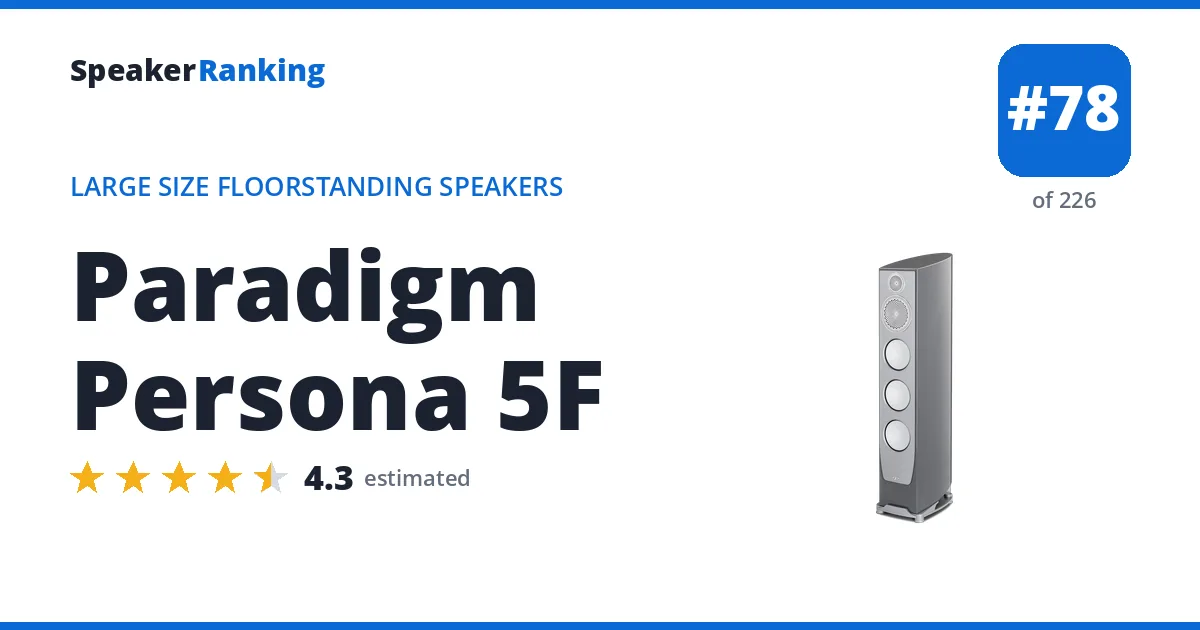
Same family: the Paradigm Persona B (bookshelf, estimated 4.1/5), the Paradigm Persona 3F (smaller floorstanding, ranked lower, estimated 4.2/5), the Paradigm Persona 7F (larger floorstanding, ranked higher, estimated 4.4/5), the Paradigm Persona 9H (larger floorstanding, ranked higher, estimated 4.4/5), the Paradigm Persona C (center, estimated 4.2/5) and the Paradigm Persona SUB (subwoofer, estimated 4.2/5).
Pros: A larger Paradigm Persona 3F with a beryllium tweeter and 7” beryllium midrange over three 7” woofers. Stereophile and Audioholics both published full measurements.
Cons: No independent measurements yet, so its tonal balance and directivity can’t be compared with ranked speakers. Stereophile measured sensitivity near 88.7dB, below the 90dB claim, and at 43 kg each it is heavy.
Full Paradigm Persona 5F review and specifications →
| Released | 2016 (10 years ago) |
|---|---|
| Dimensions | 46.7”H x 9.5”W x 16.8”D (1185 x 241 x 427 mm) |
| Drivers | 1x 1” beryllium dome tweeter, 1x 7” beryllium midrange, 3x 7” X-PAL woofers |
| Enclosure | Bass reflex |
| Frequency Response | 45Hz - 45kHz (±2dB on-axis, manufacturer specified) |
| Impedance | 8 ohms compatible (manufacturer specified) |
| Sensitivity | 93dB room / 90dB anechoic (manufacturer specified) |
| Warranty | Not found |
| Weight | 94.8 lbs (43 kg) |
- Links
- Reviews, Comparisons and Sound Samples
- Head-to-Head Comparisons
 PS Audio Aspen FR10: $12000 per pair PS Audio eBay
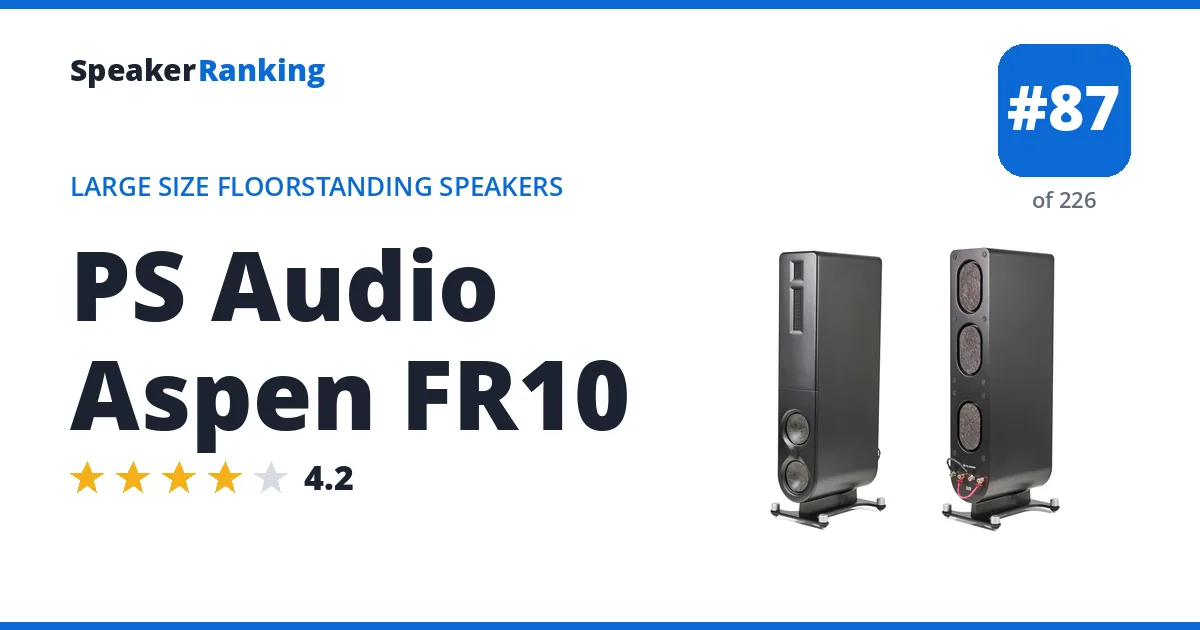
Same family: the PS Audio Aspen FR5 (bookshelf, rated 3.7/5), the PS Audio Aspen FR20 (larger floorstanding, ranked lower, estimated 4.2/5) and the PS Audio Aspen FR30 (larger floorstanding, ranked higher, estimated 4.3/5).
Pros: Distinctive driver layout: two 6” mid-bass drivers plus three 6x9” passive radiators, an 8” planar ribbon mid-range, and a 2.5” planar ribbon tweeter, with the woofers placed low near the floor to counteract typical floor-bounce cancellation in the mid-bass/lower-midrange handoff. Deliberately shelved bass response around 150Hz allows placement closer to the rear wall than typical, without the usual boominess. Extremely wide horizontal dispersion (the -6dB point isn’t reached until about 80-85° off-axis), giving a wide, enveloping soundstage that stays consistent rather than narrowing unevenly at different frequencies. Passed multiple stereo-imaging tests with precise placement despite the wide radiation, keeping instruments distinctly separated even in complex, heavily panned tracks. Exceptionally low multitone distortion at high frequency: among the best the reviewer has measured on any speaker. Bass extends smoothly to an F3 of 47Hz and F10 of 28Hz, potentially usable without a subwoofer for material that doesn’t dig much below 40Hz. Shows output enhancement rather than compression below about 50Hz even at high volume, adding extra punch and attack to bass transients. Measured bass extension of 47Hz (-3dB), with a measured sensitivity of 84.4dB.
Cons: At roughly $12000/pair, expectations are high, and the reviewer found some measured shortfalls relative to that price. A scoop around 600Hz slightly thins out vocal fullness; EQ can restore some body there. A narrow but pronounced dip around 6-7kHz shows up in measurements, though EQ didn’t meaningfully improve it in testing and the reviewer says he’d rather have a dip than a peak in that sibilance-prone region. On-axis, the treble reads as mildly elevated (though far less than some rivals like Martin Logan or Focal); needs about 20° of toe-out, per the manufacturer’s own recommendation, to sound properly balanced and take on a warmer character. Sidewall acoustic treatment should be avoided, since the speaker’s wide, room-filling sound depends on that sidewall interaction, limiting setup flexibility in treated rooms. A minor resonance-like anomaly appears around 800Hz, and some compression shows up at the highest frequencies (around 12kHz) under extreme output testing, though unlikely to be audible in real listening. Large and heavy floorstander (about 76 lbs each, 41” tall).
Full PS Audio Aspen FR10 review and specifications →
| Released | Dec 2023 (2 years ago) |
|---|---|
| Bass Extension (-10dB) | 28Hz (measured, Erin’s Audio Corner) |
| Bass Extension (-3dB) | 47Hz (measured, Erin’s Audio Corner) |
| DIY Kit | No |
| Dimensions | 41.5”H x 11.8”W x 16.3”D (1054.1 x 298.5 x 412.8 mm) |
| Drivers | 2x 6.5” carbon fiber cone woofers, 1x 8” planar magnetic ribbon midrange, 1x 2.5” planar magnetic ribbon tweeter + 3x passive radiators |
| Impedance | 4 ohms nominal, 3.6 ohms minimum (measured, Erin’s Audio Corner) |
| Sensitivity | 84.4dB (measured, Erin’s Audio Corner) |
| Spinorama Preference Score | 4.08 |
| Spinorama Preference Score with Perfect Sub | 5.40 |
| Weight | 119 lbs (54 kg) |
| Woofer Cabinet | passive radiator |
- Links
- Reviews, Comparisons and Sound Samples
- Head-to-Head Comparisons