Short answer: the PS Audio Aspen FR10. It ranks #39 of 73 floorstanding speakers by sound quality, rated 4.2/5, at $12,000. The Dali Rubikore 6 ranks #64, rated 3.3/5, at $8,000, $4,000 cheaper, not enough of a saving to outweigh the sound-quality gap.
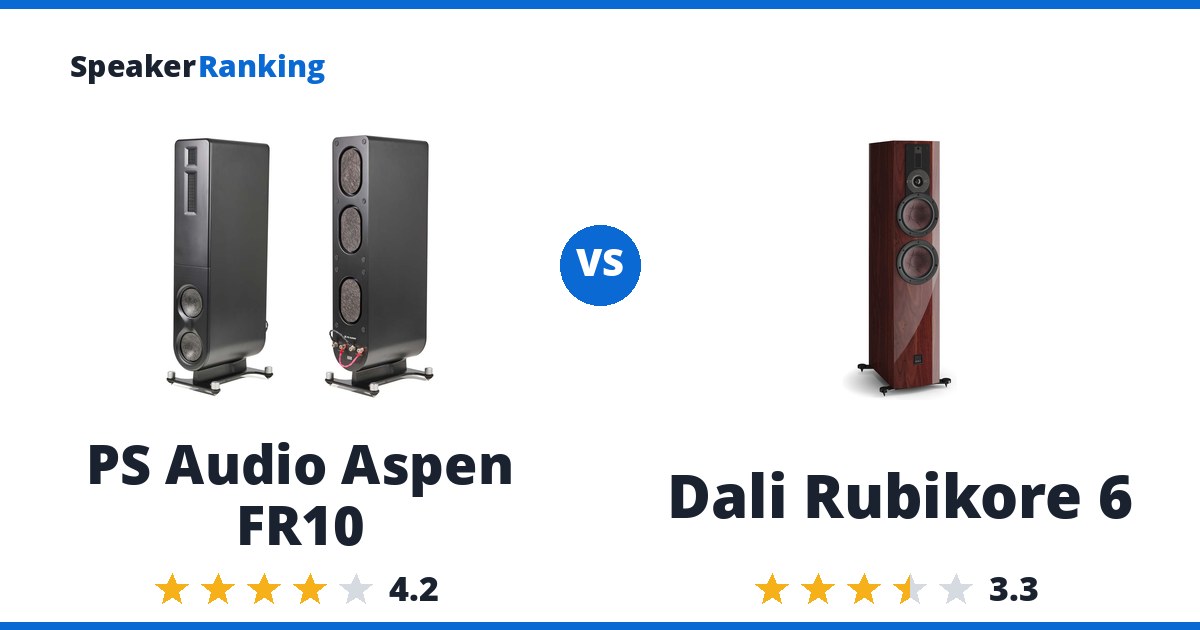
The case for the PS Audio Aspen FR10: Distinctive driver layout: two 6” mid-bass drivers plus three 6x9” passive radiators, an 8” planar ribbon mid-range, and a 2.5” planar ribbon tweeter, with the woofers placed low near the floor to counteract typical floor-bounce cancellation in the mid-bass/lower-midrange handoff. The tradeoff: At roughly $12000/pair, expectations are high, and the reviewer found some measured shortfalls relative to that price.
Why pick the Dali Rubikore 6: Unusual 2.5-plus-half-way, four-driver configuration: two woofers overlap up to 800Hz, then one continues alone to about 2600Hz where the tweeter takes over, followed by a supertweeter engaging at 14kHz. Watch for: On-axis, the treble sits 3-5dB above the midrange (especially around 4kHz), giving a sibilant, hot top end that the manufacturer itself recommends compensating for with 30° of toe-out (firing the speakers straight into the room rather than at the listener).
Buy the PS Audio Aspen FR10. It is rated higher for sound quality, and saving $4,000 with the Dali Rubikore 6 does not make up for the sound-quality gap.
Still deciding? The full Passive Home rankings cover every ranked option.
Specifications Side By Side
| PS Audio Aspen FR10 | Dali Rubikore 6 | |
|---|---|---|
| Price | $12000 per pair | $8000 per pair |
| Ranked | #39 of 73 in Large Size Floorstanding Speakers | #64 of 73 in Large Size Floorstanding Speakers |
| Bass Extension (-10dB) | 28Hz (measured, Erin’s Audio Corner) | 31Hz (measured, Erin’s Audio Corner) |
| Bass Extension (-3dB) | 47Hz (measured, Erin’s Audio Corner) | 43Hz (measured, Erin’s Audio Corner) |
| Impedance | 4 ohms nominal, 3.6 ohms minimum (measured, Erin’s Audio Corner) | 4 ohms nominal (4.3 ohms minimum above 80Hz, measured, Erin’s Audio Corner) |
| Sensitivity | 84.4dB (measured, Erin’s Audio Corner) | 86.4dB (measured, Erin’s Audio Corner; 88.5dB manufacturer specified) |
| Drivers | 2x 6.5” carbon fiber cone woofers, 1x 8” planar magnetic ribbon midrange, 1x 2.5” planar magnetic ribbon tweeter + 3x passive radiators | 28mm tweeter + dual 180mm woofers |
| Weight | 119 lbs (54 kg) | 114.9 lbs (52.1 kg) |
| Dimensions | 41.5”H x 11.8”W x 16.3”D (1054.1 x 298.5 x 412.8 mm) | 39”H x 7.9”W x 15”D (990.0 x 200.0 x 380.0 mm) |
| Woofer Cabinet | passive radiator | ported, rear |
| Spinorama Preference Score | 4.08 | 5.27 |
| Spinorama Preference Score with Perfect Sub | 5.40 | 6.96 |
| DIY Kit | No | No |
Related Speaker Comparisons
More worthwhile head-to-heads for PS Audio Aspen FR10:
- Revel F226Be vs PS Audio Aspen FR10
- Revel Concerta2 F35 vs PS Audio Aspen FR10
- JBL Studio 698 vs PS Audio Aspen FR10
- PS Audio Aspen FR10 vs Focal Aria Evo X N°2
- PS Audio Aspen FR10 vs Endow Audio Bravura 7
Prices on this page were last checked September 29, 2026 at 3:43 PM UTC. Product prices and availability are accurate as of that date/time and are subject to change; the price and availability shown on Amazon at the time of purchase will apply to the purchase of this product.
As an eBay Partner, we may be compensated if you make a purchase.
The Two Speakers In Full
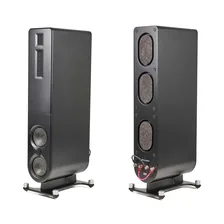 PS Audio Aspen FR10: $12000 per pair PS Audio eBay
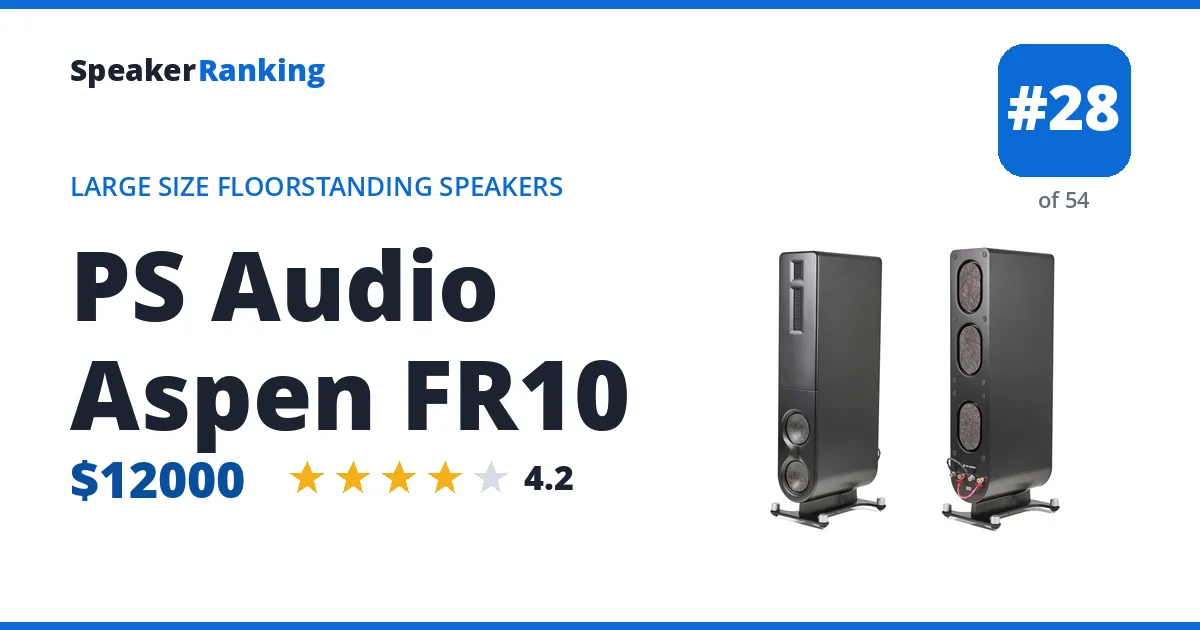
Pros: Distinctive driver layout: two 6” mid-bass drivers plus three 6x9” passive radiators, an 8” planar ribbon mid-range, and a 2.5” planar ribbon tweeter, with the woofers placed low near the floor to counteract typical floor-bounce cancellation in the mid-bass/lower-midrange handoff. Deliberately shelved bass response around 150Hz allows placement closer to the rear wall than typical, without the usual boominess. Extremely wide horizontal dispersion (the -6dB point isn’t reached until about 80-85° off-axis), giving a wide, enveloping soundstage that stays consistent rather than narrowing unevenly at different frequencies. Passed multiple stereo-imaging tests with precise placement despite the wide radiation, keeping instruments distinctly separated even in complex, heavily panned tracks. Exceptionally low multitone distortion at high frequency: among the best the reviewer has measured on any speaker. Bass extends smoothly to an F3 of 47Hz and F10 of 28Hz, potentially usable without a subwoofer for material that doesn’t dig much below 40Hz. Shows output enhancement rather than compression below about 50Hz even at high volume, adding extra punch and attack to bass transients. Measured bass extension of 47Hz (-3dB), with a measured sensitivity of 84.4dB.
Cons: At roughly $12000/pair, expectations are high, and the reviewer found some measured shortfalls relative to that price. A scoop around 600Hz slightly thins out vocal fullness; EQ can restore some body there. A narrow but pronounced dip around 6-7kHz shows up in measurements, though EQ didn’t meaningfully improve it in testing and the reviewer says he’d rather have a dip than a peak in that sibilance-prone region. On-axis, the treble reads as mildly elevated (though far less than some rivals like Martin Logan or Focal); needs about 20° of toe-out, per the manufacturer’s own recommendation, to sound properly balanced and take on a warmer character. Sidewall acoustic treatment should be avoided, since the speaker’s wide, room-filling sound depends on that sidewall interaction, limiting setup flexibility in treated rooms. A minor resonance-like anomaly appears around 800Hz, and some compression shows up at the highest frequencies (around 12kHz) under extreme output testing, though unlikely to be audible in real listening. Large and heavy floorstander (about 76 lbs each, 41” tall).
Full PS Audio Aspen FR10 review and specifications →
| Bass Extension (-10dB) | 28Hz (measured, Erin’s Audio Corner) |
|---|---|
| Bass Extension (-3dB) | 47Hz (measured, Erin’s Audio Corner) |
| DIY Kit | No |
| Dimensions | 41.5”H x 11.8”W x 16.3”D (1054.1 x 298.5 x 412.8 mm) |
| Drivers | 2x 6.5” carbon fiber cone woofers, 1x 8” planar magnetic ribbon midrange, 1x 2.5” planar magnetic ribbon tweeter + 3x passive radiators |
| Impedance | 4 ohms nominal, 3.6 ohms minimum (measured, Erin’s Audio Corner) |
| Sensitivity | 84.4dB (measured, Erin’s Audio Corner) |
| Spinorama Preference Score | 4.08 |
| Spinorama Preference Score with Perfect Sub | 5.40 |
| Weight | 119 lbs (54 kg) |
| Woofer Cabinet | passive radiator |
- Links
- Reviews, Comparisons and Sound Samples
- Head-to-Head Comparisons
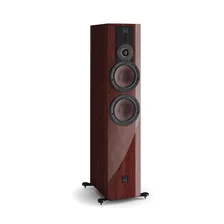 Dali Rubikore 6: $8000 per pair Safe and Sound HQ eBay
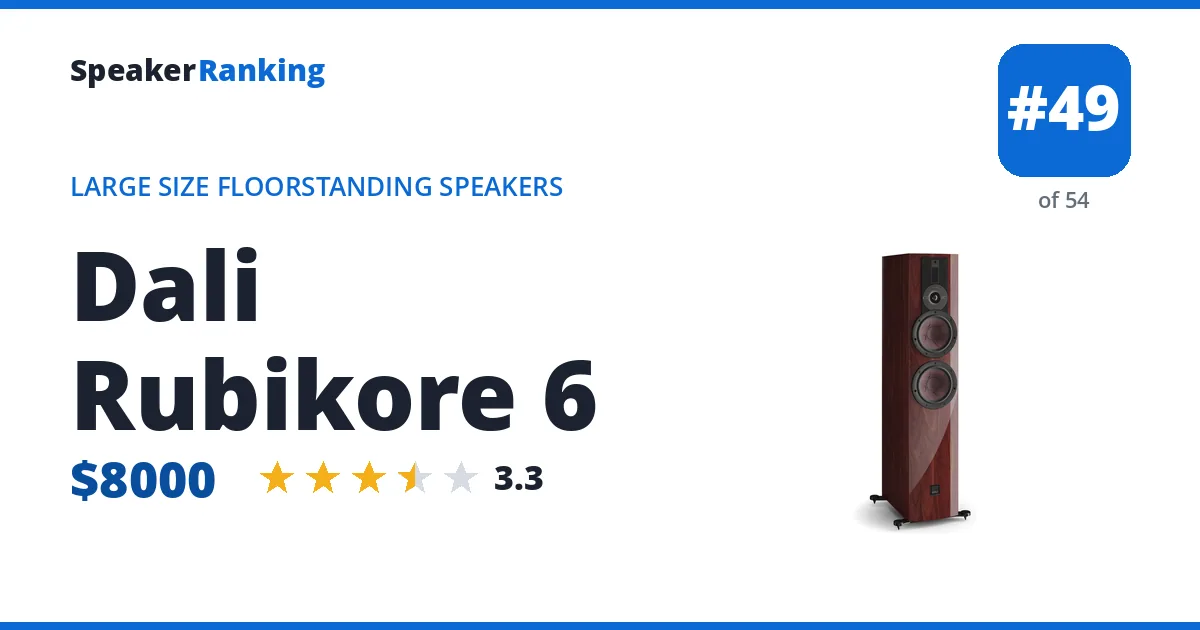
Pros: Unusual 2.5-plus-half-way, four-driver configuration: two woofers overlap up to 800Hz, then one continues alone to about 2600Hz where the tweeter takes over, followed by a supertweeter engaging at 14kHz. A design layout the reviewer says he’d never encountered before. Bass extension reaches a solid 40-45Hz in-room. Distortion is quite low overall, with an especially impressive gap between second- and third-order harmonic distortion in the midwoofers. Wide horizontal radiation of about ±75°, close to the reviewer’s preferred range for an enveloping soundstage. Very good dynamic range, holding up to about 26dB of level increase (70dB to 102dB) with distortion staying within the reviewer’s 3% threshold even at full output. Multiple attractive finish options, including bi-wireable connections. Measured bass extension of 43Hz (-3dB), with a measured sensitivity of 86.4dB.
Cons: On-axis, the treble sits 3-5dB above the midrange (especially around 4kHz), giving a sibilant, hot top end that the manufacturer itself recommends compensating for with 30° of toe-out (firing the speakers straight into the room rather than at the listener). Even with that toe-out, the midrange still reads as somewhat scooped and recessed: the reviewer needed a wide, +2dB EQ boost around 2.5kHz to bring vocals back into proper balance. A high-Q resonance appears around 590Hz, and another shows up around 800Hz in burst decay measurements. Best combined with sidewall absorption to help tame the elevated 4-5kHz energy, adding to setup complexity. Needs specific listening-height positioning: ears should be at the tweeter (not supertweeter) level for the most accurate sound. Without EQ or acoustic treatment, the reviewer found the combination of a hot tweeter and recessed midrange a “tough sale” despite otherwise strong measured performance.
Full Dali Rubikore 6 review and specifications →
| Bass Extension (-10dB) | 31Hz (measured, Erin’s Audio Corner) |
|---|---|
| Bass Extension (-3dB) | 43Hz (measured, Erin’s Audio Corner) |
| DIY Kit | No |
| Dimensions | 39”H x 7.9”W x 15”D (990.0 x 200.0 x 380.0 mm) |
| Drivers | 28mm tweeter + dual 180mm woofers |
| Impedance | 4 ohms nominal (4.3 ohms minimum above 80Hz, measured, Erin’s Audio Corner) |
| Sensitivity | 86.4dB (measured, Erin’s Audio Corner; 88.5dB manufacturer specified) |
| Spinorama Preference Score | 5.27 |
| Spinorama Preference Score with Perfect Sub | 6.96 |
| Weight | 114.9 lbs (52.1 kg) |
| Woofer Cabinet | ported, rear |
- Links
- Reviews, Comparisons and Sound Samples
- Head-to-Head Comparisons