Short answer: the Meze 105 Aer. It ranks #86 of 216 over-ear headphones by sound quality, rated 3.9/5, at $299. The Beyerdynamic DT 700 Pro X ranks #98, rated 3.8/5, at $279.99, $19.01 cheaper, not enough of a saving to outweigh the sound-quality gap.

What the Meze 105 Aer does well: The open back tuning is warm, with bass from 60 to 200 Hz about 2 dB above target and the low mids about 1.6 dB above, so voices and instruments sound full and relaxed. The catch: An 8 dB dip near 8.8 kHz and treble about 2.6 dB below target take the shimmer off cymbals and sibilance, so the top end can sound dull and veiled.
What the Beyerdynamic DT 700 Pro X does well: Bass from 60 to 200 Hz lands right on the Harman target, and the 48 ohm, 100 dB sensitivity design drives easily from a laptop or interface. The tradeoff: A deep 12.8 dB dip near 3.9 kHz pulls vocal presence and consonant clarity backward, and presence overall runs about 3.5 dB under target.
Buy the Meze 105 Aer. It is rated higher for sound quality, and saving $19.01 with the Beyerdynamic DT 700 Pro X does not make up for the sound-quality gap.
Want more options? Browse the full Headphones rankings.
Specifications Side By Side
| Meze 105 Aer | Beyerdynamic DT 700 Pro X | |
|---|---|---|
| Price | $299.00 | $279.99 |
| Ranked | #86 of 216 in Over-Ear Headphones | #98 of 216 in Over-Ear Headphones |
| Form Factor | Over-ear | Over-ear |
| Harman Preference Score | 79 (measured by oratory1990, via AutoEQ) | 77 (measured by oratory1990, via AutoEQ) |
| Deviation From Target | 2.15 dB standard deviation | 2.58 dB standard deviation |
| Tonal Tilt | -0.51 (negative is warmer, positive brighter) | -0.34 (negative is warmer, positive brighter) |
| Sub-bass Extension | Within 6 dB of target down to 20 Hz (-3.1 dB at 30 Hz) | Within 6 dB of target down to 20 Hz (-0.5 dB at 30 Hz) |
| Connection | Wired | Wired |
| Back | Open | Closed |
| Driver Type | Dynamic | Dynamic |
| Drivers | 1 x 50mm dynamic | - |
| Impedance | - | 48 ohms |
| Sensitivity | - | 100 dB SPL (1mW/500Hz) |
| Weight | - | 0.8 lbs (350 g) |
| Frequency Response | - | 5Hz - 40kHz (Manufacturer specified) |
Related Headphone Comparisons
More worthwhile head-to-heads for Meze 105 Aer:
- AKG K612 vs Meze 105 Aer
- Meze 105 Aer vs Sivga Luan
- Audio-Technica ATH-MSR7b vs Meze 105 Aer
- Meze 105 Aer vs Austrian Audio Hi-X65
- Sivga Luan vs Beyerdynamic DT 700 Pro X
Prices on this page were last checked October 11, 2026 at 4:59 PM UTC. Product prices and availability are accurate as of that date/time and are subject to change; the price and availability shown on Amazon at the time of purchase will apply to the purchase of this product.
As an eBay Partner, we may be compensated if you make a purchase.
The Two Headphones In Full
 Meze 105 Aer: $299.00 Amazon eBay
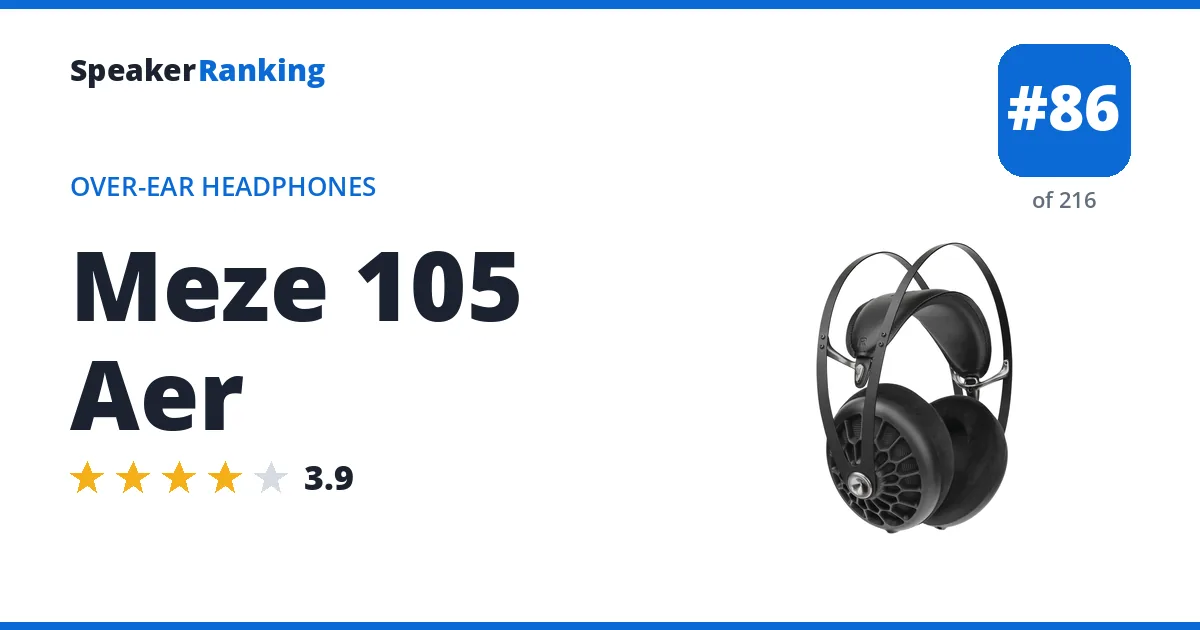
Pros: The open back tuning is warm, with bass from 60 to 200 Hz about 2 dB above target and the low mids about 1.6 dB above, so voices and instruments sound full and relaxed. Presence from 3 to 6 kHz is lifted about 2.8 dB, which adds clarity to vocals, and the preference score is 79. It uses a single 50 mm dynamic driver and matches the Sivga Luan on rating at the same price.
Cons: An 8 dB dip near 8.8 kHz and treble about 2.6 dB below target take the shimmer off cymbals and sibilance, so the top end can sound dull and veiled. A 4.4 dB peak near 4 kHz adds some forwardness to vocals. The open back leaks sound and offers no isolation.
Full Meze 105 Aer review and specifications →
| Back | Open |
|---|---|
| Connection | Wired |
| Deviation From Target | 2.15 dB standard deviation |
| Driver Type | Dynamic |
| Drivers | 1 x 50mm dynamic |
| Form Factor | Over-ear |
| Harman Preference Score | 79 (measured by oratory1990, via AutoEQ) |
| Sub-bass Extension | Within 6 dB of target down to 20 Hz (-3.1 dB at 30 Hz) |
| Tonal Tilt | -0.51 (negative is warmer, positive brighter) |
EQ preset to match the Harman target
Set a preamp of -4.9 dB, then add these filters in any parametric equalizer (Wavelet, Equalizer APO, Peace, or a player with parametric EQ). Calculated by AutoEQ from its measured frequency response.
| Filter | Frequency | Gain | Q |
|---|---|---|---|
| Low shelf | 105 Hz | +10.0 dB | 0.70 |
| Peak | 51 Hz | -8.2 dB | 0.36 |
| Peak | 1,943 Hz | +4.9 dB | 1.54 |
| Peak | 8,128 Hz | +5.6 dB | 1.84 |
| Peak | 5,283 Hz | -3.8 dB | 0.58 |
| High shelf | 10,000 Hz | -2.1 dB | 0.70 |
| Peak | 470 Hz | +0.8 dB | 2.44 |
| Peak | 4,703 Hz | +3.1 dB | 5.89 |
| Peak | 5,659 Hz | -1.5 dB | 5.63 |
| Peak | 4,063 Hz | -1.3 dB | 6.00 |
- Reviews, Comparisons and Sound Samples
- Head-to-Head Comparisons
 Beyerdynamic DT 700 Pro X: $279.99 Amazon eBay

Pros: Bass from 60 to 200 Hz lands right on the Harman target, and the 48 ohm, 100 dB sensitivity design drives easily from a laptop or interface. The closed back and 350 g weight suit tracking and long monitoring sessions where bleed matters. A preference score of 77 with a fairly smooth 2.6 dB deviation makes it an easy listen overall.
Cons: A deep 12.8 dB dip near 3.9 kHz pulls vocal presence and consonant clarity backward, and presence overall runs about 3.5 dB under target. Sub-bass is about 2 dB light, so the lowest notes lack rumble. The Austrian Audio Hi-X65 matches its rating for noticeably less money, so the price is hard to justify on sound alone.
Full Beyerdynamic DT 700 Pro X review and specifications →
| Released | Oct 2021 (5 years ago) |
|---|---|
| Back | Closed |
| Connection | Wired |
| Deviation From Target | 2.58 dB standard deviation |
| Driver Type | Dynamic |
| Form Factor | Over-ear |
| Frequency Response | 5Hz - 40kHz (Manufacturer specified) |
| Harman Preference Score | 77 (measured by oratory1990, via AutoEQ) |
| Impedance | 48 ohms |
| Sensitivity | 100 dB SPL (1mW/500Hz) |
| Sub-bass Extension | Within 6 dB of target down to 20 Hz (-0.5 dB at 30 Hz) |
| Tonal Tilt | -0.34 (negative is warmer, positive brighter) |
| Weight | 0.8 lbs (350 g) |
EQ preset to match the Harman target
Set a preamp of -4.6 dB, then add these filters in any parametric equalizer (Wavelet, Equalizer APO, Peace, or a player with parametric EQ). Calculated by AutoEQ from its measured frequency response.
| Filter | Frequency | Gain | Q |
|---|---|---|---|
| Low shelf | 105 Hz | +1.0 dB | 0.70 |
| Peak | 131 Hz | -4.1 dB | 1.24 |
| Peak | 2,692 Hz | -2.6 dB | 0.37 |
| Peak | 265 Hz | +4.2 dB | 1.71 |
| Peak | 3,557 Hz | +6.8 dB | 2.70 |
| High shelf | 10,000 Hz | -0.2 dB | 0.70 |
| Peak | 5,709 Hz | -2.0 dB | 3.38 |
| Peak | 62 Hz | +1.5 dB | 3.47 |
| Peak | 88 Hz | -0.8 dB | 3.25 |
| Peak | 4,028 Hz | +1.4 dB | 5.91 |
- Reviews, Comparisons and Sound Samples
- Head-to-Head Comparisons