Short answer: the Klipsch RP-8000F II, if you are buying new. The JBL 4367 ranks higher than it (#16 vs #113 of 188 floorstanding speakers, 4.6/5 vs 3.9/5) but is discontinued, so only consider it used; the Klipsch RP-8000F II is still sold new at $1,159.98. The JBL 4367’s replacement, the JBL 4369, is rated 4.7/5.
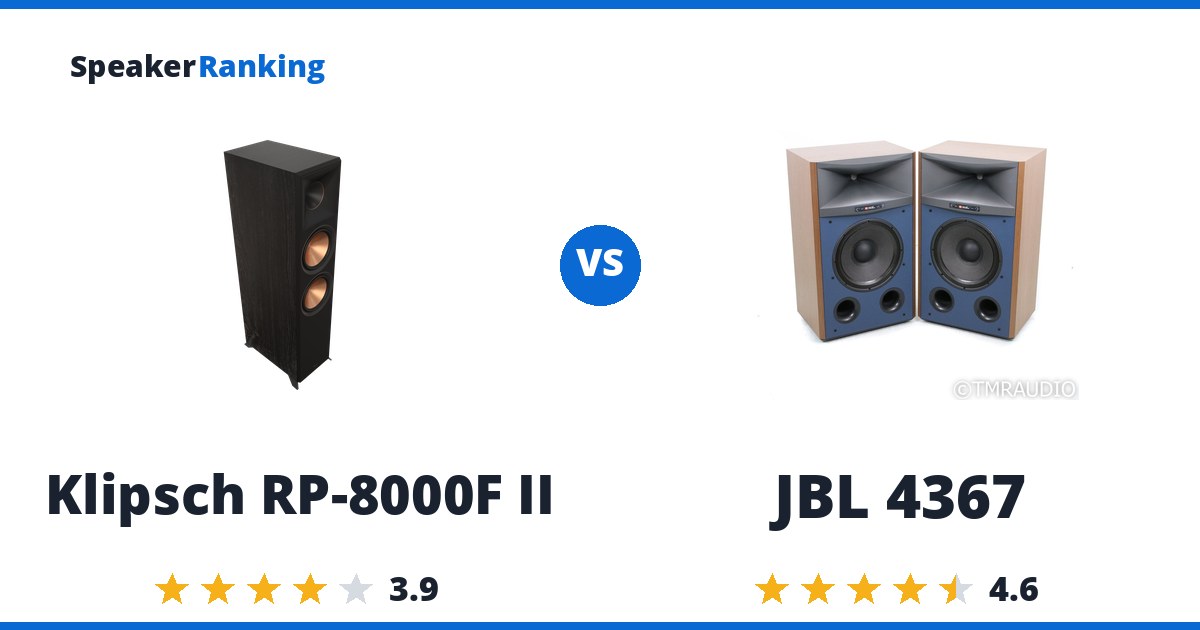
The case for the Klipsch RP-8000F II: Highest sensitivity of the RP II floorstander line (~92dB measured) and the best dynamics/compression behavior of the three under load: the cleanest at high output. Watch for: Mid-bass sounds lean despite the dual 8-inch woofers, and bass extension disappointed for its size: expected to reach 50Hz, didn’t get there in-room.
The JBL 4367 is the better-sounding, deeper-bass option. Three-way design pairing a 15” front-ported woofer with a compression driver on a controlled-dispersion horn/waveguide, crossed over at 700Hz. Its bass reaches about 43Hz before falling 3dB, against 67Hz for the Klipsch RP-8000F II. The catch: At roughly $16500/pair, this is a major investment: the reviewer recommends buying from a dealer with a liberal return policy.
Buy the Klipsch RP-8000F II if you want one new; the JBL 4367 is discontinued, so only look for it used.
Looking for alternatives? See the complete Passive Home rankings.
Specifications Side By Side
| Klipsch RP-8000F II | JBL 4367 | |
|---|---|---|
| Price | $1,159.98 per pair | $16,500 per pair Discontinued |
| Ranked | #113 of 188 in Large Size Floorstanding Speakers | #16 of 188 in Large Size Floorstanding Speakers |
| Bass Extension (-10dB) | 33Hz (measured, Erin’s Audio Corner) | 31Hz (measured, Erin’s Audio Corner) |
| Bass Extension (-3dB) | 67Hz (measured, Erin’s Audio Corner) | 43Hz (measured, Erin’s Audio Corner) |
| Sensitivity | 92dB (2.83V/1m, measured by Erin’s Audio Corner) | 92.5dB (measured average, Erin’s Audio Corner) |
| Drivers | 1” titanium tweeter with 90x90 Tractrix horn, dual 8” cerametallic woofers | 15” (380mm) 2216Nd-1 Dual Differential Drive® woofer, 3” (75mm) D2430K dual compression tweeter |
| Weight | 61.3 lbs (27.8 kg) | 119 lbs (54 kg) each |
| Impedance | 8 ohms nominal (3.7 ohms minimum above 80Hz, measured by Erin’s Audio Corner) | 4 ohms nominal (5.3 ohms minimum above 80Hz, measured by Erin’s Audio Corner) |
| Frequency Response | 35Hz - 25kHz (+-3dB, Manufacturer specified) | - |
| Crossover Frequency | 1630Hz | - |
| Power Handling | 150W continuous, 600W peak | - |
| Dimensions | 43.1” x 10.8” x 18.3” (1095 x 275 x 464 mm) | 37.2”H x 22.2”W x 16.8”D (944.9 x 563.9 x 426.7 mm) |
| Woofer Cabinet | ported, rear | ported, front |
| Spinorama Preference Score | 5.39 | 5.07 |
| Spinorama Preference Score with Perfect Sub | 7.12 | 6.88 |
| DIY Kit | No | No |
Related Speaker Comparisons
More top alternatives to JBL 4367:
- KEF Blade Two Meta vs JBL 4367
- MoFi SourcePoint V10 Master Edition vs JBL 4367
- JBL 4369 vs JBL 4367
- JBL 4367 vs MoFi SourcePoint 888
- Revel F328Be vs JBL 4367
Prices on this page were last checked October 9, 2026 at 8:01 AM UTC. Product prices and availability are accurate as of that date/time and are subject to change; the price and availability shown on Amazon at the time of purchase will apply to the purchase of this product.
As an eBay Partner, we may be compensated if you make a purchase.
The Two Speakers In Full
 Klipsch RP-8000F II: $1,159.98 per pair Amazon eBay
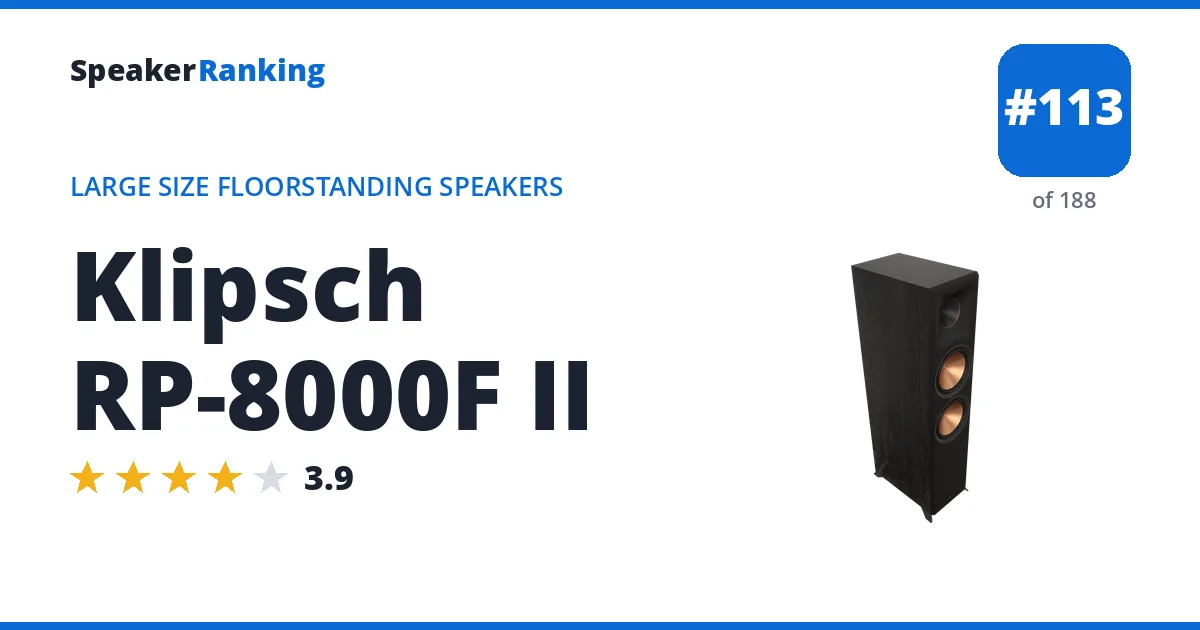
Same family: the Klipsch RP-500M II (smaller bookshelf, rated 4/5), the Klipsch RP-600M II (larger bookshelf, rated 3.7/5), the Klipsch RP-5000F II (smaller floorstanding, ranked higher, rated 4/5), the Klipsch RP-6000F II (smaller floorstanding, ranked lower, rated 3.9/5), the Klipsch RP-404C II (smallest center, rated 3.7/5), the Klipsch RP-500C II (center, rated 3.9/5) and the Klipsch RP-504C II (largest center, rated 3.8/5).
Pros: Highest sensitivity of the RP II floorstander line (~92dB measured) and the best dynamics/compression behavior of the three under load: the cleanest at high output. Dual 8-inch woofers and the highest power handling in the line. Measured bass extension of 67Hz (-3dB), with a measured sensitivity of 92dB.
Cons: Mid-bass sounds lean despite the dual 8-inch woofers, and bass extension disappointed for its size: expected to reach 50Hz, didn’t get there in-room. Has its own edgy upper-mid bump (2-6kHz) that’s harder to EQ out than the other two models’ issues, since it stems from the vertical horn/woofer offset rather than simple tonal balance. The most placement-critical of the three, with the narrowest horizontal (~40-50 degrees) and vertical (+5/-10 degrees) dispersion.
Full Klipsch RP-8000F II review and specifications →
| Bass Extension (-10dB) | 33Hz (measured, Erin’s Audio Corner) |
|---|---|
| Bass Extension (-3dB) | 67Hz (measured, Erin’s Audio Corner) |
| Crossover Frequency | 1630Hz |
| DIY Kit | No |
| Dimensions | 43.1” x 10.8” x 18.3” (1095 x 275 x 464 mm) |
| Drivers | 1” titanium tweeter with 90x90 Tractrix horn, dual 8” cerametallic woofers |
| Frequency Response | 35Hz - 25kHz (+-3dB, Manufacturer specified) |
| Impedance | 8 ohms nominal (3.7 ohms minimum above 80Hz, measured by Erin’s Audio Corner) |
| Power Handling | 150W continuous, 600W peak |
| Sensitivity | 92dB (2.83V/1m, measured by Erin’s Audio Corner) |
| Spinorama Preference Score | 5.39 |
| Spinorama Preference Score with Perfect Sub | 7.12 |
| Weight | 61.3 lbs (27.8 kg) |
| Woofer Cabinet | ported, rear |
- Links
- Reviews, Comparisons and Sound Samples
- Head-to-Head Comparisons
- Klipsch RP-8000F II vs Dynaudio Emit 30
- Klipsch RP-8000F II vs Klipsch RP-6000F II
- Klipsch RP-8000F II vs Klipsch RP-5000F II
- Klipsch RP-8000F II vs KLH Model Five
- Klipsch RP-8000F II vs KEF Q11 Meta
- Klipsch RP-8000F II vs Definitive Technology BP-9020
- Klipsch RP-8000F II vs SVS Ultra Evolution Pinnacle
- Klipsch RP-8000F II vs Klipsch Forte IV
- See all 44 comparisons
 JBL 4367: $16,500 per pair Discontinued eBay
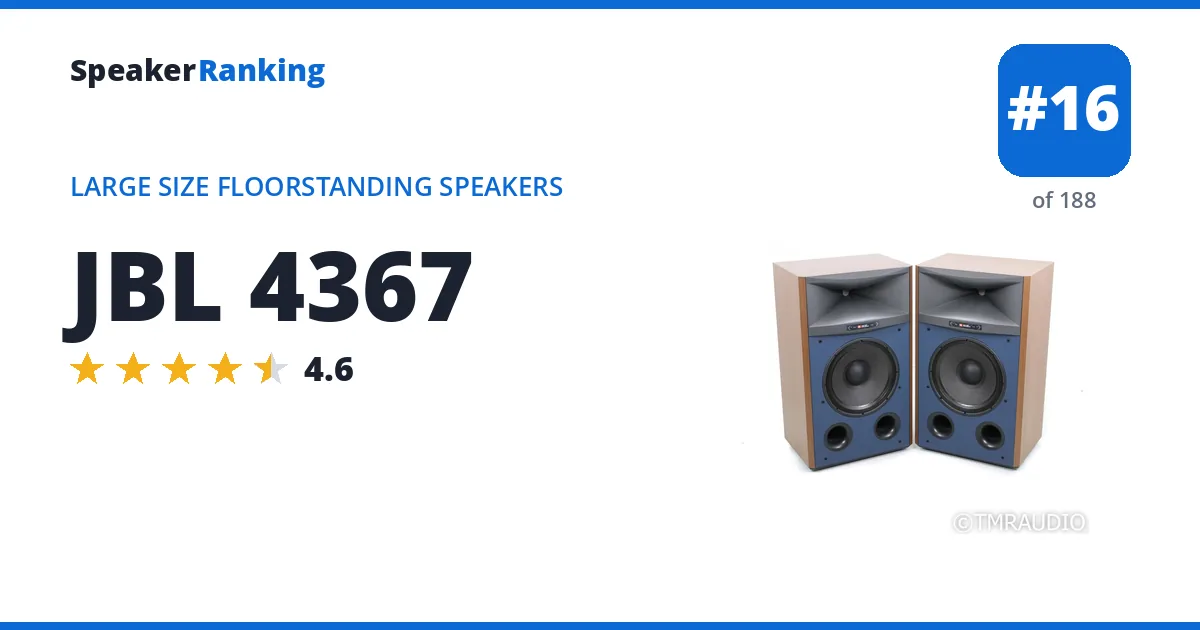
Newer model: the JBL 4369, ranked higher, estimated 4.7/5.
Same family: the JBL 4309 (smallest bookshelf, rated 3.3/5), the JBL 4312G (bookshelf, estimated 3.9/5), the JBL 4349 (largest bookshelf, rated 3.6/5) and the JBL 4369 (larger floorstanding, ranked higher, estimated 4.7/5).
Pros: Three-way design pairing a 15” front-ported woofer with a compression driver on a controlled-dispersion horn/waveguide, crossed over at 700Hz. On-axis frequency response is nearly dead flat, holding within about ±1.5dB, with the listening window tracking it closely except right at the crossover. Distortion stays below 1% THD across the entire audible band at both 86dB and 96dB. Compression/dynamic-range linearity is exceptional: within about a quarter of a dB from 76dB to 102dB, among the best the reviewer has measured. High sensitivity (about 92.6dB average) eases the amplifier match despite the speaker’s size. Minimal rear radiation thanks to the 15” woofer’s directivity and front-firing ports: rear energy runs about 20dB down from the primary wavefront, giving it a near-cardioid radiation pattern. Well-controlled horn directivity keeps the soundstage from noticeably shifting in width across the 700Hz crossover region. A natural high-frequency rolloff above about 7-8kHz gives it an easy, non-fatiguing character for extended listening sessions. Measured bass extension of 43Hz (-3dB), with a measured sensitivity of 92.5dB.
Cons: At roughly $16500/pair, this is a major investment: the reviewer recommends buying from a dealer with a liberal return policy. Vertical response shows dips beyond about ±10-20°, with a larger null further out: an inherent trade-off of mating a 15” woofer to a horn compression driver at a 700Hz crossover, since crossing lower would hurt power handling and dynamic range. Horizontal directivity isn’t perfectly consistent with frequency: narrow (about ±20°) through 200-800Hz, briefly widening to near ±50° above the crossover, then narrowing again at high frequency. An unusual, non-constant pattern. The high-frequency rolloff that gives it an easy-listening character also reduces the sense of air and space in the soundstage when listening from off-center seats. Massive and heavy (about 120 lbs, roughly 36-37” tall): needs to be raised on a stand to bring the horn to ear level, and isn’t something one person easily moves alone. Only modest EQ adjustment is available on the speaker itself (about ±1-2dB bass/treble trim). Discontinued.
Full JBL 4367 review and specifications →
| Bass Extension (-10dB) | 31Hz (measured, Erin’s Audio Corner) |
|---|---|
| Bass Extension (-3dB) | 43Hz (measured, Erin’s Audio Corner) |
| DIY Kit | No |
| Dimensions | 37.2”H x 22.2”W x 16.8”D (944.9 x 563.9 x 426.7 mm) |
| Drivers | 15” (380mm) 2216Nd-1 Dual Differential Drive® woofer, 3” (75mm) D2430K dual compression tweeter |
| Impedance | 4 ohms nominal (5.3 ohms minimum above 80Hz, measured by Erin’s Audio Corner) |
| Sensitivity | 92.5dB (measured average, Erin’s Audio Corner) |
| Spinorama Preference Score | 5.07 |
| Spinorama Preference Score with Perfect Sub | 6.88 |
| Weight | 119 lbs (54 kg) each |
| Woofer Cabinet | ported, front |
- Links
- Reviews, Comparisons and Sound Samples
- Head-to-Head Comparisons