Short answer: the Klipsch RP-8000F II for dynamics, the Forte IV for tone. The RP-8000F II has the highest sensitivity of the RP II line at ~92dB measured and the best compression behavior of the three under load, but its mid-bass sounds lean despite dual 8-inch woofers and it did not reach 50Hz in-room. The Forte IV’s 15” passive radiator and 12” woofer give it more low-end hardware, though it is recessed in the 1.5-4kHz presence region.
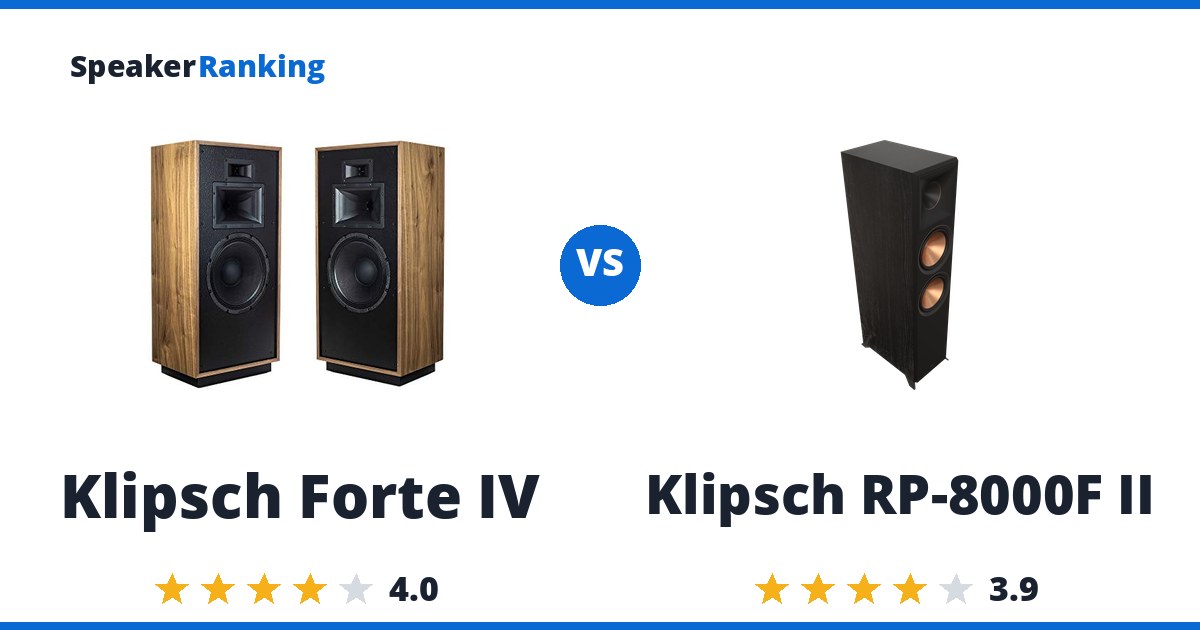
Buy the Klipsch Forte IV if sound quality matters more than the price. Buy the Klipsch RP-8000F II if the price matters more than sound quality.
Looking for alternatives? See the complete Passive Home rankings.
Specifications Side By Side
| Klipsch Forte IV | Klipsch RP-8000F II | |
|---|---|---|
| Price | $5,499.98 per pair | $1,159.98 per pair |
| Ranked | #42 of 74 in Large Size Floorstanding Speakers | #49 of 74 in Large Size Floorstanding Speakers |
| Bass Extension (-10dB) | 39Hz (measured, Erin’s Audio Corner) | 33Hz (measured, Erin’s Audio Corner) |
| Bass Extension (-3dB) | 82Hz (measured, Erin’s Audio Corner) | 67Hz (measured, Erin’s Audio Corner) |
| Sensitivity | 93.8dB (measured average, Erin’s Audio Corner; manufacturer rates 99dB in-room / ~94dB anechoic) | 92dB (2.83V/1m, measured by Erin’s Audio Corner) |
| Drivers | 1x 12” (305mm) fiber-composite woofer + 15” passive radiator, 1x 1.75” compression driver midrange on horn, 1x 1” titanium compression tweeter on horn | 1” titanium tweeter with 90x90 Tractrix horn, dual 8” cerametallic woofers |
| Weight | 117.3 lbs (53.2 kg) | 61.3 lbs (27.8 kg) |
| Woofer Cabinet | passive radiator | ported, rear |
| Impedance | 8 ohms | 8 ohms nominal (3.7 ohms minimum above 80Hz, measured by Erin’s Audio Corner) |
| Dimensions | 36”H x 16.5”W x 13”D (914.4 x 419.1 x 330.2 mm) | 43.1” x 10.8” x 18.3” (1095 x 275 x 464 mm) |
| Spinorama Preference Score | 3.78 | 5.39 |
| Spinorama Preference Score with Perfect Sub | 5.72 | 7.12 |
| DIY Kit | No | No |
| Frequency Response | - | 35Hz - 25kHz (+-3dB, Manufacturer specified) |
| Crossover Frequency | - | 1630Hz |
| Power Handling | - | 150W continuous, 600W peak |
Related Speaker Comparisons
More top alternatives to Klipsch Forte IV:
- GR-Research NX-Treme vs Klipsch Forte IV
- KEF Blade Two Meta vs Klipsch Forte IV
- Klipsch Forte IV vs MoFi SourcePoint V10 Master Edition
- Klipsch Forte IV vs MoFi SourcePoint 888
- Klipsch Forte IV vs Revel F328Be
Prices on this page were last checked October 2, 2026 at 10:18 PM UTC. Product prices and availability are accurate as of that date/time and are subject to change; the price and availability shown on Amazon at the time of purchase will apply to the purchase of this product.
As an eBay Partner, we may be compensated if you make a purchase.
The Two Speakers In Full
 Klipsch Forte IV: $5,499.98 per pair Amazon Crutchfield eBay
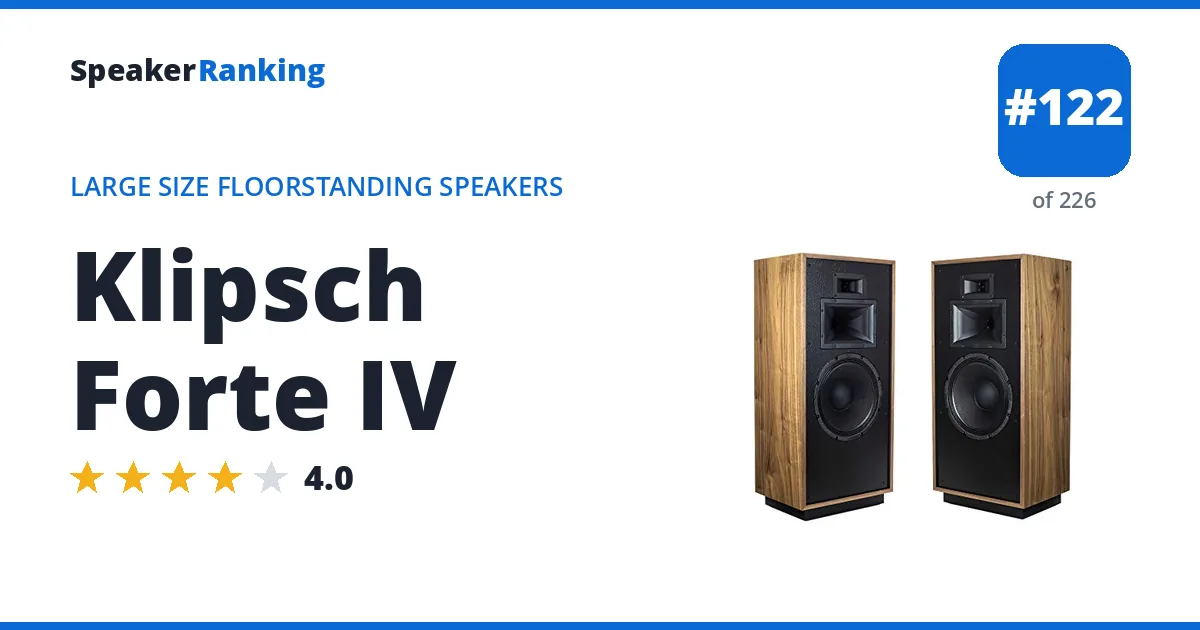
Pros: Three-way heritage design: a 1” titanium tweeter and 1.75” compression driver for the midrange mated to a 12” woofer, plus a 15” passive radiator for extra bass reinforcement. Genuinely resonance-free cabinet, a clear improvement over the notably boomy, resonant Heresy 4 in the same lineup. Surprisingly wide, expansive soundstage that beat both the Heresy 4 and a KEF LS50 Wireless 2 in direct comparison: images occasionally appeared several feet outside the physical speaker location. Deeper bass extension than the Heresy 4 (F3 of 82Hz, about 10Hz lower). Distortion measures well below 1% at 86dB and stays mostly within 1% even at 96dB. Comes as a factory-matched serial-numbered pair, backed by an unusually generous 10-year warranty. Mostly above 4 ohms impedance, so it’s compatible with AVRs, solid-state, or tube amplifiers. More neutral overall than other Klipsch models the reviewer has tested, making it a reasonable pick for listeners who already like the “Klipsch sound” but want something more balanced. Measured bass extension of 82Hz (-3dB), with a measured sensitivity of 93.8dB.
Cons: Contrary to the classic Klipsch reputation for being forward and bright, this model is actually somewhat recessed in the 1.5-4kHz “presence” region, which can make some tracks sound dull or lacking in detail. A peak around 6kHz reads as sibilant and “painful” when seated exactly on the tweeter axis; sitting a bit above that axis reduces it somewhat. Klipsch’s marketed 99dB sensitivity figure is an in-room rating that assumes 3-6dB of boundary gain: anechoic sensitivity measures closer to 94dB, which the manufacturer does disclose but can still mislead buyers comparing spec sheets. Radiation width isn’t consistent across all frequencies: a noticeable notch around 2-3kHz interrupts otherwise wide dispersion, which can cause a fundamental tone and its harmonics to image in slightly different places in the soundstage. Uses shallow low-pass crossover slopes (despite Klipsch’s steep-crossover marketing, which applies only to the high-pass side), likely contributing to some of the measured dips and possible cone-breakup artifacts. Some compression shows up around the midrange crossover point at very high output (102dB), though likely only audible at extreme volumes. At around $5500/pair, a significant investment, and still needs a subwoofer for material extending below about 50Hz.
Full Klipsch Forte IV review and specifications →
| Bass Extension (-10dB) | 39Hz (measured, Erin’s Audio Corner) |
|---|---|
| Bass Extension (-3dB) | 82Hz (measured, Erin’s Audio Corner) |
| DIY Kit | No |
| Dimensions | 36”H x 16.5”W x 13”D (914.4 x 419.1 x 330.2 mm) |
| Drivers | 1x 12” (305mm) fiber-composite woofer + 15” passive radiator, 1x 1.75” compression driver midrange on horn, 1x 1” titanium compression tweeter on horn |
| Impedance | 8 ohms |
| Sensitivity | 93.8dB (measured average, Erin’s Audio Corner; manufacturer rates 99dB in-room / ~94dB anechoic) |
| Spinorama Preference Score | 3.78 |
| Spinorama Preference Score with Perfect Sub | 5.72 |
| Weight | 117.3 lbs (53.2 kg) |
| Woofer Cabinet | passive radiator |
- Links
- Reviews, Comparisons and Sound Samples
- Head-to-Head Comparisons
- Klipsch Forte IV vs Q Acoustics 5040
- Klipsch Forte IV vs Infinity Primus 360
- Klipsch Forte IV vs KEF Q11 Meta
- Klipsch Forte IV vs Klipsch RP-5000F II
- Klipsch Forte IV vs Polk Reserve R500
- Klipsch Forte IV vs ELAC Debut 3.0 DF63
- Klipsch Forte IV vs Emotiva Airmotiv T2+
- Klipsch Forte IV vs PSB Imagine T65
- See all 47 comparisons
 Klipsch RP-8000F II: $1,159.98 per pair Amazon eBay
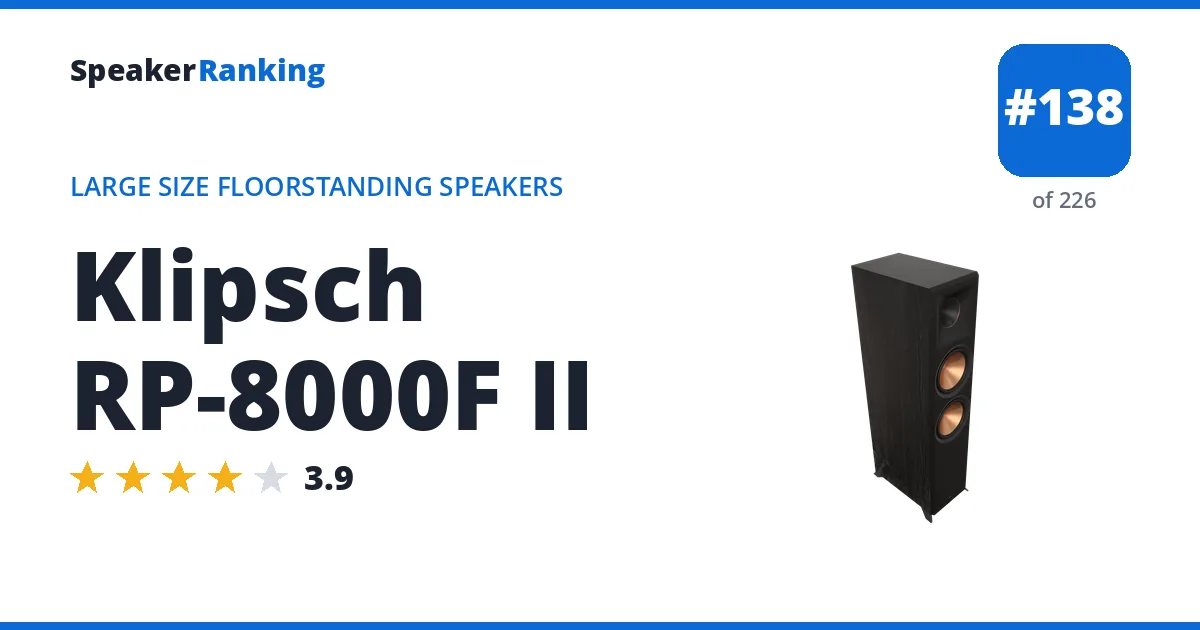
Pros: Highest sensitivity of the RP II floorstander line (~92dB measured) and the best dynamics/compression behavior of the three under load: the cleanest at high output. Dual 8-inch woofers and the highest power handling in the line. Measured bass extension of 67Hz (-3dB), with a measured sensitivity of 92dB.
Cons: Mid-bass sounds lean despite the dual 8-inch woofers, and bass extension disappointed for its size: expected to reach 50Hz, didn’t get there in-room. Has its own edgy upper-mid bump (2-6kHz) that’s harder to EQ out than the other two models’ issues, since it stems from the vertical horn/woofer offset rather than simple tonal balance. The most placement-critical of the three, with the narrowest horizontal (~40-50 degrees) and vertical (+5/-10 degrees) dispersion.
Full Klipsch RP-8000F II review and specifications →
| Bass Extension (-10dB) | 33Hz (measured, Erin’s Audio Corner) |
|---|---|
| Bass Extension (-3dB) | 67Hz (measured, Erin’s Audio Corner) |
| Crossover Frequency | 1630Hz |
| DIY Kit | No |
| Dimensions | 43.1” x 10.8” x 18.3” (1095 x 275 x 464 mm) |
| Drivers | 1” titanium tweeter with 90x90 Tractrix horn, dual 8” cerametallic woofers |
| Frequency Response | 35Hz - 25kHz (+-3dB, Manufacturer specified) |
| Impedance | 8 ohms nominal (3.7 ohms minimum above 80Hz, measured by Erin’s Audio Corner) |
| Power Handling | 150W continuous, 600W peak |
| Sensitivity | 92dB (2.83V/1m, measured by Erin’s Audio Corner) |
| Spinorama Preference Score | 5.39 |
| Spinorama Preference Score with Perfect Sub | 7.12 |
| Weight | 61.3 lbs (27.8 kg) |
| Woofer Cabinet | ported, rear |
- Links
- Reviews, Comparisons and Sound Samples
- Head-to-Head Comparisons
- Klipsch RP-8000F II vs Dynaudio Emit 30
- Klipsch RP-8000F II vs Klipsch RP-6000F II
- Klipsch RP-8000F II vs Klipsch RP-5000F II
- Klipsch RP-8000F II vs Definitive Technology BP-9020
- Klipsch RP-8000F II vs KLH Model Five
- Klipsch RP-8000F II vs SVS Ultra Evolution Pinnacle
- Klipsch RP-8000F II vs KEF Q11 Meta
- Klipsch RP-8000F II vs Polk T50
- See all 44 comparisons