Short answer: the KLH Model Five on measured sound quality, the Klipsch RP-8000F II on price. The KLH Model Five ranks #45 of 74 floorstanding speakers, rated 4.0/5, at $2,998. The Klipsch RP-8000F II ranks #49, rated 3.9/5, at $1,159.98, $1,838.02 cheaper.
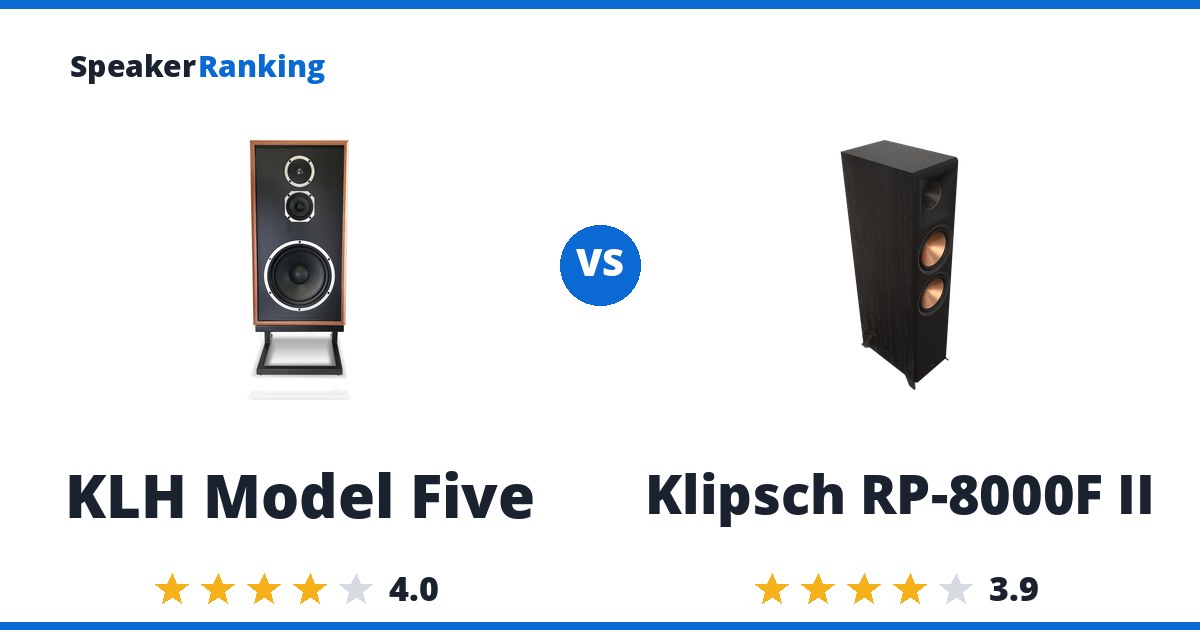
Why pick the KLH Model Five: Exceptionally wide and even horizontal radiation of roughly +/-70-80 degrees gives a spacious soundstage without sacrificing image focus when toed out about 10 degrees. Watch for: On-axis response is visibly irregular because the wide vintage baffle creates diffraction, and the upper/lower midbass mismatch around 200Hz can sound lean away from the intended wall placement.
The case for the Klipsch RP-8000F II: Highest sensitivity of the RP II floorstander line (~92dB measured) and the best dynamics/compression behavior of the three under load: the cleanest at high output. The catch: Mid-bass sounds lean despite the dual 8-inch woofers, and bass extension disappointed for its size: expected to reach 50Hz, didn’t get there in-room.
Buy the KLH Model Five if sound quality is the priority over the price, or the Klipsch RP-8000F II if the price is the priority over sound quality.
Want more options? Browse the full Passive Home rankings.
Specifications Side By Side
| KLH Model Five | Klipsch RP-8000F II | |
|---|---|---|
| Price | $2,998.00 per pair | $1,159.98 per pair |
| Ranked | #45 of 74 in Large Size Floorstanding Speakers | #49 of 74 in Large Size Floorstanding Speakers |
| Bass Extension (-3dB) | 52Hz (measured, Erin’s Audio Corner) | 67Hz (measured, Erin’s Audio Corner) |
| Bass Extension (-10dB) | 32.2Hz (measured, Erin’s Audio Corner) | 33Hz (measured, Erin’s Audio Corner) |
| Dimensions | 26”H x 13.8”W x 11.5”D (660 x 350 x 292 mm) without stand | 43.1” x 10.8” x 18.3” (1095 x 275 x 464 mm) |
| Impedance | 6 ohms nominal, 3.5 ohms minimum at 140Hz (manufacturer specified) | 8 ohms nominal (3.7 ohms minimum above 80Hz, measured by Erin’s Audio Corner) |
| Sensitivity | About 85dB @ 2.83V/1m (measured, Erin’s Audio Corner; 87.5dB free-field manufacturer specified) | 92dB (2.83V/1m, measured by Erin’s Audio Corner) |
| Drivers | 10” paper-cone woofer, 4” paper-cone midrange, 1” aluminum-dome tweeter | 1” titanium tweeter with 90x90 Tractrix horn, dual 8” cerametallic woofers |
| Weight | 44.1 lbs (20 kg) each without stand; 52 lbs (23.6 kg) with stand | 61.3 lbs (27.8 kg) |
| Woofer Cabinet | sealed acoustic suspension | ported, rear |
| Spinorama Preference Score | 4.76 | 5.39 |
| Spinorama Preference Score with Perfect Sub | 6.71 | 7.12 |
| DIY Kit | No | No |
| Frequency Response | - | 35Hz - 25kHz (+-3dB, Manufacturer specified) |
| Crossover Frequency | - | 1630Hz |
| Power Handling | - | 150W continuous, 600W peak |
Related Speaker Comparisons
More top alternatives to KLH Model Five:
- Revel Concerta2 F35 vs KLH Model Five
- Arendal 1961 Tower vs KLH Model Five
- Morel Avyra 633 vs KLH Model Five
- JBL Studio 698 vs KLH Model Five
- KEF Q11 Meta vs KLH Model Five
Prices on this page were last checked September 30, 2026 at 2:57 PM UTC. Product prices and availability are accurate as of that date/time and are subject to change; the price and availability shown on Amazon at the time of purchase will apply to the purchase of this product.
As an eBay Partner, we may be compensated if you make a purchase.
The Two Speakers In Full
 KLH Model Five: $2,998.00 per pair Amazon Crutchfield eBay
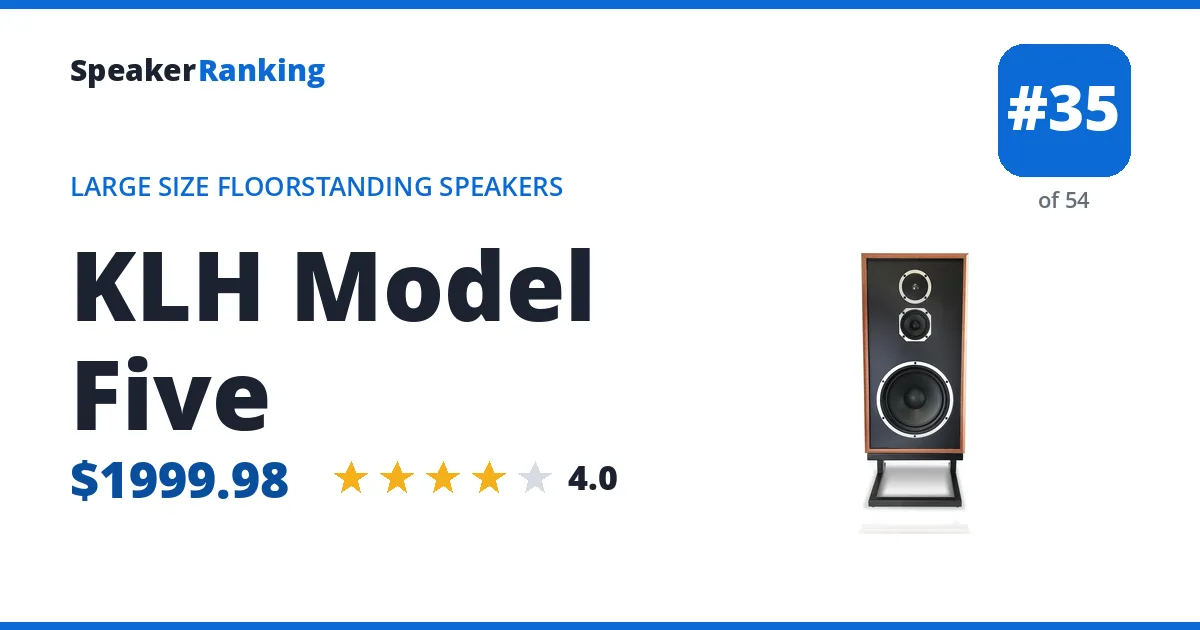
Pros: Exceptionally wide and even horizontal radiation of roughly +/-70-80 degrees gives a spacious soundstage without sacrificing image focus when toed out about 10 degrees. Three rear-panel mid/high attenuation settings are genuinely useful for room and placement matching; Erin preferred Low in his room, with the grille fitted and slight toe-out. The sealed 10-inch acoustic-suspension woofer reaches an Erin-measured F3 near 52Hz and integrates gradually with a subwoofer. At 96dB/1m, harmonic distortion stays mostly below 1%, and multitone distortion is also well controlled. Compression is good at ordinary and high listening levels until the most extreme sweep, supporting convincing dynamics. The included slanted stands aim the unusually low tweeter toward seated ear height. Near-wall placement naturally fills the mild 200Hz baffle-step depression, as the manual intends. Measured bass extension of 52Hz (-3dB), with a measured sensitivity of 85dB.
Cons: On-axis response is visibly irregular because the wide vintage baffle creates diffraction, and the upper/lower midbass mismatch around 200Hz can sound lean away from the intended wall placement. Erin heard a mild 800-900Hz resonance that coincides with a clear impedance blip, plus occasional hardness around the 2-4kHz crossover region at elevated level. Vertical directivity is narrow; the included five-degree slant bases are important because the tweeter otherwise aims below seated ears. The top end rolls off relative to the midrange, producing a warm balance that may not suit listeners seeking maximum air. At the highest test level the tweeter develops substantial compression. Large size, 52lb weight with stand and roughly $2998/pair price are significant commitments, and subwoofers remain necessary for the lowest octave.
Full KLH Model Five review and specifications →
| Bass Extension (-10dB) | 32.2Hz (measured, Erin’s Audio Corner) |
|---|---|
| Bass Extension (-3dB) | 52Hz (measured, Erin’s Audio Corner) |
| DIY Kit | No |
| Dimensions | 26”H x 13.8”W x 11.5”D (660 x 350 x 292 mm) without stand |
| Drivers | 10” paper-cone woofer, 4” paper-cone midrange, 1” aluminum-dome tweeter |
| Impedance | 6 ohms nominal, 3.5 ohms minimum at 140Hz (manufacturer specified) |
| Sensitivity | About 85dB @ 2.83V/1m (measured, Erin’s Audio Corner; 87.5dB free-field manufacturer specified) |
| Spinorama Preference Score | 4.76 |
| Spinorama Preference Score with Perfect Sub | 6.71 |
| Weight | 44.1 lbs (20 kg) each without stand; 52 lbs (23.6 kg) with stand |
| Woofer Cabinet | sealed acoustic suspension |
- Links
- Reviews, Comparisons and Sound Samples
- Head-to-Head Comparisons
 Klipsch RP-8000F II: $1,159.98 per pair Amazon eBay
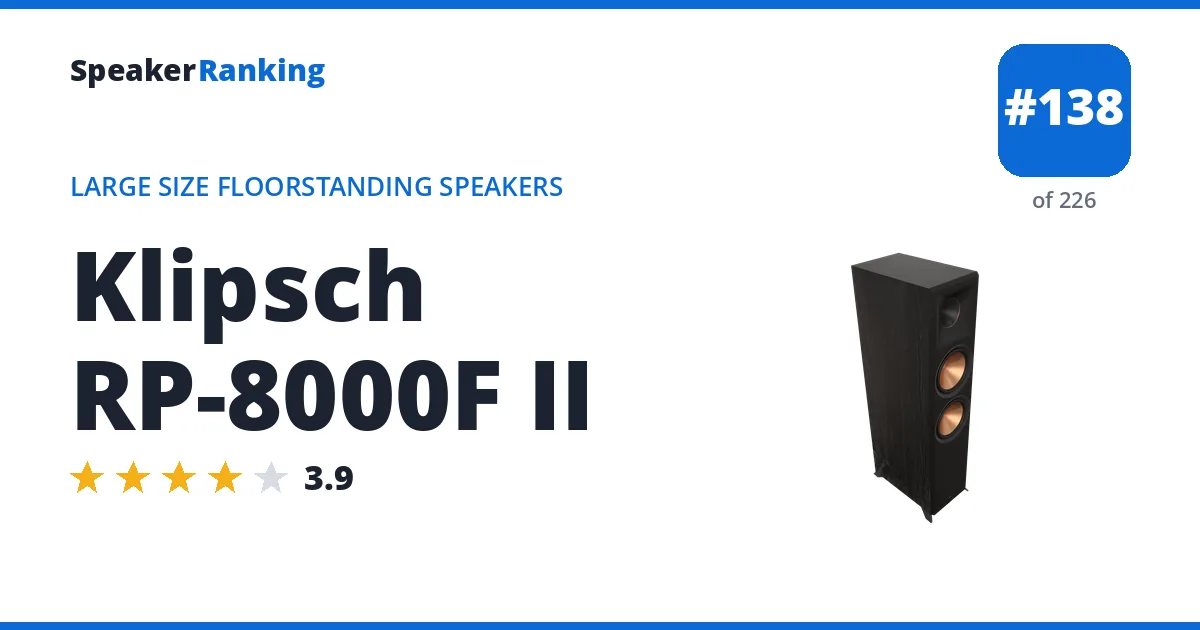
Pros: Highest sensitivity of the RP II floorstander line (~92dB measured) and the best dynamics/compression behavior of the three under load: the cleanest at high output. Dual 8-inch woofers and the highest power handling in the line. Measured bass extension of 67Hz (-3dB), with a measured sensitivity of 92dB.
Cons: Mid-bass sounds lean despite the dual 8-inch woofers, and bass extension disappointed for its size: expected to reach 50Hz, didn’t get there in-room. Has its own edgy upper-mid bump (2-6kHz) that’s harder to EQ out than the other two models’ issues, since it stems from the vertical horn/woofer offset rather than simple tonal balance. The most placement-critical of the three, with the narrowest horizontal (~40-50 degrees) and vertical (+5/-10 degrees) dispersion.
Full Klipsch RP-8000F II review and specifications →
| Bass Extension (-10dB) | 33Hz (measured, Erin’s Audio Corner) |
|---|---|
| Bass Extension (-3dB) | 67Hz (measured, Erin’s Audio Corner) |
| Crossover Frequency | 1630Hz |
| DIY Kit | No |
| Dimensions | 43.1” x 10.8” x 18.3” (1095 x 275 x 464 mm) |
| Drivers | 1” titanium tweeter with 90x90 Tractrix horn, dual 8” cerametallic woofers |
| Frequency Response | 35Hz - 25kHz (+-3dB, Manufacturer specified) |
| Impedance | 8 ohms nominal (3.7 ohms minimum above 80Hz, measured by Erin’s Audio Corner) |
| Power Handling | 150W continuous, 600W peak |
| Sensitivity | 92dB (2.83V/1m, measured by Erin’s Audio Corner) |
| Spinorama Preference Score | 5.39 |
| Spinorama Preference Score with Perfect Sub | 7.12 |
| Weight | 61.3 lbs (27.8 kg) |
| Woofer Cabinet | ported, rear |
- Links
- Reviews, Comparisons and Sound Samples
- Head-to-Head Comparisons
- Klipsch RP-8000F II vs Dynaudio Emit 30
- Klipsch RP-8000F II vs Klipsch RP-6000F II
- Klipsch RP-8000F II vs Klipsch RP-5000F II
- Klipsch RP-8000F II vs Definitive Technology BP-9020
- Klipsch RP-8000F II vs SVS Ultra Evolution Pinnacle
- Klipsch RP-8000F II vs KEF Q11 Meta
- Klipsch RP-8000F II vs Polk T50
- Klipsch RP-8000F II vs Klipsch Forte IV
- See all 44 comparisons