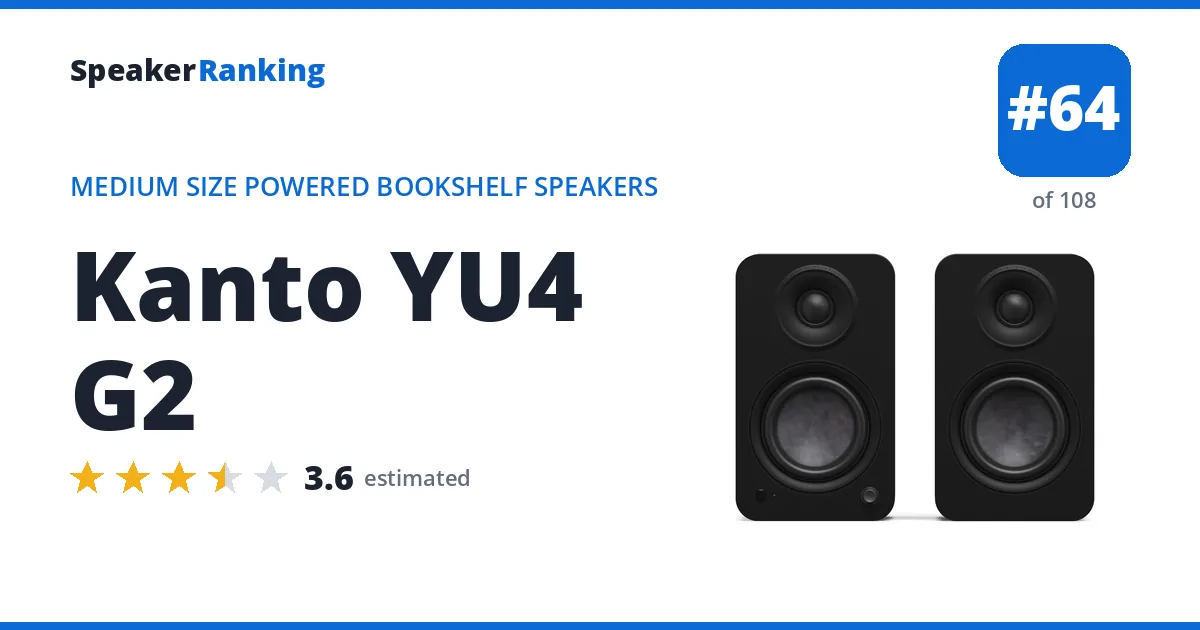
Short answer: the Kanto Ren. It ranks #49 of 108 powered bookshelf speakers by sound quality, rated 3.9/5, at $474.99. The Kanto YU4 G2 ranks #64, rated 3.6/5, at $449.99, $25 cheaper, which does not close the gap in sound quality.
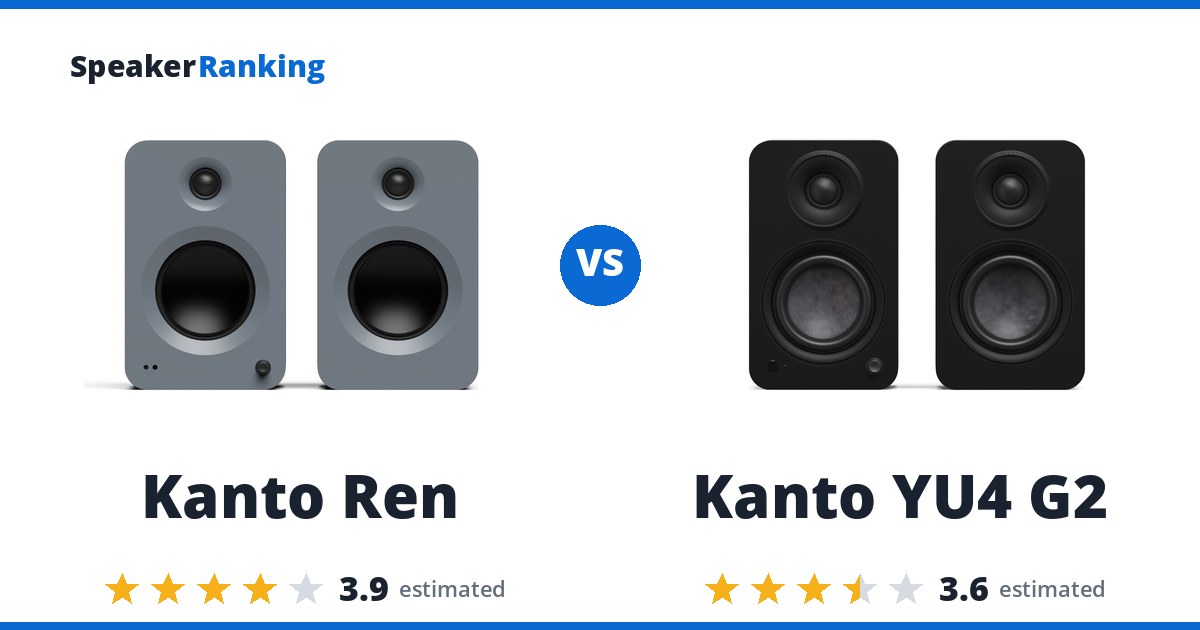
The case for the Kanto Ren: Audioholics measured a listening window within about 1.5dB to 20kHz with only minor directivity ripples, so it sounds accurate and balanced, with wide horizontal dispersion past 50 degrees. The catch: Bass begins rolling off around 90Hz in ground plane measurements, and the ports get noisy when pushed hard without a subwoofer, so maximum volume is modest on its own.
Why pick the Kanto YU4 G2: The second generation YU4 swaps the Kevlar woofers for 4” abaca paper cone woofers alongside 1” silk dome tweeters, and raises amplifier power to 110W RMS (160W peak) from the original’s 70W. The catch: Not on sale yet: Kanto lists it as coming soon.
Buy the Kanto Ren. It is rated higher for sound quality, and saving $25 with the Kanto YU4 G2 does not make up for the sound-quality gap.
About the ratings: neither speaker has been measured yet, so both ratings are estimated from measured siblings and predecessors (likely ranges: Kanto Ren 3.7 to 4.1; Kanto YU4 G2 3.4 to 3.8). Treat this verdict as provisional.
Looking for alternatives? See the complete Powered Home rankings.
Specifications Side By Side
| Kanto Ren | Kanto YU4 G2 | |
|---|---|---|
| Price | $474.99 per pair | $449.99 per pair |
| Ranked | #49 of 108 in Medium Size Powered Bookshelf Speakers Estimated | #64 of 108 in Medium Size Powered Bookshelf Speakers Estimated |
| Drivers | 5.25” aluminium concave cone woofer + 1” silk dome tweeter in waveguide (each) | 1” silk dome tweeter, 4” abaca paper cone woofer |
| Amplifier Power | 100W RMS total (200W peak) (Manufacturer specified) | 110W RMS (160W peak) per pair |
| Bluetooth | Yes | Yes |
| Bluetooth Version | 5.3 | 5.3 |
| Bluetooth Codecs | SBC, AAC | SBC, AAC |
| Weight | 9.9 lbs (4.5 kg) (active), 8.6 lbs (3.9 kg) (passive) | 8.2 lbs (3.7 kg) (active), 6.8 lbs (3.1 kg) (passive) |
| Dimensions | 7”W x 10.9”H x 8.5”D (178 x 277 x 216 mm) | 9.2”H x 5.5”W x 8.1”D (233 x 140 x 205 mm) |
| Frequency Response | 50Hz - 22kHz (Manufacturer specified) | 60Hz - 22kHz (Manufacturer specified) |
| Inputs | HDMI ARC, USB-C (24-bit/96kHz), Optical, RCA, 3.5mm Aux, Bluetooth; Sub out (auto 80Hz high pass) | RCA (switchable phono), Optical, USB-C, Aux, Bluetooth |
| Aux Input | Yes | Yes |
| App | No | - |
| EQ | Yes (bass and treble via remote, Vocal Boost and Night modes) | - |
| Coaxial Input | - | No |
| HDMI Input | - | No |
| Optical Input | - | Yes |
| RCA Input | - | Yes (switchable phono preamp) |
| Subwoofer Output | - | Yes (automatic 80Hz crossover) |
| USB Input | - | Yes |
| XLR Input | - | No |
Related Speaker Comparisons
How Kanto Ren compares with other leading options:
- Audioengine A5+ Classic vs Kanto Ren
- Kanto Ren vs Vanatoo Transparent Zero Plus
- Kanto YU4 G2 vs ADAM Audio T5V
- Kanto YU4 G2 vs Topping MA4
- Kanto YU4 G2 vs Kanto YU4
Prices on this page were last checked October 11, 2026 at 4:59 PM UTC. Product prices and availability are accurate as of that date/time and are subject to change; the price and availability shown on Amazon at the time of purchase will apply to the purchase of this product.
As an eBay Partner, we may be compensated if you make a purchase.
The Two Speakers In Full
 Kanto Ren: $474.99 per pair Estimated Amazon $474.99 eBay
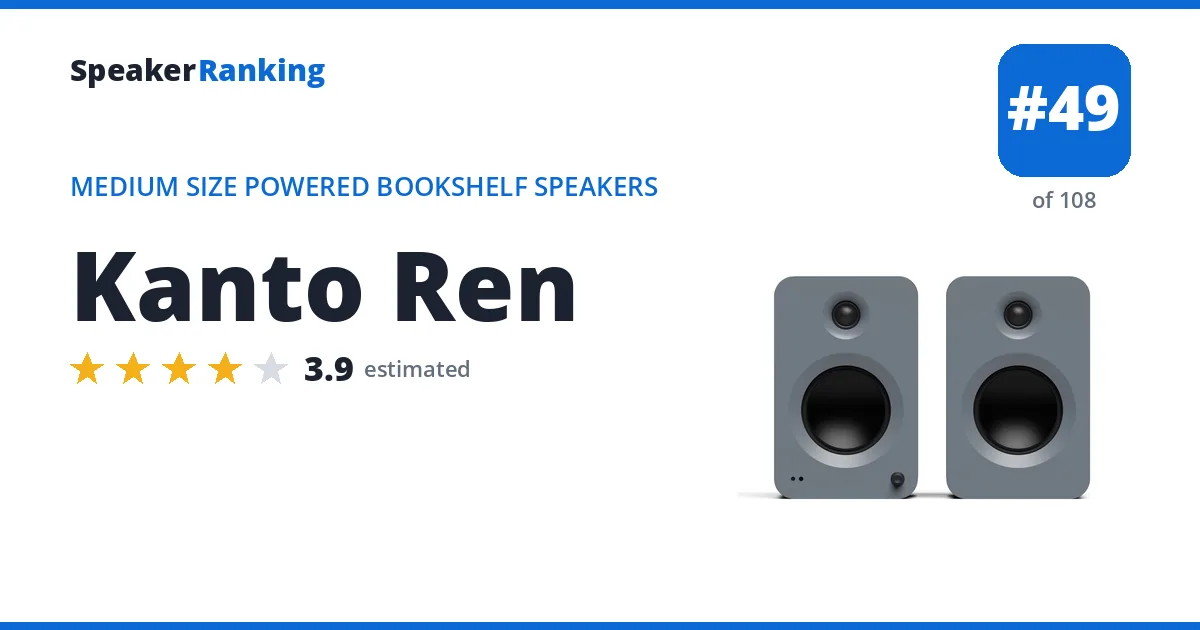
Pros: Audioholics measured a listening window within about 1.5dB to 20kHz with only minor directivity ripples, so it sounds accurate and balanced, with wide horizontal dispersion past 50 degrees. HDMI ARC with TV remote control, USB-C, optical, RCA, aux and Bluetooth with AAC cover nearly every source, and the sub out automatically high passes the speakers at 80Hz.
Cons: Bass begins rolling off around 90Hz in ground plane measurements, and the ports get noisy when pushed hard without a subwoofer, so maximum volume is modest on its own. A deep vertical null just below the tweeter axis means it should be placed at or below ear height, and there is no app or phono input.
Full Kanto Ren review and specifications →
| Released | 2024 (2 years ago) |
|---|---|
| Amplifier Power | 100W RMS total (200W peak) (Manufacturer specified) |
| App | No |
| Aux Input | Yes |
| Bluetooth | Yes |
| Bluetooth Codecs | SBC, AAC |
| Bluetooth Version | 5.3 |
| Dimensions | 7”W x 10.9”H x 8.5”D (178 x 277 x 216 mm) |
| Drivers | 5.25” aluminium concave cone woofer + 1” silk dome tweeter in waveguide (each) |
| EQ | Yes (bass and treble via remote, Vocal Boost and Night modes) |
| Frequency Response | 50Hz - 22kHz (Manufacturer specified) |
| Inputs | HDMI ARC, USB-C (24-bit/96kHz), Optical, RCA, 3.5mm Aux, Bluetooth; Sub out (auto 80Hz high pass) |
| Weight | 9.9 lbs (4.5 kg) (active), 8.6 lbs (3.9 kg) (passive) |
- Links
- Reviews, Comparisons and Sound Samples
- Audioholics: Kanto Ren Powered Speakers Review Discussion
- cheapaudioman: My Ultimate Audiophile Guilty Pleasure! These Speakers
- GearUP with Aaron: I replaced my soundbar with this // KANTO REN (subwoofer optional)
- Walts TV: KANTO REN Speakers The Soundbar KILLER? | Review + Sound Test More from Williston Audio Labs →
- Z Reviews: The Very BLUE Kanto Ren is the Softer Kanto with Beautiful Features.
- Head-to-Head Comparisons
 Kanto YU4 G2: $449.99 per pair Estimated Kanto $449.99 eBay
Older model: the Kanto YU4 (rated 3.3/5). See every Kanto YU and Tuk generation.
Same family: the Kanto YU6 G2 (larger bookshelf, estimated 3.9/5), the Kanto Tuk G2 (larger bookshelf, ranked higher, rated 3.9/5) and the Kanto TUK Grand G2 (larger bookshelf, estimated 3.9/5).
Pros: The second generation YU4 swaps the Kevlar woofers for 4” abaca paper cone woofers alongside 1” silk dome tweeters, and raises amplifier power to 110W RMS (160W peak) from the original’s 70W. Inputs cover RCA with a switchable phono preamp, optical and USB-C audio at 24 bit/96kHz, 3.5mm aux and Bluetooth 5.3 with AAC. A subwoofer output engages an automatic 80Hz crossover, and a USB-C port charges a phone. Includes a remote, speaker wire and swappable left and right channels.
Cons: Not on sale yet: Kanto lists it as coming soon. No independent measurements have been published, so it can’t be compared with the original Kanto YU4, which ASR measured, and its 60Hz to 22kHz rated response means a subwoofer is still needed for deep bass. Kanto doesn’t publish sensitivity or maximum output.
Full Kanto YU4 G2 review and specifications →
| Released | 2026 (this year) |
|---|---|
| Amplifier Power | 110W RMS (160W peak) per pair |
| Aux Input | Yes |
| Bluetooth | Yes |
| Bluetooth Codecs | SBC, AAC |
| Bluetooth Version | 5.3 |
| Coaxial Input | No |
| Dimensions | 9.2”H x 5.5”W x 8.1”D (233 x 140 x 205 mm) |
| Drivers | 1” silk dome tweeter, 4” abaca paper cone woofer |
| Frequency Response | 60Hz - 22kHz (Manufacturer specified) |
| HDMI Input | No |
| Inputs | RCA (switchable phono), Optical, USB-C, Aux, Bluetooth |
| Optical Input | Yes |
| RCA Input | Yes (switchable phono preamp) |
| Subwoofer Output | Yes (automatic 80Hz crossover) |
| USB Input | Yes |
| Weight | 8.2 lbs (3.7 kg) (active), 6.8 lbs (3.1 kg) (passive) |
| XLR Input | No |
- Links
- Reviews, Comparisons and Sound Samples
- No independent measurement review is linked for this model; it is ranked from hands-on listening and comparison against similarly priced speakers.
- Head-to-Head Comparisons