Short answer: the iBasso IT01S. It ranks #362 of 450 in-ear headphones by sound quality, rated 3.4/5, at $89.95; the FiiO FH3 ranks #367, rated 3.3/5, and costs $119.99, so there is little reason to consider the other one.

What the iBasso IT01S does well: A Harman score of 66 in Crinacle’s measurement shows the tuning lands reasonably close to what most listeners prefer. The catch: Deviation from the target averages 2.84 dB, so the response is not especially smooth.
Why pick the FiiO FH3: Bass and sub-bass sit within about 1 dB above the Harman target, giving kick drums and bass guitar a full, warm foundation without bloat. Watch for: The 3 to 6 kHz presence region sits about 5.7 dB below target, with a dip of 7.4 dB near 6.5 kHz, so vocals and cymbals lose bite and detail.
Buy the iBasso IT01S. It is rated higher for sound quality than the FiiO FH3 and costs less, so it is the default pick unless a specific strength of the other one matters more to you.
Still deciding? The full Headphones rankings cover every ranked option.
Specifications Side By Side
| iBasso IT01S | FiiO FH3 | |
|---|---|---|
| Price | $89.95 | $119.99 |
| Ranked | #362 of 450 in In-Ear Headphones | #367 of 450 in In-Ear Headphones |
| Form Factor | In-ear | In-ear |
| Harman Preference Score | 66 (measured by crinacle, via AutoEQ) | 65 (measured by HypetheSonics, via AutoEQ) |
| Deviation From Target | 2.84 dB standard deviation | 2.59 dB standard deviation |
| Tonal Tilt | -0.22 (negative is warmer, positive brighter) | -0.86 (negative is warmer, positive brighter) |
| Connection | Wired | Wired |
| Driver Type | Dynamic | Hybrid (1 dynamic + 2 balanced armature) |
| Drivers | 1 x 10mm dynamic | 1 x 10mm dynamic + 2 x balanced armature |
| Impedance | 16 ohms | 24 ohms |
| Sensitivity | 109 dB/mW | 114 dB/mW |
| Weight | 0 lbs (8 g) per earbud | 0 lbs (7.3 g) per earbud |
| Frequency Response | 10Hz - 43kHz (Manufacturer specified) | 10Hz - 40kHz (Manufacturer specified) |
| Built-in Microphone | No | - |
| Back | Closed | Closed |
| Sub-bass Extension | - | Within 6 dB of target down to 20 Hz (+1.1 dB at 30 Hz) |
Related Headphone Comparisons
How iBasso IT01S compares with other leading options:
- KZ PR1 vs iBasso IT01S
- Sennheiser IE 40 Pro vs iBasso IT01S
- iBasso IT01S vs Sennheiser Momentum True Wireless 3
- iBasso IT01S vs BGVP DN3
- iBasso IT01S vs Shure SE215
Prices on this page were last checked October 11, 2026 at 4:59 PM UTC. Product prices and availability are accurate as of that date/time and are subject to change; the price and availability shown on Amazon at the time of purchase will apply to the purchase of this product.
As an eBay Partner, we may be compensated if you make a purchase.
The Two Headphones In Full
 iBasso IT01S: $89.95 Amazon eBay

Pros: A Harman score of 66 in Crinacle’s measurement shows the tuning lands reasonably close to what most listeners prefer. The 16 ohm impedance and 109 dB/mW sensitivity mean a phone can drive it to loud levels. At 8 g per earbud with a 10mm dynamic driver, it is a light, simple wired set.
Cons: Deviation from the target averages 2.84 dB, so the response is not especially smooth. Without an inline microphone it cannot be used for calls, and the KZ PR1 has a higher rating.
Full iBasso IT01S review and specifications →
| Back | Closed |
|---|---|
| Built-in Microphone | No |
| Connection | Wired |
| Deviation From Target | 2.84 dB standard deviation |
| Driver Type | Dynamic |
| Drivers | 1 x 10mm dynamic |
| Form Factor | In-ear |
| Frequency Response | 10Hz - 43kHz (Manufacturer specified) |
| Harman Preference Score | 66 (measured by crinacle, via AutoEQ) |
| Impedance | 16 ohms |
| Sensitivity | 109 dB/mW |
| Tonal Tilt | -0.22 (negative is warmer, positive brighter) |
| Weight | 0 lbs (8 g) per earbud |
EQ preset to match the Harman target
Set a preamp of -3.7 dB, then add these filters in any parametric equalizer (Wavelet, Equalizer APO, Peace, or a player with parametric EQ). Calculated by AutoEQ from its measured frequency response.
| Filter | Frequency | Gain | Q |
|---|---|---|---|
| Low shelf | 105 Hz | +3.1 dB | 0.70 |
| Peak | 169 Hz | -4.1 dB | 0.49 |
| Peak | 918 Hz | +3.6 dB | 1.10 |
| Peak | 9,169 Hz | +3.5 dB | 2.61 |
| Peak | 3,523 Hz | +2.8 dB | 4.61 |
| High shelf | 10,000 Hz | +0.4 dB | 0.70 |
| Peak | 5,075 Hz | -6.1 dB | 5.81 |
| Peak | 6,349 Hz | +3.1 dB | 5.89 |
| Peak | 4,021 Hz | +2.0 dB | 5.78 |
| Peak | 2,467 Hz | -0.5 dB | 5.37 |
- Reviews, Comparisons and Sound Samples
- Head-to-Head Comparisons
 FiiO FH3: $119.99 Amazon AliExpress eBay
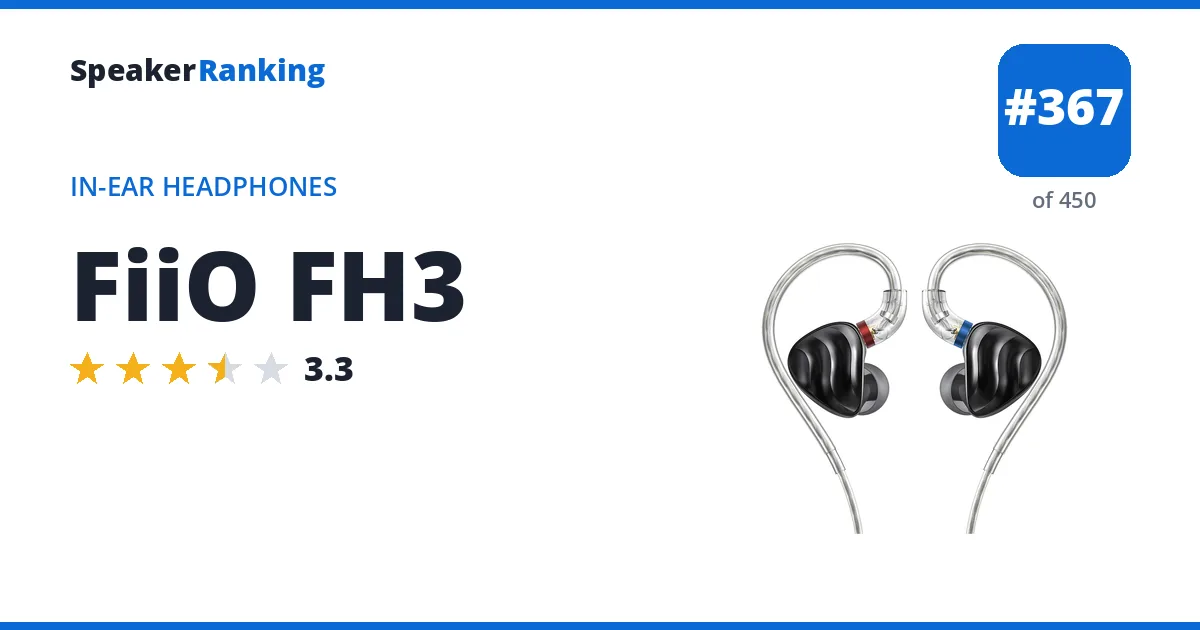
Pros: Bass and sub-bass sit within about 1 dB above the Harman target, giving kick drums and bass guitar a full, warm foundation without bloat. The hybrid design pairs a 10mm dynamic driver with two balanced armatures, and 114 dB/mW sensitivity at 24 ohms means a phone runs it easily. A preference score of 65 suits listeners who like a warm, bassy tilt.
Cons: The 3 to 6 kHz presence region sits about 5.7 dB below target, with a dip of 7.4 dB near 6.5 kHz, so vocals and cymbals lose bite and detail. Treble from 6 to 10 kHz is also about 2.2 dB low, which makes the sound dark and a little veiled. The KZ PR1 has a higher rating.
Full FiiO FH3 review and specifications →
| Back | Closed |
|---|---|
| Connection | Wired |
| Deviation From Target | 2.59 dB standard deviation |
| Driver Type | Hybrid (1 dynamic + 2 balanced armature) |
| Drivers | 1 x 10mm dynamic + 2 x balanced armature |
| Form Factor | In-ear |
| Frequency Response | 10Hz - 40kHz (Manufacturer specified) |
| Harman Preference Score | 65 (measured by HypetheSonics, via AutoEQ) |
| Impedance | 24 ohms |
| Sensitivity | 114 dB/mW |
| Sub-bass Extension | Within 6 dB of target down to 20 Hz (+1.1 dB at 30 Hz) |
| Tonal Tilt | -0.86 (negative is warmer, positive brighter) |
| Weight | 0 lbs (7.3 g) per earbud |
EQ preset to match the Harman target
Set a preamp of -4.3 dB, then add these filters in any parametric equalizer (Wavelet, Equalizer APO, Peace, or a player with parametric EQ). Calculated by AutoEQ from its measured frequency response.
| Filter | Frequency | Gain | Q |
|---|---|---|---|
| Low shelf | 105 Hz | -4.0 dB | 0.70 |
| Peak | 4,061 Hz | +4.3 dB | 1.02 |
| Peak | 178 Hz | -2.5 dB | 1.19 |
| Peak | 1,183 Hz | -3.9 dB | 2.64 |
| Peak | 60 Hz | +2.7 dB | 0.83 |
| High shelf | 10,000 Hz | -0.6 dB | 0.70 |
| Peak | 545 Hz | +1.1 dB | 2.57 |
| Peak | 2,365 Hz | -2.4 dB | 4.99 |
| Peak | 6,488 Hz | +2.3 dB | 6.00 |
| Peak | 2,972 Hz | +1.8 dB | 5.25 |
- Reviews, Comparisons and Sound Samples
- Head-to-Head Comparisons