Short answer: the HyperX Cloud II for better sound quality, the Koss KSC75 for the lower price, though neither ranks well in its class. The HyperX Cloud II ranks #174 of 216 over-ear headphones, rated 2.9/5, at $47.48. The Koss KSC75 ranks #183, rated 2.8/5, at $19.99, $27.49 cheaper. Both are rated below 3.0/5 among the 216 over-ear headphones, and the Superlux HD 660 Pro 150 Ohm, ranked #57 at $34, is a better place to start if sound quality matters.

Why pick the HyperX Cloud II: A built-in microphone and a closed-back design make it a ready-made gaming headset, and the 60 ohm impedance with 98 dB sensitivity means it runs easily from a PC or console. The tradeoff: A deep dip of roughly 15 dB near 4.2 kHz hollows out presence, so voices and the attack of instruments sound recessed, while a peak of about 9 dB near 8.6 kHz adds a sharp, sizzly edge to cymbals and sibilance.
Why pick the Koss KSC75: An extremely low cost and a featherweight 0.1 lbs (43 g) clip-on design make it easy to carry and wear for long stretches. Watch for: Sub-bass is about 17 dB below target under 60 Hz, so there is almost no rumble and bass-heavy music sounds thin.
Buy the HyperX Cloud II if sound quality is the priority over the price, or the Koss KSC75 if the price is the priority over sound quality.
Looking for alternatives? See the complete Headphones rankings.
Specifications Side By Side
| HyperX Cloud II | Koss KSC75 | |
|---|---|---|
| Price | $47.48 | $19.99 |
| Ranked | #174 of 216 in Over-Ear Headphones | #183 of 216 in Over-Ear Headphones |
| Form Factor | Over-ear | Over-ear |
| Harman Preference Score | 58 (measured by oratory1990, via AutoEQ) | 54 (measured by oratory1990, via AutoEQ) |
| Deviation From Target | 3.60 dB standard deviation | 3.33 dB standard deviation |
| Tonal Tilt | -0.74 (negative is warmer, positive brighter) | +1.22 (negative is warmer, positive brighter) |
| Sub-bass Extension | Within 6 dB of target down to 20 Hz (+0.1 dB at 30 Hz) | Falls 6 dB below target at 67 Hz (-19.2 dB at 30 Hz) |
| Connection | Wired | Wired |
| Back | Closed | Open |
| Driver Type | Dynamic | Dynamic |
| Drivers | 1 x 53mm dynamic | 1 x 35mm dynamic |
| Impedance | 60 ohms | 60 ohms |
| Sensitivity | 98 dB SPL/mW | 101 dB SPL/1mW |
| Frequency Response | 15Hz - 25kHz (Manufacturer specified) | 15Hz - 25kHz (Manufacturer specified) |
| Built-in Microphone | Yes | - |
| Weight | - | 0.1 lbs (43 g) |
Related Headphone Comparisons
How HyperX Cloud II compares with other leading options:
- Audio-Technica ATH-M20x vs HyperX Cloud II
- Sony WH-CH510 vs HyperX Cloud II
- Superlux HD 681 vs HyperX Cloud II
- HyperX Cloud II vs Koss KPH40
- HyperX Cloud II vs Koss Porta Pro
Prices on this page were last checked October 11, 2026 at 4:59 PM UTC. Product prices and availability are accurate as of that date/time and are subject to change; the price and availability shown on Amazon at the time of purchase will apply to the purchase of this product.
As an eBay Partner, we may be compensated if you make a purchase.
The Two Headphones In Full
 HyperX Cloud II: $47.48 Amazon eBay
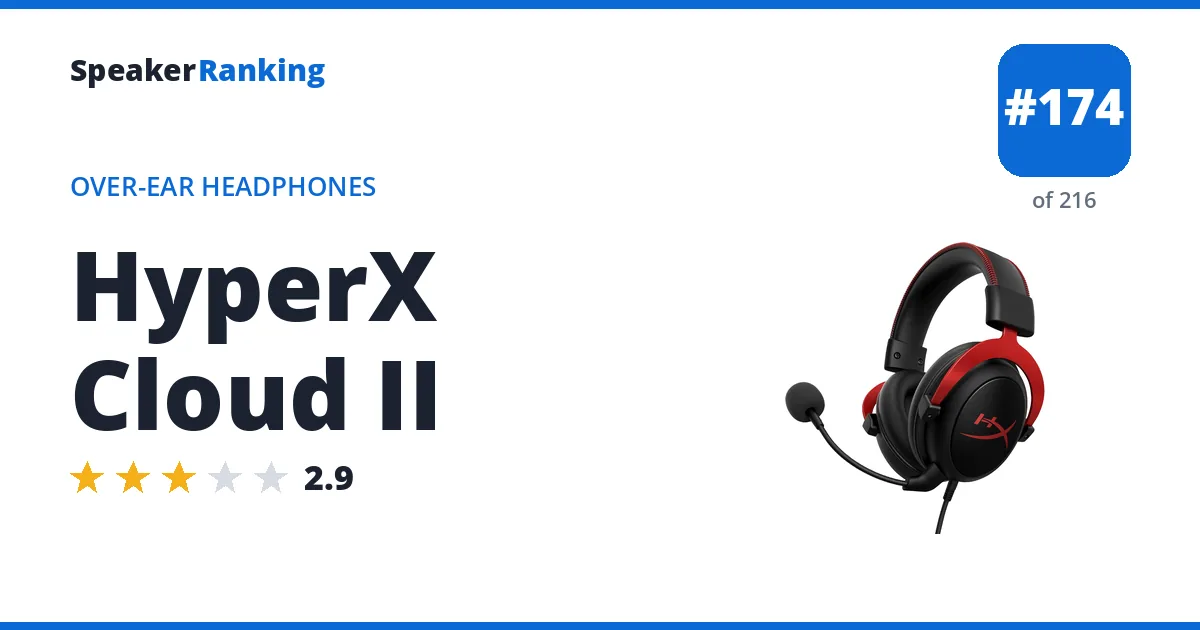
Pros: A built-in microphone and a closed-back design make it a ready-made gaming headset, and the 60 ohm impedance with 98 dB sensitivity means it runs easily from a PC or console. The large 53mm driver delivers bass about 4 dB above the Harman target, which suits listeners who want punchy explosions and a warm, bass-forward presentation. Sub-bass and the lower midrange sit close to target, so the low end is fuller without being muddy.
Cons: A deep dip of roughly 15 dB near 4.2 kHz hollows out presence, so voices and the attack of instruments sound recessed, while a peak of about 9 dB near 8.6 kHz adds a sharp, sizzly edge to cymbals and sibilance. Treble above 6 kHz runs about 4 to 5 dB hot, which can become fatiguing at higher volumes. The HyperX Cloud Alpha has a higher rating at a lower price.
Full HyperX Cloud II review and specifications →
| Released | Feb 2015 (11 years ago) |
|---|---|
| Back | Closed |
| Built-in Microphone | Yes |
| Connection | Wired |
| Deviation From Target | 3.60 dB standard deviation |
| Driver Type | Dynamic |
| Drivers | 1 x 53mm dynamic |
| Form Factor | Over-ear |
| Frequency Response | 15Hz - 25kHz (Manufacturer specified) |
| Harman Preference Score | 58 (measured by oratory1990, via AutoEQ) |
| Impedance | 60 ohms |
| Sensitivity | 98 dB SPL/mW |
| Sub-bass Extension | Within 6 dB of target down to 20 Hz (+0.1 dB at 30 Hz) |
| Tonal Tilt | -0.74 (negative is warmer, positive brighter) |
EQ preset to match the Harman target
Set a preamp of -6.4 dB, then add these filters in any parametric equalizer (Wavelet, Equalizer APO, Peace, or a player with parametric EQ). Calculated by AutoEQ from its measured frequency response.
| Filter | Frequency | Gain | Q |
|---|---|---|---|
| Low shelf | 105 Hz | +4.1 dB | 0.70 |
| Peak | 170 Hz | -7.0 dB | 1.06 |
| Peak | 271 Hz | +3.7 dB | 0.58 |
| Peak | 3,828 Hz | +5.4 dB | 3.60 |
| Peak | 57 Hz | -4.8 dB | 0.58 |
| High shelf | 10,000 Hz | -7.0 dB | 0.70 |
| Peak | 8,085 Hz | -3.0 dB | 3.98 |
| Peak | 2,378 Hz | -1.9 dB | 2.78 |
| Peak | 3,700 Hz | +1.3 dB | 2.71 |
| Peak | 1,123 Hz | +1.1 dB | 3.29 |
- Reviews, Comparisons and Sound Samples
- Head-to-Head Comparisons
 Koss KSC75: $19.99 Amazon eBay

Pros: An extremely low cost and a featherweight 43 g clip-on design make it easy to carry and wear for long stretches. The midrange is close to target, with the low mids within 0.2 dB, so voices sound natural, and the slightly lifted treble of about 2 to 3 dB adds clarity. The open back gives an airy sound, and 101 dB sensitivity at 60 ohms works from a phone.
Cons: Sub-bass is about 17 dB below target under 60 Hz, so there is almost no rumble and bass-heavy music sounds thin. Bass in the 60 to 200 Hz range is also about 2 dB low, and a 4 dB peak near 5.3 kHz can add some edge. The open design leaks sound and gives no noise isolation.
Full Koss KSC75 review and specifications →
| Back | Open |
|---|---|
| Connection | Wired |
| Deviation From Target | 3.33 dB standard deviation |
| Driver Type | Dynamic |
| Drivers | 1 x 35mm dynamic |
| Form Factor | Over-ear |
| Frequency Response | 15Hz - 25kHz (Manufacturer specified) |
| Harman Preference Score | 54 (measured by oratory1990, via AutoEQ) |
| Impedance | 60 ohms |
| Sensitivity | 101 dB SPL/1mW |
| Sub-bass Extension | Falls 6 dB below target at 67 Hz (-19.2 dB at 30 Hz) |
| Tonal Tilt | +1.22 (negative is warmer, positive brighter) |
| Weight | 0.1 lbs (43 g) |
EQ preset to match the Harman target
Set a preamp of -6.3 dB, then add these filters in any parametric equalizer (Wavelet, Equalizer APO, Peace, or a player with parametric EQ). Calculated by AutoEQ from its measured frequency response.
| Filter | Frequency | Gain | Q |
|---|---|---|---|
| Low shelf | 105 Hz | +6.2 dB | 0.70 |
| Peak | 610 Hz | +2.2 dB | 0.63 |
| Peak | 2,358 Hz | -3.4 dB | 1.92 |
| Peak | 169 Hz | -2.3 dB | 0.77 |
| Peak | 74 Hz | +2.0 dB | 2.94 |
| High shelf | 10,000 Hz | -3.0 dB | 0.70 |
| Peak | 4,033 Hz | +3.3 dB | 5.88 |
| Peak | 5,191 Hz | -3.4 dB | 5.53 |
| Peak | 7,220 Hz | -1.5 dB | 2.25 |
| Peak | 4,517 Hz | +0.7 dB | 4.34 |
- Reviews, Comparisons and Sound Samples
- Head-to-Head Comparisons