Short answer: the HyperX Cloud Alpha. It ranks #150 of 231 over-ear headphones by sound quality, rated 3.3/5, at $59.99; the HyperX Cloud III ranks #168, rated 3.1/5, at $57.99. The price gap is small enough that the sound-quality ranking should decide it.
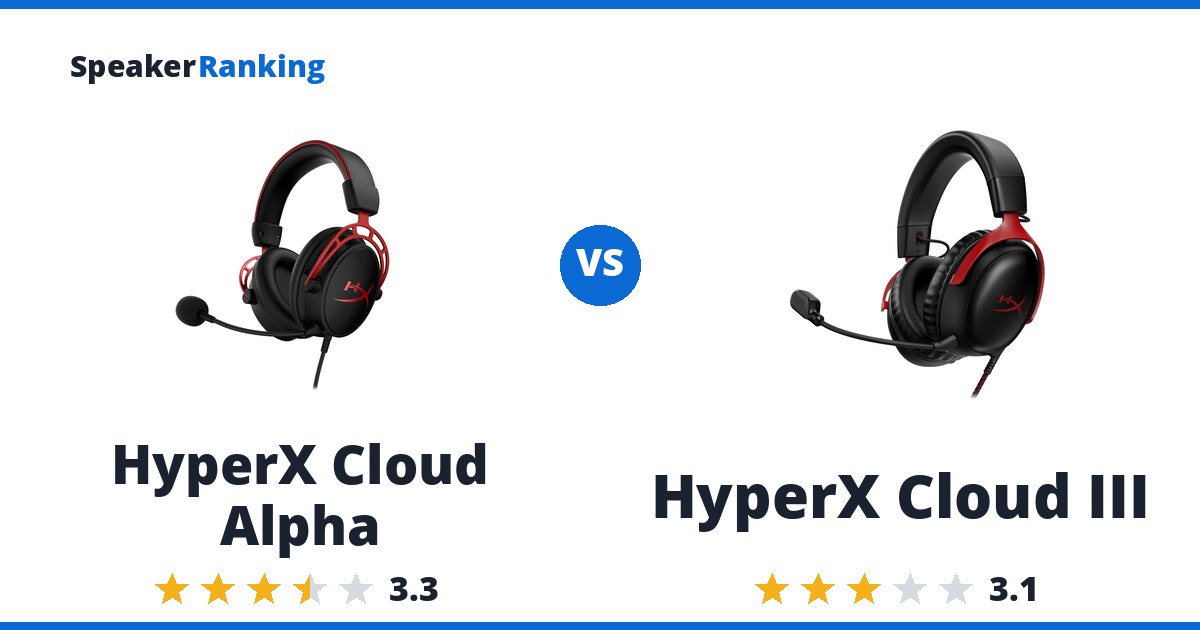
Why pick the HyperX Cloud Alpha: Bass from 60 to 200 Hz sits about 4 dB above the Harman target in oratory1990’s measurement, which gives kick drums and bass guitar extra weight for games and pop. The tradeoff: Treble is uneven, with a 4.6 dB peak near 8 kHz that can make cymbals and sibilants sharp and a 5.8 dB dip near 4 kHz that pulls vocals slightly back.
Why pick the HyperX Cloud III: Bass runs about 3 dB above target in a squig.link measurement, giving games and music a warm, punchy low end. The tradeoff: A 9.1 dB dip near 11.5 kHz and air about 3.6 dB below target dull the sparkle of cymbals and the sense of space, while a 3.9 dB presence shortfall pushes voices back.
Buy the HyperX Cloud Alpha. It is rated higher for sound quality, and the $2 saving on the HyperX Cloud III is not enough to make up the difference.
Want more options? Browse the full Headphones rankings.
Specifications Side By Side
| HyperX Cloud Alpha | HyperX Cloud III | |
|---|---|---|
| Price | $59.99 | $57.99 |
| Ranked | #150 of 231 in Over-Ear Headphones | #168 of 231 in Over-Ear Headphones |
| Form Factor | Over-ear | Over-ear |
| Harman Preference Score | 66 (measured by oratory1990, via AutoEQ) | 60 (median of 1 squig.link measurements, calibrated to AutoEQ) |
| Deviation From Target | 2.80 dB standard deviation | 3.12 dB standard deviation |
| Tonal Tilt | -0.87 (negative is warmer, positive brighter) | -0.92 (negative is warmer, positive brighter) |
| Sub-bass Extension | Within 6 dB of target down to 20 Hz (-2.4 dB at 30 Hz) | Within 6 dB of target down to 20 Hz (-3.5 dB at 30 Hz) |
| Connection | Wired | Wired |
| Back | Closed | Closed |
| Driver Type | Dynamic | Dynamic |
| Drivers | 1 x 50mm dynamic | 1 x 53mm dynamic |
| Impedance | 65 ohms | 64 ohms |
| Sensitivity | 98 dB SPL/mW | - |
| Weight | 0.7 lbs (298 g) | 0.7 lbs (308 g) |
| Frequency Response | 13Hz - 27kHz (Manufacturer specified) | 10Hz - 21kHz (Manufacturer specified) |
| Built-in Microphone | Yes | Yes |
Related Headphone Comparisons
How HyperX Cloud Alpha compares with other leading options:
- AKG K240 Studio vs HyperX Cloud Alpha
- Sennheiser HD 400 S vs HyperX Cloud Alpha
- Audio-Technica ATH-M20x vs HyperX Cloud Alpha
- HyperX Cloud Alpha vs Sony WH-CH510
- HyperX Cloud II vs HyperX Cloud III
Prices on this page were last checked October 11, 2026 at 4:59 PM UTC. Product prices and availability are accurate as of that date/time and are subject to change; the price and availability shown on Amazon at the time of purchase will apply to the purchase of this product.
As an eBay Partner, we may be compensated if you make a purchase.
The Two Headphones In Full
 HyperX Cloud Alpha: $59.99 Amazon $59.99 eBay
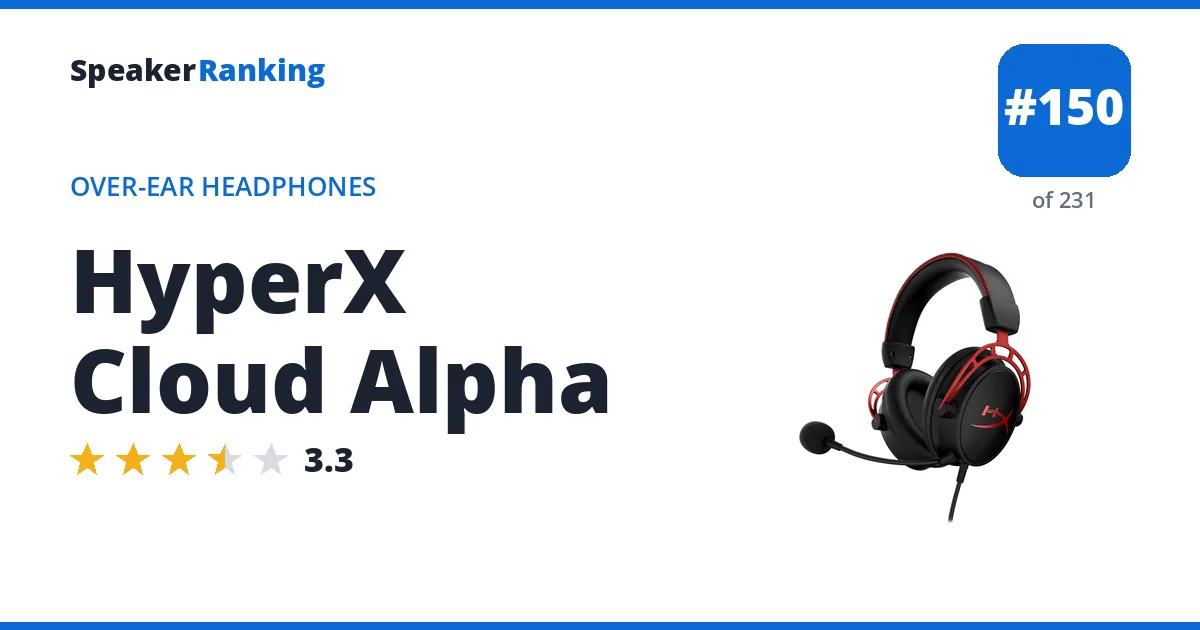
Pros: Bass from 60 to 200 Hz sits about 4 dB above the Harman target in oratory1990’s measurement, which gives kick drums and bass guitar extra weight for games and pop. The closed 50mm driver at 98 dB sensitivity and 65 ohms runs easily from a phone or console controller, and the built-in microphone suits voice chat.
Cons: Treble is uneven, with a 4.6 dB peak near 8 kHz that can make cymbals and sibilants sharp and a 5.8 dB dip near 4 kHz that pulls vocals slightly back. Air above 10 kHz runs about 4 dB hot, adding a hint of fizz on top of the warm tilt.
Full HyperX Cloud Alpha review and specifications →
| Released | Sep 2017 (9 years ago) |
|---|---|
| Back | Closed |
| Built-in Microphone | Yes |
| Connection | Wired |
| Deviation From Target | 2.80 dB standard deviation |
| Driver Type | Dynamic |
| Drivers | 1 x 50mm dynamic |
| Form Factor | Over-ear |
| Frequency Response | 13Hz - 27kHz (Manufacturer specified) |
| Harman Preference Score | 66 (measured by oratory1990, via AutoEQ) |
| Impedance | 65 ohms |
| Sensitivity | 98 dB SPL/mW |
| Sub-bass Extension | Within 6 dB of target down to 20 Hz (-2.4 dB at 30 Hz) |
| Tonal Tilt | -0.87 (negative is warmer, positive brighter) |
| Weight | 0.7 lbs (298 g) |
EQ preset to match the Harman target
Set a preamp of -6.3 dB, then add these filters in any parametric equalizer (Wavelet, Equalizer APO, Peace, or a player with parametric EQ). Calculated by AutoEQ from its measured frequency response.
| Filter | Frequency | Gain | Q |
|---|---|---|---|
| Low shelf | 105 Hz | +7.1 dB | 0.70 |
| Peak | 104 Hz | -5.9 dB | 0.23 |
| Peak | 733 Hz | +4.5 dB | 0.92 |
| Peak | 4,324 Hz | +6.7 dB | 2.87 |
| Peak | 6,110 Hz | -3.0 dB | 3.21 |
| High shelf | 10,000 Hz | -5.6 dB | 0.70 |
| Peak | 41 Hz | -0.4 dB | 2.00 |
| Peak | 159 Hz | +0.5 dB | 3.01 |
| Peak | 212 Hz | -0.5 dB | 3.66 |
| Peak | 1,964 Hz | +0.5 dB | 4.33 |
- Reviews, Comparisons and Sound Samples
- Head-to-Head Comparisons
 HyperX Cloud III: $57.99 Amazon $57.99 eBay
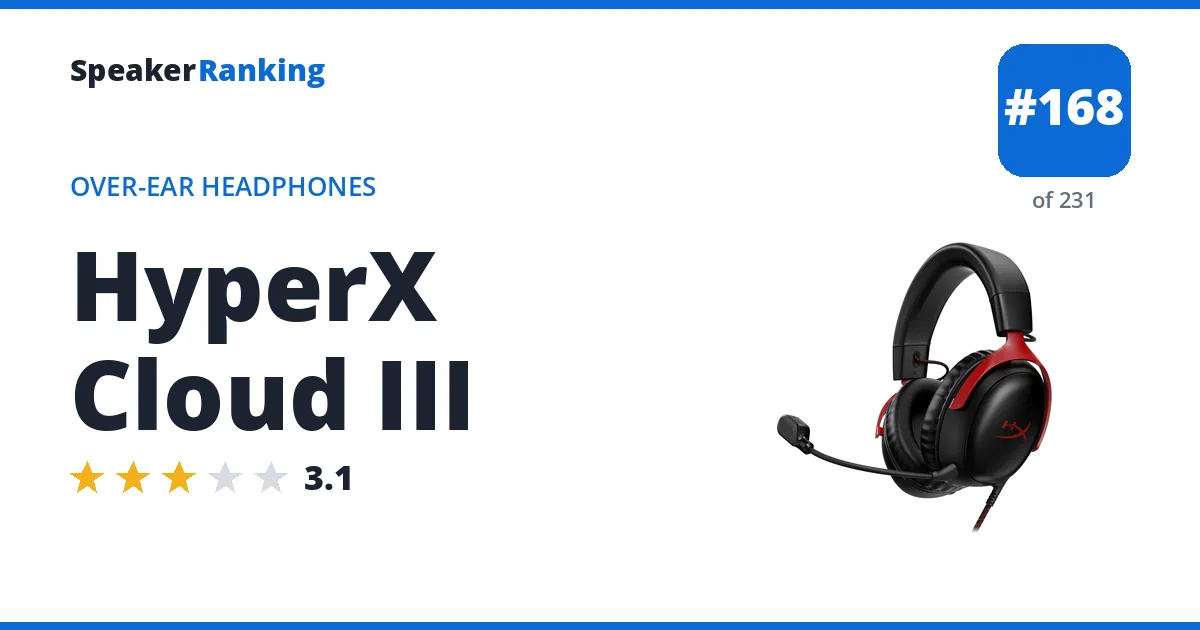
Pros: Bass runs about 3 dB above target in a squig.link measurement, giving games and music a warm, punchy low end. The closed back keeps sound in and outside noise out, and the built-in microphone covers voice chat. A 64 ohm load is still easy for a PC, console controller or phone to drive.
Cons: A 9.1 dB dip near 11.5 kHz and air about 3.6 dB below target dull the sparkle of cymbals and the sense of space, while a 3.9 dB presence shortfall pushes voices back. Sub-bass also sits 3.6 dB under target, so the deepest rumble is soft. The Audio-Technica ATH-M20x rates higher at nearly the same price.
Full HyperX Cloud III review and specifications →
| Released | May 2023 (3 years ago) |
|---|---|
| Back | Closed |
| Built-in Microphone | Yes |
| Connection | Wired |
| Deviation From Target | 3.12 dB standard deviation |
| Driver Type | Dynamic |
| Drivers | 1 x 53mm dynamic |
| Form Factor | Over-ear |
| Frequency Response | 10Hz - 21kHz (Manufacturer specified) |
| Harman Preference Score | 60 (median of 1 squig.link measurements, calibrated to AutoEQ) |
| Impedance | 64 ohms |
| Sub-bass Extension | Within 6 dB of target down to 20 Hz (-3.5 dB at 30 Hz) |
| Tonal Tilt | -0.92 (negative is warmer, positive brighter) |
| Weight | 0.7 lbs (308 g) |
- Reviews, Comparisons and Sound Samples
- Head-to-Head Comparisons