Short answer: the Westone Pro X50, though neither ranks well in its class. Both are rated 1.0/5 for sound quality (#450 and #449 of 450 in-ear headphones), and the Westone Pro X50 costs $609.96 against $657.57 for the Final Audio F3100, and with sound quality even, the cheaper one is the better buy. Both are rated below 3.0/5 among the 450 in-ear headphones, so if sound quality matters, consider the Truthear Nova instead, ranked #2 at $169.99.
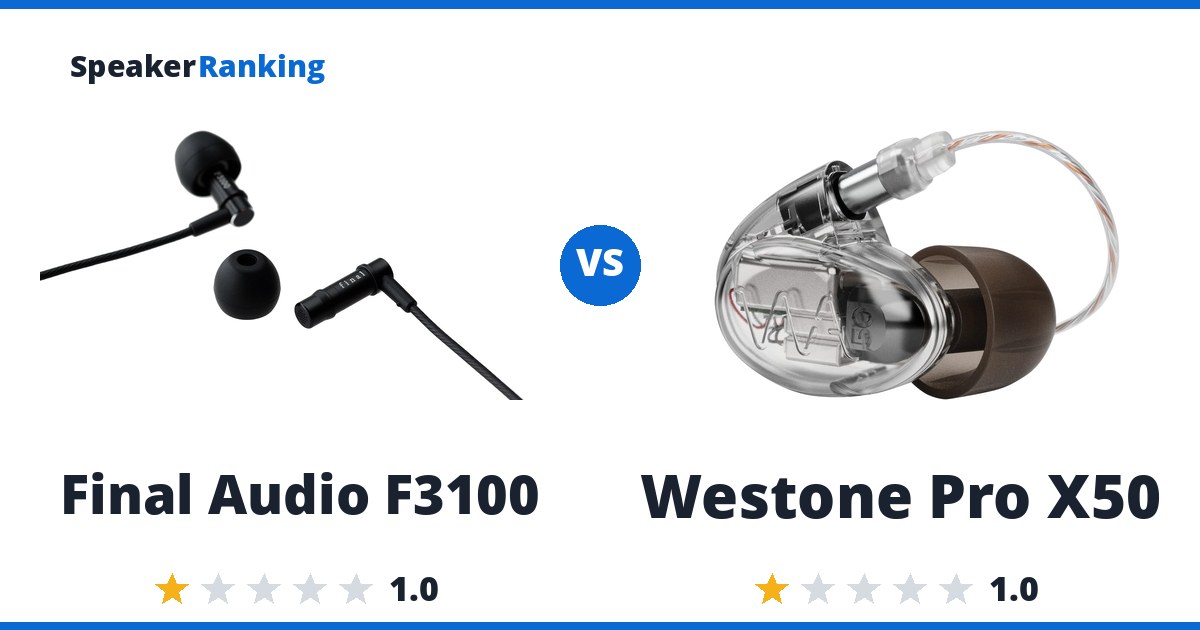
What the Final Audio F3100 does well: The single balanced armature has a 42 ohm load that suits phones and dongles without needing a separate amp. Watch for: Oratory1990’s measurement gives a preference score of only 25 with 5.83 dB of deviation, and sub-bass sits 12.8 dB below target, falling 6 dB short at 80 Hz, so bass has almost no weight.
The case for the Westone Pro X50: Five balanced armatures with 115 dB/mW sensitivity make it easy to drive from a phone or stage monitor pack. The tradeoff: Its preference score of 11 from crinacle’s measurement is among the lowest of any in-ear, with 6.39 dB of deviation and a strongly dark tilt, so its tonal balance is far from what most listeners prefer.
Buy the Westone Pro X50. Both are rated the same for sound quality, and it costs $47.61 less than the Final Audio F3100.
Still deciding? The full Headphones rankings cover every ranked option.
Specifications Side By Side
| Final Audio F3100 | Westone Pro X50 | |
|---|---|---|
| Price | $657.57 | $609.96 |
| Ranked | #449 of 450 in In-Ear Headphones | #450 of 450 in In-Ear Headphones |
| Form Factor | In-ear | In-ear |
| Back | Closed | Closed |
| Harman Preference Score | 25 (measured by oratory1990, via AutoEQ) | 11 (measured by crinacle, via AutoEQ) |
| Deviation From Target | 5.83 dB standard deviation | 6.39 dB standard deviation |
| Tonal Tilt | +1.83 (negative is warmer, positive brighter) | -2.11 (negative is warmer, positive brighter) |
| Sub-bass Extension | Falls 6 dB below target at 80 Hz (-15.8 dB at 30 Hz) | - |
| Connection | Wired | Wired |
| Driver Type | Balanced armature | Balanced armature |
| Drivers | 1 x balanced armature | 5 x balanced armature |
| Impedance | 42 ohms | 45 ohms |
| Sensitivity | 106 dB | 115 dB/mW |
| Frequency Response | - | 20Hz - 20kHz (Manufacturer specified) |
| Built-in Microphone | - | No |
Related Headphone Comparisons
More worthwhile head-to-heads for Final Audio F3100:
- Campfire Audio Dorado 2020 vs Final Audio F3100
- EarSonics ES2 vs Final Audio F3100
- Campfire Audio Dorado 2020 vs Westone Pro X50
- EarSonics ES2 vs Westone Pro X50
- Etymotic ER4SR vs EarSonics ES2
Prices on this page were last checked October 11, 2026 at 4:59 PM UTC. Product prices and availability are accurate as of that date/time and are subject to change; the price and availability shown on Amazon at the time of purchase will apply to the purchase of this product.
As an eBay Partner, we may be compensated if you make a purchase.
The Two Headphones In Full
 Final Audio F3100: $657.57 Amazon eBay
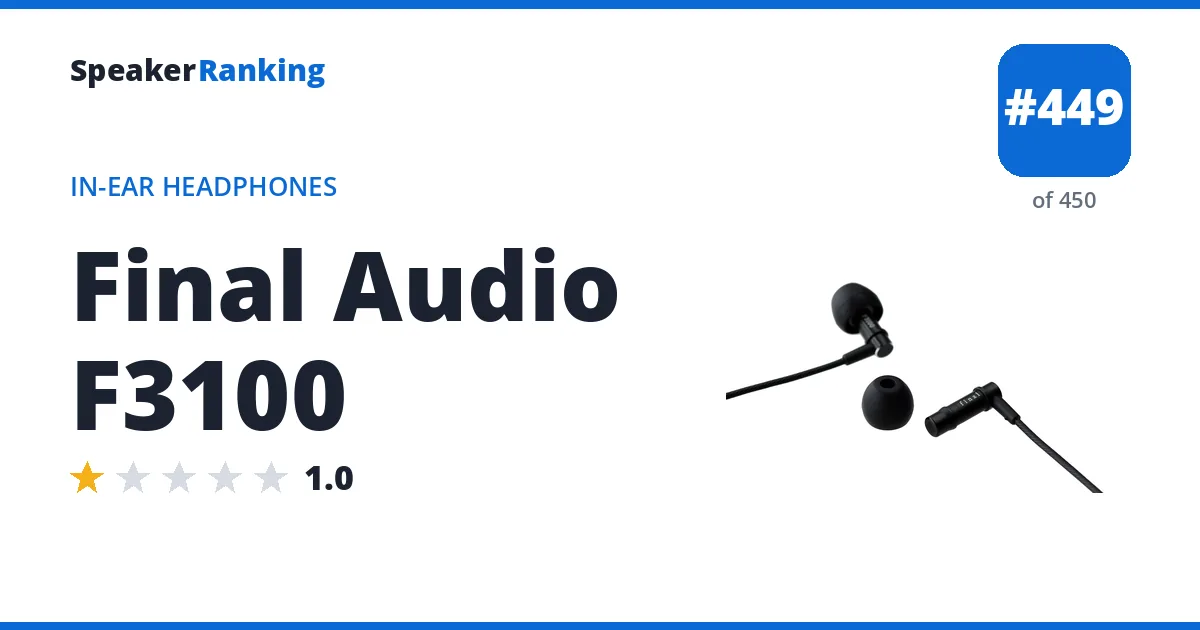
Pros: The single balanced armature has a 42 ohm load that suits phones and dongles without needing a separate amp. Its tuning fits listeners who favor a diffuse-field, studio-flat style of balance over a bass-forward one. It matches the rating of the Westone Pro X50.
Cons: Oratory1990’s measurement gives a preference score of only 25 with 5.83 dB of deviation, and sub-bass sits 12.8 dB below target, falling 6 dB short at 80 Hz, so bass has almost no weight. A 7.7 dB dip near 5.3 kHz next to a 5.7 dB peak around 8.3 kHz makes the treble uneven, with vocals recessed and sibilance accented. The Audio-Technica ATH-E70 and Mackie MP-360 rate higher and cost less.
Full Final Audio F3100 review and specifications →
| Released | Aug 2016 (10 years ago) |
|---|---|
| Back | Closed |
| Connection | Wired |
| Deviation From Target | 5.83 dB standard deviation |
| Driver Type | Balanced armature |
| Drivers | 1 x balanced armature |
| Form Factor | In-ear |
| Harman Preference Score | 25 (measured by oratory1990, via AutoEQ) |
| Impedance | 42 ohms |
| Sensitivity | 106 dB |
| Sub-bass Extension | Falls 6 dB below target at 80 Hz (-15.8 dB at 30 Hz) |
| Tonal Tilt | +1.83 (negative is warmer, positive brighter) |
EQ preset to match the Harman target
Set a preamp of -7.1 dB, then add these filters in any parametric equalizer (Wavelet, Equalizer APO, Peace, or a player with parametric EQ). Calculated by AutoEQ from its measured frequency response.
| Filter | Frequency | Gain | Q |
|---|---|---|---|
| Low shelf | 105 Hz | +6.4 dB | 0.70 |
| Peak | 271 Hz | -2.5 dB | 0.72 |
| Peak | 5,071 Hz | +7.3 dB | 2.62 |
| Peak | 2,119 Hz | +3.6 dB | 1.90 |
| Peak | 3,249 Hz | -6.8 dB | 4.17 |
| High shelf | 10,000 Hz | +3.2 dB | 0.70 |
| Peak | 8,619 Hz | -4.0 dB | 1.94 |
| Peak | 6,111 Hz | +2.8 dB | 6.00 |
| Peak | 73 Hz | +1.1 dB | 3.14 |
| Peak | 133 Hz | -0.5 dB | 1.86 |
- Reviews, Comparisons and Sound Samples
- Head-to-Head Comparisons
 Westone Pro X50: $609.96 Amazon eBay
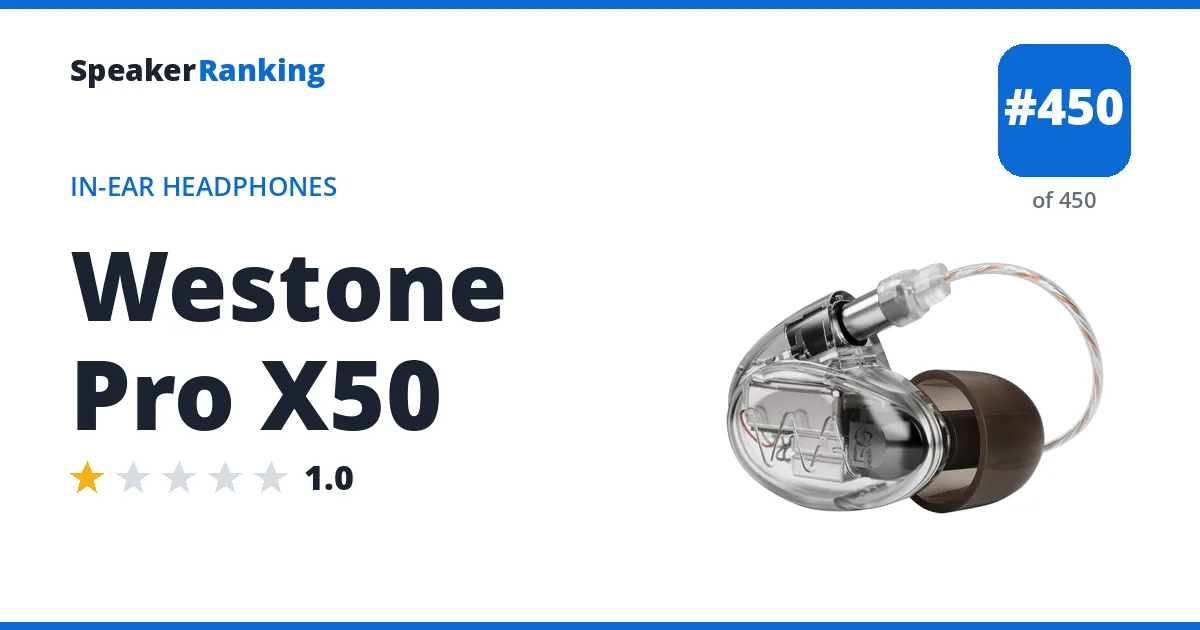
Pros: Five balanced armatures with 115 dB/mW sensitivity make it easy to drive from a phone or stage monitor pack. The closed in-ear design isolates well from loud surroundings.
Cons: Its preference score of 11 from crinacle’s measurement is among the lowest of any in-ear, with 6.39 dB of deviation and a strongly dark tilt, so its tonal balance is far from what most listeners prefer. The Mackie MP-360 and Audio-Technica ATH-E70 earn higher ratings for less money.
Full Westone Pro X50 review and specifications →
| Released | 2021 (5 years ago) |
|---|---|
| Back | Closed |
| Built-in Microphone | No |
| Connection | Wired |
| Deviation From Target | 6.39 dB standard deviation |
| Driver Type | Balanced armature |
| Drivers | 5 x balanced armature |
| Form Factor | In-ear |
| Frequency Response | 20Hz - 20kHz (Manufacturer specified) |
| Harman Preference Score | 11 (measured by crinacle, via AutoEQ) |
| Impedance | 45 ohms |
| Sensitivity | 115 dB/mW |
| Tonal Tilt | -2.11 (negative is warmer, positive brighter) |
EQ preset to match the Harman target
Set a preamp of -6.1 dB, then add these filters in any parametric equalizer (Wavelet, Equalizer APO, Peace, or a player with parametric EQ). Calculated by AutoEQ from its measured frequency response.
| Filter | Frequency | Gain | Q |
|---|---|---|---|
| Low shelf | 105 Hz | +0.5 dB | 0.70 |
| Peak | 221 Hz | -8.1 dB | 0.40 |
| Peak | 2,016 Hz | +7.5 dB | 0.67 |
| Peak | 9,337 Hz | +5.4 dB | 0.36 |
| Peak | 1,719 Hz | -9.7 dB | 1.82 |
| High shelf | 10,000 Hz | -6.4 dB | 0.70 |
| Peak | 9,549 Hz | +2.7 dB | 1.77 |
| Peak | 2,260 Hz | +1.0 dB | 2.61 |
| Peak | 1,810 Hz | +0.1 dB | 6.00 |
| Peak | 2,047 Hz | -1.8 dB | 5.70 |
- Reviews, Comparisons and Sound Samples
- Head-to-Head Comparisons