Short answer: the Etymotic ER4SR, though neither ranks well in its class. It ranks #440 of 450 in-ear headphones by sound quality, rated 1.7/5, at $299.99. The EarSonics ES2 ranks #448, rated 1.0/5, at $289.99, $10 cheaper, not enough of a saving to outweigh the sound-quality gap. Both are rated below 3.0/5 among the 450 in-ear headphones, so if sound quality matters, consider the Truthear Nova instead, ranked #2 at $169.99.

The Etymotic ER4SR is the better-sounding choice. For listeners who prefer a flat, studio style sound, the midrange from 200 Hz to 3 kHz stays within about 1 dB of target and its largest upper range peak is only 1.6 dB, so vocals come through clear without any glare. The tradeoff: Sub-bass sits about 11 dB below target and falls 6 dB short at 75 Hz, so bass heavy music sounds lean and lacks impact.
The case for the EarSonics ES2: Two balanced armature drivers and a very high 119 dB/mW sensitivity mean it reaches loud levels from any phone or dongle with little effort. The tradeoff: Crinacle’s measurement gives it a preference score of only 29, one of the furthest from the Harman target among in-ears, so its tonal balance will sound off to most listeners without EQ.
Buy the Etymotic ER4SR. It is rated higher for sound quality, and the $10 saving on the EarSonics ES2 is not enough to make up the difference.
Want more options? Browse the full Headphones rankings.
Specifications Side By Side
| Etymotic ER4SR | EarSonics ES2 | |
|---|---|---|
| Price | $299.99 | $289.99 |
| Ranked | #440 of 450 in In-Ear Headphones | #448 of 450 in In-Ear Headphones |
| Form Factor | In-ear | In-ear |
| Back | Closed | Closed |
| Harman Preference Score | 45 (measured by oratory1990, via AutoEQ) | 29 (measured by crinacle, via AutoEQ) |
| Deviation From Target | 4.26 dB standard deviation | 6.14 dB standard deviation |
| Tonal Tilt | +1.38 (negative is warmer, positive brighter) | -0.01 (negative is warmer, positive brighter) |
| Sub-bass Extension | Falls 6 dB below target at 75 Hz (-10.6 dB at 30 Hz) | - |
| Connection | Wired | Wired |
| Driver Type | Balanced armature | Balanced armature |
| Drivers | 1 x balanced armature | 2 x balanced armature |
| Impedance | 45 ohms | 26.5 ohms |
| Sensitivity | 98 dB/mW | 119 dB/mW |
| Frequency Response | 20Hz - 16kHz (Manufacturer specified) | 10Hz - 20kHz (Manufacturer specified) |
| Built-in Microphone | No | - |
Related Headphone Comparisons
More top alternatives to Etymotic ER4SR:
- Shure SE425 vs Etymotic ER4SR
- Audio-Technica ATH-E70 vs Etymotic ER4SR
- Etymotic ER4SR vs Mackie MP-360
- Etymotic ER4SR vs Sennheiser Momentum True Wireless 2
- EarSonics ES2 vs Westone W20
Prices on this page were last checked October 11, 2026 at 4:59 PM UTC. Product prices and availability are accurate as of that date/time and are subject to change; the price and availability shown on Amazon at the time of purchase will apply to the purchase of this product.
As an eBay Partner, we may be compensated if you make a purchase.
The Two Headphones In Full
 Etymotic ER4SR: $299.99 B&H Photo Video eBay

Pros: For listeners who prefer a flat, studio style sound, the midrange from 200 Hz to 3 kHz stays within about 1 dB of target and its largest upper range peak is only 1.6 dB, so vocals come through clear without any glare. It is rated level with the Audio-Technica ATH-E70 and Mackie MP-360, which cost more.
Cons: Sub-bass sits about 11 dB below target and falls 6 dB short at 75 Hz, so bass heavy music sounds lean and lacks impact. Treble about 6 dB low from 6 to 10 kHz and a 9 dB dip near 11.7 kHz take away air and shimmer. Its 98 dB/mW sensitivity is on the low side for an in ear, so it needs more volume than most.
Full Etymotic ER4SR review and specifications →
| Released | 2016 (10 years ago) |
|---|---|
| Back | Closed |
| Built-in Microphone | No |
| Connection | Wired |
| Deviation From Target | 4.26 dB standard deviation |
| Driver Type | Balanced armature |
| Drivers | 1 x balanced armature |
| Form Factor | In-ear |
| Frequency Response | 20Hz - 16kHz (Manufacturer specified) |
| Harman Preference Score | 45 (measured by oratory1990, via AutoEQ) |
| Impedance | 45 ohms |
| Sensitivity | 98 dB/mW |
| Sub-bass Extension | Falls 6 dB below target at 75 Hz (-10.6 dB at 30 Hz) |
| Tonal Tilt | +1.38 (negative is warmer, positive brighter) |
EQ preset to match the Harman target
Set a preamp of -6.0 dB, then add these filters in any parametric equalizer (Wavelet, Equalizer APO, Peace, or a player with parametric EQ). Calculated by AutoEQ from its measured frequency response.
| Filter | Frequency | Gain | Q |
|---|---|---|---|
| Low shelf | 105 Hz | +6.0 dB | 0.70 |
| Peak | 2,470 Hz | -3.7 dB | 0.94 |
| Peak | 7,389 Hz | +6.4 dB | 1.15 |
| Peak | 77 Hz | +1.2 dB | 2.20 |
| Peak | 1,450 Hz | -1.8 dB | 2.27 |
| High shelf | 10,000 Hz | +2.5 dB | 0.70 |
| Peak | 269 Hz | -0.5 dB | 1.17 |
| Peak | 745 Hz | +0.5 dB | 2.09 |
| Peak | 7,552 Hz | -0.8 dB | 4.20 |
| Peak | 9,634 Hz | -1.0 dB | 5.99 |
- Reviews, Comparisons and Sound Samples
- Head-to-Head Comparisons
 EarSonics ES2: $289.99 Amazon eBay
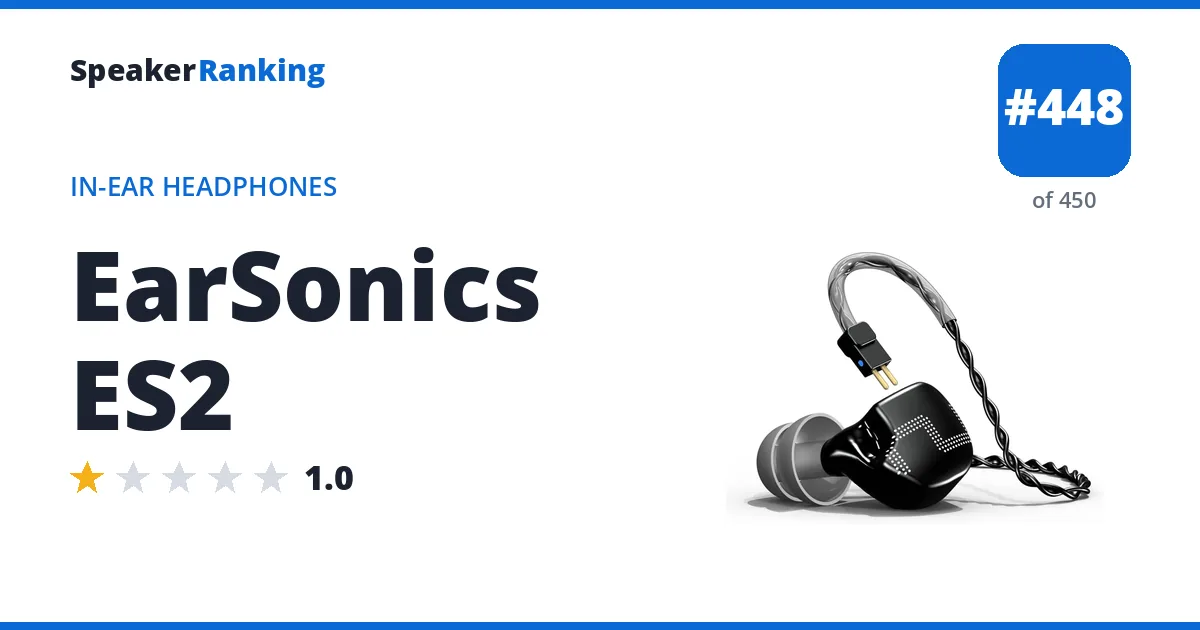
Pros: Two balanced armature drivers and a very high 119 dB/mW sensitivity mean it reaches loud levels from any phone or dongle with little effort. The closed in-ear design isolates well from outside noise.
Cons: Crinacle’s measurement gives it a preference score of only 29, one of the furthest from the Harman target among in-ears, so its tonal balance will sound off to most listeners without EQ. The Oriolus Finschi Hifi rates higher and costs less, and the Westone W20 matches its rating for less money.
Full EarSonics ES2 review and specifications →
| Released | 2016 (10 years ago) |
|---|---|
| Back | Closed |
| Connection | Wired |
| Deviation From Target | 6.14 dB standard deviation |
| Driver Type | Balanced armature |
| Drivers | 2 x balanced armature |
| Form Factor | In-ear |
| Frequency Response | 10Hz - 20kHz (Manufacturer specified) |
| Harman Preference Score | 29 (measured by crinacle, via AutoEQ) |
| Impedance | 26.5 ohms |
| Sensitivity | 119 dB/mW |
| Tonal Tilt | -0.01 (negative is warmer, positive brighter) |
EQ preset to match the Harman target
Set a preamp of -6.8 dB, then add these filters in any parametric equalizer (Wavelet, Equalizer APO, Peace, or a player with parametric EQ). Calculated by AutoEQ from its measured frequency response.
| Filter | Frequency | Gain | Q |
|---|---|---|---|
| Low shelf | 105 Hz | +6.9 dB | 0.70 |
| Peak | 231 Hz | -6.1 dB | 0.40 |
| Peak | 4,946 Hz | +6.9 dB | 0.22 |
| Peak | 1,862 Hz | -9.7 dB | 1.06 |
| Peak | 2,685 Hz | +5.9 dB | 2.30 |
| High shelf | 10,000 Hz | +2.5 dB | 0.70 |
| Peak | 49 Hz | +0.7 dB | 3.05 |
| Peak | 1,238 Hz | -0.5 dB | 4.83 |
| Peak | 940 Hz | +0.3 dB | 3.33 |
| Peak | 81 Hz | -0.4 dB | 4.68 |
- Reviews, Comparisons and Sound Samples
- Head-to-Head Comparisons