Short answer: the Bowers & Wilkins Px8, though neither ranks well in its class. It ranks #199 of 231 over-ear headphones by sound quality, rated 2.6/5, at $479. The Sony WH-1000XM6 ranks #211, rated 2.3/5, at $378, $101 cheaper, a saving that is not big enough to make up the sound-quality gap. Both are rated below 3.0/5 among the 231 over-ear headphones; for better sound, the HIFIMAN Ananda Nano ranks #4 at $319.
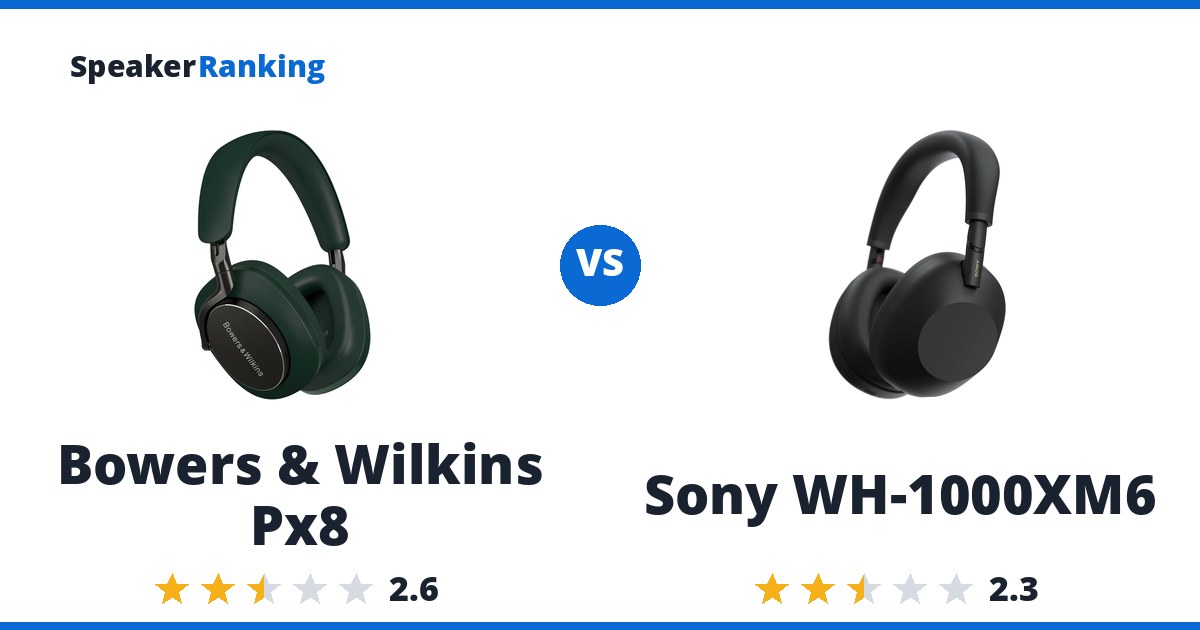
The Bowers & Wilkins Px8 is the better-sounding pick. Active noise cancelling and a manufacturer rated 30 hours of battery suit travel and commuting, and it also works over a cable. The catch: The bass boost spills into the low mids and upper mids sit 1.7 dB under target, so vocals sound thick and recessed, for a preference score of 50.
Why pick the Sony WH-1000XM6: Active noise cancelling, up to 30 hours of battery with ANC on (40 with it off) and LDAC, AAC and LC3 support cover most wireless needs, and a cable can be used too. It supports LDAC Bluetooth, which the Bowers & Wilkins Px8 lacks. The catch: An 11.5 dB dip near 8.1 kHz and treble about 3 dB under target leave cymbals and detail muted, so the sound is dark and heavy rather than balanced, with a preference score of only 43.
Buy the Bowers & Wilkins Px8. It is rated higher for sound quality, and the $101 saving on the Sony WH-1000XM6 is not enough to make up the difference.
Still deciding? The full Headphones rankings cover every ranked option.
Specifications Side By Side
| Bowers & Wilkins Px8 | Sony WH-1000XM6 | |
|---|---|---|
| Price | $479.00 | $378.00 |
| Ranked | #199 of 231 in Over-Ear Headphones | #211 of 231 in Over-Ear Headphones |
| Form Factor | Over-ear | Over-ear |
| Harman Preference Score | 50 (measured by oratory1990, via AutoEQ) | 43 (median of 4 squig.link measurements, calibrated to AutoEQ) |
| Deviation From Target | 3.14 dB standard deviation | 3.41 dB standard deviation |
| Tonal Tilt | -1.61 (negative is warmer, positive brighter) | -1.83 (negative is warmer, positive brighter) |
| Sub-bass Extension | Within 6 dB of target down to 20 Hz (+3.9 dB at 30 Hz) | Within 6 dB of target down to 20 Hz (+7.1 dB at 30 Hz) |
| Connection | Wireless and wired | Wireless and wired |
| Driver Type | Dynamic | Dynamic |
| Drivers | 1 x 40mm dynamic (carbon cone) | 1 x 30mm dynamic |
| Weight | 0.7 lbs (320 g) | 0.6 lbs (254 g) |
| Active Noise Cancelling | Yes | Yes |
| Battery Life | 30 hours (Manufacturer specified) | 30 hours (40 with ANC off, Manufacturer specified) |
| Bluetooth Version | 5.2 | 5.3 |
| Bluetooth Codecs | SBC, AAC, aptX, aptX HD, aptX Adaptive | SBC, AAC, LDAC, LC3 |
| Built-in Microphone | Yes | Yes |
| Back | - | Closed |
| Impedance | - | 48 ohms |
| Sensitivity | - | 103 dB/mW |
| Frequency Response | - | 4Hz - 40kHz (Manufacturer specified) |
Related Headphone Comparisons
More top alternatives to Bowers & Wilkins Px8:
- Bowers & Wilkins Px8 vs Sennheiser Momentum 4 Wireless
- Bose QuietComfort 35 II vs Sony WH-1000XM6
- Sennheiser Momentum 4 Wireless vs Sony WH-1000XM6
- Sony WH-1000XM5 vs Sony WH-1000XM6
- Sony ULT Wear vs Sony WH-1000XM6
Prices on this page were last checked October 11, 2026 at 4:59 PM UTC. Product prices and availability are accurate as of that date/time and are subject to change; the price and availability shown on Amazon at the time of purchase will apply to the purchase of this product.
As an eBay Partner, we may be compensated if you make a purchase.
The Two Headphones In Full
 Bowers & Wilkins Px8: $479.00 Wireless Amazon $479.00 eBay
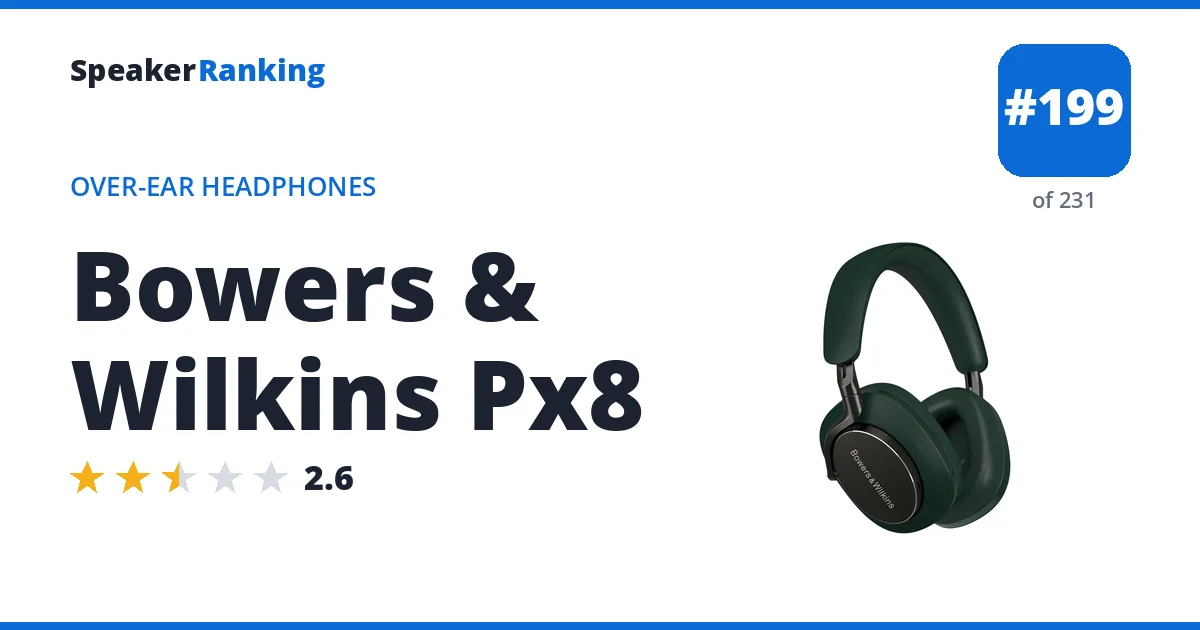
Pros: Active noise cancelling and a manufacturer rated 30 hours of battery suit travel and commuting, and it also works over a cable. Bluetooth 5.2 with AAC, aptX HD and aptX Adaptive covers high quality streaming on both iPhone and Android. Bass about 5.8 dB above target in oratory1990’s measurement suits listeners who prefer a big, warm low end.
Cons: The bass boost spills into the low mids and upper mids sit 1.7 dB under target, so vocals sound thick and recessed, for a preference score of 50. A 5.2 dB dip near 6.5 kHz softens detail. The Bowers & Wilkins Px7 S2e rates slightly higher for less money.
Full Bowers & Wilkins Px8 review and specifications →
| Released | 2022 (4 years ago) |
|---|---|
| Active Noise Cancelling | Yes |
| Battery Life | 30 hours (Manufacturer specified) |
| Bluetooth Codecs | SBC, AAC, aptX, aptX HD, aptX Adaptive |
| Bluetooth Version | 5.2 |
| Built-in Microphone | Yes |
| Connection | Wireless and wired |
| Deviation From Target | 3.14 dB standard deviation |
| Driver Type | Dynamic |
| Drivers | 1 x 40mm dynamic (carbon cone) |
| Form Factor | Over-ear |
| Harman Preference Score | 50 (measured by oratory1990, via AutoEQ) |
| Sub-bass Extension | Within 6 dB of target down to 20 Hz (+3.9 dB at 30 Hz) |
| Tonal Tilt | -1.61 (negative is warmer, positive brighter) |
| Weight | 0.7 lbs (320 g) |
EQ preset to match the Harman target
Set a preamp of -4.7 dB, then add these filters in any parametric equalizer (Wavelet, Equalizer APO, Peace, or a player with parametric EQ). Calculated by AutoEQ from its measured frequency response.
| Filter | Frequency | Gain | Q |
|---|---|---|---|
| Low shelf | 105 Hz | -3.9 dB | 0.70 |
| Peak | 259 Hz | -6.2 dB | 0.18 |
| Peak | 1,994 Hz | +5.3 dB | 0.55 |
| Peak | 425 Hz | +6.3 dB | 1.08 |
| Peak | 53 Hz | +4.7 dB | 1.09 |
| High shelf | 10,000 Hz | +0.5 dB | 0.70 |
| Peak | 6,260 Hz | +3.6 dB | 5.24 |
| Peak | 4,355 Hz | -2.7 dB | 4.52 |
| Peak | 9,862 Hz | +1.0 dB | 2.38 |
| Peak | 1,013 Hz | -0.5 dB | 3.11 |
- Reviews, Comparisons and Sound Samples
- Head-to-Head Comparisons
 Sony WH-1000XM6: $378.00 Wireless Amazon $378.00 eBay
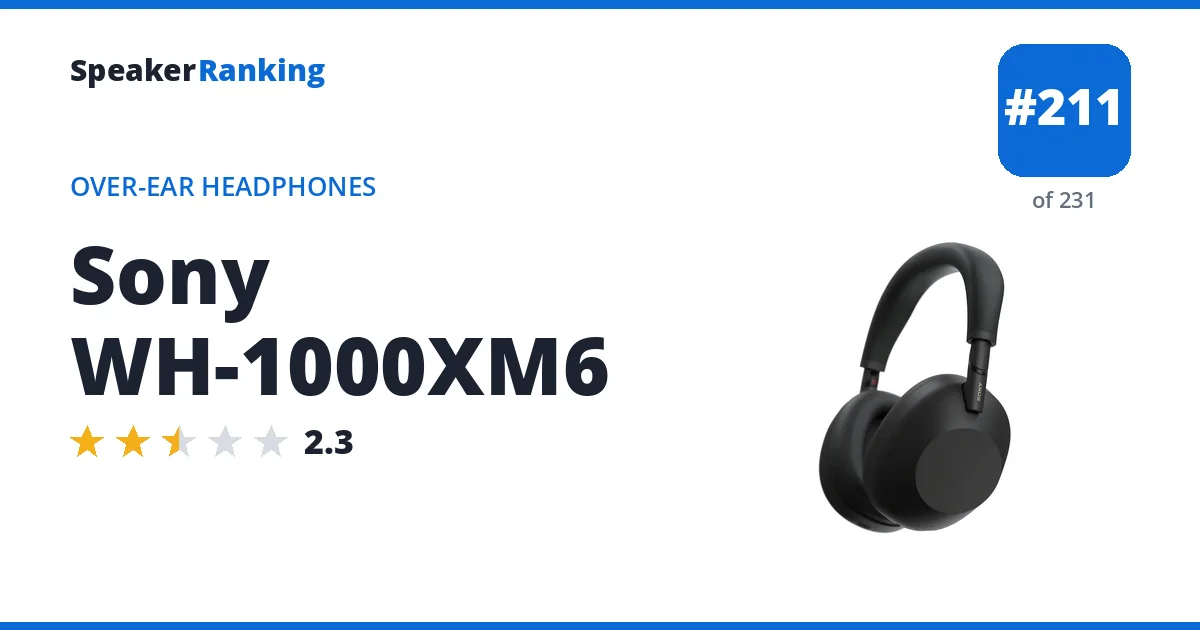
Pros: Active noise cancelling, up to 30 hours of battery with ANC on (40 with it off) and LDAC, AAC and LC3 support cover most wireless needs, and a cable can be used too. The tuning suits bass lovers: in hobbyist measurements on squig.link sub-bass sits about 7.5 dB and mid-bass about 6 dB above target, giving films and electronic music plenty of weight. At 48 ohms and 103 dB/mW it also runs easily from a phone in wired mode, and it rates above the Sony INZONE H9 II.
Cons: An 11.5 dB dip near 8.1 kHz and treble about 3 dB under target leave cymbals and detail muted, so the sound is dark and heavy rather than balanced, with a preference score of only 43. The Sennheiser Momentum 4 Wireless rates higher and costs less.
Full Sony WH-1000XM6 review and specifications →
| Released | May 2025 (1 year ago) |
|---|---|
| Active Noise Cancelling | Yes |
| Back | Closed |
| Battery Life | 30 hours (40 with ANC off, Manufacturer specified) |
| Bluetooth Codecs | SBC, AAC, LDAC, LC3 |
| Bluetooth Version | 5.3 |
| Built-in Microphone | Yes |
| Connection | Wireless and wired |
| Deviation From Target | 3.41 dB standard deviation |
| Driver Type | Dynamic |
| Drivers | 1 x 30mm dynamic |
| Form Factor | Over-ear |
| Frequency Response | 4Hz - 40kHz (Manufacturer specified) |
| Harman Preference Score | 43 (median of 4 squig.link measurements, calibrated to AutoEQ) |
| Impedance | 48 ohms |
| Sensitivity | 103 dB/mW |
| Sub-bass Extension | Within 6 dB of target down to 20 Hz (+7.1 dB at 30 Hz) |
| Tonal Tilt | -1.83 (negative is warmer, positive brighter) |
| Weight | 0.6 lbs (254 g) |
- Reviews, Comparisons and Sound Samples
- Head-to-Head Comparisons