Short answer: the Bowers & Wilkins Px8 on measured sound quality, the Sennheiser Momentum 4 Wireless on price, though neither ranks well in its class. The Bowers & Wilkins Px8 ranks #199 of 231 over-ear headphones, rated 2.6/5, at $479. The Sennheiser Momentum 4 Wireless ranks #208, rated 2.5/5, at $227.38, $251.62 cheaper. Both are rated below 3.0/5 among the 231 over-ear headphones; for better sound, the HIFIMAN Ananda Nano ranks #4 at $319.
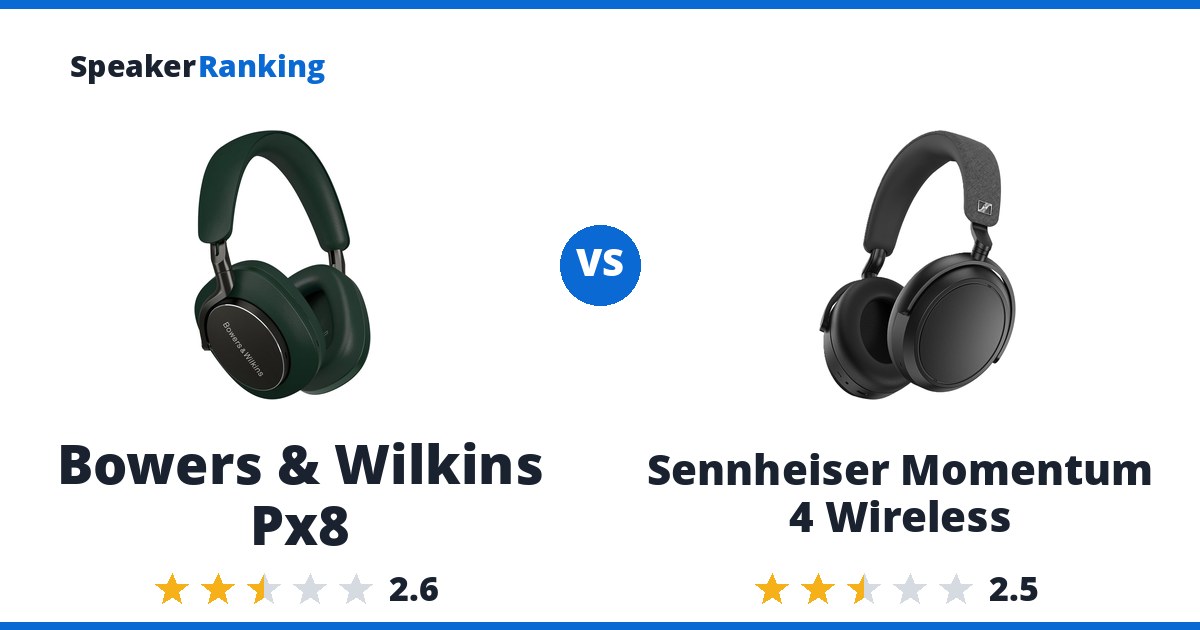
Why pick the Bowers & Wilkins Px8: Active noise cancelling and a manufacturer rated 30 hours of battery suit travel and commuting, and it also works over a cable. It supports aptX HD Bluetooth, which the Sennheiser Momentum 4 Wireless lacks. The catch: The bass boost spills into the low mids and upper mids sit 1.7 dB under target, so vocals sound thick and recessed, for a preference score of 50.
The Sennheiser Momentum 4 Wireless is the longer-running option. Feature set is strong: active noise cancelling, Bluetooth 5.2 with SBC, AAC, aptX and aptX Adaptive, and a rated 60 hours of battery. It is rated for 60 hours of battery against 30 for the Bowers & Wilkins Px8. Watch for: That bass boost overshoots the Harman target by a clear margin and adds about 2 dB in the low mids, which can make vocals and bass guitar thick.
Buy the Bowers & Wilkins Px8 if sound quality is the priority over the price, or the Sennheiser Momentum 4 Wireless if the price is the priority over sound quality.
Still deciding? The full Headphones rankings cover every ranked option.
Specifications Side By Side
| Bowers & Wilkins Px8 | Sennheiser Momentum 4 Wireless | |
|---|---|---|
| Price | $479.00 | $227.38 |
| Ranked | #199 of 231 in Over-Ear Headphones | #208 of 231 in Over-Ear Headphones |
| Form Factor | Over-ear | Over-ear |
| Harman Preference Score | 50 (measured by oratory1990, via AutoEQ) | 47 (measured by oratory1990, via AutoEQ) |
| Deviation From Target | 3.14 dB standard deviation | 3.31 dB standard deviation |
| Tonal Tilt | -1.61 (negative is warmer, positive brighter) | -1.68 (negative is warmer, positive brighter) |
| Sub-bass Extension | Within 6 dB of target down to 20 Hz (+3.9 dB at 30 Hz) | Within 6 dB of target down to 20 Hz (+8.2 dB at 30 Hz) |
| Connection | Wireless and wired | Wireless and wired |
| Driver Type | Dynamic | Dynamic |
| Drivers | 1 x 40mm dynamic (carbon cone) | 1 x 42mm dynamic |
| Weight | 0.7 lbs (320 g) | 0.6 lbs (293 g) |
| Active Noise Cancelling | Yes | Yes |
| Battery Life | 30 hours (Manufacturer specified) | 60 hours (Manufacturer specified) |
| Bluetooth Version | 5.2 | 5.2 |
| Bluetooth Codecs | SBC, AAC, aptX, aptX HD, aptX Adaptive | SBC, AAC, aptX, aptX Adaptive |
| Built-in Microphone | Yes | Yes |
| Back | - | Closed |
| Sensitivity | - | 106 dB SPL (1 kHz / 0 dB FS) |
| Frequency Response | - | 6Hz - 22kHz (Manufacturer specified) |
| IP Rating | - | None |
Related Headphone Comparisons
How Bowers & Wilkins Px8 compares with other leading options:
- Bowers & Wilkins Px8 vs Sony WH-1000XM6
- Sennheiser Momentum 4 Wireless vs Sony WH-1000XM6
- KLH Ultimate One vs Sennheiser Momentum 4 Wireless
- Sennheiser Momentum 4 Wireless vs Audio-Technica ATH-A990Z
- Audio-Technica ATH-AD900X vs Sennheiser Momentum 4 Wireless
Prices on this page were last checked October 11, 2026 at 4:59 PM UTC. Product prices and availability are accurate as of that date/time and are subject to change; the price and availability shown on Amazon at the time of purchase will apply to the purchase of this product.
As an eBay Partner, we may be compensated if you make a purchase.
The Two Headphones In Full
 Bowers & Wilkins Px8: $479.00 Wireless Amazon $479.00 eBay
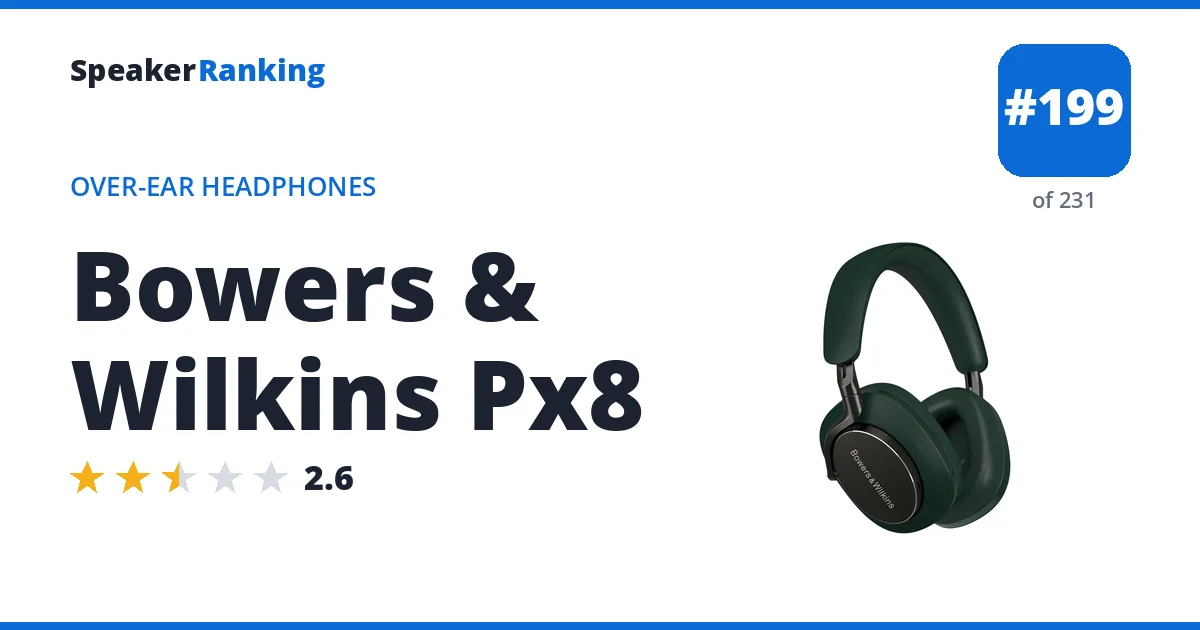
Pros: Active noise cancelling and a manufacturer rated 30 hours of battery suit travel and commuting, and it also works over a cable. Bluetooth 5.2 with AAC, aptX HD and aptX Adaptive covers high quality streaming on both iPhone and Android. Bass about 5.8 dB above target in oratory1990’s measurement suits listeners who prefer a big, warm low end.
Cons: The bass boost spills into the low mids and upper mids sit 1.7 dB under target, so vocals sound thick and recessed, for a preference score of 50. A 5.2 dB dip near 6.5 kHz softens detail. The Bowers & Wilkins Px7 S2e rates slightly higher for less money.
Full Bowers & Wilkins Px8 review and specifications →
| Released | 2022 (4 years ago) |
|---|---|
| Active Noise Cancelling | Yes |
| Battery Life | 30 hours (Manufacturer specified) |
| Bluetooth Codecs | SBC, AAC, aptX, aptX HD, aptX Adaptive |
| Bluetooth Version | 5.2 |
| Built-in Microphone | Yes |
| Connection | Wireless and wired |
| Deviation From Target | 3.14 dB standard deviation |
| Driver Type | Dynamic |
| Drivers | 1 x 40mm dynamic (carbon cone) |
| Form Factor | Over-ear |
| Harman Preference Score | 50 (measured by oratory1990, via AutoEQ) |
| Sub-bass Extension | Within 6 dB of target down to 20 Hz (+3.9 dB at 30 Hz) |
| Tonal Tilt | -1.61 (negative is warmer, positive brighter) |
| Weight | 0.7 lbs (320 g) |
EQ preset to match the Harman target
Set a preamp of -4.7 dB, then add these filters in any parametric equalizer (Wavelet, Equalizer APO, Peace, or a player with parametric EQ). Calculated by AutoEQ from its measured frequency response.
| Filter | Frequency | Gain | Q |
|---|---|---|---|
| Low shelf | 105 Hz | -3.9 dB | 0.70 |
| Peak | 259 Hz | -6.2 dB | 0.18 |
| Peak | 1,994 Hz | +5.3 dB | 0.55 |
| Peak | 425 Hz | +6.3 dB | 1.08 |
| Peak | 53 Hz | +4.7 dB | 1.09 |
| High shelf | 10,000 Hz | +0.5 dB | 0.70 |
| Peak | 6,260 Hz | +3.6 dB | 5.24 |
| Peak | 4,355 Hz | -2.7 dB | 4.52 |
| Peak | 9,862 Hz | +1.0 dB | 2.38 |
| Peak | 1,013 Hz | -0.5 dB | 3.11 |
- Reviews, Comparisons and Sound Samples
- Head-to-Head Comparisons
 Sennheiser Momentum 4 Wireless: $227.38 Wireless Amazon $227.38 eBay
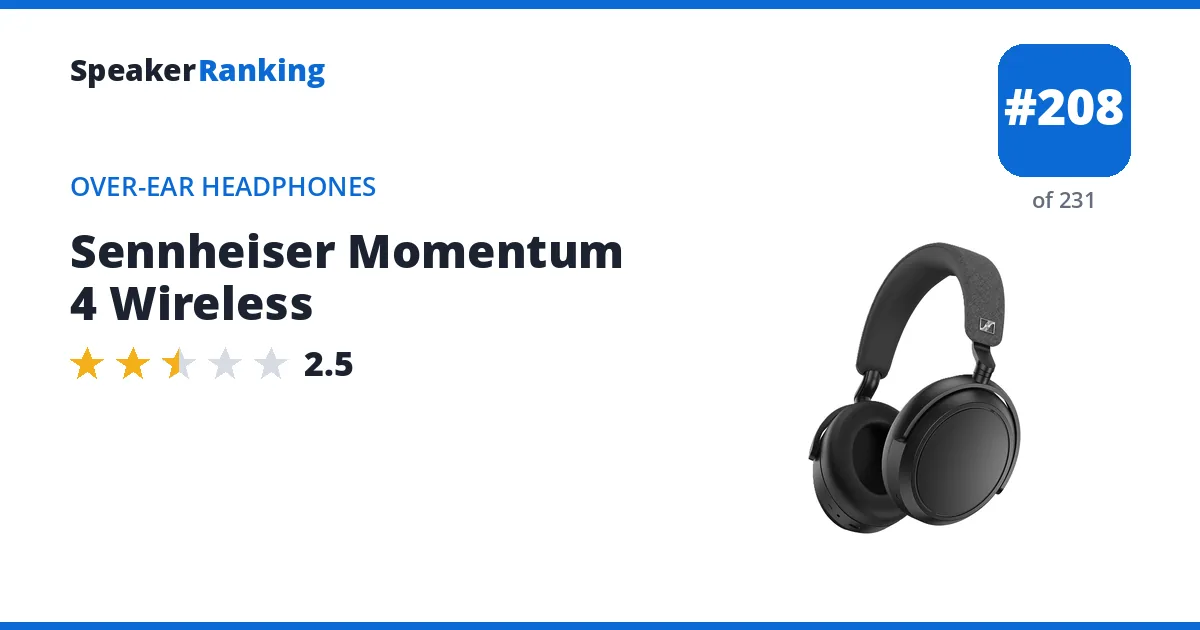
Pros: Feature set is strong: active noise cancelling, Bluetooth 5.2 with SBC, AAC, aptX and aptX Adaptive, and a rated 60 hours of battery. It also plays wired and has a built-in microphone. The deep bass lift, about 9 dB in the sub-bass and 6 dB in the bass, suits listeners who like a warm, bass-heavy sound.
Cons: That bass boost overshoots the Harman target by a clear margin and adds about 2 dB in the low mids, which can make vocals and bass guitar thick. A 4.7 dB dip near 2.4 kHz followed by a 3.5 dB peak near 6.8 kHz makes the upper midrange uneven. Its preference score of 47 trails the Beats Studio3 Wireless, which is rated higher.
Full Sennheiser Momentum 4 Wireless review and specifications →
| Released | Aug 2022 (4 years ago) |
|---|---|
| Active Noise Cancelling | Yes |
| Back | Closed |
| Battery Life | 60 hours (Manufacturer specified) |
| Bluetooth Codecs | SBC, AAC, aptX, aptX Adaptive |
| Bluetooth Version | 5.2 |
| Built-in Microphone | Yes |
| Connection | Wireless and wired |
| Deviation From Target | 3.31 dB standard deviation |
| Driver Type | Dynamic |
| Drivers | 1 x 42mm dynamic |
| Form Factor | Over-ear |
| Frequency Response | 6Hz - 22kHz (Manufacturer specified) |
| Harman Preference Score | 47 (measured by oratory1990, via AutoEQ) |
| IP Rating | None |
| Sensitivity | 106 dB SPL (1 kHz / 0 dB FS) |
| Sub-bass Extension | Within 6 dB of target down to 20 Hz (+8.2 dB at 30 Hz) |
| Tonal Tilt | -1.68 (negative is warmer, positive brighter) |
| Weight | 0.6 lbs (293 g) |
EQ preset to match the Harman target
Set a preamp of -6.4 dB, then add these filters in any parametric equalizer (Wavelet, Equalizer APO, Peace, or a player with parametric EQ). Calculated by AutoEQ from its measured frequency response.
| Filter | Frequency | Gain | Q |
|---|---|---|---|
| Low shelf | 105 Hz | -7.4 dB | 0.70 |
| Peak | 195 Hz | -3.6 dB | 1.22 |
| Peak | 2,393 Hz | +6.1 dB | 1.81 |
| Peak | 1,726 Hz | +1.6 dB | 1.71 |
| Peak | 2,893 Hz | -3.2 dB | 5.94 |
| High shelf | 10,000 Hz | +0.5 dB | 0.70 |
| Peak | 63 Hz | +1.7 dB | 2.86 |
| Peak | 652 Hz | +1.2 dB | 2.25 |
| Peak | 952 Hz | -1.0 dB | 3.69 |
| Peak | 316 Hz | -0.9 dB | 3.46 |
- Reviews, Comparisons and Sound Samples
- Head-to-Head Comparisons
- Sennheiser Momentum 4 Wireless vs Sony WH-1000XM6
- Sennheiser Momentum 4 Wireless vs AKG K271 MKII
- Sennheiser Momentum 4 Wireless vs KLH Ultimate One
- Sennheiser Momentum 4 Wireless vs Audio-Technica ATH-AD900X
- Sennheiser Momentum 4 Wireless vs Jabra Evolve 40
- Sennheiser Momentum 4 Wireless vs Audio-Technica ATH-A990Z
- Sennheiser Momentum 4 Wireless vs Sony WH-1000XM5