Short answer: the 64 Audio U18S. It ranks #386 of 450 in-ear headphones by sound quality, rated 3.1/5, at $2,999. The 64 Audio Volur ranks #391, rated 3.0/5, at $2,499, $500 cheaper, a saving that is not big enough to make up the sound-quality gap.

What the 64 Audio U18S does well: Eighteen balanced armature drivers per side deliver a warm, relaxed tuning with bass about 1.6 dB above target and sub-bass within 6 dB of target down to 20 Hz. The tradeoff: Across seven hobbyist measurements on squig.link, the 3 to 6 kHz presence region sits about 6 dB below target with a 9 dB dip near 5.8 kHz, so vocals and guitars lose bite and fine detail sounds veiled.
What the 64 Audio Volur does well: Two 9mm dynamic drivers deliver about 3 to 4 dB of extra sub-bass and bass in HypetheSonics’ measurement, still 2 dB above target at 30 Hz, so bass-heavy music has real depth and slam. The tradeoff: A 4.6 dB dip near 3.4 kHz and a 2.4 dB shortfall across 3 to 6 kHz push vocals back behind the bass.
Buy the 64 Audio U18S. It is rated higher for sound quality, and saving $500 with the 64 Audio Volur does not make up for the sound-quality gap.
Still deciding? The full Headphones rankings cover every ranked option.
Specifications Side By Side
| 64 Audio U18S | 64 Audio Volur | |
|---|---|---|
| Price | $2,999.00 | $2,499.00 |
| Ranked | #386 of 450 in In-Ear Headphones | #391 of 450 in In-Ear Headphones |
| Form Factor | In-ear | In-ear |
| Back | Closed | Closed |
| Harman Preference Score | 63 (measured by crinacle, via AutoEQ) | 62 (measured by HypetheSonics, via AutoEQ) |
| Deviation From Target | 2.78 dB standard deviation | 2.56 dB standard deviation |
| Tonal Tilt | -0.81 (negative is warmer, positive brighter) | -1.19 (negative is warmer, positive brighter) |
| Connection | Wired | Wired |
| Driver Type | Balanced armature | Hybrid (2 dynamic + 8 balanced armature) |
| Drivers | 18 x balanced armature (1 tia high + 1 high-mid + 8 mid + 8 low) | 2 x 9mm dynamic + 8 x balanced armature |
| Impedance | 8 ohms | 6.3 ohms |
| Sensitivity | 106 dB/mW | 103 dB/mW |
| Frequency Response | 10Hz - 20kHz (Manufacturer specified) | 5Hz - 22kHz (Manufacturer specified) |
| Built-in Microphone | No | No |
| Sub-bass Extension | Within 6 dB of target down to 20 Hz (-2.7 dB at 30 Hz) | Within 6 dB of target down to 20 Hz (+2.0 dB at 30 Hz) |
Related Headphone Comparisons
How 64 Audio U18S compares with other leading options:
- 64 Audio U18S vs HIFIMAN RE2000 Pro
- 64 Audio U18S vs Shure KSE1500
- 64 Audio Volur vs Shure KSE1500
- 64 Audio Tia Trio vs 64 Audio Volur
- HIFIMAN RE2000 Pro vs 64 Audio Volur
Prices on this page were last checked October 11, 2026 at 4:59 PM UTC. Product prices and availability are accurate as of that date/time and are subject to change; the price and availability shown on Amazon at the time of purchase will apply to the purchase of this product.
As an eBay Partner, we may be compensated if you make a purchase.
The Two Headphones In Full
 64 Audio U18S: $2,999.00 64 Audio eBay
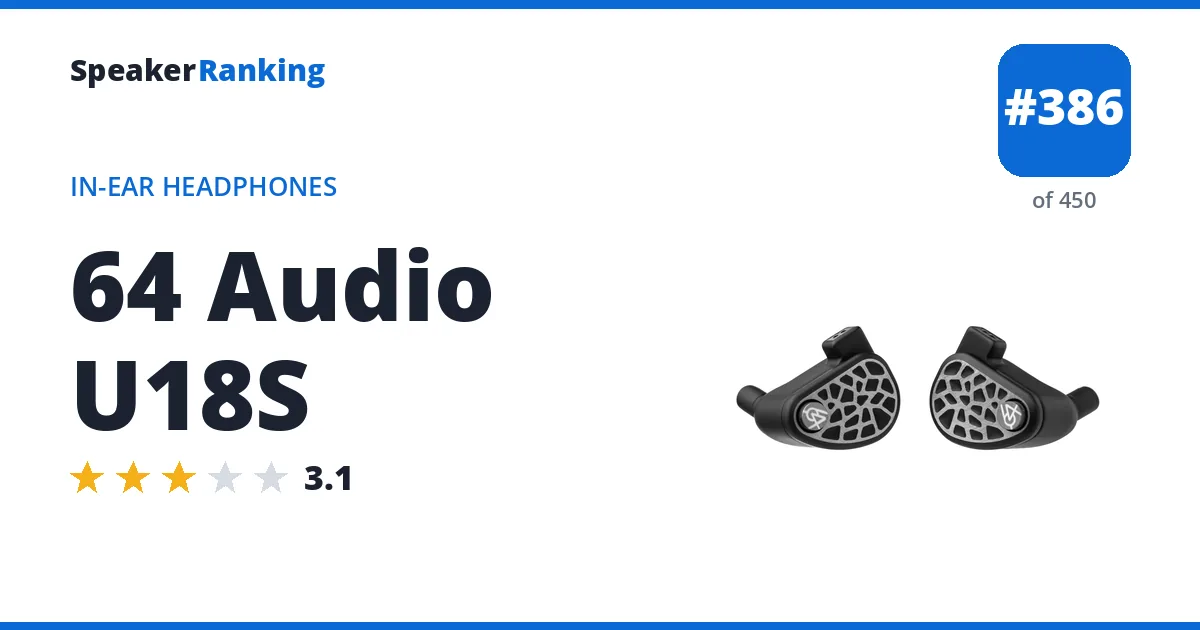
Pros: Eighteen balanced armature drivers per side deliver a warm, relaxed tuning with bass about 1.6 dB above target and sub-bass within 6 dB of target down to 20 Hz. The upper treble near 10 kHz stays close to neutral, so the top end keeps some air without glare. At 106 dB/mW it plays comfortably loud from a phone. It rates above the 64 Audio Volur from the same maker.
Cons: Across seven hobbyist measurements on squig.link, the 3 to 6 kHz presence region sits about 6 dB below target with a 9 dB dip near 5.8 kHz, so vocals and guitars lose bite and fine detail sounds veiled. The 64 Audio U12t rates higher for about a third less money. Its 8 ohm impedance makes the tuning sensitive to sources with high output impedance.
Full 64 Audio U18S review and specifications →
| Released | Mar 2021 (5 years ago) |
|---|---|
| Back | Closed |
| Built-in Microphone | No |
| Connection | Wired |
| Deviation From Target | 2.78 dB standard deviation |
| Driver Type | Balanced armature |
| Drivers | 18 x balanced armature (1 tia high + 1 high-mid + 8 mid + 8 low) |
| Form Factor | In-ear |
| Frequency Response | 10Hz - 20kHz (Manufacturer specified) |
| Harman Preference Score | 63 (measured by crinacle, via AutoEQ) |
| Impedance | 8 ohms |
| Sensitivity | 106 dB/mW |
| Sub-bass Extension | Within 6 dB of target down to 20 Hz (-2.7 dB at 30 Hz) |
| Tonal Tilt | -0.81 (negative is warmer, positive brighter) |
EQ preset to match the Harman target
Set a preamp of -6.4 dB, then add these filters in any parametric equalizer (Wavelet, Equalizer APO, Peace, or a player with parametric EQ). Calculated by AutoEQ from its measured frequency response.
| Filter | Frequency | Gain | Q |
|---|---|---|---|
| Low shelf | 105 Hz | -0.2 dB | 0.70 |
| Peak | 3,810 Hz | +5.3 dB | 0.39 |
| Peak | 188 Hz | -2.5 dB | 0.55 |
| Peak | 1,693 Hz | -5.3 dB | 0.92 |
| Peak | 9,264 Hz | +3.3 dB | 2.44 |
| High shelf | 10,000 Hz | -4.7 dB | 0.70 |
| Peak | 6,104 Hz | +2.5 dB | 5.82 |
| Peak | 2,983 Hz | +1.3 dB | 4.04 |
| Peak | 5,102 Hz | -1.7 dB | 6.00 |
| Peak | 2,279 Hz | -1.0 dB | 5.11 |
- Reviews, Comparisons and Sound Samples
- Head-to-Head Comparisons
 64 Audio Volur: $2,499.00 64 Audio eBay

Pros: Two 9mm dynamic drivers deliver about 3 to 4 dB of extra sub-bass and bass in HypetheSonics’ measurement, still 2 dB above target at 30 Hz, so bass-heavy music has real depth and slam. Air above 10 kHz rises about 5.5 dB for shimmer on cymbals. The treble avoids sharp peaks, topping out at 3.8 dB near 11.9 kHz, so it stays easy to listen to at volume. At 103 dB/mW a phone drives it adequately.
Cons: A 4.6 dB dip near 3.4 kHz and a 2.4 dB shortfall across 3 to 6 kHz push vocals back behind the bass. A 1.9 dB lift in the lower mids adds thickness that can muddy dense mixes. The 64 Audio U12t and Fir Audio e12 both rate higher for less money.
Full 64 Audio Volur review and specifications →
| Released | Sep 2023 (3 years ago) |
|---|---|
| Back | Closed |
| Built-in Microphone | No |
| Connection | Wired |
| Deviation From Target | 2.56 dB standard deviation |
| Driver Type | Hybrid (2 dynamic + 8 balanced armature) |
| Drivers | 2 x 9mm dynamic + 8 x balanced armature |
| Form Factor | In-ear |
| Frequency Response | 5Hz - 22kHz (Manufacturer specified) |
| Harman Preference Score | 62 (measured by HypetheSonics, via AutoEQ) |
| Impedance | 6.3 ohms |
| Sensitivity | 103 dB/mW |
| Sub-bass Extension | Within 6 dB of target down to 20 Hz (+2.0 dB at 30 Hz) |
| Tonal Tilt | -1.19 (negative is warmer, positive brighter) |
EQ preset to match the Harman target
Set a preamp of -4.4 dB, then add these filters in any parametric equalizer (Wavelet, Equalizer APO, Peace, or a player with parametric EQ). Calculated by AutoEQ from its measured frequency response.
| Filter | Frequency | Gain | Q |
|---|---|---|---|
| Low shelf | 105 Hz | -3.0 dB | 0.70 |
| Peak | 193 Hz | -3.4 dB | 0.86 |
| Peak | 3,229 Hz | +4.2 dB | 3.02 |
| Peak | 883 Hz | +2.0 dB | 1.56 |
| Peak | 8,213 Hz | +2.8 dB | 2.15 |
| High shelf | 10,000 Hz | -11.7 dB | 0.70 |
| Peak | 9,744 Hz | +5.1 dB | 1.56 |
| Peak | 69 Hz | +0.7 dB | 1.81 |
| Peak | 2,041 Hz | -0.8 dB | 4.65 |
| Peak | 119 Hz | -0.5 dB | 2.33 |
- Reviews, Comparisons and Sound Samples
- Head-to-Head Comparisons