Short answer: the 64 Audio U18S. It ranks #386 of 450 in-ear headphones by sound quality, rated 3.1/5, at $2,999; the Shure KSE1500 ranks #405, rated 2.8/5, at $2,999. The price gap is small enough that the sound-quality ranking should decide it.

The 64 Audio U18S is the better-sounding choice. Eighteen balanced armature drivers per side deliver a warm, relaxed tuning with bass about 1.6 dB above target and sub-bass within 6 dB of target down to 20 Hz. Watch for: Across seven hobbyist measurements on squig.link, the 3 to 6 kHz presence region sits about 6 dB below target with a 9 dB dip near 5.8 kHz, so vocals and guitars lose bite and fine detail sounds veiled.
What the Shure KSE1500 does well: It is one of very few electrostatic in-ears, with a claimed 10 Hz to 50 kHz range. The tradeoff: In oratory1990’s measurement the presence band from 3 to 6 kHz sits about 8.6 dB below target with a 9.5 dB dip near 4.1 kHz, which recesses vocals and instrument attack, while a 9.9 dB peak near 9.4 kHz can make cymbals and sibilance hiss.
Buy the 64 Audio U18S. It is rated higher for sound quality than the Shure KSE1500 at the same price, which makes it the one to get unless you need something the other one does better.
Want more options? Browse the full Headphones rankings.
Specifications Side By Side
| 64 Audio U18S | Shure KSE1500 | |
|---|---|---|
| Price | $2,999.00 | $2,999.00 |
| Ranked | #386 of 450 in In-Ear Headphones | #405 of 450 in In-Ear Headphones |
| Form Factor | In-ear | In-ear |
| Back | Closed | Closed |
| Harman Preference Score | 63 (measured by crinacle, via AutoEQ) | 59 (measured by oratory1990, via AutoEQ) |
| Deviation From Target | 2.78 dB standard deviation | 3.55 dB standard deviation |
| Tonal Tilt | -0.81 (negative is warmer, positive brighter) | -0.27 (negative is warmer, positive brighter) |
| Connection | Wired | Wired |
| Driver Type | Balanced armature | Electrostatic |
| Drivers | 18 x balanced armature (1 tia high + 1 high-mid + 8 mid + 8 low) | 1 x electrostatic |
| Impedance | 8 ohms | - |
| Sensitivity | 106 dB/mW | - |
| Frequency Response | 10Hz - 20kHz (Manufacturer specified) | 10Hz - 50kHz (Manufacturer specified) |
| Built-in Microphone | No | - |
| Sub-bass Extension | Within 6 dB of target down to 20 Hz (-2.7 dB at 30 Hz) | Within 6 dB of target down to 20 Hz (-1.9 dB at 30 Hz) |
Related Headphone Comparisons
More worthwhile head-to-heads for 64 Audio U18S:
- 64 Audio U18S vs HIFIMAN RE2000 Pro
- 64 Audio U18S vs 64 Audio Volur
- 64 Audio Volur vs Shure KSE1500
- HIFIMAN RE2000 Pro vs Shure KSE1500
- HIFIMAN RE2000 Pro vs 64 Audio Volur
Prices on this page were last checked October 11, 2026 at 4:59 PM UTC. Product prices and availability are accurate as of that date/time and are subject to change; the price and availability shown on Amazon at the time of purchase will apply to the purchase of this product.
As an eBay Partner, we may be compensated if you make a purchase.
The Two Headphones In Full
 64 Audio U18S: $2,999.00 64 Audio eBay
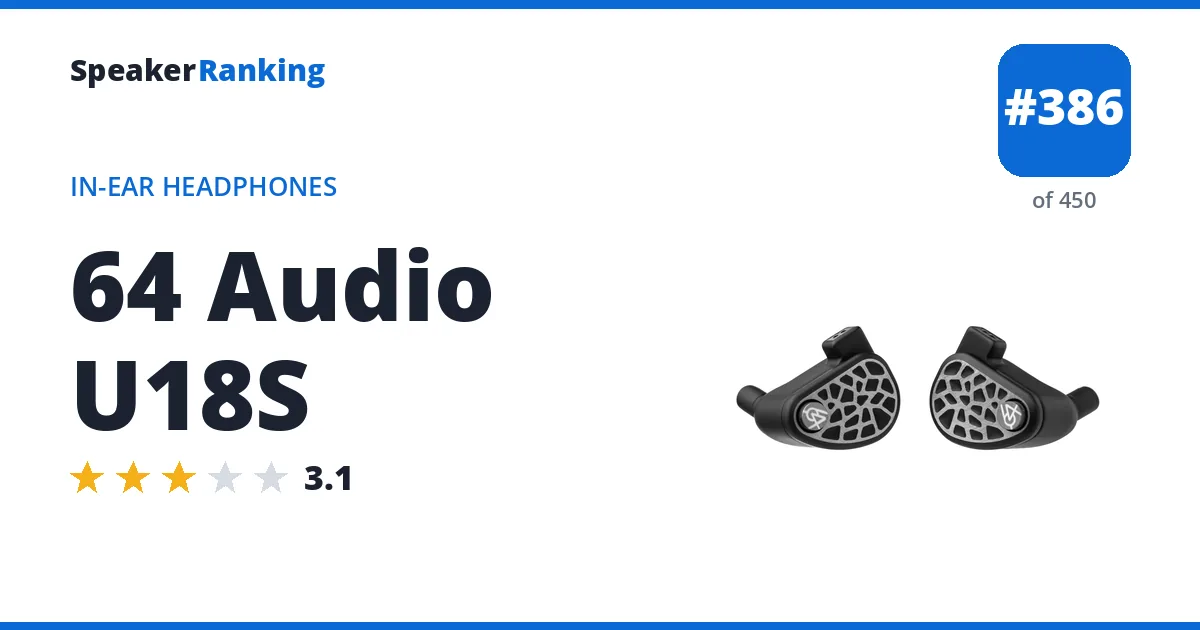
Pros: Eighteen balanced armature drivers per side deliver a warm, relaxed tuning with bass about 1.6 dB above target and sub-bass within 6 dB of target down to 20 Hz. The upper treble near 10 kHz stays close to neutral, so the top end keeps some air without glare. At 106 dB/mW it plays comfortably loud from a phone. It rates above the 64 Audio Volur from the same maker.
Cons: Across seven hobbyist measurements on squig.link, the 3 to 6 kHz presence region sits about 6 dB below target with a 9 dB dip near 5.8 kHz, so vocals and guitars lose bite and fine detail sounds veiled. The 64 Audio U12t rates higher for about a third less money. Its 8 ohm impedance makes the tuning sensitive to sources with high output impedance.
Full 64 Audio U18S review and specifications →
| Released | Mar 2021 (5 years ago) |
|---|---|
| Back | Closed |
| Built-in Microphone | No |
| Connection | Wired |
| Deviation From Target | 2.78 dB standard deviation |
| Driver Type | Balanced armature |
| Drivers | 18 x balanced armature (1 tia high + 1 high-mid + 8 mid + 8 low) |
| Form Factor | In-ear |
| Frequency Response | 10Hz - 20kHz (Manufacturer specified) |
| Harman Preference Score | 63 (measured by crinacle, via AutoEQ) |
| Impedance | 8 ohms |
| Sensitivity | 106 dB/mW |
| Sub-bass Extension | Within 6 dB of target down to 20 Hz (-2.7 dB at 30 Hz) |
| Tonal Tilt | -0.81 (negative is warmer, positive brighter) |
EQ preset to match the Harman target
Set a preamp of -6.4 dB, then add these filters in any parametric equalizer (Wavelet, Equalizer APO, Peace, or a player with parametric EQ). Calculated by AutoEQ from its measured frequency response.
| Filter | Frequency | Gain | Q |
|---|---|---|---|
| Low shelf | 105 Hz | -0.2 dB | 0.70 |
| Peak | 3,810 Hz | +5.3 dB | 0.39 |
| Peak | 188 Hz | -2.5 dB | 0.55 |
| Peak | 1,693 Hz | -5.3 dB | 0.92 |
| Peak | 9,264 Hz | +3.3 dB | 2.44 |
| High shelf | 10,000 Hz | -4.7 dB | 0.70 |
| Peak | 6,104 Hz | +2.5 dB | 5.82 |
| Peak | 2,983 Hz | +1.3 dB | 4.04 |
| Peak | 5,102 Hz | -1.7 dB | 6.00 |
| Peak | 2,279 Hz | -1.0 dB | 5.11 |
- Reviews, Comparisons and Sound Samples
- Head-to-Head Comparisons
 Shure KSE1500: $2,999.00 Amazon eBay

Pros: It is one of very few electrostatic in-ears, with a claimed 10 Hz to 50 kHz range. Its warm, V-shaped balance suits listeners who like low end weight paired with an emphasized top.
Cons: In oratory1990’s measurement the presence band from 3 to 6 kHz sits about 8.6 dB below target with a 9.5 dB dip near 4.1 kHz, which recesses vocals and instrument attack, while a 9.9 dB peak near 9.4 kHz can make cymbals and sibilance hiss. A preference score of 59 at such a steep price makes it hard to justify on sound alone.
Full Shure KSE1500 review and specifications →
| Released | Oct 2015 (11 years ago) |
|---|---|
| Back | Closed |
| Connection | Wired |
| Deviation From Target | 3.55 dB standard deviation |
| Driver Type | Electrostatic |
| Drivers | 1 x electrostatic |
| Form Factor | In-ear |
| Frequency Response | 10Hz - 50kHz (Manufacturer specified) |
| Harman Preference Score | 59 (measured by oratory1990, via AutoEQ) |
| Sub-bass Extension | Within 6 dB of target down to 20 Hz (-1.9 dB at 30 Hz) |
| Tonal Tilt | -0.27 (negative is warmer, positive brighter) |
EQ preset to match the Harman target
Set a preamp of -6.1 dB, then add these filters in any parametric equalizer (Wavelet, Equalizer APO, Peace, or a player with parametric EQ). Calculated by AutoEQ from its measured frequency response.
| Filter | Frequency | Gain | Q |
|---|---|---|---|
| Low shelf | 105 Hz | +0.9 dB | 0.70 |
| Peak | 3,452 Hz | +15.7 dB | 0.27 |
| Peak | 8,710 Hz | -13.6 dB | 1.31 |
| Peak | 170 Hz | -3.0 dB | 0.68 |
| Peak | 1,869 Hz | -16.5 dB | 0.71 |
| High shelf | 10,000 Hz | -5.8 dB | 0.70 |
| Peak | 9,052 Hz | +2.9 dB | 4.96 |
| Peak | 6,070 Hz | +1.4 dB | 4.06 |
| Peak | 4,262 Hz | -0.8 dB | 4.01 |
| Peak | 3,254 Hz | +0.7 dB | 4.39 |
- Reviews, Comparisons and Sound Samples
- Head-to-Head Comparisons