Short answer: the 64 Audio A12t. Both are rated 3.3/5 for sound quality (#374 and #373 of 450 in-ear headphones), and the 64 Audio A12t costs $1,999 against $2,299 for the 64 Audio Tia Trio, with sound quality a draw, the lower price decides it.
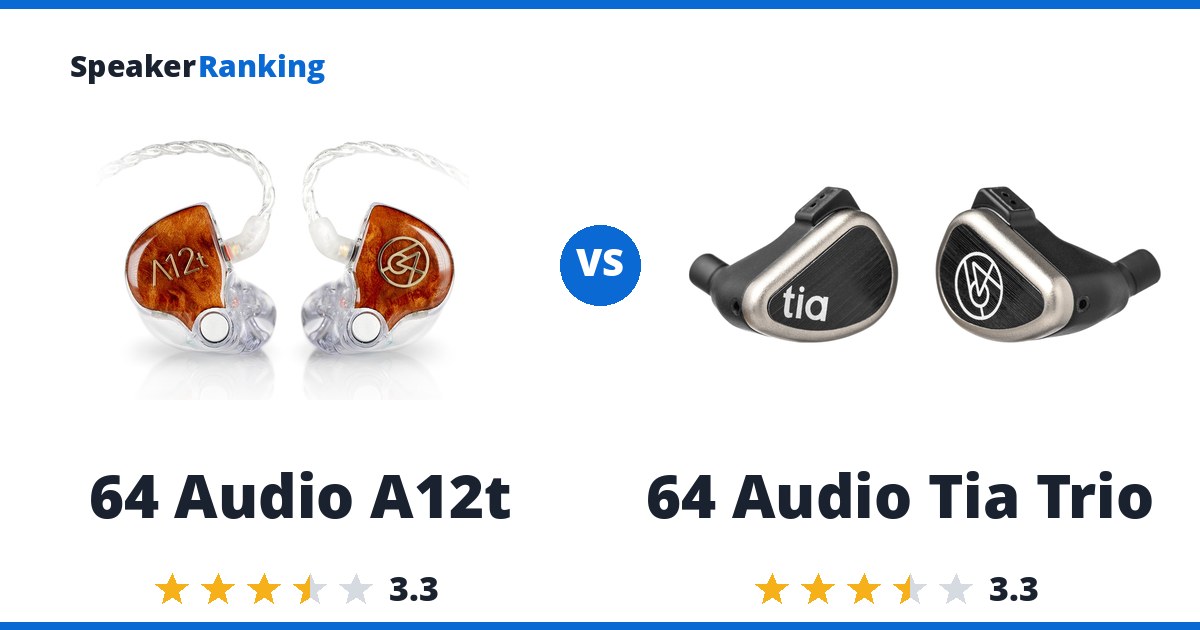
What the 64 Audio A12t does well: Bass is on target down to 20 Hz with a slight 1.9 dB lift from 60 to 200 Hz, so low end feels full and solid without boom. Watch for: In the two hobbyist measurements on squig.link, treble from 6 to 10 kHz sits about 10 dB below target with a 13.7 dB dip near 8.7 kHz, and presence is 7.3 dB low, so cymbals, strings and vocal clarity sound noticeably dark and muffled.
Why pick the 64 Audio Tia Trio: A single dynamic driver and two balanced armatures give near-neutral sub-bass down to 20 Hz and about 1.8 dB of extra bass for warmth and weight. The tradeoff: In squig.link measurements the 3 to 6 kHz presence band sits about 4.7 dB below target with a 6.6 dB dip near 5.5 kHz, so vocals and strings can sound recessed.
Buy the 64 Audio A12t. Both are rated the same for sound quality, and it costs $300 less than the 64 Audio Tia Trio.
Want more options? Browse the full Headphones rankings.
Specifications Side By Side
| 64 Audio A12t | 64 Audio Tia Trio | |
|---|---|---|
| Price | $1,999.00 | $2,299.00 |
| Ranked | #374 of 450 in In-Ear Headphones | #373 of 450 in In-Ear Headphones |
| Form Factor | In-ear | In-ear |
| Back | Closed | Closed |
| Harman Preference Score | 65 (measured by crinacle, via AutoEQ) | 65 (measured by crinacle, via AutoEQ) |
| Deviation From Target | 2.50 dB standard deviation | 2.59 dB standard deviation |
| Tonal Tilt | -0.87 (negative is warmer, positive brighter) | -0.76 (negative is warmer, positive brighter) |
| Connection | Wired | Wired |
| Driver Type | Balanced armature | Hybrid (1 dynamic + 2 balanced armature) |
| Drivers | 12 x balanced armature (incl. 1 tia high driver) | 1 x dynamic + 2 x balanced armature |
| Impedance | 12.6 ohms | 5.5 ohms |
| Sensitivity | 108 dB/mW | 104 dB/mW |
| Frequency Response | 10Hz - 20kHz (Manufacturer specified) | 5Hz - 22kHz (Manufacturer specified) |
| Built-in Microphone | No | No |
| Sub-bass Extension | Within 6 dB of target down to 20 Hz (+0.2 dB at 30 Hz) | Within 6 dB of target down to 20 Hz (-0.6 dB at 30 Hz) |
Related Headphone Comparisons
More top alternatives to 64 Audio Tia Trio:
- Oriolus Mellianus vs 64 Audio Tia Trio
- qdc Anole VX vs 64 Audio Tia Trio
- 64 Audio Tia Trio vs SoftEars Cerberus
- 64 Audio Tia Trio vs 64 Audio U12t
- 64 Audio Tia Trio vs 64 Audio Volur
Prices on this page were last checked October 11, 2026 at 4:59 PM UTC. Product prices and availability are accurate as of that date/time and are subject to change; the price and availability shown on Amazon at the time of purchase will apply to the purchase of this product.
As an eBay Partner, we may be compensated if you make a purchase.
The Two Headphones In Full
 64 Audio A12t: $1,999.00 64 Audio eBay

Pros: Bass is on target down to 20 Hz with a slight 1.9 dB lift from 60 to 200 Hz, so low end feels full and solid without boom. That warm balance suits listeners who prefer a relaxed, bass rich sound for long sessions. At 12.6 ohms and 108 dB/mW it runs easily from a phone.
Cons: In the two hobbyist measurements on squig.link, treble from 6 to 10 kHz sits about 10 dB below target with a 13.7 dB dip near 8.7 kHz, and presence is 7.3 dB low, so cymbals, strings and vocal clarity sound noticeably dark and muffled. The qdc Anole V6 earns the same rating for considerably less.
Full 64 Audio A12t review and specifications →
| Released | Mar 2018 (8 years ago) |
|---|---|
| Back | Closed |
| Built-in Microphone | No |
| Connection | Wired |
| Deviation From Target | 2.50 dB standard deviation |
| Driver Type | Balanced armature |
| Drivers | 12 x balanced armature (incl. 1 tia high driver) |
| Form Factor | In-ear |
| Frequency Response | 10Hz - 20kHz (Manufacturer specified) |
| Harman Preference Score | 65 (measured by crinacle, via AutoEQ) |
| Impedance | 12.6 ohms |
| Sensitivity | 108 dB/mW |
| Sub-bass Extension | Within 6 dB of target down to 20 Hz (+0.2 dB at 30 Hz) |
| Tonal Tilt | -0.87 (negative is warmer, positive brighter) |
EQ preset to match the Harman target
Set a preamp of -4.8 dB, then add these filters in any parametric equalizer (Wavelet, Equalizer APO, Peace, or a player with parametric EQ). Calculated by AutoEQ from its measured frequency response.
| Filter | Frequency | Gain | Q |
|---|---|---|---|
| Low shelf | 105 Hz | -0.9 dB | 0.70 |
| Peak | 206 Hz | -2.2 dB | 0.47 |
| Peak | 9,038 Hz | +5.2 dB | 1.59 |
| Peak | 3,244 Hz | +5.1 dB | 2.01 |
| Peak | 2,134 Hz | -2.6 dB | 2.47 |
| High shelf | 10,000 Hz | -6.1 dB | 0.70 |
| Peak | 5,789 Hz | +2.4 dB | 5.93 |
| Peak | 599 Hz | -0.7 dB | 2.55 |
| Peak | 951 Hz | +0.8 dB | 3.06 |
| Peak | 5,061 Hz | -1.6 dB | 6.00 |
- Reviews, Comparisons and Sound Samples
- Head-to-Head Comparisons
 64 Audio Tia Trio: $2,299.00 64 Audio eBay
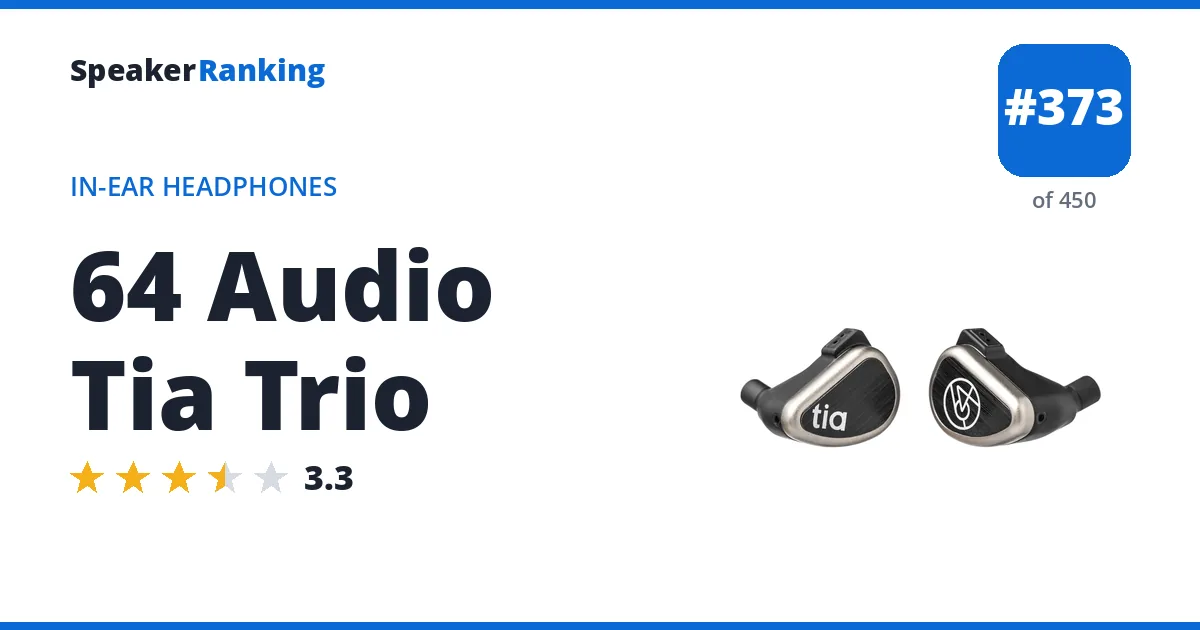
Pros: A single dynamic driver and two balanced armatures give near-neutral sub-bass down to 20 Hz and about 1.8 dB of extra bass for warmth and weight. Air above 10 kHz rises about 4.9 dB, giving cymbals shimmer and a sense of space. At 104 dB/mW it runs fine from a phone. It rates above the 64 Audio U12t and the SoftEars Cerberus.
Cons: In squig.link measurements the 3 to 6 kHz presence band sits about 4.7 dB below target with a 6.6 dB dip near 5.5 kHz, so vocals and strings can sound recessed. A 5.9 dB peak near 11.9 kHz may add a touch of sizzle. The 64 Audio A12t from the same maker earns the same rating for less money.
Full 64 Audio Tia Trio review and specifications →
| Released | 2017 (9 years ago) |
|---|---|
| Back | Closed |
| Built-in Microphone | No |
| Connection | Wired |
| Deviation From Target | 2.59 dB standard deviation |
| Driver Type | Hybrid (1 dynamic + 2 balanced armature) |
| Drivers | 1 x dynamic + 2 x balanced armature |
| Form Factor | In-ear |
| Frequency Response | 5Hz - 22kHz (Manufacturer specified) |
| Harman Preference Score | 65 (measured by crinacle, via AutoEQ) |
| Impedance | 5.5 ohms |
| Sensitivity | 104 dB/mW |
| Sub-bass Extension | Within 6 dB of target down to 20 Hz (-0.6 dB at 30 Hz) |
| Tonal Tilt | -0.76 (negative is warmer, positive brighter) |
EQ preset to match the Harman target
Set a preamp of -5.3 dB, then add these filters in any parametric equalizer (Wavelet, Equalizer APO, Peace, or a player with parametric EQ). Calculated by AutoEQ from its measured frequency response.
| Filter | Frequency | Gain | Q |
|---|---|---|---|
| Low shelf | 105 Hz | -0.1 dB | 0.70 |
| Peak | 173 Hz | -2.9 dB | 0.47 |
| Peak | 5,866 Hz | +5.1 dB | 2.52 |
| Peak | 1,079 Hz | +3.6 dB | 3.41 |
| Peak | 3,899 Hz | +3.2 dB | 3.50 |
| High shelf | 10,000 Hz | -10.9 dB | 0.70 |
| Peak | 9,335 Hz | +5.3 dB | 1.90 |
| Peak | 2,172 Hz | -1.4 dB | 3.36 |
| Peak | 642 Hz | -1.1 dB | 3.27 |
| Peak | 364 Hz | +0.6 dB | 1.70 |
- Reviews, Comparisons and Sound Samples
- Head-to-Head Comparisons