Short answer: the SoftEars Twilight. It ranks #329 of 450 in-ear headphones by sound quality, rated 3.8/5, at $930. The HIFIMAN RE2000 ranks #339, rated 3.6/5, at $799, $131 cheaper, a saving that is not big enough to make up the sound-quality gap.
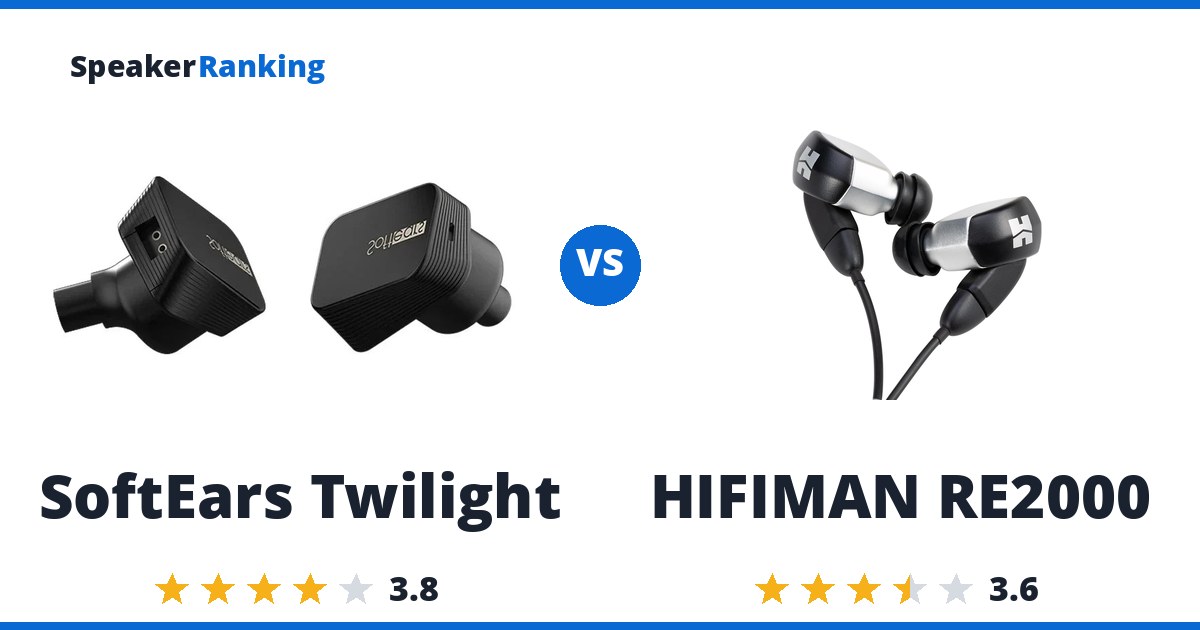
What the SoftEars Twilight does well: Across 20 hobbyist measurements on squig.link no deviation between 1.5 and 12 kHz exceeds 3.4 dB, so the treble stays smooth and free of sharp peaks. Watch for: Sub-bass trails the target by about 2.9 dB and is down nearly 5 dB at 30 Hz, so the deepest rumble in electronic and film soundtracks is lighter than ideal.
What the HIFIMAN RE2000 does well: Crinacle’s measurement gives a Harman preference score of 69 with a deviation of 2.63 dB, a respectable match to the target most listeners prefer. The tradeoff: A score of 69 is only middling for a flagship in-ear, and a response that deviates from the target by 2.63 dB leaves audible coloration.
Buy the SoftEars Twilight. It is rated higher for sound quality, and the $131 saving on the HIFIMAN RE2000 is not enough to make up the difference.
Still deciding? The full Headphones rankings cover every ranked option.
Specifications Side By Side
| SoftEars Twilight | HIFIMAN RE2000 | |
|---|---|---|
| Price | $930.00 | $799.00 |
| Ranked | #329 of 450 in In-Ear Headphones | #339 of 450 in In-Ear Headphones |
| Form Factor | In-ear | In-ear |
| Harman Preference Score | 71 (measured by crinacle, via AutoEQ) | 69 (measured by crinacle, via AutoEQ) |
| Deviation From Target | 2.42 dB standard deviation | 2.63 dB standard deviation |
| Tonal Tilt | -0.10 (negative is warmer, positive brighter) | +0.32 (negative is warmer, positive brighter) |
| Connection | Wired | Wired |
| Driver Type | Dynamic | - |
| Drivers | 1 x 10mm dynamic | - |
| Impedance | 16 ohms | - |
| Sensitivity | 116 dB/V | - |
| Weight | 0 lbs (6 g) per earbud | - |
| Frequency Response | 20Hz - 20kHz (Manufacturer specified) | - |
| Back | Closed | Closed |
| Sub-bass Extension | Within 6 dB of target down to 20 Hz (-4.8 dB at 30 Hz) | - |
Related Headphone Comparisons
More worthwhile head-to-heads for SoftEars Twilight:
- Unique Melody MEXT vs SoftEars Twilight
- SoftEars Twilight vs Symphonium Audio Triton
- HIFIMAN RE2000 vs Symphonium Audio Triton
- HIFIMAN RE2000 vs JVC HA-FW1500
- HIFIMAN RE2000 vs Sennheiser IE 600
Prices on this page were last checked October 11, 2026 at 4:59 PM UTC. Product prices and availability are accurate as of that date/time and are subject to change; the price and availability shown on Amazon at the time of purchase will apply to the purchase of this product.
As an eBay Partner, we may be compensated if you make a purchase.
The Two Headphones In Full
 SoftEars Twilight: $930.00 Amazon AliExpress eBay
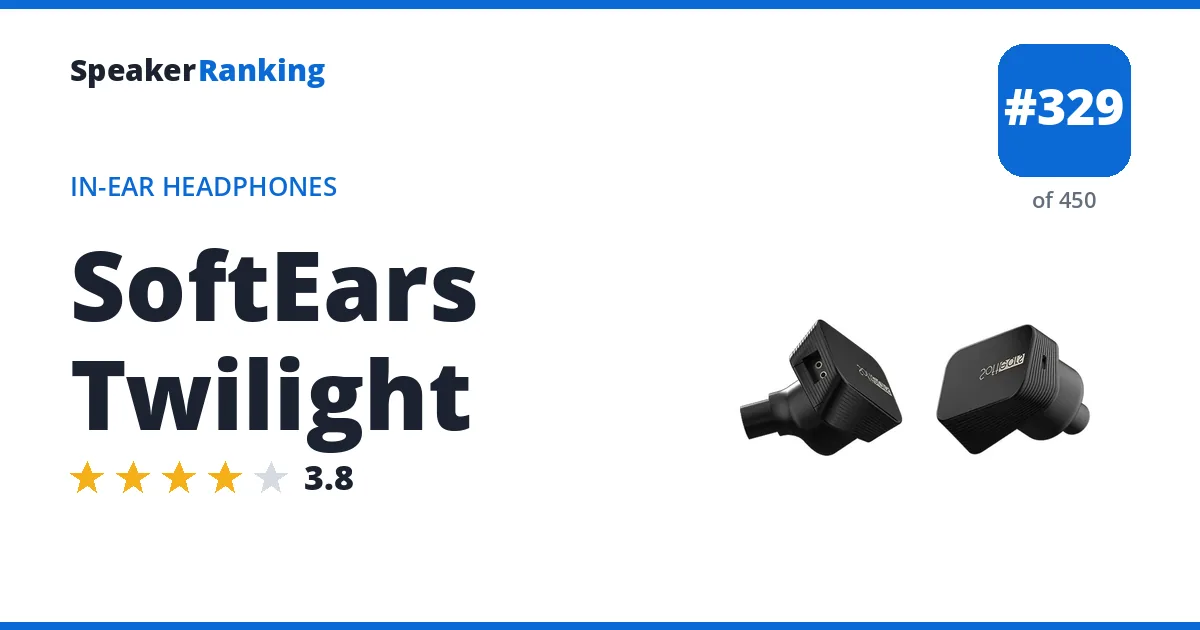
Pros: Across 20 hobbyist measurements on squig.link no deviation between 1.5 and 12 kHz exceeds 3.4 dB, so the treble stays smooth and free of sharp peaks. Bass and low mids sit about 2 dB above target, giving vocals and acoustic instruments a warm, rich body. With 16 ohm impedance and 116 dB/V sensitivity it is easy to drive from a phone, and it rates higher than the Sennheiser IE 600 and HIFIMAN RE2000.
Cons: Sub-bass trails the target by about 2.9 dB and is down nearly 5 dB at 30 Hz, so the deepest rumble in electronic and film soundtracks is lighter than ideal. The presence region sits about 1.9 dB low, softening some vocal clarity, and the cheaper SoftEars RSV rates noticeably higher.
Full SoftEars Twilight review and specifications →
| Back | Closed |
|---|---|
| Connection | Wired |
| Deviation From Target | 2.42 dB standard deviation |
| Driver Type | Dynamic |
| Drivers | 1 x 10mm dynamic |
| Form Factor | In-ear |
| Frequency Response | 20Hz - 20kHz (Manufacturer specified) |
| Harman Preference Score | 71 (measured by crinacle, via AutoEQ) |
| Impedance | 16 ohms |
| Sensitivity | 116 dB/V |
| Sub-bass Extension | Within 6 dB of target down to 20 Hz (-4.8 dB at 30 Hz) |
| Tonal Tilt | -0.10 (negative is warmer, positive brighter) |
| Weight | 0 lbs (6 g) per earbud |
EQ preset to match the Harman target
Set a preamp of -3.5 dB, then add these filters in any parametric equalizer (Wavelet, Equalizer APO, Peace, or a player with parametric EQ). Calculated by AutoEQ from its measured frequency response.
| Filter | Frequency | Gain | Q |
|---|---|---|---|
| Low shelf | 105 Hz | +3.5 dB | 0.70 |
| Peak | 176 Hz | -3.8 dB | 0.48 |
| Peak | 7,545 Hz | +3.4 dB | 0.90 |
| Peak | 866 Hz | +2.8 dB | 1.07 |
| Peak | 4,388 Hz | -1.1 dB | 2.46 |
| High shelf | 10,000 Hz | +0.8 dB | 0.70 |
| Peak | 2,853 Hz | -0.9 dB | 4.10 |
| Peak | 2,069 Hz | +0.5 dB | 3.38 |
| Peak | 7,411 Hz | -1.0 dB | 5.97 |
| Peak | 6,202 Hz | +0.9 dB | 6.00 |
- Reviews, Comparisons and Sound Samples
- Head-to-Head Comparisons
 HIFIMAN RE2000: $799.00 Amazon eBay

Pros: Crinacle’s measurement gives a Harman preference score of 69 with a deviation of 2.63 dB, a respectable match to the target most listeners prefer. The tonal balance is close to neutral, with a tilt of only 0.32 dB toward brightness, so it avoids sounding either dark or harsh.
Cons: A score of 69 is only middling for a flagship in-ear, and a response that deviates from the target by 2.63 dB leaves audible coloration. The wired-only design has no built-in mic or wireless option. The FiiO FD5 carries a higher rating at a notably lower cost, which makes this model a hard sell on sound value.
Full HIFIMAN RE2000 review and specifications →
| Back | Closed |
|---|---|
| Connection | Wired |
| Deviation From Target | 2.63 dB standard deviation |
| Form Factor | In-ear |
| Harman Preference Score | 69 (measured by crinacle, via AutoEQ) |
| Tonal Tilt | +0.32 (negative is warmer, positive brighter) |
EQ preset to match the Harman target
Set a preamp of -4.8 dB, then add these filters in any parametric equalizer (Wavelet, Equalizer APO, Peace, or a player with parametric EQ). Calculated by AutoEQ from its measured frequency response.
| Filter | Frequency | Gain | Q |
|---|---|---|---|
| Low shelf | 105 Hz | +7.5 dB | 0.70 |
| Peak | 76 Hz | -4.7 dB | 0.24 |
| Peak | 916 Hz | +5.3 dB | 0.86 |
| Peak | 4,638 Hz | -5.1 dB | 5.93 |
| Peak | 1,592 Hz | -2.1 dB | 1.01 |
| High shelf | 10,000 Hz | -4.6 dB | 0.70 |
| Peak | 6,553 Hz | +3.5 dB | 5.51 |
| Peak | 8,895 Hz | +3.3 dB | 2.20 |
| Peak | 5,174 Hz | -1.3 dB | 5.99 |
| Peak | 7,469 Hz | -0.3 dB | 5.72 |
- Reviews, Comparisons and Sound Samples
- Head-to-Head Comparisons