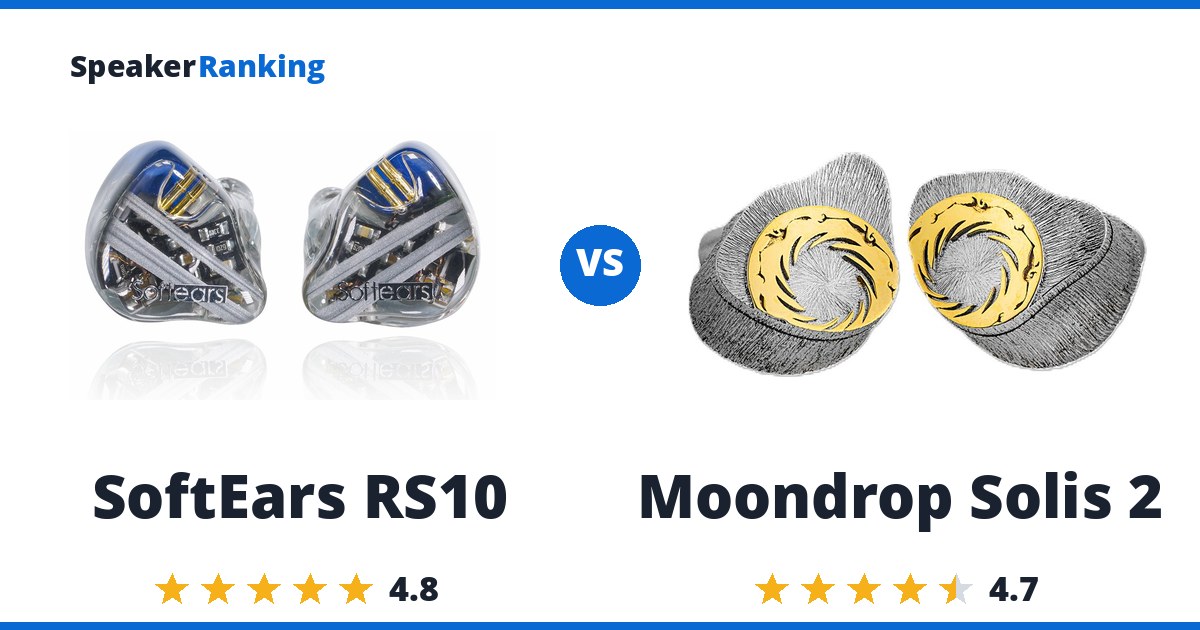
Short answer: the SoftEars RS10. It ranks #16 of 450 in-ear headphones by sound quality, rated 4.8/5, at $2,099.99; the Moondrop Solis 2 ranks #32, rated 4.7/5, and costs $2,999, so there is little reason to consider the other one.
Why pick the SoftEars RS10: A crinacle preference score of 84, and across seven hobbyist measurements on squig.link the response stays within 0.1 dB of target from 200 Hz to 3 kHz, so vocals and instruments sound natural. The catch: In squig.link measurements sub-bass sits about 3.2 dB below target from 20 to 60 Hz, so the deepest rumble in electronic and film scores is lighter than a dynamic driver delivers.
Why pick the Moondrop Solis 2: The Solis 2 combines dynamic, balanced armature and electrostatic drivers, and the median of five hobbyist measurements on squig.link gives it a preference score of 82 with about 1.2 dB of unevenness. The tradeoff: A 4.7 dB peak near 8.1 kHz can make cymbals and sibilants a touch hot, while the presence region dips about 3.5 dB near 5.9 kHz.
Buy the SoftEars RS10. It is rated higher for sound quality than the Moondrop Solis 2 and costs less, so it is the default pick unless a specific strength of the other one matters more to you.
Want more options? Browse the full Headphones rankings.
Specifications Side By Side
| SoftEars RS10 | Moondrop Solis 2 | |
|---|---|---|
| Price | $2,099.99 | $2,999.00 |
| Ranked | #16 of 450 in In-Ear Headphones | #32 of 450 in In-Ear Headphones |
| Form Factor | In-ear | In-ear |
| Back | Closed | Closed |
| Harman Preference Score | 84 (measured by crinacle, via AutoEQ) | 82 (median of 5 squig.link measurements, calibrated to AutoEQ) |
| Deviation From Target | 1.49 dB standard deviation | 1.23 dB standard deviation |
| Tonal Tilt | -0.03 (negative is warmer, positive brighter) | -0.18 (negative is warmer, positive brighter) |
| Sub-bass Extension | Within 6 dB of target down to 20 Hz (-3.5 dB at 30 Hz) | Within 6 dB of target down to 20 Hz (-0.5 dB at 30 Hz) |
| Connection | Wired | Wired |
| Driver Type | Balanced armature | Hybrid (2 dynamic + 2 balanced armature + 4 electrostatic) |
| Drivers | 10 x balanced armature | 2 x 10mm dynamic + 2 x balanced armature + 4 x electrostatic |
| Impedance | 25 ohms | 10 ohms |
| Frequency Response | 20Hz - 40kHz (Manufacturer specified) | 7Hz - 40kHz (Manufacturer specified) |
| Built-in Microphone | No | No |
| Sensitivity | - | 121 dB/Vrms |
Related Headphone Comparisons
More worthwhile head-to-heads for SoftEars RS10:
- Simgot EW100P vs SoftEars RS10
- SoftEars RS10 vs Moondrop Psyche
- Moondrop Solis 2 vs Moondrop Psyche
- Moondrop Solis 2 vs Truthear Hexa
- Moondrop Solis 2 vs Simgot EW200
Prices on this page were last checked October 11, 2026 at 4:59 PM UTC. Product prices and availability are accurate as of that date/time and are subject to change; the price and availability shown on Amazon at the time of purchase will apply to the purchase of this product.
As an eBay Partner, we may be compensated if you make a purchase.
The Two Headphones In Full
 SoftEars RS10: $2,099.99 HiFiGo eBay

Pros: A crinacle preference score of 84, and across seven hobbyist measurements on squig.link the response stays within 0.1 dB of target from 200 Hz to 3 kHz, so vocals and instruments sound natural. Ten balanced armature drivers per side deliver a smooth 1.49 dB standard deviation from target. It rates well above the Shuoer Cadenza 12, a rival at a similar price.
Cons: In squig.link measurements sub-bass sits about 3.2 dB below target from 20 to 60 Hz, so the deepest rumble in electronic and film scores is lighter than a dynamic driver delivers. A 5 dB peak near 7.9 kHz next to a 6.2 dB dip near 10.6 kHz can make some cymbals and sibilants stand out while the air above them fades.
Full SoftEars RS10 review and specifications →
| Back | Closed |
|---|---|
| Built-in Microphone | No |
| Connection | Wired |
| Deviation From Target | 1.49 dB standard deviation |
| Driver Type | Balanced armature |
| Drivers | 10 x balanced armature |
| Form Factor | In-ear |
| Frequency Response | 20Hz - 40kHz (Manufacturer specified) |
| Harman Preference Score | 84 (measured by crinacle, via AutoEQ) |
| Impedance | 25 ohms |
| Sub-bass Extension | Within 6 dB of target down to 20 Hz (-3.5 dB at 30 Hz) |
| Tonal Tilt | -0.03 (negative is warmer, positive brighter) |
EQ preset to match the Harman target
Set a preamp of -3.3 dB, then add these filters in any parametric equalizer (Wavelet, Equalizer APO, Peace, or a player with parametric EQ). Calculated by AutoEQ from its measured frequency response.
| Filter | Frequency | Gain | Q |
|---|---|---|---|
| Low shelf | 105 Hz | +0.5 dB | 0.70 |
| Peak | 9,243 Hz | +3.7 dB | 2.06 |
| Peak | 3,129 Hz | -1.6 dB | 0.48 |
| Peak | 5,594 Hz | +4.0 dB | 3.62 |
| Peak | 828 Hz | +1.3 dB | 1.70 |
| High shelf | 10,000 Hz | -2.0 dB | 0.70 |
| Peak | 137 Hz | -0.6 dB | 1.76 |
| Peak | 8,268 Hz | +1.1 dB | 5.96 |
| Peak | 3,787 Hz | -0.3 dB | 5.52 |
| Peak | 481 Hz | +0.2 dB | 2.43 |
- Reviews, Comparisons and Sound Samples
- Head-to-Head Comparisons
 Moondrop Solis 2: $2,999.00 Amazon eBay

Pros: The Solis 2 combines dynamic, balanced armature and electrostatic drivers, and the median of five hobbyist measurements on squig.link gives it a preference score of 82 with about 1.2 dB of unevenness. Sub-bass sits right on target and bass runs about 1 dB rich, so it suits listeners who want warmth and weight without boom. Sensitivity of 121 dB/Vrms means it runs easily from a phone or dongle, and it rates well above the Noble Audio Sultan.
Cons: A 4.7 dB peak near 8.1 kHz can make cymbals and sibilants a touch hot, while the presence region dips about 3.5 dB near 5.9 kHz. The SoftEars RS10 rates higher for considerably less money, which makes this flagship hard to justify on sound alone.
Full Moondrop Solis 2 review and specifications →
| Back | Closed |
|---|---|
| Built-in Microphone | No |
| Connection | Wired |
| Deviation From Target | 1.23 dB standard deviation |
| Driver Type | Hybrid (2 dynamic + 2 balanced armature + 4 electrostatic) |
| Drivers | 2 x 10mm dynamic + 2 x balanced armature + 4 x electrostatic |
| Form Factor | In-ear |
| Frequency Response | 7Hz - 40kHz (Manufacturer specified) |
| Harman Preference Score | 82 (median of 5 squig.link measurements, calibrated to AutoEQ) |
| Impedance | 10 ohms |
| Sensitivity | 121 dB/Vrms |
| Sub-bass Extension | Within 6 dB of target down to 20 Hz (-0.5 dB at 30 Hz) |
| Tonal Tilt | -0.18 (negative is warmer, positive brighter) |
- Reviews, Comparisons and Sound Samples
- Head-to-Head Comparisons