Short answer: the Simgot SuperMix 4. Both are rated 4.8/5 for sound quality (#18 and #20 of 450 in-ear headphones), and the Simgot SuperMix 4 costs $169.99 against $189 for the Tin HiFi T7, so with nothing between them on sound quality, price settles it.

What the Simgot SuperMix 4 does well: Across 48 hobbyist measurements on squig.link it scores 83 for preference, with an average deviation of only about 1 dB, so the overall balance is even and easy to like. The catch: A roughly 3 dB dip near 6.5 kHz and a presence region about 2 dB under target make vocals and guitar attack a touch recessed, while a 5.7 dB peak near 11.9 kHz adds a hint of glare up top.
Why pick the Tin HiFi T7: Across ten hobbyist measurements on squig.link, the T7 earns a preference score of 83.5 with a low 1.11 dB deviation from target. The catch: Air above 10 kHz runs about 3.2 dB high and a 5.4 dB peak near 8.1 kHz can add glare to sibilance and cymbals.
Buy the Simgot SuperMix 4. Both are rated the same for sound quality, and it costs $19.01 less than the Tin HiFi T7.
Looking for alternatives? See the complete Headphones rankings.
Specifications Side By Side
| Simgot SuperMix 4 | Tin HiFi T7 | |
|---|---|---|
| Price | $169.99 | $189.00 |
| Ranked | #18 of 450 in In-Ear Headphones | #20 of 450 in In-Ear Headphones |
| Form Factor | In-ear | In-ear |
| Back | Closed | Closed |
| Harman Preference Score | 84 (median of 48 squig.link measurements, calibrated to AutoEQ) | 84 (median of 10 squig.link measurements, calibrated to AutoEQ) |
| Deviation From Target | 1.00 dB standard deviation | 1.11 dB standard deviation |
| Tonal Tilt | -0.39 (negative is warmer, positive brighter) | -0.16 (negative is warmer, positive brighter) |
| Sub-bass Extension | Within 6 dB of target down to 20 Hz (+1.4 dB at 30 Hz) | Within 6 dB of target down to 20 Hz (+1.5 dB at 30 Hz) |
| Connection | Wired | Wired |
| Driver Type | Hybrid (1 dynamic + 1 balanced armature + 1 planar magnetic + 1 piezoelectric) | Dynamic |
| Drivers | 1 x 10mm dynamic + 1 x balanced armature + 1 x planar magnetic + 1 x piezoelectric | 1 x 10mm dynamic |
| Impedance | 7.2 ohms | 22 ohms |
| Sensitivity | 120 dB/Vrms | 112 dB (at 0.126 V) |
| Frequency Response | 8Hz - 40kHz (Manufacturer specified) | 10Hz - 20kHz (Manufacturer specified) |
| Weight | - | 0 lbs (7.7 g) per earbud |
| Built-in Microphone | - | No |
Related Headphone Comparisons
How Simgot SuperMix 4 compares with other leading options:
- Truthear Nova vs Simgot SuperMix 4
- EPZ P40 vs Simgot SuperMix 4
- Simgot EW100P vs Simgot SuperMix 4
- Simgot SuperMix 4 vs SeeAudio Yume
- Simgot SuperMix 4 vs Simgot SuperMix 5
Prices on this page were last checked October 11, 2026 at 4:59 PM UTC. Product prices and availability are accurate as of that date/time and are subject to change; the price and availability shown on Amazon at the time of purchase will apply to the purchase of this product.
As an eBay Partner, we may be compensated if you make a purchase.
The Two Headphones In Full
 Simgot SuperMix 4: $169.99 Amazon eBay

Pros: Across 48 hobbyist measurements on squig.link it scores 83 for preference, with an average deviation of only about 1 dB, so the overall balance is even and easy to like. Sub-bass sits about 1 dB above target down to 20 Hz, giving warm, full low end that suits bass and warm listeners. The 7.2 ohm, 120 dB/Vrms hybrid of dynamic, balanced armature, planar and piezoelectric drivers gets loud from any phone or dongle.
Cons: A roughly 3 dB dip near 6.5 kHz and a presence region about 2 dB under target make vocals and guitar attack a touch recessed, while a 5.7 dB peak near 11.9 kHz adds a hint of glare up top. Its rating sits below the EPZ P40 at a similar price, and its very low impedance can pick up hiss from noisy sources.
Full Simgot SuperMix 4 review and specifications →
| Released | May 2024 (2 years ago) |
|---|---|
| Back | Closed |
| Connection | Wired |
| Deviation From Target | 1.00 dB standard deviation |
| Driver Type | Hybrid (1 dynamic + 1 balanced armature + 1 planar magnetic + 1 piezoelectric) |
| Drivers | 1 x 10mm dynamic + 1 x balanced armature + 1 x planar magnetic + 1 x piezoelectric |
| Form Factor | In-ear |
| Frequency Response | 8Hz - 40kHz (Manufacturer specified) |
| Harman Preference Score | 84 (median of 48 squig.link measurements, calibrated to AutoEQ) |
| Impedance | 7.2 ohms |
| Sensitivity | 120 dB/Vrms |
| Sub-bass Extension | Within 6 dB of target down to 20 Hz (+1.4 dB at 30 Hz) |
| Tonal Tilt | -0.39 (negative is warmer, positive brighter) |
- Reviews, Comparisons and Sound Samples
- Head-to-Head Comparisons
 Tin HiFi T7: $189.00 Amazon eBay
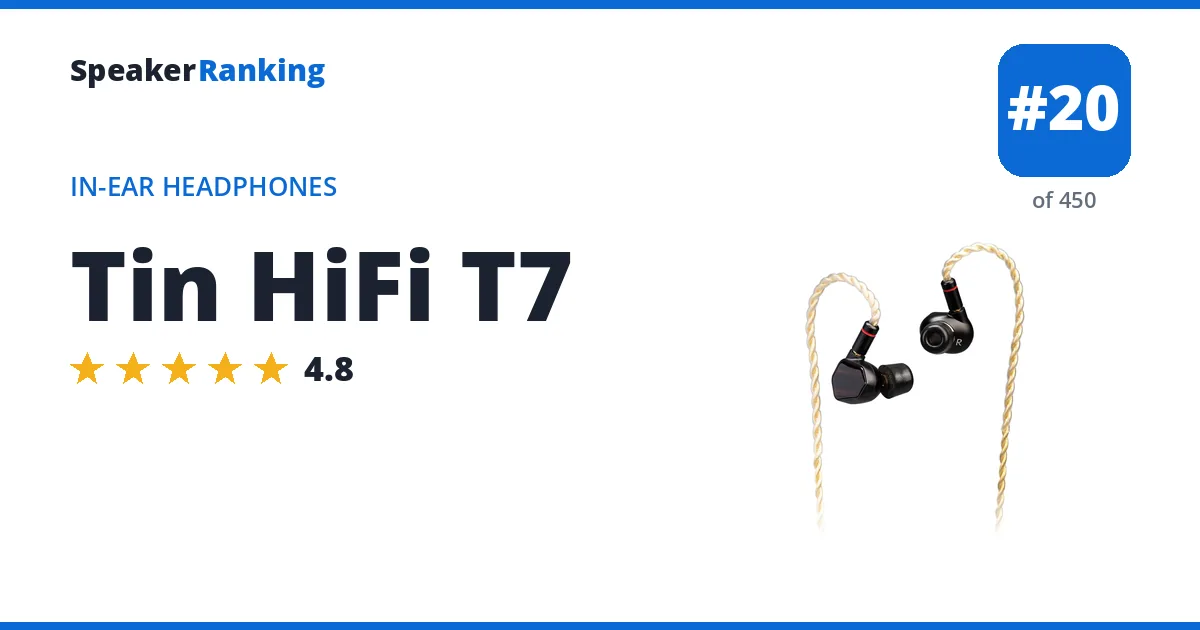
Pros: Across ten hobbyist measurements on squig.link, the T7 earns a preference score of 83.5 with a low 1.11 dB deviation from target. Sub-bass sits about 1.2 dB above target and holds strong at 30 Hz, so electronic music and film scores get satisfying rumble, while the mids stay within half a decibel of target. The 22 ohm impedance and 7.7 gram earpieces make it easy to drive and very light.
Cons: Air above 10 kHz runs about 3.2 dB high and a 5.4 dB peak near 8.1 kHz can add glare to sibilance and cymbals. A 4.3 dB dip near 10.3 kHz follows, leaving the upper treble slightly uneven. It shares its rating with the cheaper Juzear 81T and Simgot SuperMix 4.
Full Tin HiFi T7 review and specifications →
| Released | 2025 (1 year ago) |
|---|---|
| Back | Closed |
| Built-in Microphone | No |
| Connection | Wired |
| Deviation From Target | 1.11 dB standard deviation |
| Driver Type | Dynamic |
| Drivers | 1 x 10mm dynamic |
| Form Factor | In-ear |
| Frequency Response | 10Hz - 20kHz (Manufacturer specified) |
| Harman Preference Score | 84 (median of 10 squig.link measurements, calibrated to AutoEQ) |
| Impedance | 22 ohms |
| Sensitivity | 112 dB (at 0.126 V) |
| Sub-bass Extension | Within 6 dB of target down to 20 Hz (+1.5 dB at 30 Hz) |
| Tonal Tilt | -0.16 (negative is warmer, positive brighter) |
| Weight | 0 lbs (7.7 g) per earbud |
- Reviews, Comparisons and Sound Samples
- Head-to-Head Comparisons