Short answer: a tie on sound quality. Both are rated 4.7/5 (#28 and #27 of 450 in-ear headphones), so choose on features and fit.

What the Simgot EW200 does well: Crinacle’s measurement gives it an excellent preference score of 82, and the median of 37 hobbyist measurements on squig.link keeps every band from sub-bass to presence within about 1.5 dB of target, so music sounds natural and balanced across genres. The catch: A 3.5 dB peak near 8.1 kHz and air about 2.3 dB above target can make cymbals and sibilance a little crisp for treble-sensitive listeners.
What the Truthear Hexa does well: A preference score of 82 in oratory1990’s measurement and a 1.58 dB deviation put this hybrid of one dynamic driver and three balanced armatures very close to the Harman target. The catch: The presence region from 3 to 6 kHz sits 2.6 dB under target with a 4 dB dip near 4.5 kHz, which pushes vocals and guitars slightly back.
Buy the Simgot EW200 or the Truthear Hexa on features: they are rated the same for sound quality at close to the same price.
Looking for alternatives? See the complete Headphones rankings.
Specifications Side By Side
| Simgot EW200 | Truthear Hexa | |
|---|---|---|
| Price | - | - |
| Ranked | #28 of 450 in In-Ear Headphones | #27 of 450 in In-Ear Headphones |
| Form Factor | In-ear | In-ear |
| Back | Closed | Closed |
| Harman Preference Score | 82 (measured by crinacle, via AutoEQ) | 82 (measured by oratory1990, via AutoEQ) |
| Deviation From Target | 1.56 dB standard deviation | 1.58 dB standard deviation |
| Tonal Tilt | -0.16 (negative is warmer, positive brighter) | -0.05 (negative is warmer, positive brighter) |
| Connection | Wired | Wired |
| Driver Type | Dynamic | Hybrid (1 dynamic + 3 balanced armature) |
| Drivers | 1 x 10mm dynamic | 1 x dynamic + 3 x balanced armature |
| Impedance | 16 ohms | 20.5 ohms |
| Sensitivity | 126 dB/Vrms | 120 dB/Vrms |
| Frequency Response | 10Hz - 50kHz (Manufacturer specified) | 8Hz - 40kHz (Manufacturer specified) |
| Sub-bass Extension | Within 6 dB of target down to 20 Hz (-0.2 dB at 30 Hz) | Within 6 dB of target down to 20 Hz (-1.7 dB at 30 Hz) |
Related Headphone Comparisons
How Truthear Hexa compares with other leading options:
- Aoshida E20 vs Truthear Hexa
- SeeAudio Yume vs Truthear Hexa
- Moondrop Solis 2 vs Truthear Hexa
- Aoshida E20 vs Simgot EW200
- SeeAudio Yume vs Simgot EW200
Prices on this page were last checked October 11, 2026 at 4:59 PM UTC. Product prices and availability are accurate as of that date/time and are subject to change; the price and availability shown on Amazon at the time of purchase will apply to the purchase of this product.
As an eBay Partner, we may be compensated if you make a purchase.
The Two Headphones In Full
 Simgot EW200 AliExpress eBay

Pros: Crinacle’s measurement gives it an excellent preference score of 82, and the median of 37 hobbyist measurements on squig.link keeps every band from sub-bass to presence within about 1.5 dB of target, so music sounds natural and balanced across genres. Sub-bass holds right to 20 Hz with only 0.2 dB of shortfall at 30 Hz, giving kick drums real depth, and a 1.56 dB spread marks an unusually smooth response. Its 16 ohm load and 126 dB/V sensitivity let it run loud from any phone.
Cons: A 3.5 dB peak near 8.1 kHz and air about 2.3 dB above target can make cymbals and sibilance a little crisp for treble-sensitive listeners. The 1.5 dB bass lift gives a slightly warm tilt that strict neutral purists may not want.
Full Simgot EW200 review and specifications →
| Released | Jun 2023 (3 years ago) |
|---|---|
| Back | Closed |
| Connection | Wired |
| Deviation From Target | 1.56 dB standard deviation |
| Driver Type | Dynamic |
| Drivers | 1 x 10mm dynamic |
| Form Factor | In-ear |
| Frequency Response | 10Hz - 50kHz (Manufacturer specified) |
| Harman Preference Score | 82 (measured by crinacle, via AutoEQ) |
| Impedance | 16 ohms |
| Sensitivity | 126 dB/Vrms |
| Sub-bass Extension | Within 6 dB of target down to 20 Hz (-0.2 dB at 30 Hz) |
| Tonal Tilt | -0.16 (negative is warmer, positive brighter) |
EQ preset to match the Harman target
Set a preamp of -2.7 dB, then add these filters in any parametric equalizer (Wavelet, Equalizer APO, Peace, or a player with parametric EQ). Calculated by AutoEQ from its measured frequency response.
| Filter | Frequency | Gain | Q |
|---|---|---|---|
| Low shelf | 105 Hz | +1.0 dB | 0.70 |
| Peak | 8,017 Hz | +3.6 dB | 1.13 |
| Peak | 153 Hz | -2.1 dB | 0.78 |
| Peak | 794 Hz | +2.8 dB | 1.01 |
| Peak | 2,472 Hz | -1.4 dB | 0.30 |
| High shelf | 10,000 Hz | -2.4 dB | 0.70 |
| Peak | 4,761 Hz | -1.7 dB | 4.96 |
| Peak | 6,133 Hz | +1.6 dB | 5.59 |
| Peak | 3,418 Hz | +0.9 dB | 3.56 |
| Peak | 1,477 Hz | -0.3 dB | 2.90 |
- Reviews, Comparisons and Sound Samples
- Head-to-Head Comparisons
 Truthear Hexa AliExpress eBay
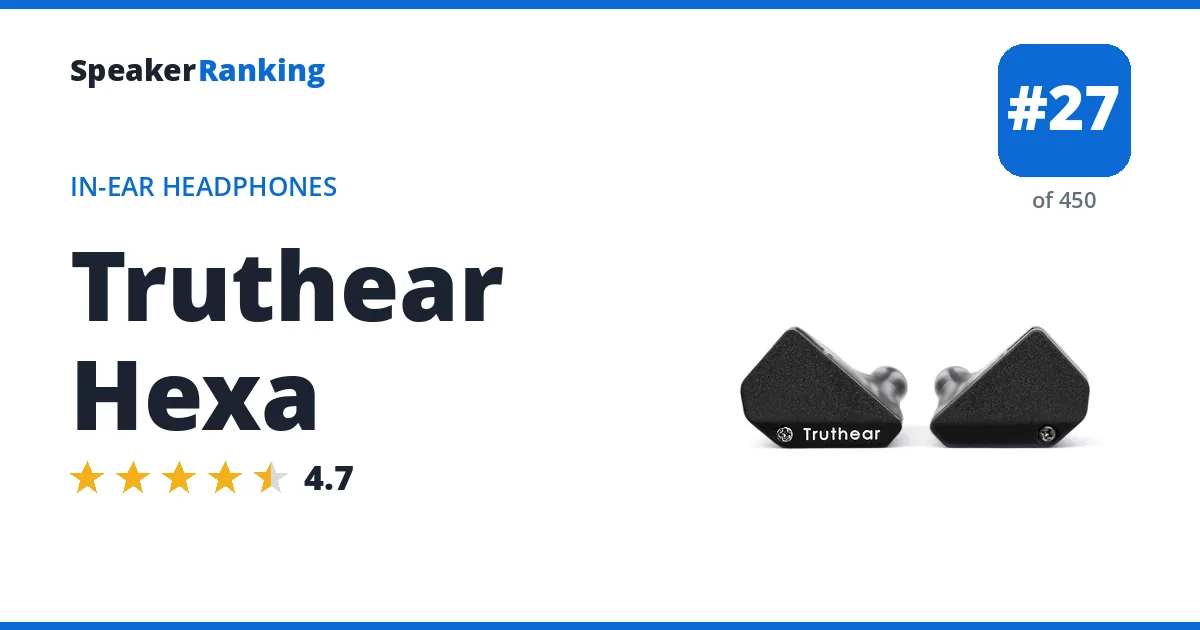
Pros: A preference score of 82 in oratory1990’s measurement and a 1.58 dB deviation put this hybrid of one dynamic driver and three balanced armatures very close to the Harman target. Bass from 60 to 200 Hz is within 0.2 dB of target and sub-bass is just 1.7 dB down at 30 Hz, so low end is full but controlled. The 20.5 ohm impedance and 120 dB/Vrms sensitivity make it easy to drive from a phone.
Cons: The presence region from 3 to 6 kHz sits 2.6 dB under target with a 4 dB dip near 4.5 kHz, which pushes vocals and guitars slightly back. A 4.7 dB peak near 8.3 kHz and extra air above 10 kHz can make sibilance stand out on bright recordings.
Full Truthear Hexa review and specifications →
| Released | 2022 (4 years ago) |
|---|---|
| Back | Closed |
| Connection | Wired |
| Deviation From Target | 1.58 dB standard deviation |
| Driver Type | Hybrid (1 dynamic + 3 balanced armature) |
| Drivers | 1 x dynamic + 3 x balanced armature |
| Form Factor | In-ear |
| Frequency Response | 8Hz - 40kHz (Manufacturer specified) |
| Harman Preference Score | 82 (measured by oratory1990, via AutoEQ) |
| Impedance | 20.5 ohms |
| Sensitivity | 120 dB/Vrms |
| Sub-bass Extension | Within 6 dB of target down to 20 Hz (-1.7 dB at 30 Hz) |
| Tonal Tilt | -0.05 (negative is warmer, positive brighter) |
EQ preset to match the Harman target
Set a preamp of -3.2 dB, then add these filters in any parametric equalizer (Wavelet, Equalizer APO, Peace, or a player with parametric EQ). Calculated by AutoEQ from its measured frequency response.
| Filter | Frequency | Gain | Q |
|---|---|---|---|
| Low shelf | 105 Hz | -0.1 dB | 0.70 |
| Peak | 4,844 Hz | +3.4 dB | 1.81 |
| Peak | 199 Hz | -1.9 dB | 1.54 |
| Peak | 62 Hz | +1.6 dB | 1.05 |
| Peak | 3,160 Hz | -2.1 dB | 3.72 |
| High shelf | 10,000 Hz | -4.4 dB | 0.70 |
| Peak | 707 Hz | +1.0 dB | 1.89 |
| Peak | 6,318 Hz | +1.6 dB | 5.54 |
| Peak | 349 Hz | -0.5 dB | 2.22 |
| Peak | 2,113 Hz | +0.6 dB | 3.41 |
- Reviews, Comparisons and Sound Samples
- Head-to-Head Comparisons