Short answer: the Sennheiser MOMENTUM True Wireless 4. It ranks #368 of 450 in-ear headphones by sound quality, rated 3.3/5, at $249.95. The Muse HiFi Power ranks #378, rated 3.2/5, at $199, $50.95 cheaper, not enough of a saving to outweigh the sound-quality gap.

The case for the Sennheiser MOMENTUM True Wireless 4: This true wireless set adds active noise cancelling, Bluetooth 5.4 and a codec list that runs from SBC and AAC up to aptX Lossless and LC3. Watch for: Presence from 3 to 6 kHz is about 6.9 dB under target, with an 8.2 dB dip near 5.7 kHz, so voices and guitars sound recessed.
Why pick the Muse HiFi Power: A 14.5mm planar magnetic driver with about 2.3 dB of extra bass and sub-bass that stays within 6 dB of target down to 20 Hz, for a full, warm low end. The catch: Squig.link measurements show a 12.7 dB peak near 11.9 kHz on top of a 6.5 dB dip near 6.5 kHz, so the lower treble sounds dim while the very top can add a hissy sheen.
Buy the Sennheiser MOMENTUM True Wireless 4. It is rated higher for sound quality, and the $50.95 you would save on the Muse HiFi Power does not close the gap.
Looking for alternatives? See the complete Headphones rankings.
Specifications Side By Side
| Sennheiser MOMENTUM True Wireless 4 | Muse HiFi Power | |
|---|---|---|
| Price | $249.95 | $199.00 |
| Ranked | #368 of 450 in In-Ear Headphones | #378 of 450 in In-Ear Headphones |
| Form Factor | In-ear | In-ear |
| Harman Preference Score | 65 (measured by oratory1990, via AutoEQ) | 64 (measured by crinacle, via AutoEQ) |
| Deviation From Target | 2.63 dB standard deviation | 2.99 dB standard deviation |
| Tonal Tilt | -0.74 (negative is warmer, positive brighter) | -0.51 (negative is warmer, positive brighter) |
| Sub-bass Extension | Within 6 dB of target down to 20 Hz (-1.4 dB at 30 Hz) | Within 6 dB of target down to 20 Hz (-1.6 dB at 30 Hz) |
| Connection | True wireless | Wired |
| Driver Type | Dynamic | Planar magnetic |
| Drivers | 1 x 7mm dynamic | 1 x 14.5mm planar magnetic |
| Weight | 0 lbs (6.2 g) per earbud | - |
| Active Noise Cancelling | Yes | - |
| Battery Life | 7.5 hours (30 with case, Manufacturer specified) | - |
| Bluetooth Version | 5.4 | - |
| Bluetooth Codecs | SBC, AAC, aptX, aptX Adaptive, aptX Lossless, LC3 | - |
| Built-in Microphone | Yes | No |
| IP Rating | IP54 | - |
| Back | Closed | Closed |
| Impedance | - | 32 ohms |
| Sensitivity | - | 106 dB/mW |
| Frequency Response | - | 10Hz - 40kHz (Manufacturer specified) |
Related Headphone Comparisons
How Sennheiser MOMENTUM True Wireless 4 compares with other leading options:
- 7Hz Eternal vs Sennheiser MOMENTUM True Wireless 4
- Sennheiser MOMENTUM True Wireless 4 vs FiiO FH7S
- Sennheiser MOMENTUM True Wireless 4 vs Etymotic ER4XR
- Muse HiFi Power vs Tipsy Dunmer Pro
- Shanling ME200 vs Muse HiFi Power
Prices on this page were last checked October 11, 2026 at 4:59 PM UTC. Product prices and availability are accurate as of that date/time and are subject to change; the price and availability shown on Amazon at the time of purchase will apply to the purchase of this product.
As an eBay Partner, we may be compensated if you make a purchase.
The Two Headphones In Full
 Sennheiser MOMENTUM True Wireless 4: $249.95 TWS Amazon eBay
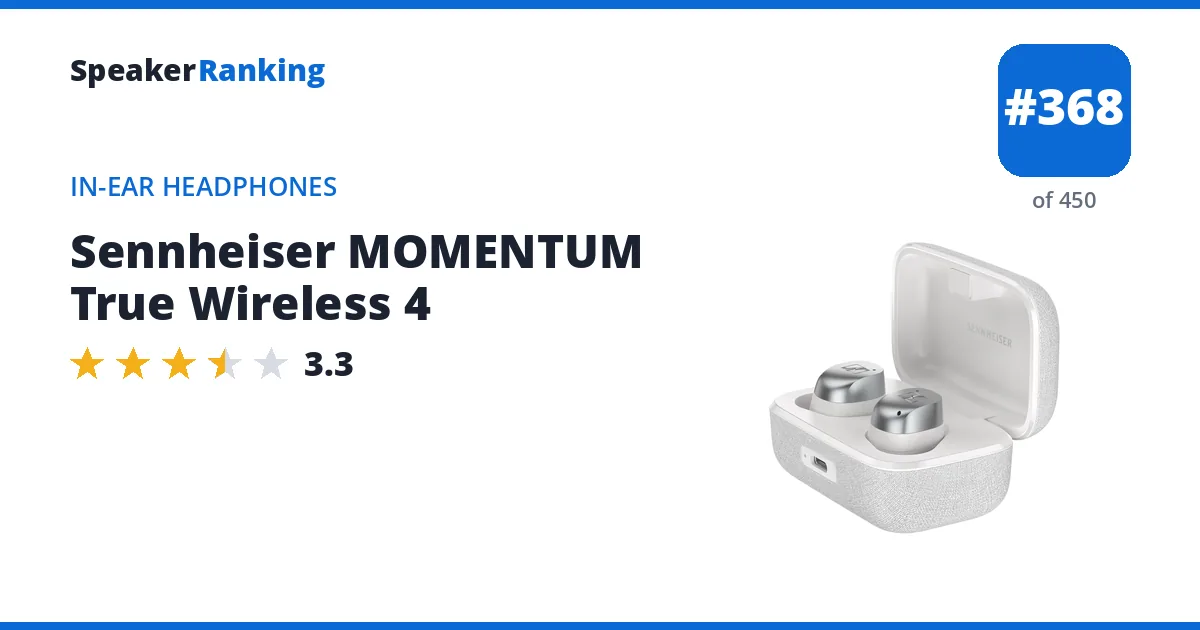
Older model: the Sennheiser Momentum True Wireless 3 (ranked higher, rated 3.4/5). See every Sennheiser Momentum True Wireless generation.
Pros: This true wireless set adds active noise cancelling, Bluetooth 5.4 and a codec list that runs from SBC and AAC up to aptX Lossless and LC3. Battery life is 7.5 hours per charge and 30 hours with the case, and IP54 resistance covers sweat and light rain. Oratory1990’s measurement shows bass about 0.6 dB above target, so low end is full without being overdone.
Cons: Presence from 3 to 6 kHz is about 6.9 dB under target, with an 8.2 dB dip near 5.7 kHz, so voices and guitars sound recessed. Air above 10 kHz runs 5 dB hot with a peak of 4.2 dB near 10.6 kHz, which can add a thin, sparkly edge. The Tin HiFi P1 Max has a higher rating, for a lower price.
Full Sennheiser MOMENTUM True Wireless 4 review and specifications →
| Released | Feb 2024 (2 years ago) |
|---|---|
| Active Noise Cancelling | Yes |
| Back | Closed |
| Battery Life | 7.5 hours (30 with case, Manufacturer specified) |
| Bluetooth Codecs | SBC, AAC, aptX, aptX Adaptive, aptX Lossless, LC3 |
| Bluetooth Version | 5.4 |
| Built-in Microphone | Yes |
| Connection | True wireless |
| Deviation From Target | 2.63 dB standard deviation |
| Driver Type | Dynamic |
| Drivers | 1 x 7mm dynamic |
| Form Factor | In-ear |
| Harman Preference Score | 65 (measured by oratory1990, via AutoEQ) |
| IP Rating | IP54 |
| Sub-bass Extension | Within 6 dB of target down to 20 Hz (-1.4 dB at 30 Hz) |
| Tonal Tilt | -0.74 (negative is warmer, positive brighter) |
| Weight | 0 lbs (6.2 g) per earbud |
EQ preset to match the Harman target
Set a preamp of -6.5 dB, then add these filters in any parametric equalizer (Wavelet, Equalizer APO, Peace, or a player with parametric EQ). Calculated by AutoEQ from its measured frequency response.
| Filter | Frequency | Gain | Q |
|---|---|---|---|
| Low shelf | 105 Hz | -0.1 dB | 0.70 |
| Peak | 5,605 Hz | +5.8 dB | 2.82 |
| Peak | 123 Hz | -2.8 dB | 0.23 |
| Peak | 3,977 Hz | +3.9 dB | 2.27 |
| Peak | 70 Hz | +2.1 dB | 0.97 |
| High shelf | 10,000 Hz | -5.2 dB | 0.70 |
| Peak | 1,511 Hz | -1.3 dB | 1.73 |
| Peak | 877 Hz | +0.8 dB | 2.46 |
| Peak | 7,841 Hz | +2.1 dB | 5.59 |
| Peak | 3,002 Hz | +0.7 dB | 3.65 |
- Reviews, Comparisons and Sound Samples
- Head-to-Head Comparisons
 Muse HiFi Power: $199.00 Audio46 eBay

Pros: A 14.5mm planar magnetic driver with about 2.3 dB of extra bass and sub-bass that stays within 6 dB of target down to 20 Hz, for a full, warm low end. The midrange from 200 Hz to 3 kHz stays within a decibel of target, so vocals sound natural. At 32 ohms and 106 dB/mW it runs fine from a phone. It matches the rating of the FiiO FH7S for less money.
Cons: Squig.link measurements show a 12.7 dB peak near 11.9 kHz on top of a 6.5 dB dip near 6.5 kHz, so the lower treble sounds dim while the very top can add a hissy sheen. The Shanling ME200 and FiiO FH3 both rate higher for less money.
Full Muse HiFi Power review and specifications →
| Released | 2022 (4 years ago) |
|---|---|
| Back | Closed |
| Built-in Microphone | No |
| Connection | Wired |
| Deviation From Target | 2.99 dB standard deviation |
| Driver Type | Planar magnetic |
| Drivers | 1 x 14.5mm planar magnetic |
| Form Factor | In-ear |
| Frequency Response | 10Hz - 40kHz (Manufacturer specified) |
| Harman Preference Score | 64 (measured by crinacle, via AutoEQ) |
| Impedance | 32 ohms |
| Sensitivity | 106 dB/mW |
| Sub-bass Extension | Within 6 dB of target down to 20 Hz (-1.6 dB at 30 Hz) |
| Tonal Tilt | -0.51 (negative is warmer, positive brighter) |
EQ preset to match the Harman target
Set a preamp of -6.7 dB, then add these filters in any parametric equalizer (Wavelet, Equalizer APO, Peace, or a player with parametric EQ). Calculated by AutoEQ from its measured frequency response.
| Filter | Frequency | Gain | Q |
|---|---|---|---|
| Low shelf | 105 Hz | +1.5 dB | 0.70 |
| Peak | 136 Hz | -2.9 dB | 0.34 |
| Peak | 7,851 Hz | +7.0 dB | 2.69 |
| Peak | 2,388 Hz | -5.3 dB | 2.11 |
| Peak | 651 Hz | +2.6 dB | 0.77 |
| High shelf | 10,000 Hz | -7.9 dB | 0.70 |
| Peak | 9,555 Hz | +4.3 dB | 2.98 |
| Peak | 4,757 Hz | -5.0 dB | 4.77 |
| Peak | 3,703 Hz | +2.2 dB | 3.53 |
| Peak | 6,695 Hz | +2.5 dB | 5.82 |
- Reviews, Comparisons and Sound Samples
- Head-to-Head Comparisons