Short answer: the Seeburg K20. It ranks #20 of 39 10-inch pa speakers by sound quality (rated 3.6/5); the Yamaha CBR10 ranks #33 (rated 3.2/5).
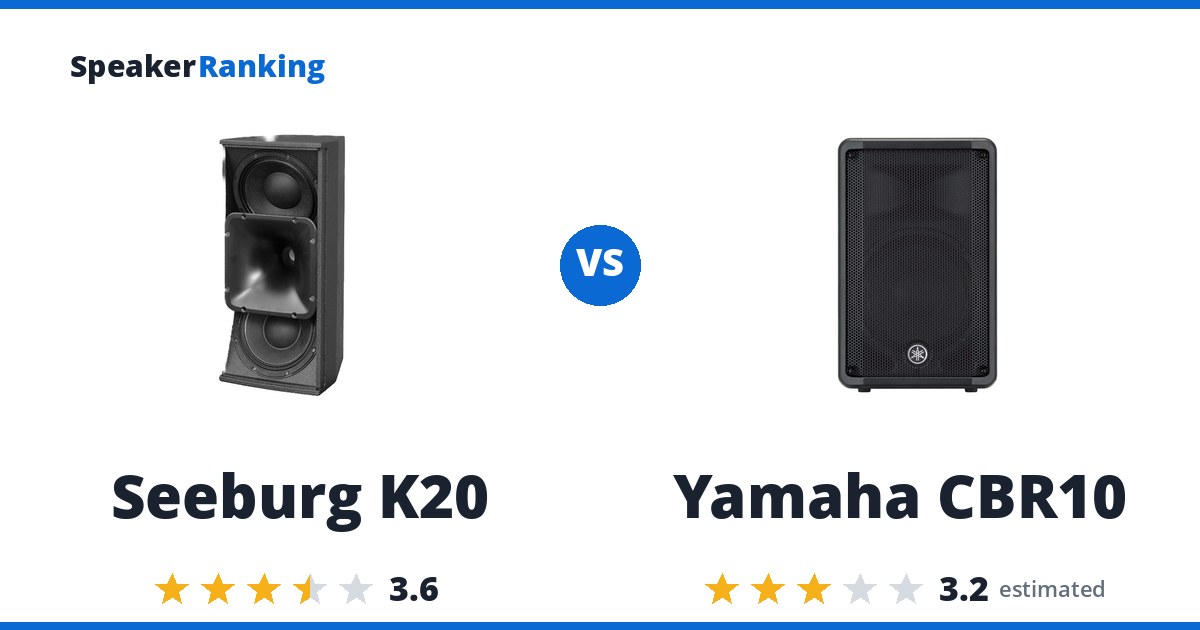
The Seeburg K20 is the better-sounding pick. Dual 10-inch woofers and a 1.4-inch compression driver reach 134dB in a 49.6 lbs (22.5 kg) cabinet. The catch: Bass reaches only about 95Hz (-3dB) and on-axis narrow-band deviation is 0.562, so the response is uneven and thin without a subwoofer.
Why pick the Yamaha CBR10: The passive version of the measured Yamaha DBR10, sharing its 10” woofer, compression driver and lightweight polypropylene cabinet with 90° x 60° coverage. Watch for: No independent measurements yet, so it can’t be compared with ranked PA speakers.
Buy the Seeburg K20. It is rated higher for sound quality than the Yamaha CBR10.
Worth knowing: the Yamaha CBR10 has not been measured yet. Its rating is estimated from related models, with a likely range of 2.8 to 3.6, so treat this verdict as provisional.
Still deciding? The full PA & Live Sound rankings cover every ranked option.
Specifications Side By Side
| Seeburg K20 | Yamaha CBR10 | |
|---|---|---|
| Price | Passive | $299.99 Passive |
| Ranked | #20 of 39 in 10-Inch PA Speakers | #33 of 39 in 10-Inch PA Speakers Estimated |
| Rigging | 10 x M10 inserts; 35mm pole mount | 2 x M8 eyebolt points; 35mm pole socket |
| Passive | Yes | Yes |
| Configuration | Passive 2-way high-mid PA speaker | Passive 2-way bass-reflex PA speaker |
| Drivers | Dual 10” neodymium woofers, 1.4” neodymium compression driver | 10” woofer, 1” voice coil compression driver |
| Frequency Response | 70Hz - 18kHz (manufacturer specified) | 50Hz - 20kHz (-10dB, manufacturer specified) |
| Dimensions | 26”H x 11.8”W x 14.2”D (660 x 300 x 360 mm) | - |
| Amplifier Power | Passive speaker; requires external amplification within the 800W AES / 2400W peak handling rating | Passive speaker; requires external amplification |
| Power Handling | 800W AES / 2400W peak at 4 ohms (manufacturer specified) | 700W peak |
| Maximum SPL | 134dB (manufacturer specified) | 123dB (calculated, manufacturer specified) |
| Coverage | 90° x 60° (60° x 50° variant also offered) | 90° x 60° |
| DSP | No (passive) | No (passive) |
| Weight | 49.6 lbs (22.5 kg) | 20.7 lbs (9.4 kg) |
| Bass Extension (-3dB) | 95Hz (measured, vendor Spinorama data) | - |
| Bluetooth | No | No |
| Spinorama Preference Score | 3.14 | - |
| Spinorama Preference Score with Perfect Sub | 6.61 | - |
| XLR Input | No | No |
| RCA Input | No | - |
| TRS Input | No | - |
| Optical Input | No | - |
| Coaxial Input | No | - |
| USB Input | No | - |
| HDMI Input | No | - |
| AES Input | No | - |
| Aux Input | No | - |
| Microphone Input | No | - |
| Guitar Input | No | - |
| Sensitivity | - | 94dB |
| Impedance | - | 8 ohms |
Related Speaker Comparisons
How Seeburg K20 compares with other leading options:
- d&b audiotechnik 10S vs Seeburg K20
- Seeburg K20 vs DAS Audio ARTEC 510A
- Seeburg K20 vs Amate Audio X102FD
- Seeburg K20 vs d&b audiotechnik V10P
- Yamaha DBR10 vs Yamaha CBR10
Prices on this page were last checked October 11, 2026 at 4:59 PM UTC. Product prices and availability are accurate as of that date/time and are subject to change; the price and availability shown on Amazon at the time of purchase will apply to the purchase of this product.
As an eBay Partner, we may be compensated if you make a purchase.
The Two Speakers In Full
 Seeburg K20 Passive Thomann eBay
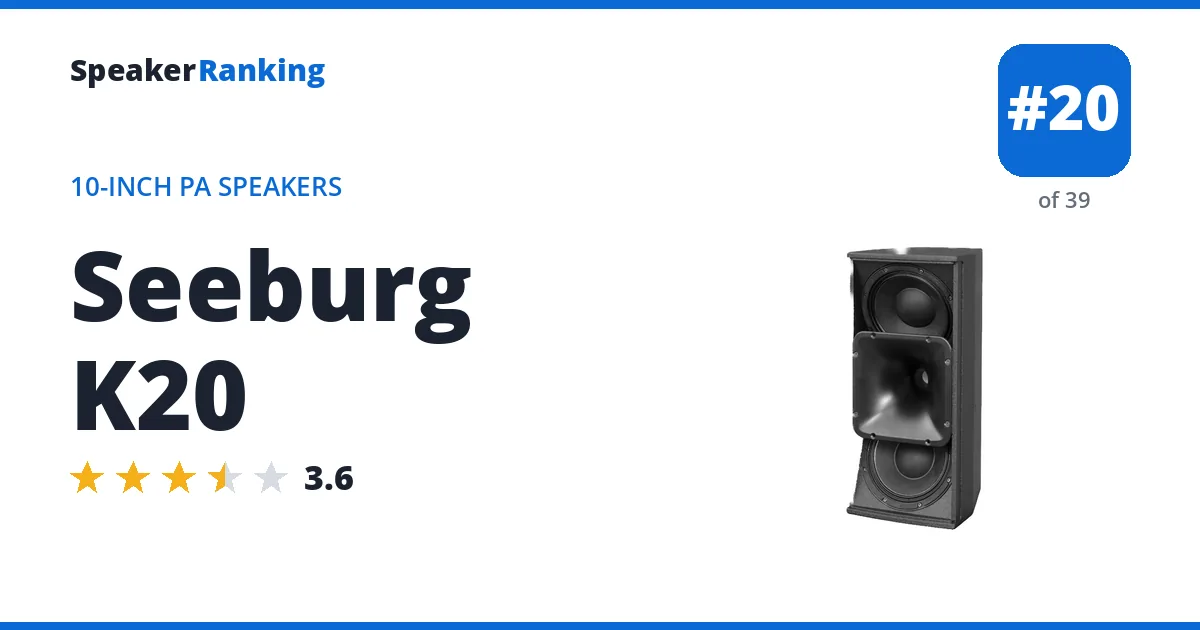
Pros: Dual 10-inch woofers and a 1.4-inch compression driver reach 134dB in a 22.5kg cabinet. Predicted in-room smoothness is a solid 0.711, and vendor Spinorama data gives preference scores of 3.14 standalone and 6.61 with an ideal subwoofer. Measured bass extension of 95Hz (-3dB).
Cons: Bass reaches only about 95Hz (-3dB) and on-axis narrow-band deviation is 0.562, so the response is uneven and thin without a subwoofer. It is passive, so an external amplifier and processor are needed, and pricing is high for the class.
Full Seeburg K20 review and specifications →
| AES Input | No |
|---|---|
| Amplifier Power | Passive speaker; requires external amplification within the 800W AES / 2400W peak handling rating |
| Aux Input | No |
| Bass Extension (-3dB) | 95Hz (measured, vendor Spinorama data) |
| Bluetooth | No |
| Coaxial Input | No |
| Configuration | Passive 2-way high-mid PA speaker |
| Coverage | 90° x 60° (60° x 50° variant also offered) |
| DSP | No (passive) |
| Dimensions | 26”H x 11.8”W x 14.2”D (660 x 300 x 360 mm) |
| Drivers | Dual 10” neodymium woofers, 1.4” neodymium compression driver |
| Frequency Response | 70Hz - 18kHz (manufacturer specified) |
| Guitar Input | No |
| HDMI Input | No |
| Maximum SPL | 134dB (manufacturer specified) |
| Microphone Input | No |
| Optical Input | No |
| Passive | Yes |
| Power Handling | 800W AES / 2400W peak at 4 ohms (manufacturer specified) |
| RCA Input | No |
| Rigging | 10 x M10 inserts; 35mm pole mount |
| Spinorama Preference Score | 3.14 |
| Spinorama Preference Score with Perfect Sub | 6.61 |
| TRS Input | No |
| USB Input | No |
| Weight | 49.6 lbs (22.5 kg) |
| XLR Input | No |
- Links
- Reviews, Comparisons and Sound Samples
- Head-to-Head Comparisons
 Yamaha CBR10: $299.99 Passive Estimated B&H Photo Video eBay
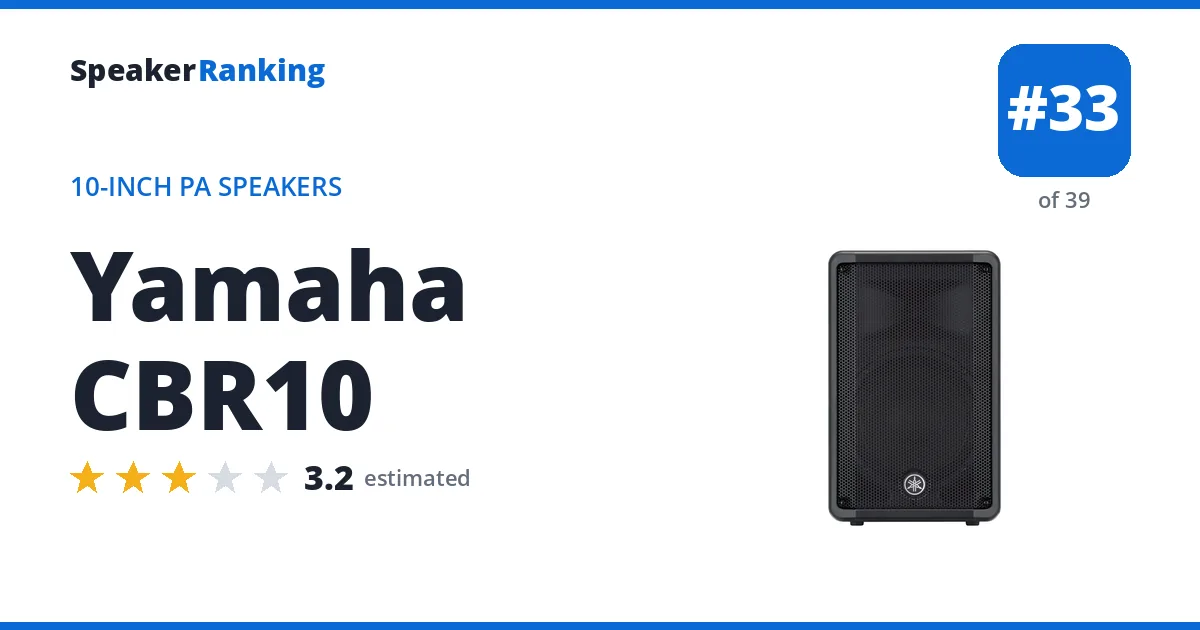
Same family: the Yamaha DBR10 (smallest powered model, ranked higher, rated 3.4/5), the Yamaha DBR12 (powered model, rated 3.6/5), the Yamaha DBR15 (largest powered model, rated 2.9/5), the Yamaha CBR12 (larger passive model, estimated 3.4/5) and the Yamaha CBR15 (larger passive model, estimated 2.7/5).
Pros: The passive version of the measured Yamaha DBR10, sharing its 10” woofer, compression driver and lightweight polypropylene cabinet with 90° x 60° coverage. Yamaha rates it at 94dB sensitivity, 123dB maximum SPL and bass to 50Hz (-10dB), and at 9.4 kg it is one of the lighter 10-inch boxes.
Cons: No independent measurements yet, so it can’t be compared with ranked PA speakers. It needs an external amplifier, and without the powered model’s DSP its response depends on the amplifier’s EQ. The measured powered version is a budget design, so expect the same limits on output and smoothness.
Full Yamaha CBR10 review and specifications →
| Amplifier Power | Passive speaker; requires external amplification |
|---|---|
| Bluetooth | No |
| Configuration | Passive 2-way bass-reflex PA speaker |
| Coverage | 90° x 60° |
| DSP | No (passive) |
| Drivers | 10” woofer, 1” voice coil compression driver |
| Frequency Response | 50Hz - 20kHz (-10dB, manufacturer specified) |
| Impedance | 8 ohms |
| Maximum SPL | 123dB (calculated, manufacturer specified) |
| Passive | Yes |
| Power Handling | 700W peak |
| Rigging | 2 x M8 eyebolt points; 35mm pole socket |
| Sensitivity | 94dB |
| Weight | 20.7 lbs (9.4 kg) |
| XLR Input | No |
- Links
- Reviews, Comparisons and Sound Samples
- No independent measurement review is linked for this model; it is ranked from hands-on listening and comparison against similarly priced speakers.
- Head-to-Head Comparisons