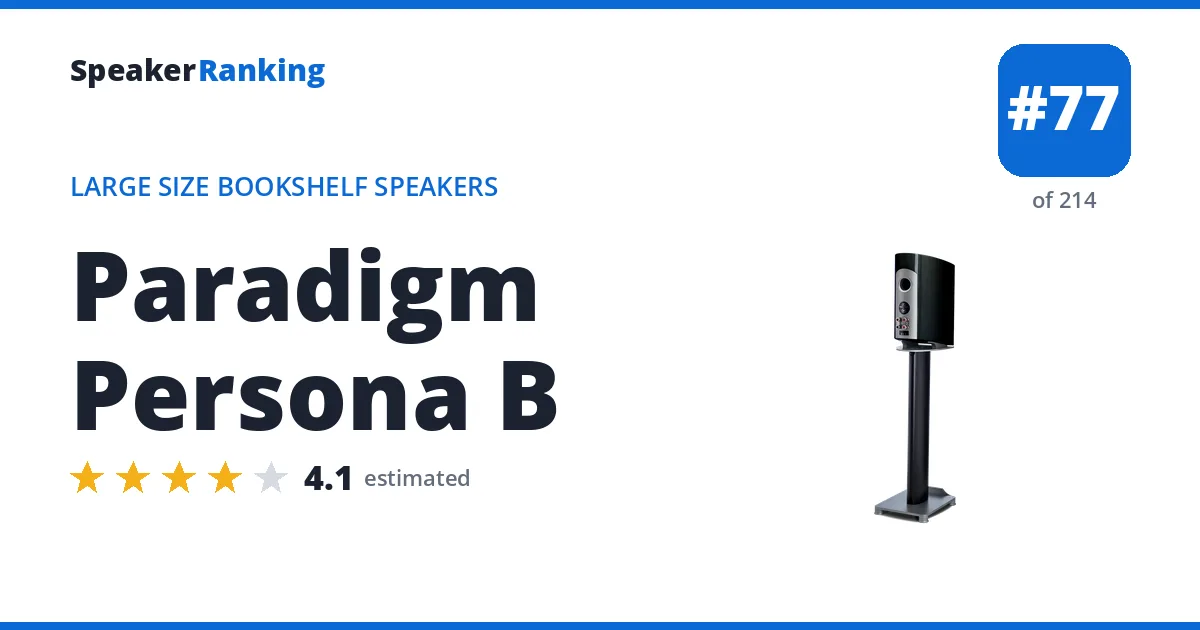
Short answer: the Paradigm Persona B. It ranks #77 of 214 bookshelf speakers by sound quality, rated 4.1/5, at $10,499.98. The Dynaudio Contour 20i ranks #96, rated 3.9/5, at $5,750, $4,749.98 cheaper, not enough of a saving to outweigh the sound-quality gap.

What the Paradigm Persona B does well: The standmount of the Paradigm Persona 3F family, with a 1” beryllium dome tweeter and a 7” beryllium mid/bass driver, rated from 60Hz to 45kHz (±2dB on axis). The tradeoff: No independent measurements yet, so its tonal balance and directivity can’t be compared with ranked speakers.
Why pick the Dynaudio Contour 20i: Two-way design with a 1.125” Esotar2i silk dome tweeter and a 7” magnesium silicate polymer woofer in a vented enclosure. The catch: Notably room-dependent: sounds too bright in the lower treble in smaller rooms with close sidewalls, needing sidewall absorption to sound neutral, while performing better in larger or more open rooms without that treatment.
Buy the Paradigm Persona B. It is rated higher for sound quality, and the $4,749.98 you would save on the Dynaudio Contour 20i does not close the gap.
Worth knowing: the Paradigm Persona B has not been measured yet. Its rating is estimated from related models, with a likely range of 3.7 to 4.5, so treat this verdict as provisional.
Looking for alternatives? See the complete Passive Home rankings.
Specifications Side By Side
| Paradigm Persona B | Dynaudio Contour 20i | |
|---|---|---|
| Price | $10,499.98 per pair | $5750 per pair |
| Ranked | #77 of 214 in Large Size Bookshelf Speakers Estimated | #96 of 214 in Large Size Bookshelf Speakers |
| Drivers | 1x 1” beryllium dome tweeter, 1x 7” beryllium mid/bass driver | 18 cm MSP woofer, 28mm Esotar 2i with Hexis tweeter |
| Sensitivity | 92dB room / 89dB anechoic (manufacturer specified) | 82.5dB |
| Impedance | 8 ohms compatible (manufacturer specified) | 4 ohms |
| Frequency Response | 60Hz - 45kHz (±2dB on-axis, manufacturer specified) | - |
| Dimensions | 17.1”H x 8.9”W x 13”D (435 x 225 x 330 mm) | 17.4”H x 8.5”W x 14.2”D (442 x 215.9 x 360.7 mm) |
| Weight | 30.9 lbs (14 kg) | 30.9 lbs (14 kg) each |
| Enclosure | Bass reflex | - |
| Bass Extension (-10dB) | - | 32Hz (measured, Erin’s Audio Corner) |
| Bass Extension (-3dB) | - | 56Hz (measured, Erin’s Audio Corner) |
| Woofer Cabinet | - | ported, rear |
| DIY Kit | - | No |
Related Speaker Comparisons
More top alternatives to Paradigm Persona B:
- Paradigm Persona B vs Yamaha NS-800A
- Paradigm Persona B vs Focal Sopra N°1
- KEF Reference 1 Meta vs Dynaudio Contour 20i
- Focal Sopra N°1 vs Dynaudio Contour 20i
- Perlisten S4b vs Dynaudio Contour 20i
Prices on this page were last checked October 11, 2026 at 4:59 PM UTC. Product prices and availability are accurate as of that date/time and are subject to change; the price and availability shown on Amazon at the time of purchase will apply to the purchase of this product.
As an eBay Partner, we may be compensated if you make a purchase.
The Two Speakers In Full
 Paradigm Persona B: $10,499.98 per pair Estimated Paradigm eBay
Same family: the Paradigm Persona 3F (smallest floorstanding, estimated 4.2/5), the Paradigm Persona 5F (floorstanding, estimated 4.3/5), the Paradigm Persona 7F (floorstanding, estimated 4.4/5), the Paradigm Persona 9H (largest floorstanding, estimated 4.4/5), the Paradigm Persona C (center, estimated 4.2/5) and the Paradigm Persona SUB (subwoofer, estimated 4.2/5).
Pros: The standmount of the Paradigm Persona 3F family, with a 1” beryllium dome tweeter and a 7” beryllium mid/bass driver, rated from 60Hz to 45kHz (±2dB on axis).
Cons: No independent measurements yet, so its tonal balance and directivity can’t be compared with ranked speakers. Bass is limited compared with the Persona towers, so a subwoofer helps for full range listening.
Full Paradigm Persona B review and specifications →
| Dimensions | 17.1”H x 8.9”W x 13”D (435 x 225 x 330 mm) |
|---|---|
| Drivers | 1x 1” beryllium dome tweeter, 1x 7” beryllium mid/bass driver |
| Enclosure | Bass reflex |
| Frequency Response | 60Hz - 45kHz (±2dB on-axis, manufacturer specified) |
| Impedance | 8 ohms compatible (manufacturer specified) |
| Sensitivity | 92dB room / 89dB anechoic (manufacturer specified) |
| Weight | 30.9 lbs (14 kg) |
- Links
- Reviews, Comparisons and Sound Samples
- Head-to-Head Comparisons
 Dynaudio Contour 20i: $5750 per pair Safe and Sound HQ eBay
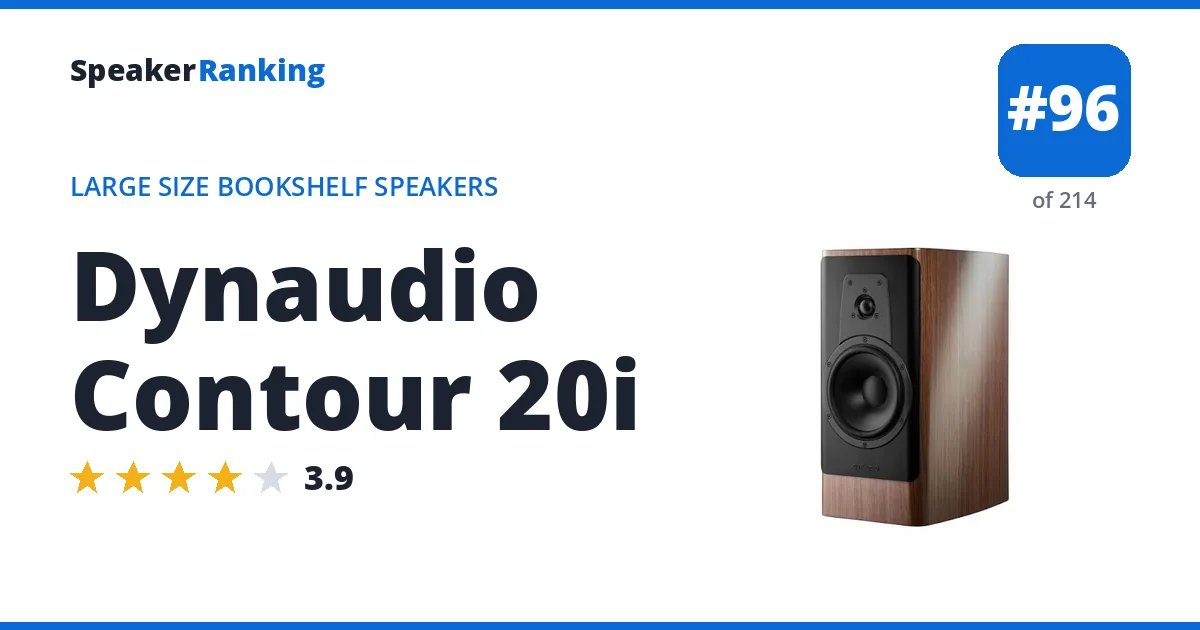
Pros: Two-way design with a 1.125” Esotar2i silk dome tweeter and a 7” magnesium silicate polymer woofer in a vented enclosure. A shallow bass rolloff profile lets it sit closer to a wall (about 1-2 feet worked best in testing) without becoming boomy, and makes subwoofer integration comparatively easy. Very wide horizontal radiation (about ±70° through the midrange) gives an enveloping, spacious sound in a suitably sized room. On-axis response holds within about ±3dB overall and ±1.5dB through the midrange. Attractive build quality with a distinctive metal front baffle and gloss finish options. Long-term compression stays good up to 96dB, and short-term compression is within about 0.5dB at that same level. Measured bass extension of 56Hz (-3dB).
Cons: Notably room-dependent: sounds too bright in the lower treble in smaller rooms with close sidewalls, needing sidewall absorption to sound neutral, while performing better in larger or more open rooms without that treatment. A roughly 2dB lift in the lower treble combined with wide dispersion means more energy reflecting off sidewalls than some listeners will prefer. Relatively low sensitivity (about 82.5dB measured). Unusually sensitive to amplifier output impedance: high-output-impedance amps like tube or SET designs introduce up to a 2dB dip in the midrange, making the sound more mellow rather than “warmer,” the opposite of what many tube-amp buyers expect. Elevated harmonic and multitone distortion around 700Hz, which the reviewer attributes to typical cone-edge/surround behavior common across many driver brands, though it stands out on the measurement graphs. An upper-midrange dip around 2kHz can reduce attack and clarity on vocals and brass instruments. Vertical listening window is fairly narrow (roughly -20° to +30°): moving outside that range causes a noticeable tonal shift, unlike coaxial designs that tolerate more vertical movement.
Full Dynaudio Contour 20i review and specifications →
| Released | 2020 (6 years ago) |
|---|---|
| Bass Extension (-10dB) | 32Hz (measured, Erin’s Audio Corner) |
| Bass Extension (-3dB) | 56Hz (measured, Erin’s Audio Corner) |
| DIY Kit | No |
| Dimensions | 17.4”H x 8.5”W x 14.2”D (442 x 215.9 x 360.7 mm) |
| Drivers | 18 cm MSP woofer, 28mm Esotar 2i with Hexis tweeter |
| Impedance | 4 ohms |
| Sensitivity | 82.5dB |
| Weight | 30.9 lbs (14 kg) each |
| Woofer Cabinet | ported, rear |
- Links
- Reviews, Comparisons and Sound Samples
- Head-to-Head Comparisons
- Dynaudio Contour 20i vs SVS Ultra Bookshelf
- Dynaudio Contour 20i vs Focal Sopra N°1
- Dynaudio Contour 20i vs Technics SB-C700
- Dynaudio Contour 20i vs Definitive Technology Demand D11
- Dynaudio Contour 20i vs Infinity Reference R162
- Dynaudio Contour 20i vs Yamaha NS-800A
- Dynaudio Contour 20i vs Ascend Acoustics CBM-170 SE2
- Dynaudio Contour 20i vs ELAC DBR62
- See all 59 comparisons