Short answer: the Myer Audio CKLVX D62. It ranks #74 of 450 in-ear headphones by sound quality, rated 4.5/5, at $399; the Moondrop Blessing ranks #93, rated 4.4/5, and costs $399.99, so there is little reason to consider the other one.

The case for the Myer Audio CKLVX D62: Nine hobbyist measurements on squig.link score it 79.6 for preference with a near neutral tilt and 1.59 dB of deviation. Watch for: Presence sits about 2.8 dB low with a 5.5 dB dip near 5.4 kHz, while a 4.8 dB peak follows at 8.1 kHz, so the treble swings between recessed vocals and occasional sibilant edge.
Why pick the Moondrop Blessing: A preference score of 79 in oratory1990’s measurement, with the midrange from 200 Hz to 3 kHz held within 0.3 dB of target, so voices and instruments sound natural and correctly weighted. Watch for: Sub-bass runs 3.5 dB below target from 20 to 60 Hz, so deep electronic and hip hop bass hits a bit lighter than it should.
Buy the Myer Audio CKLVX D62. It is rated higher for sound quality than the Moondrop Blessing and costs less, so it is the default pick unless a specific strength of the other one matters more to you.
Looking for alternatives? See the complete Headphones rankings.
Specifications Side By Side
| Myer Audio CKLVX D62 | Moondrop Blessing | |
|---|---|---|
| Price | $399.00 | $399.99 |
| Ranked | #74 of 450 in In-Ear Headphones | #93 of 450 in In-Ear Headphones |
| Form Factor | In-ear | In-ear |
| Back | Closed | Closed |
| Harman Preference Score | 80 (median of 9 squig.link measurements, calibrated to AutoEQ) | 79 (measured by oratory1990, via AutoEQ) |
| Deviation From Target | 1.59 dB standard deviation | 1.68 dB standard deviation |
| Tonal Tilt | -0.06 (negative is warmer, positive brighter) | +0.36 (negative is warmer, positive brighter) |
| Sub-bass Extension | Within 6 dB of target down to 20 Hz (-0.8 dB at 30 Hz) | Within 6 dB of target down to 20 Hz (-3.6 dB at 30 Hz) |
| Connection | Wired | Wired |
| Driver Type | Hybrid (2 dynamic + 6 balanced armature) | Hybrid (1 dynamic + 4 balanced armature) |
| Drivers | 1 x 10mm dynamic + 1 x 8mm dynamic + 6 x balanced armature | 1 x dynamic + 4 x balanced armature |
| Impedance | - | 23 ohms |
| Sensitivity | - | 105 dB @ 1kHz |
| Frequency Response | - | 20Hz - 40kHz (Manufacturer specified) |
| Built-in Microphone | - | No |
Related Headphone Comparisons
More worthwhile head-to-heads for Myer Audio CKLVX D62:
- Myer Audio CKLVX D62 vs Unique Melody 3DT
- Myer Audio CKLVX D62 vs ThieAudio Hype 2
- Moondrop Blessing vs Unique Melody 3DT
- Moondrop Blessing vs ThieAudio Hype 2
- Moondrop Blessing vs Moondrop Blessing 3
Prices on this page were last checked October 11, 2026 at 4:59 PM UTC. Product prices and availability are accurate as of that date/time and are subject to change; the price and availability shown on Amazon at the time of purchase will apply to the purchase of this product.
As an eBay Partner, we may be compensated if you make a purchase.
The Two Headphones In Full
 Myer Audio CKLVX D62: $399.00 Amazon eBay
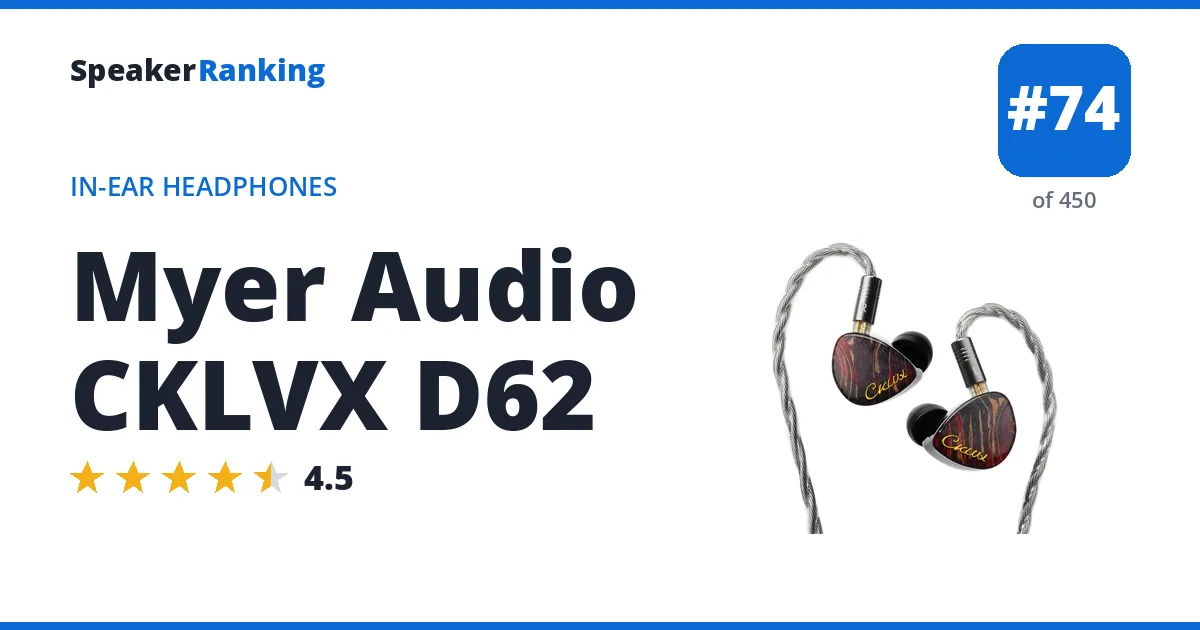
Pros: Nine hobbyist measurements on squig.link score it 79.6 for preference with a near neutral tilt and 1.59 dB of deviation. Two dynamic drivers and six balanced armatures keep bass and midrange within about 1 dB of target, and air above 10 kHz runs about 5.1 dB hot for an airy, detailed presentation. It matches the Kiwi Ears Orchestra II on rating.
Cons: Presence sits about 2.8 dB low with a 5.5 dB dip near 5.4 kHz, while a 4.8 dB peak follows at 8.1 kHz, so the treble swings between recessed vocals and occasional sibilant edge. It rates below the IOAudio Volare, and no impedance or sensitivity figure is published.
Full Myer Audio CKLVX D62 review and specifications →
| Back | Closed |
|---|---|
| Connection | Wired |
| Deviation From Target | 1.59 dB standard deviation |
| Driver Type | Hybrid (2 dynamic + 6 balanced armature) |
| Drivers | 1 x 10mm dynamic + 1 x 8mm dynamic + 6 x balanced armature |
| Form Factor | In-ear |
| Harman Preference Score | 80 (median of 9 squig.link measurements, calibrated to AutoEQ) |
| Sub-bass Extension | Within 6 dB of target down to 20 Hz (-0.8 dB at 30 Hz) |
| Tonal Tilt | -0.06 (negative is warmer, positive brighter) |
- Reviews, Comparisons and Sound Samples
- Head-to-Head Comparisons
 Moondrop Blessing: $399.99 Apos Audio eBay
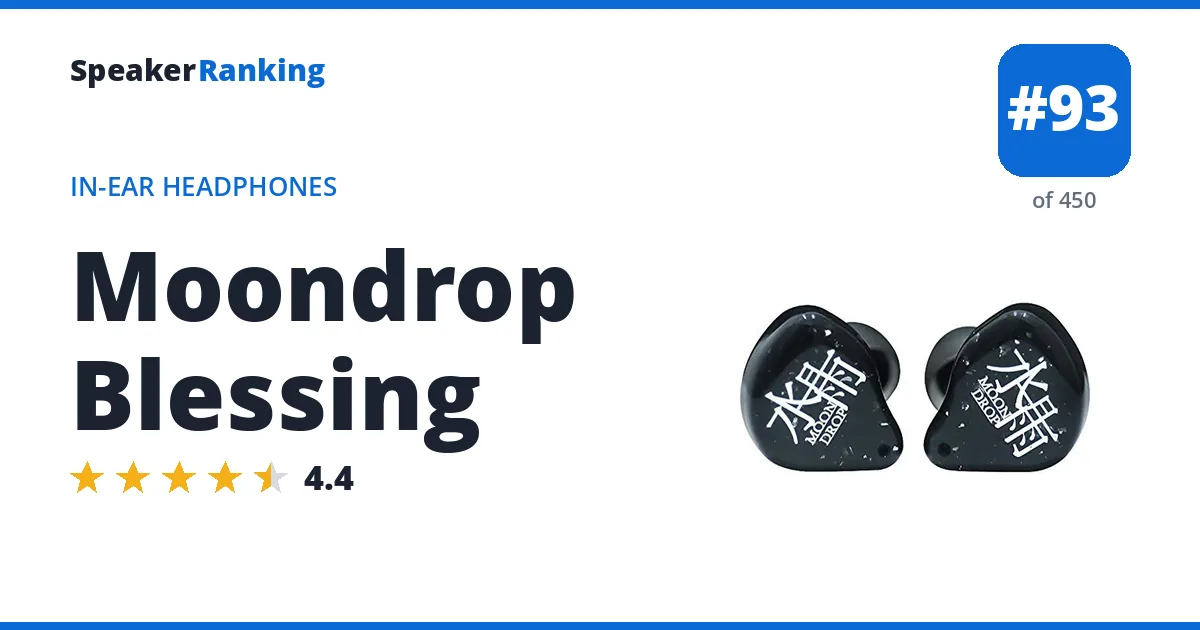
Pros: A preference score of 79 in oratory1990’s measurement, with the midrange from 200 Hz to 3 kHz held within 0.3 dB of target, so voices and instruments sound natural and correctly weighted. The hybrid layout of one dynamic driver and four balanced armatures keeps the response even, at 1.68 dB standard deviation. It suits listeners after a neutral or gently warm sound, and it rates above the cheaper Tanchjim Oxygen.
Cons: Sub-bass runs 3.5 dB below target from 20 to 60 Hz, so deep electronic and hip hop bass hits a bit lighter than it should. A 5.3 dB dip near 11.4 kHz trims the airy sparkle on cymbals. The Etymotic EVO shares the same rating for less money.
Full Moondrop Blessing review and specifications →
| Released | 2019 (7 years ago) |
|---|---|
| Back | Closed |
| Built-in Microphone | No |
| Connection | Wired |
| Deviation From Target | 1.68 dB standard deviation |
| Driver Type | Hybrid (1 dynamic + 4 balanced armature) |
| Drivers | 1 x dynamic + 4 x balanced armature |
| Form Factor | In-ear |
| Frequency Response | 20Hz - 40kHz (Manufacturer specified) |
| Harman Preference Score | 79 (measured by oratory1990, via AutoEQ) |
| Impedance | 23 ohms |
| Sensitivity | 105 dB @ 1kHz |
| Sub-bass Extension | Within 6 dB of target down to 20 Hz (-3.6 dB at 30 Hz) |
| Tonal Tilt | +0.36 (negative is warmer, positive brighter) |
EQ preset to match the Harman target
Set a preamp of -3.7 dB, then add these filters in any parametric equalizer (Wavelet, Equalizer APO, Peace, or a player with parametric EQ). Calculated by AutoEQ from its measured frequency response.
| Filter | Frequency | Gain | Q |
|---|---|---|---|
| Low shelf | 105 Hz | +2.7 dB | 0.70 |
| Peak | 193 Hz | -1.0 dB | 1.56 |
| Peak | 6,362 Hz | +3.6 dB | 5.00 |
| Peak | 9,074 Hz | +2.5 dB | 2.29 |
| Peak | 2,658 Hz | -1.8 dB | 2.21 |
| High shelf | 10,000 Hz | -2.6 dB | 0.70 |
| Peak | 821 Hz | +1.2 dB | 1.58 |
| Peak | 1,348 Hz | -0.9 dB | 2.20 |
| Peak | 65 Hz | +0.4 dB | 1.89 |
| Peak | 34 Hz | -0.3 dB | 1.69 |
- Reviews, Comparisons and Sound Samples
- Head-to-Head Comparisons