Short answer: the Master & Dynamic MW07, though neither ranks well in its class. It ranks #424 of 450 in-ear headphones by sound quality, rated 2.3/5, at $163.57. The 1MORE Penta Driver ranks #427, rated 2.1/5, at $139.99, $23.58 cheaper, not enough of a saving to outweigh the sound-quality gap. Both are rated below 3.0/5 among the 450 in-ear headphones, so if sound quality matters, consider the Truthear Nova instead, ranked #2 at $169.99.
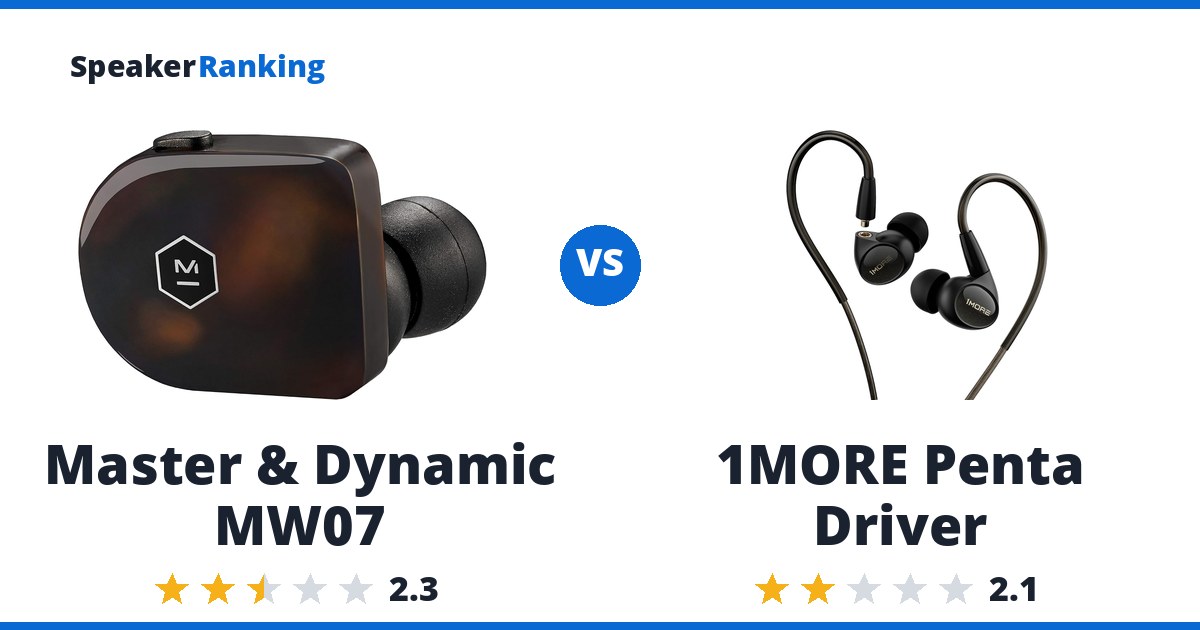
What the Master & Dynamic MW07 does well: These true wireless earbuds support aptX alongside SBC for better quality from compatible Android phones, and an IPX4 rating protects them against sweat and splashes. The tradeoff: Crinacle’s measurement gives it a preference score of 53, far from the balance most listeners prefer.
The case for the 1MORE Penta Driver: Bass sits about 1 dB above target between 60 and 200 Hz while the treble is pulled well back, so listeners who like a warm, dark presentation will find little that sounds sharp. Watch for: A deep 13.5 dB dip at 6.6 kHz and a presence band nearly 8 dB below target leave vocals recessed and cymbals dull, which drags the preference score in HypetheSonics’ measurement down to 51.
Buy the Master & Dynamic MW07. It is rated higher for sound quality, and the $23.58 saving on the 1MORE Penta Driver is not enough to make up the difference.
Looking for alternatives? See the complete Headphones rankings.
Specifications Side By Side
| Master & Dynamic MW07 | 1MORE Penta Driver | |
|---|---|---|
| Price | $163.57 | $139.99 |
| Ranked | #424 of 450 in In-Ear Headphones | #427 of 450 in In-Ear Headphones |
| Form Factor | In-ear | In-ear |
| Back | Closed | Closed |
| Harman Preference Score | 53 (measured by crinacle, via AutoEQ) | 51 (measured by HypetheSonics, via AutoEQ) |
| Deviation From Target | 3.61 dB standard deviation | 3.82 dB standard deviation |
| Tonal Tilt | -0.75 (negative is warmer, positive brighter) | -1.00 (negative is warmer, positive brighter) |
| Connection | True wireless | Wired |
| Driver Type | Dynamic | Hybrid (1 dynamic + 4 planar magnetic) |
| Drivers | 1 x 10mm dynamic | 1 x dynamic + 4 x planar |
| Active Noise Cancelling | No | - |
| Battery Life | 3.5 hours (14 with case, Manufacturer specified) | - |
| Bluetooth Version | 4.2 | - |
| Bluetooth Codecs | SBC, aptX | - |
| Built-in Microphone | Yes | Yes |
| IP Rating | IPX4 | - |
| Weight | 0 lbs (9 g) per earbud | 0 lbs (3.5 g) per earbud |
| Sub-bass Extension | - | Within 6 dB of target down to 20 Hz (-2.6 dB at 30 Hz) |
| Impedance | - | 32 ohms |
| Sensitivity | - | 105 dB/mW |
| Frequency Response | - | 20Hz - 40kHz (Manufacturer specified) |
Related Headphone Comparisons
More top alternatives to Master & Dynamic MW07:
- Etymotic ER3XR vs Master & Dynamic MW07
- Master & Dynamic MW07 vs Etymotic ER3SE
- Master & Dynamic MW07 vs Etymotic ER2SE
- 1MORE Penta Driver vs Etymotic ER3SE
- 1MORE Penta Driver vs Etymotic ER2SE
Prices on this page were last checked October 11, 2026 at 4:59 PM UTC. Product prices and availability are accurate as of that date/time and are subject to change; the price and availability shown on Amazon at the time of purchase will apply to the purchase of this product.
As an eBay Partner, we may be compensated if you make a purchase.
The Two Headphones In Full
 Master & Dynamic MW07: $163.57 TWS Amazon eBay
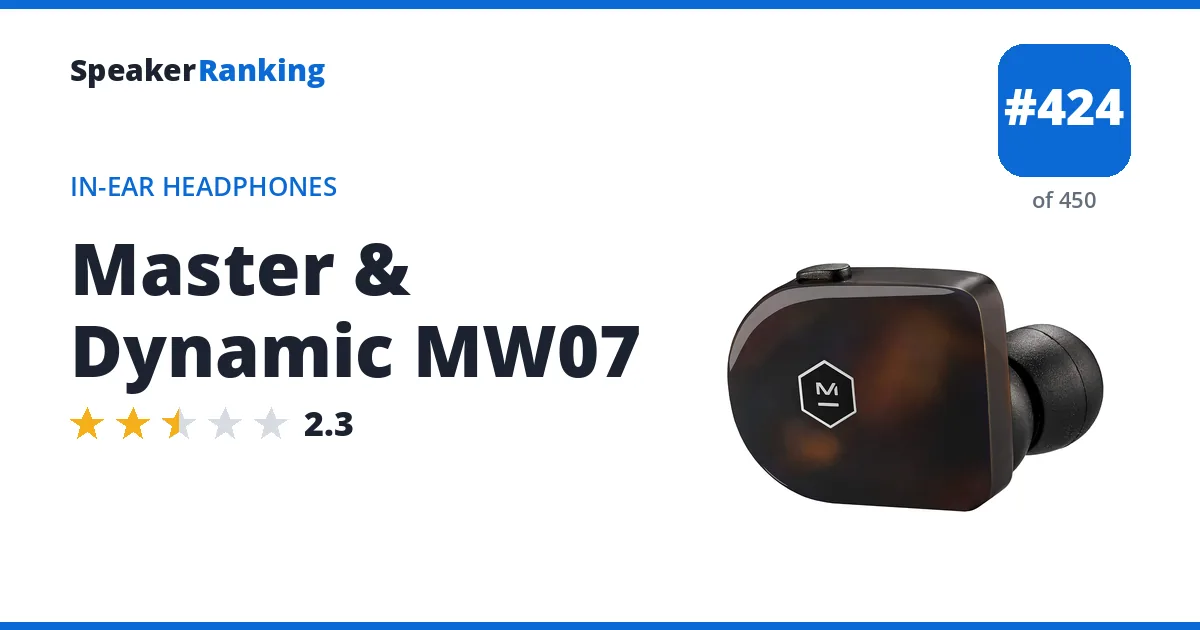
Pros: These true wireless earbuds support aptX alongside SBC for better quality from compatible Android phones, and an IPX4 rating protects them against sweat and splashes. A built-in microphone handles calls, and the case extends total playtime to about 14 hours.
Cons: Crinacle’s measurement gives it a preference score of 53, far from the balance most listeners prefer. Battery life is only about 3.5 hours per charge, there is no active noise cancelling, and Bluetooth 4.2 is dated. The Jabra Elite Active 65t rates higher at a similar price.
Full Master & Dynamic MW07 review and specifications →
| Released | Sep 2018 (8 years ago) |
|---|---|
| Active Noise Cancelling | No |
| Back | Closed |
| Battery Life | 3.5 hours (14 with case, Manufacturer specified) |
| Bluetooth Codecs | SBC, aptX |
| Bluetooth Version | 4.2 |
| Built-in Microphone | Yes |
| Connection | True wireless |
| Deviation From Target | 3.61 dB standard deviation |
| Driver Type | Dynamic |
| Drivers | 1 x 10mm dynamic |
| Form Factor | In-ear |
| Harman Preference Score | 53 (measured by crinacle, via AutoEQ) |
| IP Rating | IPX4 |
| Tonal Tilt | -0.75 (negative is warmer, positive brighter) |
| Weight | 0 lbs (9 g) per earbud |
EQ preset to match the Harman target
Set a preamp of -6.0 dB, then add these filters in any parametric equalizer (Wavelet, Equalizer APO, Peace, or a player with parametric EQ). Calculated by AutoEQ from its measured frequency response.
| Filter | Frequency | Gain | Q |
|---|---|---|---|
| Low shelf | 105 Hz | +0.2 dB | 0.70 |
| Peak | 2,136 Hz | +4.9 dB | 1.95 |
| Peak | 166 Hz | -5.2 dB | 0.54 |
| Peak | 5,807 Hz | -6.3 dB | 3.42 |
| Peak | 938 Hz | +4.7 dB | 0.91 |
| High shelf | 10,000 Hz | +3.8 dB | 0.70 |
| Peak | 9,393 Hz | +1.8 dB | 1.52 |
| Peak | 6,798 Hz | -2.1 dB | 4.67 |
| Peak | 3,625 Hz | -1.6 dB | 3.21 |
| Peak | 2,736 Hz | +0.9 dB | 4.33 |
- Reviews, Comparisons and Sound Samples
- Head-to-Head Comparisons
 1MORE Penta Driver: $139.99 Amazon eBay
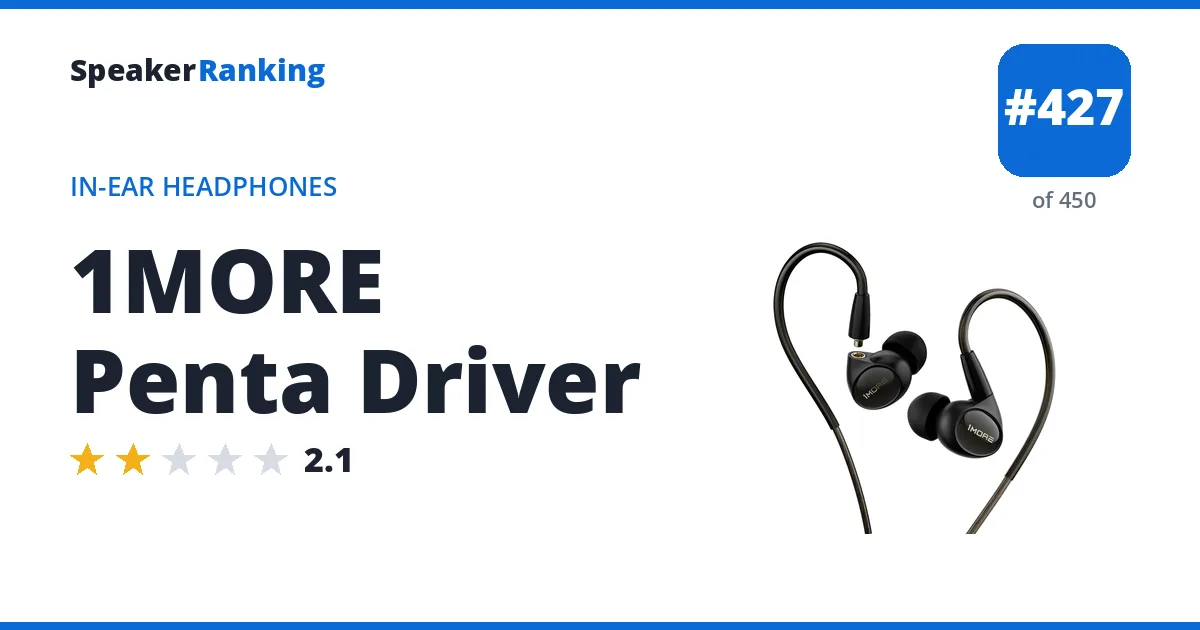
Pros: Bass sits about 1 dB above target between 60 and 200 Hz while the treble is pulled well back, so listeners who like a warm, dark presentation will find little that sounds sharp. Sub-bass stays within 6 dB of target down to 20 Hz, only 2.6 dB short at 30 Hz. At 32 ohms and 105 dB/mW it plays loud straight from a phone, and a built-in microphone handles calls.
Cons: A deep 13.5 dB dip at 6.6 kHz and a presence band nearly 8 dB below target leave vocals recessed and cymbals dull, which drags the preference score in HypetheSonics’ measurement down to 51. The Zero Audio Duoza ZH-DWX10 carries the same rating for considerably less money.
Full 1MORE Penta Driver review and specifications →
| Released | Aug 2023 (3 years ago) |
|---|---|
| Back | Closed |
| Built-in Microphone | Yes |
| Connection | Wired |
| Deviation From Target | 3.82 dB standard deviation |
| Driver Type | Hybrid (1 dynamic + 4 planar magnetic) |
| Drivers | 1 x dynamic + 4 x planar |
| Form Factor | In-ear |
| Frequency Response | 20Hz - 40kHz (Manufacturer specified) |
| Harman Preference Score | 51 (measured by HypetheSonics, via AutoEQ) |
| Impedance | 32 ohms |
| Sensitivity | 105 dB/mW |
| Sub-bass Extension | Within 6 dB of target down to 20 Hz (-2.6 dB at 30 Hz) |
| Tonal Tilt | -1.00 (negative is warmer, positive brighter) |
| Weight | 0 lbs (3.5 g) per earbud |
EQ preset to match the Harman target
Set a preamp of -6.2 dB, then add these filters in any parametric equalizer (Wavelet, Equalizer APO, Peace, or a player with parametric EQ). Calculated by AutoEQ from its measured frequency response.
| Filter | Frequency | Gain | Q |
|---|---|---|---|
| Low shelf | 105 Hz | +0.9 dB | 0.70 |
| Peak | 141 Hz | -4.1 dB | 0.58 |
| Peak | 7,515 Hz | +6.5 dB | 1.13 |
| Peak | 1,680 Hz | -5.4 dB | 1.73 |
| Peak | 3,040 Hz | +5.4 dB | 2.17 |
| High shelf | 10,000 Hz | -7.8 dB | 0.70 |
| Peak | 9,460 Hz | +3.7 dB | 2.61 |
| Peak | 652 Hz | +0.8 dB | 2.00 |
| Peak | 4,664 Hz | -2.0 dB | 6.00 |
| Peak | 5,733 Hz | +2.1 dB | 5.79 |
- Reviews, Comparisons and Sound Samples
- Head-to-Head Comparisons