Short answer: the KZ AS10, though neither ranks well in its class. It ranks #398 of 450 in-ear headphones by sound quality, rated 2.9/5, at $59.99; the Sennheiser CX 3.00 ranks #409, rated 2.7/5, and costs $79.99, so there is not much of a tradeoff to weigh. Both are rated below 3.0/5 among the 450 in-ear headphones, so if sound quality matters, consider the Intuaura Reference 2019 instead, ranked #5 at $34.99.

What the KZ AS10 does well: Five balanced armature drivers per side is an unusual layout at a modest price, and the bass sits about 6 dB above target between 60 and 200 Hz for listeners who want a thick, warm low end. Watch for: That bass boost spills into the low mids, 3.3 dB over target, which muddies voices and guitars, and a 6.4 dB peak near 11.9 kHz adds glare up top in hobbyist measurements on squig.link.
The case for the Sennheiser CX 3.00: Bass is boosted about 4 dB at 60 to 200 Hz and 2.5 dB below that in oratory1990’s measurement, so kick drums and bass lines hit with extra weight. The catch: A sharp 8.6 dB peak near 7.6 kHz can make hi-hats and sibilants harsh, and presence between 3 and 6 kHz is down about 4.3 dB, with a 5.7 dB dip near 3.5 kHz that pushes vocals back.
Buy the KZ AS10. It is rated higher for sound quality than the Sennheiser CX 3.00 and costs less, which makes it the one to get unless you need something the other one does better.
Looking for alternatives? See the complete Headphones rankings.
Specifications Side By Side
| KZ AS10 | Sennheiser CX 3.00 | |
|---|---|---|
| Price | $59.99 | $79.99 |
| Ranked | #398 of 450 in In-Ear Headphones | #409 of 450 in In-Ear Headphones |
| Form Factor | In-ear | In-ear |
| Harman Preference Score | 60 (measured by crinacle, via AutoEQ) | 58 (measured by oratory1990, via AutoEQ) |
| Deviation From Target | 2.91 dB standard deviation | 3.19 dB standard deviation |
| Tonal Tilt | -0.89 (negative is warmer, positive brighter) | -0.74 (negative is warmer, positive brighter) |
| Connection | Wired | Wired |
| Driver Type | Balanced armature | Dynamic |
| Drivers | 5 x balanced armature | - |
| Impedance | 14 ohms | 18 ohms |
| Sensitivity | 105 dB/mW | 118 dB SPL/V |
| Frequency Response | 20Hz - 40kHz (Manufacturer specified) | 17Hz - 21kHz (Manufacturer specified) |
| Back | Closed | Closed |
| Sub-bass Extension | Within 6 dB of target down to 20 Hz (+0.2 dB at 30 Hz) | Within 6 dB of target down to 20 Hz (+1.4 dB at 30 Hz) |
Related Headphone Comparisons
How KZ AS10 compares with other leading options:
- KZ AS10 vs 1MORE Triple Driver
- KZ AS10 vs Final Audio E3000
- KZ AS10 vs Tin HiFi T2 Evo
- Sennheiser CX 3.00 vs 1MORE Triple Driver
- Sennheiser CX 3.00 vs KZ ZAS
Prices on this page were last checked October 11, 2026 at 4:59 PM UTC. Product prices and availability are accurate as of that date/time and are subject to change; the price and availability shown on Amazon at the time of purchase will apply to the purchase of this product.
As an eBay Partner, we may be compensated if you make a purchase.
The Two Headphones In Full
 KZ AS10: $59.99 Amazon eBay
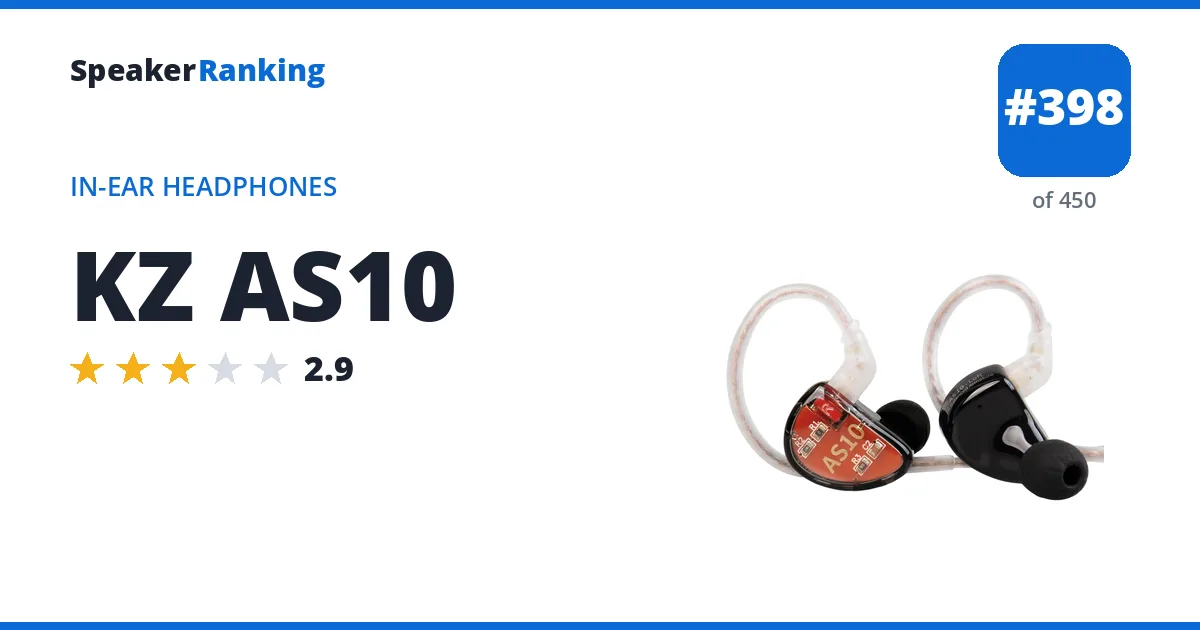
Pros: Five balanced armature drivers per side is an unusual layout at a modest price, and the bass sits about 6 dB above target between 60 and 200 Hz for listeners who want a thick, warm low end. It is rated above the Sennheiser CX 3.00, 1MORE Triple Driver and Questyle NHB12. At 14 ohms and 105 dB/mW it runs easily from a phone.
Cons: That bass boost spills into the low mids, 3.3 dB over target, which muddies voices and guitars, and a 6.4 dB peak near 11.9 kHz adds glare up top in hobbyist measurements on squig.link. Crinacle’s preference score of 60 shows how far the overall tuning is from what most listeners prefer, and there is no microphone.
Full KZ AS10 review and specifications →
| Released | 2019 (7 years ago) |
|---|---|
| Back | Closed |
| Connection | Wired |
| Deviation From Target | 2.91 dB standard deviation |
| Driver Type | Balanced armature |
| Drivers | 5 x balanced armature |
| Form Factor | In-ear |
| Frequency Response | 20Hz - 40kHz (Manufacturer specified) |
| Harman Preference Score | 60 (measured by crinacle, via AutoEQ) |
| Impedance | 14 ohms |
| Sensitivity | 105 dB/mW |
| Sub-bass Extension | Within 6 dB of target down to 20 Hz (+0.2 dB at 30 Hz) |
| Tonal Tilt | -0.89 (negative is warmer, positive brighter) |
EQ preset to match the Harman target
Set a preamp of -5.0 dB, then add these filters in any parametric equalizer (Wavelet, Equalizer APO, Peace, or a player with parametric EQ). Calculated by AutoEQ from its measured frequency response.
| Filter | Frequency | Gain | Q |
|---|---|---|---|
| Low shelf | 105 Hz | -1.0 dB | 0.70 |
| Peak | 157 Hz | -4.3 dB | 0.67 |
| Peak | 1,285 Hz | +4.5 dB | 0.47 |
| Peak | 3,019 Hz | -6.4 dB | 2.71 |
| Peak | 298 Hz | -1.2 dB | 1.07 |
| High shelf | 10,000 Hz | +5.0 dB | 0.70 |
| Peak | 5,029 Hz | -5.0 dB | 5.86 |
| Peak | 6,215 Hz | +2.7 dB | 5.38 |
| Peak | 2,075 Hz | +1.1 dB | 3.28 |
| Peak | 1,354 Hz | -0.8 dB | 3.11 |
- Reviews, Comparisons and Sound Samples
- Head-to-Head Comparisons
 Sennheiser CX 3.00: $79.99 Amazon eBay

Pros: Bass is boosted about 4 dB at 60 to 200 Hz and 2.5 dB below that in oratory1990’s measurement, so kick drums and bass lines hit with extra weight. Treble from 6 to 10 kHz is lifted about 6 dB, which adds a bright edge to cymbals and gives it a V-shaped character some listeners enjoy. The 18 ohm impedance and 118 dB SPL/V sensitivity let a phone drive it easily.
Cons: A sharp 8.6 dB peak near 7.6 kHz can make hi-hats and sibilants harsh, and presence between 3 and 6 kHz is down about 4.3 dB, with a 5.7 dB dip near 3.5 kHz that pushes vocals back. A preference score of 58 and a 3.19 dB deviation mean the balance is far from the target. The Shure SE215 and FiiO FH3 are rated higher.
Full Sennheiser CX 3.00 review and specifications →
| Released | 2015 (11 years ago) |
|---|---|
| Back | Closed |
| Connection | Wired |
| Deviation From Target | 3.19 dB standard deviation |
| Driver Type | Dynamic |
| Form Factor | In-ear |
| Frequency Response | 17Hz - 21kHz (Manufacturer specified) |
| Harman Preference Score | 58 (measured by oratory1990, via AutoEQ) |
| Impedance | 18 ohms |
| Sensitivity | 118 dB SPL/V |
| Sub-bass Extension | Within 6 dB of target down to 20 Hz (+1.4 dB at 30 Hz) |
| Tonal Tilt | -0.74 (negative is warmer, positive brighter) |
EQ preset to match the Harman target
Set a preamp of -5.3 dB, then add these filters in any parametric equalizer (Wavelet, Equalizer APO, Peace, or a player with parametric EQ). Calculated by AutoEQ from its measured frequency response.
| Filter | Frequency | Gain | Q |
|---|---|---|---|
| Low shelf | 105 Hz | -2.1 dB | 0.70 |
| Peak | 3,874 Hz | +7.0 dB | 0.66 |
| Peak | 7,101 Hz | -10.4 dB | 0.77 |
| Peak | 167 Hz | -3.4 dB | 1.15 |
| Peak | 4,954 Hz | +4.9 dB | 1.44 |
| High shelf | 10,000 Hz | +0.3 dB | 0.70 |
| Peak | 736 Hz | +1.5 dB | 1.33 |
| Peak | 1,412 Hz | -1.1 dB | 2.20 |
| Peak | 55 Hz | +0.4 dB | 1.63 |
| Peak | 314 Hz | -1.0 dB | 3.41 |
- Reviews, Comparisons and Sound Samples
- Head-to-Head Comparisons