Short answer: the KRK Rokit 7 G5. Both are rated 4.0/5 for sound quality (#84 and #87 of 118 powered bookshelf speakers), and the KRK Rokit 7 G5 costs $538 against $599.98 for the Mackie MR824, so with nothing between them on sound quality, price settles it.
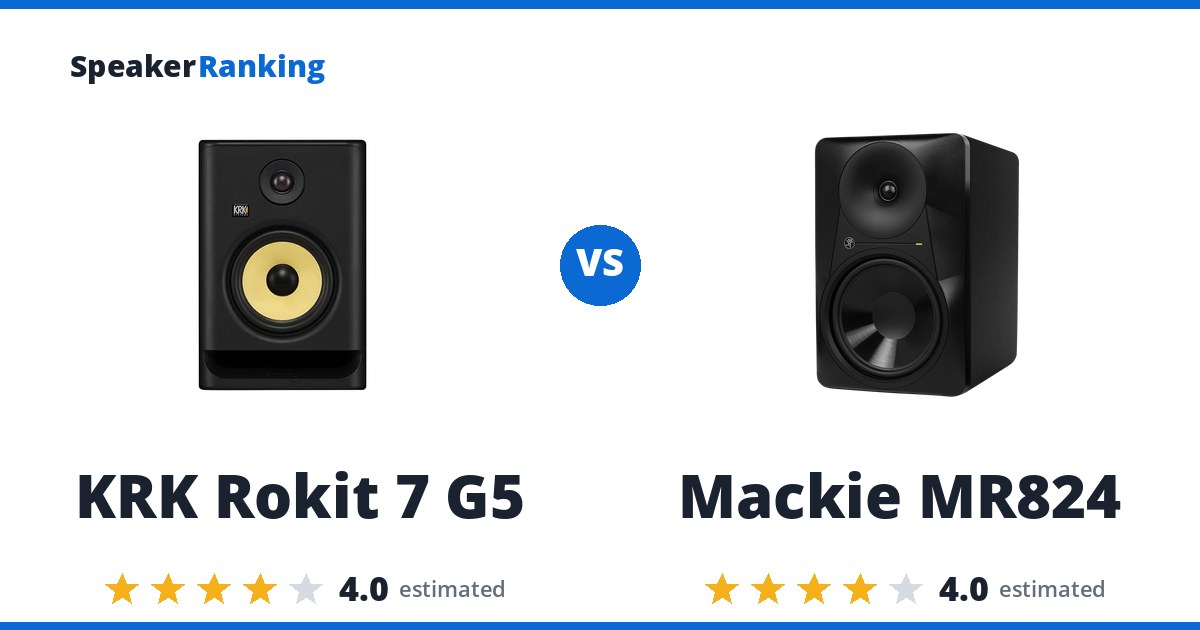
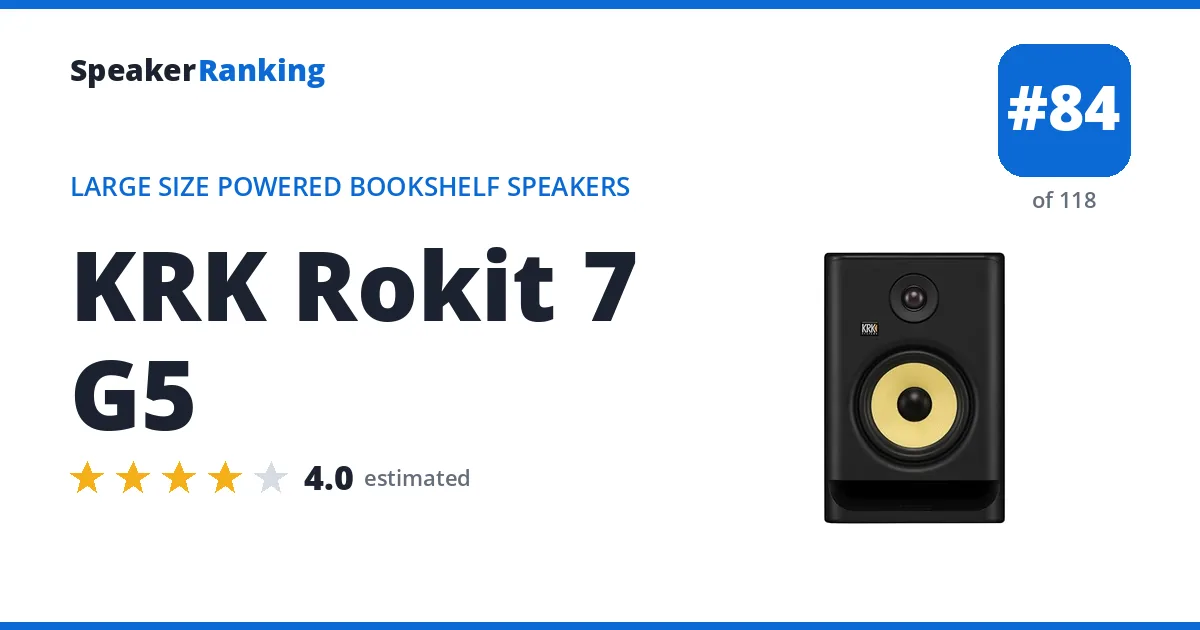
The case for the KRK Rokit 7 G5: 7-inch bi-amplified nearfield studio monitor in KRK’s fifth-generation Rokit line featuring custom 145W Class-D power. The catch: Rating estimated based on Generation 5 sibling acoustic architecture and G4 laboratory testing.
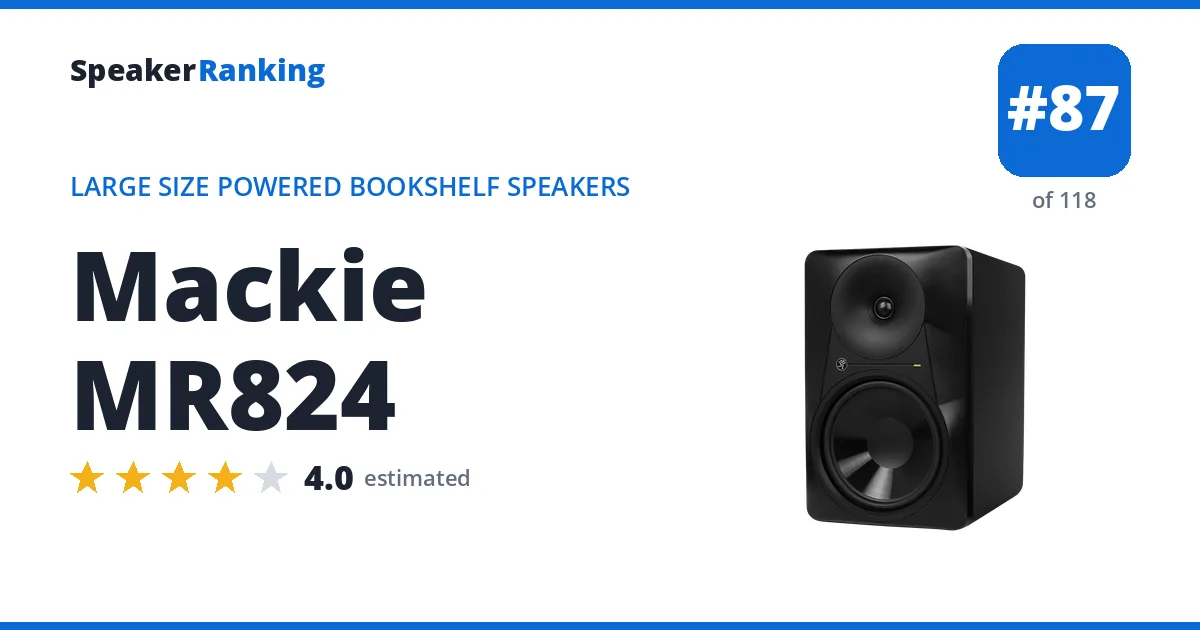
What the Mackie MR824 does well: A larger sibling of the Mackie MR524 using the same logarithmic waveguide, which spreads the treble wide for a broad sweet spot. Watch for: No independent measurements yet, so its tonal balance and directivity can’t be compared directly with measured speakers; the rating is estimated from the measured Mackie MR524, which measured slightly bright.
Buy the KRK Rokit 7 G5. Both are rated the same for sound quality, and it costs $61.98 less than the Mackie MR824.
About the ratings: neither speaker has been measured yet, so both ratings are estimated from measured siblings and predecessors (likely ranges: KRK Rokit 7 G5 3.8 to 4.2; Mackie MR824 3.6 to 4.3). Treat this verdict as provisional.
Want more options? Browse the full Powered Home rankings.
Specifications Side By Side
| KRK Rokit 7 G5 | Mackie MR824 | |
|---|---|---|
| Price | $538 per pair | $599.98 per pair |
| Ranked | #84 of 118 in Large Size Powered Bookshelf Speakers Estimated | #87 of 118 in Large Size Powered Bookshelf Speakers Estimated |
| Amplifier Power | 145W (97W LF + 48W HF, Class D) | 85W Class A/B bi-amplified per speaker |
| Crossover Frequency | 1.7kHz | - |
| Dimensions | 13.3” x 8.9” x 11.4” (339 x 225 x 290 mm) | 15.8”H x 10.9”W x 13.2”D (401 x 277 x 335 mm) |
| Drivers | 1” silk dome copper cap tweeter, 7” woven Kevlar aramid fiber woofer | 8” polypropylene woofer, 1” silk-dome tweeter |
| Frequency Response | 45Hz - 36kHz (±3dB) | 35Hz - 20kHz |
| Weight | 16.9 lbs (7.65 kg) each | 22.9 lbs (10.4 kg) |
| Bluetooth | No | No |
| Inputs | - | Balanced XLR, balanced TRS, RCA |
| XLR Input | - | Yes |
| RCA Input | - | Yes |
| TRS Input | - | Yes |
| Optical Input | - | No |
| Coaxial Input | - | No |
| USB Input | - | No |
| HDMI Input | - | No |
| AES Input | - | No |
| Aux Input | - | No |
Related Speaker Comparisons
How KRK Rokit 7 G5 compares with other leading options:
- KRK Rokit 7 G5 vs KRK Rokit 8 G5
- KRK Rokit 7 G5 vs Mackie MR624
- KRK Rokit 7 G5 vs Pioneer DJ VM-70
- KRK Rokit 7 G5 vs KRK Rokit 8 G4
- KRK Rokit 7 G5 vs KRK Rokit 7 G4
Prices on this page were last checked October 11, 2026 at 4:59 PM UTC. Product prices and availability are accurate as of that date/time and are subject to change; the price and availability shown on Amazon at the time of purchase will apply to the purchase of this product.
As an eBay Partner, we may be compensated if you make a purchase.
The Two Speakers In Full
 KRK Rokit 7 G5: $538 per pair Estimated Amazon eBay
Older model: the KRK Rokit 7 G4 (ranked lower, rated 3.9/5). See every KRK Rokit generation.
Same family: the KRK Rokit 5 G5 (smaller bookshelf, estimated 3.8/5) and the KRK Rokit 8 G5 (larger bookshelf, ranked higher, estimated 4/5).
Pros: 7-inch bi-amplified nearfield studio monitor in KRK’s fifth-generation Rokit line featuring custom 145W Class-D power. Introduces three onboard DSP voicing profiles: Mix Mode (linear, flat monitoring), Create Mode (inspirational listening), and Focus Mode (midrange critical analysis). Woven Kevlar aramid fiber woofer and front-firing port produce low-distortion bass extension down to 45Hz, bridging the gap between the KRK Rokit 5 G5 and KRK Rokit 8 G5.
Cons: Rating estimated based on Generation 5 sibling acoustic architecture and G4 laboratory testing. Substantial enclosure size requires adequate desk space or sturdy monitor stands.
Full KRK Rokit 7 G5 review and specifications →
| Released | Mar 2024 (2 years ago) |
|---|---|
| Amplifier Power | 145W (97W LF + 48W HF, Class D) |
| Bluetooth | No |
| Crossover Frequency | 1.7kHz |
| Dimensions | 13.3” x 8.9” x 11.4” (339 x 225 x 290 mm) |
| Drivers | 1” silk dome copper cap tweeter, 7” woven Kevlar aramid fiber woofer |
| Frequency Response | 45Hz - 36kHz (±3dB) |
| Weight | 16.9 lbs (7.65 kg) each |
- Links
- Reviews, Comparisons and Sound Samples
- Head-to-Head Comparisons
 Mackie MR824: $599.98 per pair Estimated B&H Photo Video eBay
Same family: the Mackie MR524 (smaller bookshelf, rated 4/5) and the Mackie MR624 (smaller bookshelf, ranked higher, estimated 4/5).
Pros: A larger sibling of the Mackie MR524 using the same logarithmic waveguide, which spreads the treble wide for a broad sweet spot. An 8” polypropylene woofer and 1” silk-dome tweeter are bi-amplified with 85W, and Mackie specifies 35Hz to 20kHz. The 8” woofer gives it the most bass reach and output in the MR range. Balanced XLR and TRS plus RCA inputs, three acoustic space settings for wall or corner placement and a treble trim make it easy to set up in a home studio.
Cons: No independent measurements yet, so its tonal balance and directivity can’t be compared directly with measured speakers; the rating is estimated from the measured Mackie MR524, which measured slightly bright. Room correction is limited to simple boundary and treble switches, with no parametric EQ.
Full Mackie MR824 review and specifications →
| Released | 2018 (8 years ago) |
|---|---|
| AES Input | No |
| Amplifier Power | 85W Class A/B bi-amplified per speaker |
| Aux Input | No |
| Bluetooth | No |
| Coaxial Input | No |
| Dimensions | 15.8”H x 10.9”W x 13.2”D (401 x 277 x 335 mm) |
| Drivers | 8” polypropylene woofer, 1” silk-dome tweeter |
| Frequency Response | 35Hz - 20kHz |
| HDMI Input | No |
| Inputs | Balanced XLR, balanced TRS, RCA |
| Optical Input | No |
| RCA Input | Yes |
| TRS Input | Yes |
| USB Input | No |
| Weight | 22.9 lbs (10.4 kg) |
| XLR Input | Yes |
- Links
- Reviews, Comparisons and Sound Samples
- No independent measurement review is linked for this model; it is ranked from hands-on listening and comparison against similarly priced speakers.
- Head-to-Head Comparisons