Short answer: the HEDD Heddphone 2. It ranks #172 of 216 over-ear headphones by sound quality, rated 3.0/5, at $1,999; the Dan Clark Audio Voce ranks #179, rated 2.9/5, and costs $2,599, so there is little reason to consider the other one.

The case for the HEDD Heddphone 2: A full range Air Motion Transformer driver sets it apart from conventional dynamic and planar designs, and the open back gives a spacious presentation. Watch for: oratory1990’s measurement shows treble about 8.9 dB below target with an 11.8 dB dip near 9.6 kHz, which leaves cymbals and air sounding muffled, and sub-bass falls 6 dB short by 47 Hz.
What the Dan Clark Audio Voce does well: It uses an 88mm electrostatic driver in an open back design, a rare driver type among current headphones. The tradeoff: A preference score of 56 from crinacle’s measurement puts its tonal balance far from what most listeners prefer.
Buy the HEDD Heddphone 2. It is rated higher for sound quality than the Dan Clark Audio Voce and costs less, so it is the default pick unless a specific strength of the other one matters more to you.
Looking for alternatives? See the complete Headphones rankings.
Specifications Side By Side
| HEDD Heddphone 2 | Dan Clark Audio Voce | |
|---|---|---|
| Price | $1,999.00 | $2,599.00 |
| Ranked | #172 of 216 in Over-Ear Headphones | #179 of 216 in Over-Ear Headphones |
| Form Factor | Over-ear | Over-ear |
| Harman Preference Score | 60 (measured by oratory1990, via AutoEQ) | 56 (measured by crinacle, via AutoEQ) |
| Deviation From Target | 3.17 dB standard deviation | 4.06 dB standard deviation |
| Tonal Tilt | -0.95 (negative is warmer, positive brighter) | -0.48 (negative is warmer, positive brighter) |
| Sub-bass Extension | Falls 6 dB below target at 47 Hz (-7.7 dB at 30 Hz) | - |
| Connection | Wired | Wired |
| Back | Open | Open |
| Driver Type | Air Motion Transformer | Electrostatic |
| Drivers | 1 x Air Motion Transformer (full range) | 1 x 88mm electrostatic |
| Impedance | 41 ohms | - |
| Sensitivity | 89 dB/mW | - |
| Weight | 1.2 lbs (550 g) | - |
| Frequency Response | 10Hz - 40kHz (Manufacturer specified) | - |
| Built-in Microphone | No | No |
Related Headphone Comparisons
How HEDD Heddphone 2 compares with other leading options:
- Audio-Technica ATH-AWKT vs HEDD Heddphone 2
- Fostex TH909 vs HEDD Heddphone 2
- Audeze LCD-3 vs HEDD Heddphone 2
- HEDD Heddphone 2 vs Focal Stellia
- HEDD Heddphone 2 vs Sennheiser HD 820
Prices on this page were last checked October 11, 2026 at 4:59 PM UTC. Product prices and availability are accurate as of that date/time and are subject to change; the price and availability shown on Amazon at the time of purchase will apply to the purchase of this product.
As an eBay Partner, we may be compensated if you make a purchase.
The Two Headphones In Full
 HEDD Heddphone 2: $1,999.00 HEDD eBay

Pros: A full range Air Motion Transformer driver sets it apart from conventional dynamic and planar designs, and the open back gives a spacious presentation. In oratory1990’s measurement the low mids sit about 0.8 dB above target, and its warm tilt suits listeners who dislike bright treble. Its rating equals the Audeze LCD-3 and sits above the Dan Clark Audio Voce.
Cons: oratory1990’s measurement shows treble about 8.9 dB below target with an 11.8 dB dip near 9.6 kHz, which leaves cymbals and air sounding muffled, and sub-bass falls 6 dB short by 47 Hz. At 89 dB/mW it needs a dedicated headphone amp to reach comfortable levels. It weighs 550 g, and the open back leaks sound and offers no isolation. See headphone amps and DACs with enough power to drive it.
Full HEDD Heddphone 2 review and specifications →
| Back | Open |
|---|---|
| Built-in Microphone | No |
| Connection | Wired |
| Deviation From Target | 3.17 dB standard deviation |
| Driver Type | Air Motion Transformer |
| Drivers | 1 x Air Motion Transformer (full range) |
| Form Factor | Over-ear |
| Frequency Response | 10Hz - 40kHz (Manufacturer specified) |
| Harman Preference Score | 60 (measured by oratory1990, via AutoEQ) |
| Impedance | 41 ohms |
| Sensitivity | 89 dB/mW |
| Sub-bass Extension | Falls 6 dB below target at 47 Hz (-7.7 dB at 30 Hz) |
| Tonal Tilt | -0.95 (negative is warmer, positive brighter) |
| Weight | 1.2 lbs (550 g) |
EQ preset to match the Harman target
Set a preamp of -6.0 dB, then add these filters in any parametric equalizer (Wavelet, Equalizer APO, Peace, or a player with parametric EQ). Calculated by AutoEQ from its measured frequency response.
| Filter | Frequency | Gain | Q |
|---|---|---|---|
| Low shelf | 105 Hz | +7.1 dB | 0.70 |
| Peak | 126 Hz | -3.6 dB | 0.26 |
| Peak | 6,938 Hz | +5.6 dB | 1.34 |
| Peak | 1,094 Hz | -2.8 dB | 3.12 |
| Peak | 9,336 Hz | +3.0 dB | 2.62 |
| High shelf | 10,000 Hz | -4.4 dB | 0.70 |
| Peak | 2,136 Hz | +3.1 dB | 2.31 |
| Peak | 1,441 Hz | -1.4 dB | 3.31 |
| Peak | 3,207 Hz | -1.8 dB | 5.46 |
| Peak | 131 Hz | +0.4 dB | 2.04 |
- Reviews, Comparisons and Sound Samples
- Head-to-Head Comparisons
 Dan Clark Audio Voce: $2,599.00 Amazon eBay
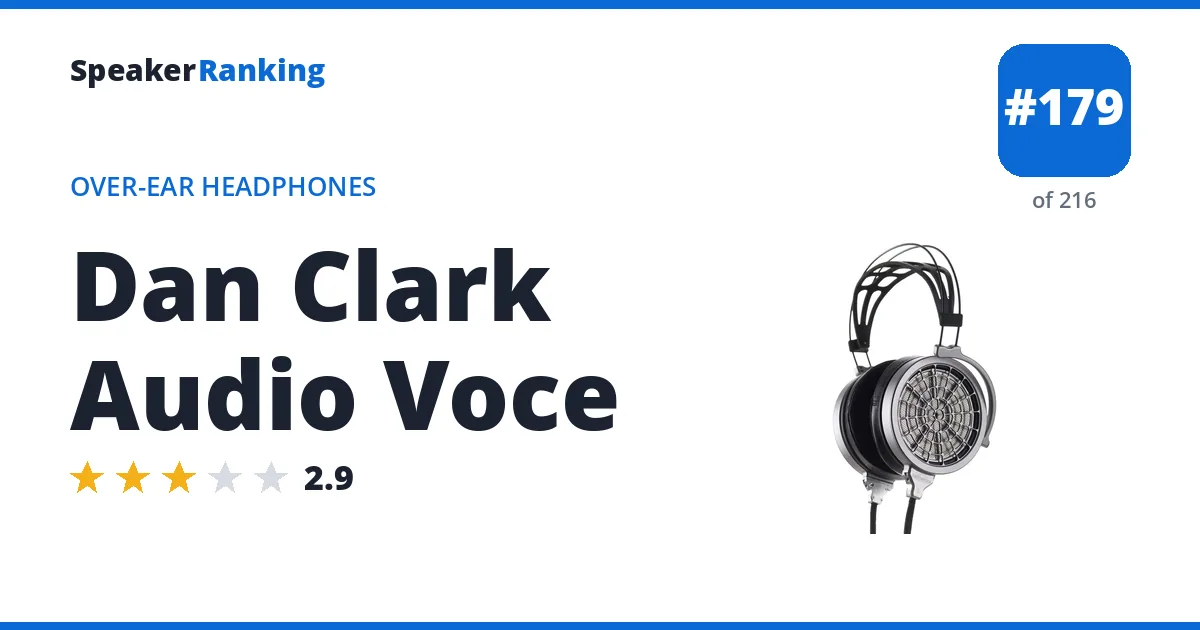
Pros: It uses an 88mm electrostatic driver in an open back design, a rare driver type among current headphones. It is rated above the Sennheiser HD 820 and the AKG K872 Pro and rated the same as the more expensive Focal Stellia.
Cons: A preference score of 56 from crinacle’s measurement puts its tonal balance far from what most listeners prefer. As an electrostatic design it needs a dedicated energizer rather than a normal headphone amp, which adds substantially to the system cost. The Audeze LCD-3 earns a higher rating for less money.
Full Dan Clark Audio Voce review and specifications →
| Released | 2018 (8 years ago) |
|---|---|
| Back | Open |
| Built-in Microphone | No |
| Connection | Wired |
| Deviation From Target | 4.06 dB standard deviation |
| Driver Type | Electrostatic |
| Drivers | 1 x 88mm electrostatic |
| Form Factor | Over-ear |
| Harman Preference Score | 56 (measured by crinacle, via AutoEQ) |
| Tonal Tilt | -0.48 (negative is warmer, positive brighter) |
EQ preset to match the Harman target
Set a preamp of -6.9 dB, then add these filters in any parametric equalizer (Wavelet, Equalizer APO, Peace, or a player with parametric EQ). Calculated by AutoEQ from its measured frequency response.
| Filter | Frequency | Gain | Q |
|---|---|---|---|
| Low shelf | 105 Hz | +6.3 dB | 0.70 |
| Peak | 1,149 Hz | -7.5 dB | 1.65 |
| Peak | 273 Hz | -1.7 dB | 0.18 |
| Peak | 2,121 Hz | +5.4 dB | 1.37 |
| Peak | 8,560 Hz | +5.7 dB | 1.81 |
| High shelf | 10,000 Hz | +3.7 dB | 0.70 |
| Peak | 4,724 Hz | -4.6 dB | 5.65 |
| Peak | 3,207 Hz | +2.8 dB | 6.00 |
| Peak | 79 Hz | -0.7 dB | 2.76 |
| Peak | 5,558 Hz | +1.9 dB | 6.00 |
- Reviews, Comparisons and Sound Samples
- Head-to-Head Comparisons