Short answer: the Dan Clark Audio Voce, though neither ranks well in its class. It ranks #179 of 216 over-ear headphones by sound quality, rated 2.9/5, at $2,599; the Yamaha YH-5000SE ranks #190, rated 2.7/5, and costs $4,999.95, so there is not much of a tradeoff to weigh. Both are rated below 3.0/5 among the 216 over-ear headphones, and the Dan Clark Audio E3, ranked #1 at $2,299, is a better place to start if sound quality matters.
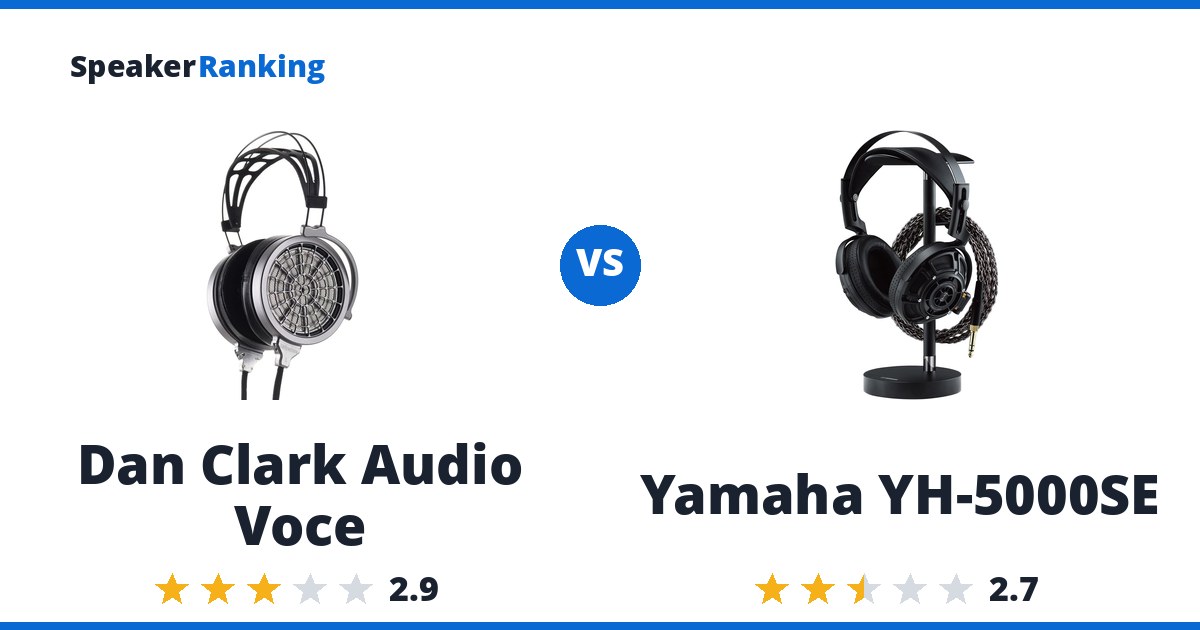
Why pick the Dan Clark Audio Voce: It uses an 88mm electrostatic driver in an open back design, a rare driver type among current headphones. The catch: A preference score of 56 from crinacle’s measurement puts its tonal balance far from what most listeners prefer.
What the Yamaha YH-5000SE does well: The open back planar magnetic driver has a 34 ohm, 98 dB/mW load that a phone or small dongle can drive. The catch: In oratory1990’s measurement a deep 16.7 dB dip near 2.75 kHz and a presence band 6.9 dB under target push vocals and lead instruments far back, for a preference score of 52 with 3.88 dB of deviation.
Buy the Dan Clark Audio Voce. It is rated higher for sound quality than the Yamaha YH-5000SE and costs less, so it is the default pick unless a specific strength of the other one matters more to you.
Still deciding? The full Headphones rankings cover every ranked option.
Specifications Side By Side
| Dan Clark Audio Voce | Yamaha YH-5000SE | |
|---|---|---|
| Price | $2,599.00 | $4,999.95 |
| Ranked | #179 of 216 in Over-Ear Headphones | #190 of 216 in Over-Ear Headphones |
| Form Factor | Over-ear | Over-ear |
| Harman Preference Score | 56 (measured by crinacle, via AutoEQ) | 52 (measured by oratory1990, via AutoEQ) |
| Deviation From Target | 4.06 dB standard deviation | 3.88 dB standard deviation |
| Tonal Tilt | -0.48 (negative is warmer, positive brighter) | -0.90 (negative is warmer, positive brighter) |
| Connection | Wired | Wired |
| Back | Open | Open |
| Driver Type | Electrostatic | Planar magnetic |
| Drivers | 1 x 88mm electrostatic | 1 x planar magnetic (Orthodynamic) |
| Built-in Microphone | No | No |
| Sub-bass Extension | - | Falls 6 dB below target at 27 Hz (-5.4 dB at 30 Hz) |
| Impedance | - | 34 ohms |
| Sensitivity | - | 98 dB/mW |
| Weight | - | 0.7 lbs (320 g) |
| Frequency Response | - | 5Hz - 70kHz (Manufacturer specified) |
Related Headphone Comparisons
How Dan Clark Audio Voce compares with other leading options:
- Audeze LCD-3 vs Dan Clark Audio Voce
- HEDD Heddphone 2 vs Dan Clark Audio Voce
- Dan Clark Audio Voce vs Focal Stellia
- Dan Clark Audio Voce vs Audeze LCD-4z
- Audeze LCD-4z vs Yamaha YH-5000SE
Prices on this page were last checked October 11, 2026 at 4:59 PM UTC. Product prices and availability are accurate as of that date/time and are subject to change; the price and availability shown on Amazon at the time of purchase will apply to the purchase of this product.
As an eBay Partner, we may be compensated if you make a purchase.
The Two Headphones In Full
 Dan Clark Audio Voce: $2,599.00 Amazon eBay
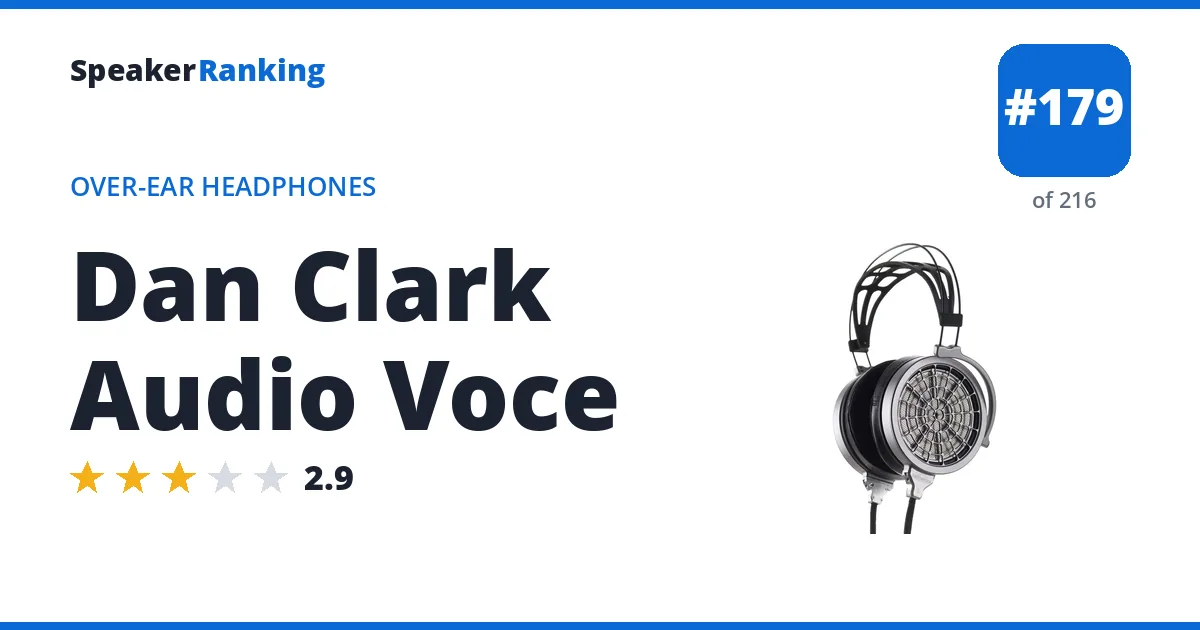
Pros: It uses an 88mm electrostatic driver in an open back design, a rare driver type among current headphones. It is rated above the Sennheiser HD 820 and the AKG K872 Pro and rated the same as the more expensive Focal Stellia.
Cons: A preference score of 56 from crinacle’s measurement puts its tonal balance far from what most listeners prefer. As an electrostatic design it needs a dedicated energizer rather than a normal headphone amp, which adds substantially to the system cost. The Audeze LCD-3 earns a higher rating for less money.
Full Dan Clark Audio Voce review and specifications →
| Released | 2018 (8 years ago) |
|---|---|
| Back | Open |
| Built-in Microphone | No |
| Connection | Wired |
| Deviation From Target | 4.06 dB standard deviation |
| Driver Type | Electrostatic |
| Drivers | 1 x 88mm electrostatic |
| Form Factor | Over-ear |
| Harman Preference Score | 56 (measured by crinacle, via AutoEQ) |
| Tonal Tilt | -0.48 (negative is warmer, positive brighter) |
EQ preset to match the Harman target
Set a preamp of -6.9 dB, then add these filters in any parametric equalizer (Wavelet, Equalizer APO, Peace, or a player with parametric EQ). Calculated by AutoEQ from its measured frequency response.
| Filter | Frequency | Gain | Q |
|---|---|---|---|
| Low shelf | 105 Hz | +6.3 dB | 0.70 |
| Peak | 1,149 Hz | -7.5 dB | 1.65 |
| Peak | 273 Hz | -1.7 dB | 0.18 |
| Peak | 2,121 Hz | +5.4 dB | 1.37 |
| Peak | 8,560 Hz | +5.7 dB | 1.81 |
| High shelf | 10,000 Hz | +3.7 dB | 0.70 |
| Peak | 4,724 Hz | -4.6 dB | 5.65 |
| Peak | 3,207 Hz | +2.8 dB | 6.00 |
| Peak | 79 Hz | -0.7 dB | 2.76 |
| Peak | 5,558 Hz | +1.9 dB | 6.00 |
- Reviews, Comparisons and Sound Samples
- Head-to-Head Comparisons
 Yamaha YH-5000SE: $4,999.95 Amazon eBay
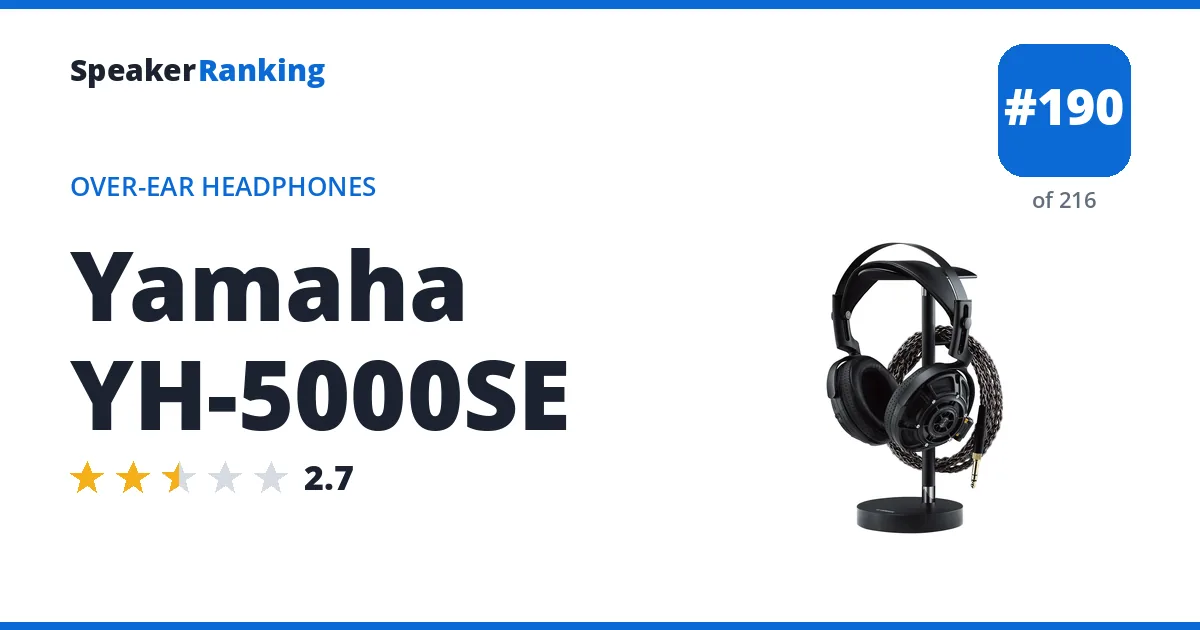
Pros: The open back planar magnetic driver has a 34 ohm, 98 dB/mW load that a phone or small dongle can drive. Its warm tilt suits listeners who prefer a relaxed, bass-leaning balance over a bright one. At 320 g it is moderate in weight for a planar headphone.
Cons: In oratory1990’s measurement a deep 16.7 dB dip near 2.75 kHz and a presence band 6.9 dB under target push vocals and lead instruments far back, for a preference score of 52 with 3.88 dB of deviation. Sub-bass also sits 6 dB below target, and the open back leaks sound. The Audeze LCD-2 Closed Back rates far higher for much less money.
Full Yamaha YH-5000SE review and specifications →
| Released | Dec 2022 (3 years ago) |
|---|---|
| Back | Open |
| Built-in Microphone | No |
| Connection | Wired |
| Deviation From Target | 3.88 dB standard deviation |
| Driver Type | Planar magnetic |
| Drivers | 1 x planar magnetic (Orthodynamic) |
| Form Factor | Over-ear |
| Frequency Response | 5Hz - 70kHz (Manufacturer specified) |
| Harman Preference Score | 52 (measured by oratory1990, via AutoEQ) |
| Impedance | 34 ohms |
| Sensitivity | 98 dB/mW |
| Sub-bass Extension | Falls 6 dB below target at 27 Hz (-5.4 dB at 30 Hz) |
| Tonal Tilt | -0.90 (negative is warmer, positive brighter) |
| Weight | 0.7 lbs (320 g) |
EQ preset to match the Harman target
Set a preamp of -6.6 dB, then add these filters in any parametric equalizer (Wavelet, Equalizer APO, Peace, or a player with parametric EQ). Calculated by AutoEQ from its measured frequency response.
| Filter | Frequency | Gain | Q |
|---|---|---|---|
| Low shelf | 105 Hz | +9.4 dB | 0.70 |
| Peak | 2,812 Hz | +6.8 dB | 1.88 |
| Peak | 1,242 Hz | -7.9 dB | 2.00 |
| Peak | 57 Hz | -8.0 dB | 0.46 |
| Peak | 3,792 Hz | +2.7 dB | 5.86 |
| High shelf | 10,000 Hz | -5.1 dB | 0.70 |
| Peak | 9,174 Hz | +2.0 dB | 0.67 |
| Peak | 326 Hz | -0.9 dB | 2.14 |
| Peak | 230 Hz | +0.8 dB | 2.83 |
| Peak | 4,523 Hz | -2.0 dB | 6.00 |
- Reviews, Comparisons and Sound Samples
- Head-to-Head Comparisons