Short answer: the GR-Research LGK 2.0, though neither ranks well in its class. Both are rated 2.8/5 for sound quality (#117 and #114 of 168 bookshelf speakers), and the GR-Research LGK 2.0 costs $290 against $476.70 for the MartinLogan Motion 4i, with sound quality a draw, the lower price decides it. Both are rated below 3.0/5 among the 168 bookshelf speakers; for better sound, the Ascend Acoustics HTM-200SE2 ranks #7 at $368.
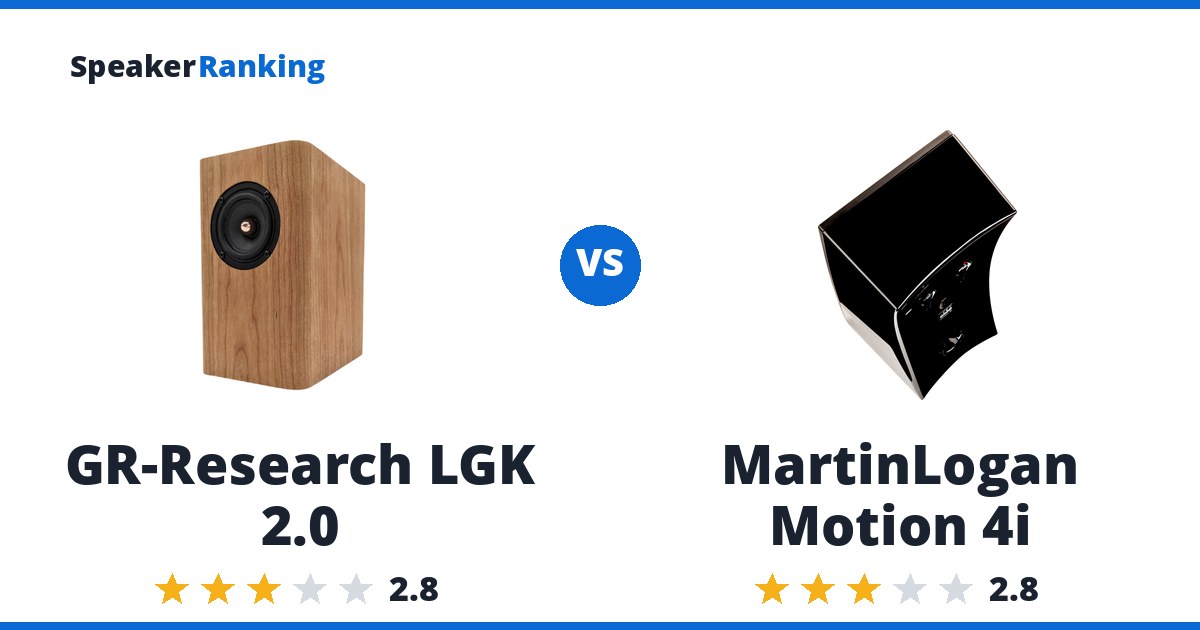
The GR-Research LGK 2.0 is the more accurate, deeper-bass option. A small kit speaker from GR Research built around a single 3” wide-band driver, sold as a kit or flat-pack for desktops and near-field listening. Its measured preference score, a predictor of how neutral it sounds, is 3.31 against 2.73 for the MartinLogan Motion 4i. Its bass reaches about 79.1Hz before falling 3dB, against 159.7Hz for the MartinLogan Motion 4i. The tradeoff: Sensitivity is low at 84dB.
What the MartinLogan Motion 4i does well: Best treated as a satellite: crossing it to a subwoofer lifts its predicted preference score from 2.73 to 6.36, so the shallow bass matters far less in a 2.1 or home-theater setup. The catch: Bass-shy to the point of needing a subwoofer: the measured -3dB point is 159.7Hz, so on its own it produces almost nothing below roughly 160Hz.
Buy the GR-Research LGK 2.0. Both are rated the same for sound quality, and it costs $186.70 less than the MartinLogan Motion 4i.
Still deciding? The full Passive Home rankings cover every ranked option.
Specifications Side By Side
| GR-Research LGK 2.0 | MartinLogan Motion 4i | |
|---|---|---|
| Price | $290 per pair kit | $476.70 per pair |
| Ranked | #117 of 168 in Medium Size Bookshelf Speakers | #114 of 168 in Medium Size Bookshelf Speakers |
| Weight | 7.9 lbs (3.6 kg) | 6 lbs (2.72 kg) |
| Drivers | 3” wide-band driver | 1” x 1.4” Folded Motion tweeter, 4” paper cone woofer |
| Sensitivity | 84dB (manufacturer specified) | 87.5dB (2.83V/1m, measured, Audio Science Review) |
| Frequency Response | 80Hz-20kHz (manufacturer specified) | 70Hz - 23kHz (±3dB, Manufacturer specified) |
| Bass Extension (-3dB) | 79.1Hz (measured, Audio Science Review) | 159.7Hz (measured, Audio Science Review via spinorama.org) |
| Bass Extension (-10dB) | about 63.0Hz (measured, Audio Science Review) | about 67.1Hz (measured, Audio Science Review) |
| Spinorama Preference Score | 3.31 | 2.73 |
| Spinorama Preference Score with Perfect Sub | 6.23 | 6.36 |
| DIY Kit | Yes | No |
| Configuration | - | Passive 2-way bookshelf speaker |
| Enclosure | - | ported, rear |
| Crossover Frequency | - | 2,900 Hz |
| Coverage | - | 80° x 80° |
| Impedance | - | 4 ohms nominal |
| Recommended Power | - | 20-150W |
| Dimensions | - | 12.6” x 5.6” x 5.7” (320 x 143 x 145 mm) (H x W x D) |
| Country | - | United States (design) |
| Measurement Source | - | Audio Science Review |
Frequency Response Compared
Both speakers’ spinorama measurements, overlaid. A flatter line is more neutral: peaks sound forward or harsh, dips sound recessed. Each curve is shifted so its average from 300 Hz to 3 kHz sits at 0 dB, so loudness differences between the two are removed and only the shape is compared.
Measurement data: GR-Research LGK 2.0 (measured by Audio Science Review) and MartinLogan Motion 4i (measured by Audio Science Review), via spinorama.org.
Related Speaker Comparisons
More top alternatives to MartinLogan Motion 4i:
- ELAC Debut 2.0 B5.2 vs MartinLogan Motion 4i
- JBL Stage 250B vs MartinLogan Motion 4i
- MartinLogan Motion 4i vs Pioneer SP-BS22-LR (Philharmonic AAM Mod)
- MartinLogan Motion 4i vs Triangle Borea BR02
- GR-Research LGK 2.0 vs Triangle Borea BR02
Prices on this page were last checked October 11, 2026 at 4:59 PM UTC. Product prices and availability are accurate as of that date/time and are subject to change; the price and availability shown on Amazon at the time of purchase will apply to the purchase of this product.
As an eBay Partner, we may be compensated if you make a purchase.
The Two Speakers In Full
 GR-Research LGK 2.0: $290 per pair kit GR Research eBay
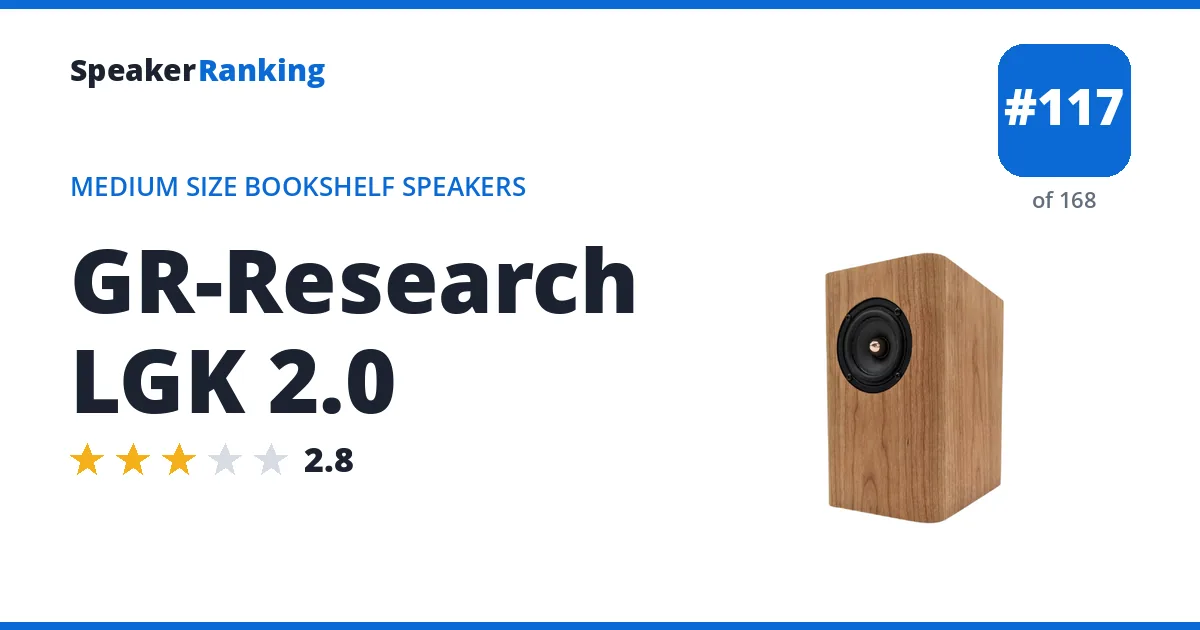
Pros: A small kit speaker from GR Research built around a single 3” wide-band driver, sold as a kit or flat-pack for desktops and near-field listening. Audio Science Review measured a preference score of 3.31 that reaches 6.23 with an ideal subwoofer, with 0.52 listening window deviation. Measured bass extension of 79.1Hz (-3dB).
Cons: Sensitivity is low at 84dB. Audio Science Review found an uneven response (1.17 average on-axis deviation). It is a kit to build yourself. Bass reaches 79.1Hz (-3dB) and about 63Hz (-10dB).
Full GR-Research LGK 2.0 review and specifications →
| Released | Feb 2022 (4 years ago) |
|---|---|
| Bass Extension (-10dB) | about 63.0Hz (measured, Audio Science Review) |
| Bass Extension (-3dB) | 79.1Hz (measured, Audio Science Review) |
| DIY Kit | Yes |
| Drivers | 3” wide-band driver |
| Frequency Response | 80Hz-20kHz (manufacturer specified) |
| Sensitivity | 84dB (manufacturer specified) |
| Spinorama Preference Score | 3.31 |
| Spinorama Preference Score with Perfect Sub | 6.23 |
| Weight | 7.9 lbs (3.6 kg) |
- Reviews, Comparisons and Sound Samples
- Head-to-Head Comparisons
 MartinLogan Motion 4i: $476.70 per pair Amazon Crutchfield eBay

Pros: Best treated as a satellite: crossing it to a subwoofer lifts its predicted preference score from 2.73 to 6.36, so the shallow bass matters far less in a 2.1 or home-theater setup. Directivity is the strong point, with sound-power deviation (NBD 0.426) lower than its on-axis figure (0.547), meaning the off-axis output tracks the front more evenly than most budget cabinets and the image stays stable around the room. The Folded Motion tweeter measures cleanly for the price, and 87.5dB measured sensitivity (2.83V/1m) means modest amplifiers drive it easily. Measured bass extension of 159.7Hz (-3dB), with a measured sensitivity of 87.5dB.
Cons: Bass-shy to the point of needing a subwoofer: the measured -3dB point is 159.7Hz, so on its own it produces almost nothing below roughly 160Hz. The balance is bright and uneven, deviating 2.7dB across 300Hz-5kHz with a clear upward tilt, and the review’s verdict is a “bass-shy, bright” speaker. A port resonance near 850Hz and high woofer distortion add audible roughness through the midrange, and impedance dips below 3 ohms, so it wants an amplifier comfortable with low-impedance loads.
Full MartinLogan Motion 4i review and specifications →
| Released | May 2024 (2 years ago) |
|---|---|
| Bass Extension (-10dB) | about 67.1Hz (measured, Audio Science Review) |
| Bass Extension (-3dB) | 159.7Hz (measured, Audio Science Review via spinorama.org) |
| Configuration | Passive 2-way bookshelf speaker |
| Country | United States (design) |
| Coverage | 80° x 80° |
| Crossover Frequency | 2,900 Hz |
| DIY Kit | No |
| Dimensions | 12.6” x 5.6” x 5.7” (320 x 143 x 145 mm) (H x W x D) |
| Drivers | 1” x 1.4” Folded Motion tweeter, 4” paper cone woofer |
| Enclosure | ported, rear |
| Frequency Response | 70Hz - 23kHz (±3dB, Manufacturer specified) |
| Impedance | 4 ohms nominal |
| Measurement Source | Audio Science Review |
| Recommended Power | 20-150W |
| Sensitivity | 87.5dB (2.83V/1m, measured, Audio Science Review) |
| Spinorama Preference Score | 2.73 |
| Spinorama Preference Score with Perfect Sub | 6.36 |
| Weight | 6 lbs (2.72 kg) |
- Links
- Reviews, Comparisons and Sound Samples
- Head-to-Head Comparisons