Short answer: the Focal Utopia 2022, if you are buying new. The Focal Utopia ranks higher than it (#160 vs #208 of 382 over-ear headphones, 3.8/5 vs 3.5/5) but is discontinued, so only consider it used; the Focal Utopia 2022 is still sold new at $4,089.
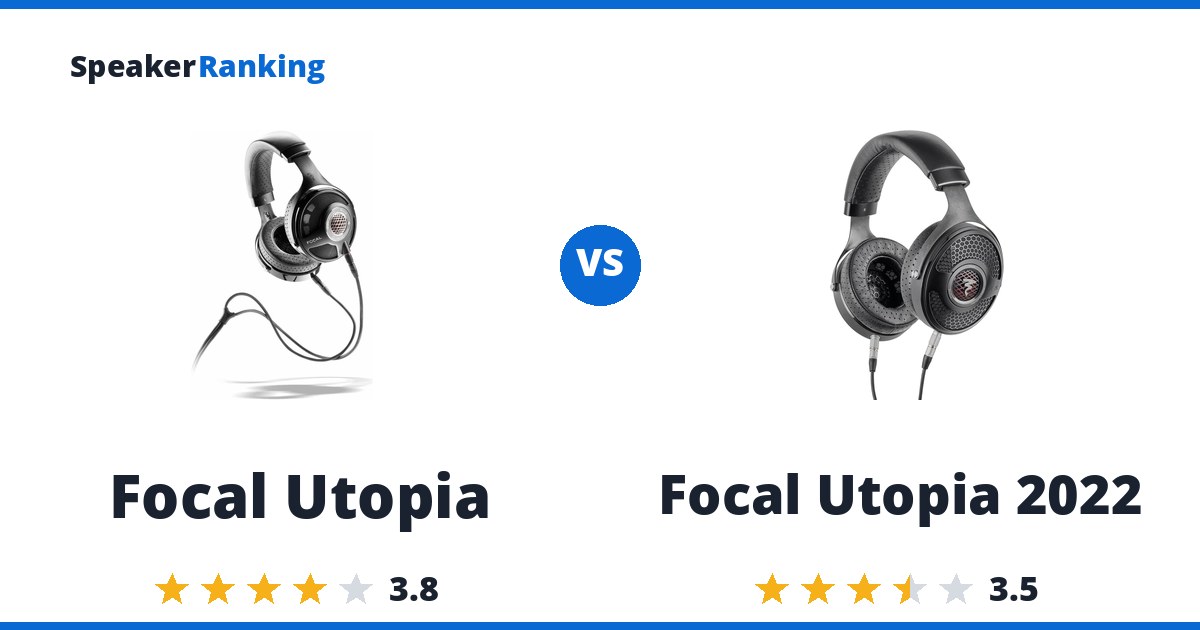
Why pick the Focal Utopia: Measured response gives it a very good Harman preference score of 77 with a 2.32 dB spread, and its mids sit within about 0.5 dB of target, so vocals and instruments sound natural. The tradeoff: Discontinued, so it is mainly found used.
The case for the Focal Utopia 2022: The midrange is very close to target, within about 0.7 dB from 60 Hz through 3 kHz, so vocals and instruments sit naturally. The tradeoff: Sub-bass is about 5.5 dB under target and treble is about 5.4 dB low from 6 to 10 kHz, with a 12.6 dB dip near 10 kHz, so cymbals and air sound muted and deep bass lacks rumble.
Buy the Focal Utopia 2022 new; the Focal Utopia is no longer sold new, so it only makes sense as a used find.
Still deciding? The full Headphones rankings cover every ranked option.
Specifications Side By Side
| Focal Utopia | Focal Utopia 2022 | |
|---|---|---|
| Price | Discontinued | $4,089.00 |
| Ranked | #160 of 382 in Over-Ear Headphones | #208 of 382 in Over-Ear Headphones |
| Form Factor | Over-ear | Over-ear |
| Back | Open | Open |
| Connection | Wired | Wired |
| Driver Type | Dynamic | Dynamic |
| Drivers | 1 x 40mm beryllium dynamic | 1 x 40mm dynamic |
| Impedance | 80 ohms | 80 ohms |
| Sensitivity | 104 dB/mW | 104 dB SPL/mW |
| Frequency Response | 5Hz - 50kHz | 5Hz - 50kHz (Manufacturer specified) |
| Weight | 1.1 lbs (490g) | 1.1 lbs (490 g) |
| Harman Preference Score | 77 (measured by oratory1990, via AutoEQ) | 71 (measured by oratory1990, via AutoEQ) |
| Deviation From Target | 2.32 dB standard deviation | 2.62 dB standard deviation |
| Tonal Tilt | -0.56 (negative is warmer, positive brighter) | -0.70 (negative is warmer, positive brighter) |
| Sub-bass Extension | Falls 6 dB below target at 30 Hz (-6.0 dB at 30 Hz) | Falls 6 dB below target at 30 Hz (-6.0 dB at 30 Hz) |
| Built-in Microphone | - | No |
Related Headphone Comparisons
More worthwhile head-to-heads for Focal Utopia:
- Focal Utopia 2022 vs Audeze LCD-4z
- Audeze LCD-5 vs Focal Utopia 2022
- ZMF Caldera Closed vs Focal Utopia 2022
- Focal Utopia 2022 vs T+A Solitaire PSE
- ZMF Ori 3.0 vs Denon AH-D9200
Prices on this page were last checked October 12, 2026 at 4:13 PM UTC. Product prices and availability are accurate as of that date/time and are subject to change; the price and availability shown on Amazon at the time of purchase will apply to the purchase of this product.
As an eBay Partner, we may be compensated if you make a purchase.
The Two Headphones In Full
 Focal Utopia Discontinued eBay
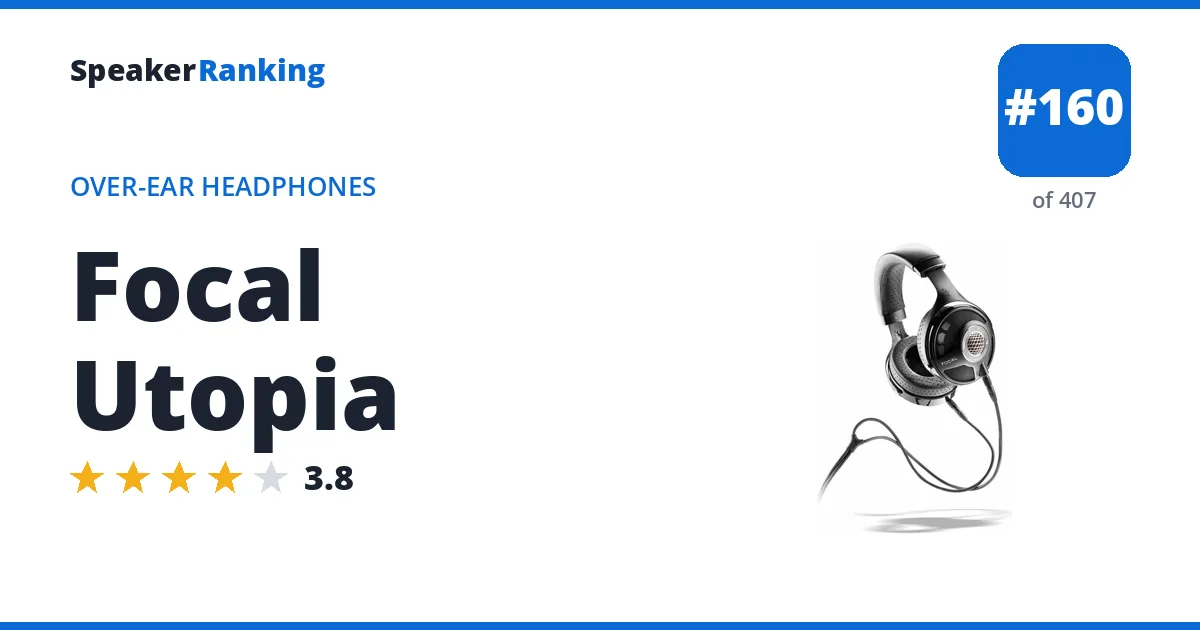
Pros: Measured response gives it a very good Harman preference score of 77 with a 2.32 dB spread, and its mids sit within about 0.5 dB of target, so vocals and instruments sound natural. It uses 1 x 40mm beryllium dynamic.
Cons: Discontinued, so it is mainly found used. Sub-bass is 6 dB short at 30 Hz, so deep bass lacks rumble. Treble sits about 5.7 dB low, so it sounds a little dark.
Full Focal Utopia review and specifications →
| Released | 2016 (10 years ago) |
|---|---|
| Back | Open |
| Connection | Wired |
| Deviation From Target | 2.32 dB standard deviation |
| Driver Type | Dynamic |
| Drivers | 1 x 40mm beryllium dynamic |
| Form Factor | Over-ear |
| Frequency Response | 5Hz - 50kHz |
| Harman Preference Score | 77 (measured by oratory1990, via AutoEQ) |
| Impedance | 80 ohms |
| Sensitivity | 104 dB/mW |
| Sub-bass Extension | Falls 6 dB below target at 30 Hz (-6.0 dB at 30 Hz) |
| Tonal Tilt | -0.56 (negative is warmer, positive brighter) |
| Weight | 1.1 lbs (490g) |
EQ preset to match the Harman target
Set a preamp of -6.4 dB, then add these filters in any parametric equalizer (Wavelet, Equalizer APO, Peace, or a player with parametric EQ). Calculated by AutoEQ from its measured frequency response.
| Filter | Frequency | Gain | Q |
|---|---|---|---|
| Low shelf | 105 Hz | +8.5 dB | 0.70 |
| Peak | 8,972 Hz | +5.4 dB | 1.61 |
| Peak | 68 Hz | -5.0 dB | 0.37 |
| Peak | 1,245 Hz | -2.9 dB | 2.09 |
| Peak | 1,946 Hz | +3.4 dB | 3.68 |
| High shelf | 10,000 Hz | -2.0 dB | 0.70 |
| Peak | 5,903 Hz | -3.1 dB | 6.00 |
| Peak | 6,765 Hz | +2.6 dB | 5.89 |
| Peak | 2,714 Hz | -1.7 dB | 5.90 |
| Peak | 3,557 Hz | +1.9 dB | 5.99 |
- Reviews, Comparisons and Sound Samples
 Focal Utopia 2022: $4,089.00 Amazon $4,089.00 eBay
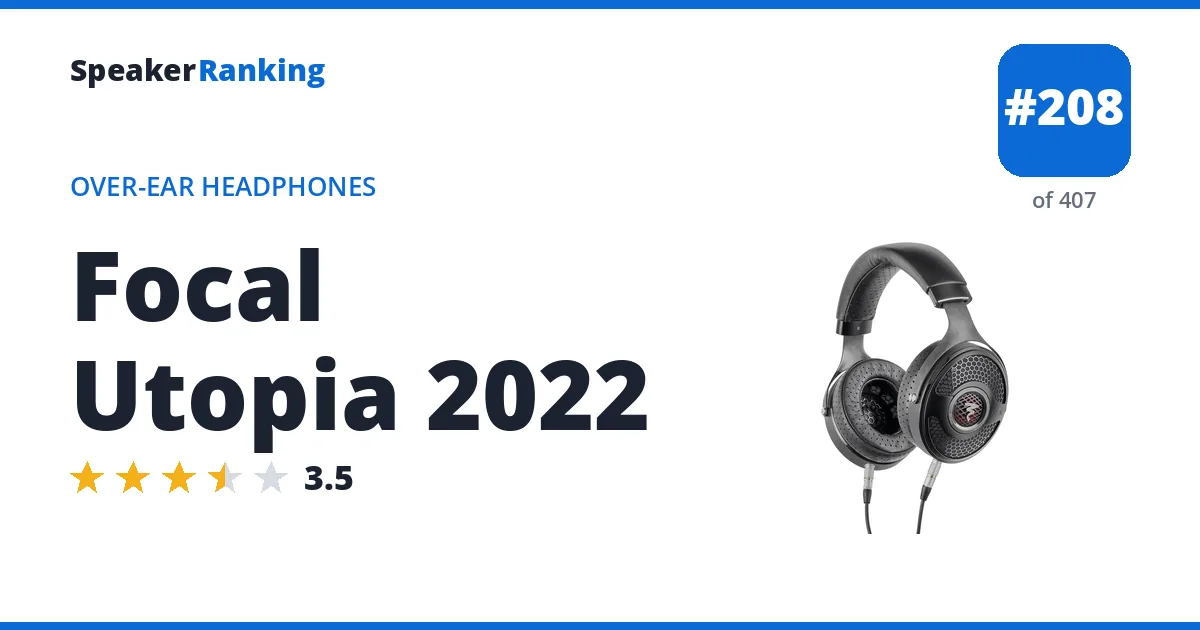
Pros: The midrange is very close to target, within about 0.7 dB from 60 Hz through 3 kHz, so vocals and instruments sit naturally. A 2.62 dB deviation and a preference score of 71 show a smooth profile with no large peaks, the biggest being only 0.3 dB near 1.5 kHz. An 80 ohm, 104 dB/mW design is manageable from a decent amplifier, and the open back gives a spacious presentation.
Cons: Sub-bass is about 5.5 dB under target and treble is about 5.4 dB low from 6 to 10 kHz, with a 12.6 dB dip near 10 kHz, so cymbals and air sound muted and deep bass lacks rumble. Presence is also about 3 dB low, which makes the sound dark and veiled. It weighs 490 g, the open back leaks sound, and it sits well below higher rated rivals like the HIFIMAN Susvara.
Full Focal Utopia 2022 review and specifications →
| Released | Sep 2022 (4 years ago) |
|---|---|
| Back | Open |
| Built-in Microphone | No |
| Connection | Wired |
| Deviation From Target | 2.62 dB standard deviation |
| Driver Type | Dynamic |
| Drivers | 1 x 40mm dynamic |
| Form Factor | Over-ear |
| Frequency Response | 5Hz - 50kHz (Manufacturer specified) |
| Harman Preference Score | 71 (measured by oratory1990, via AutoEQ) |
| Impedance | 80 ohms |
| Sensitivity | 104 dB SPL/mW |
| Sub-bass Extension | Falls 6 dB below target at 30 Hz (-6.0 dB at 30 Hz) |
| Tonal Tilt | -0.70 (negative is warmer, positive brighter) |
| Weight | 1.1 lbs (490 g) |
EQ preset to match the Harman target
Set a preamp of -6.3 dB, then add these filters in any parametric equalizer (Wavelet, Equalizer APO, Peace, or a player with parametric EQ). Calculated by AutoEQ from its measured frequency response.
| Filter | Frequency | Gain | Q |
|---|---|---|---|
| Low shelf | 105 Hz | +9.1 dB | 0.70 |
| Peak | 65 Hz | -5.4 dB | 0.33 |
| Peak | 1,227 Hz | -3.1 dB | 1.92 |
| Peak | 10,000 Hz | +6.3 dB | 0.87 |
| Peak | 1,980 Hz | +2.9 dB | 3.30 |
| High shelf | 10,000 Hz | -3.1 dB | 0.70 |
| Peak | 5,018 Hz | +2.9 dB | 4.42 |
| Peak | 5,972 Hz | -3.2 dB | 6.00 |
| Peak | 3,000 Hz | -1.7 dB | 4.41 |
| Peak | 3,578 Hz | +1.5 dB | 6.00 |
- Reviews, Comparisons and Sound Samples
- Head-to-Head Comparisons