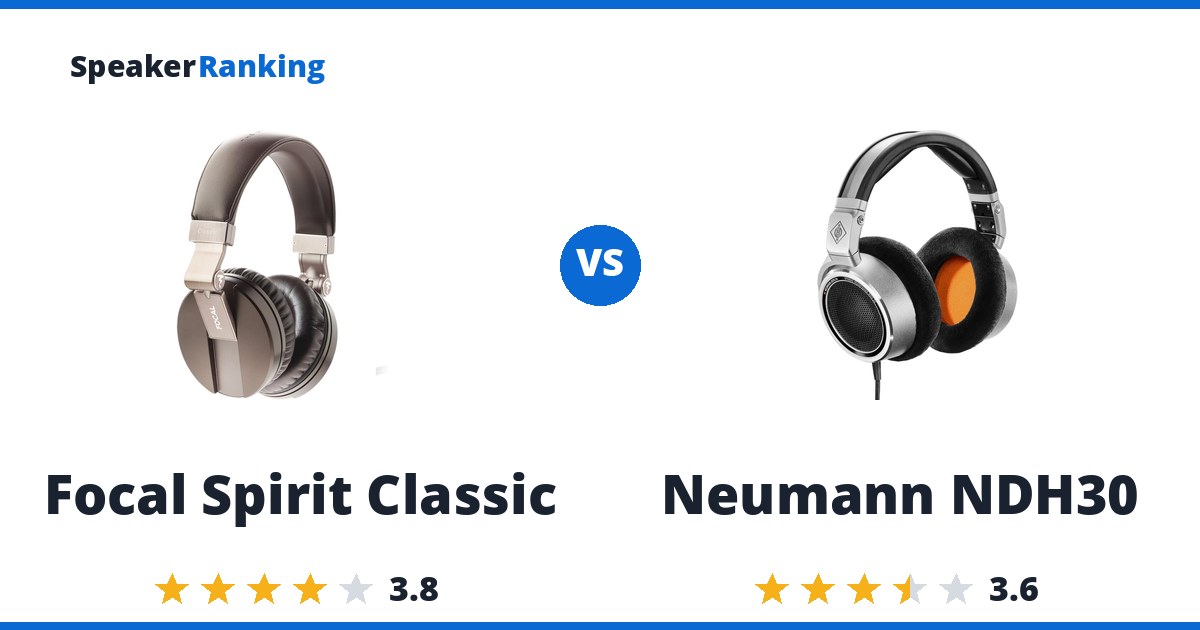
Short answer: the Focal Spirit Classic. It ranks #99 of 216 over-ear headphones by sound quality, rated 3.8/5, at $672.53; the Neumann NDH30 ranks #118, rated 3.6/5, and costs $699, which makes this an easy call rather than a real tradeoff.
Why pick the Focal Spirit Classic: The response is smooth, with a deviation of only 2.15 dB around the target, so tonal balance sounds coherent without sharp spikes. The tradeoff: Sub-bass is about 3 dB light and the upper mids, presence and treble all run roughly 2.5 dB under target, giving a warm, slightly veiled tilt that softens detail.
The case for the Neumann NDH30: In oratory1990’s measurement the bass from 60 to 200 Hz lands right on target and sub-bass stays within 6 dB down to 20 Hz, only 3.9 dB short at 30 Hz, so this open back reaches deeper than many rivals of its type. The catch: A 12.5 dB dip near 9.7 kHz leaves the treble about 5 dB and the air band about 6 dB below target, so cymbals and spatial detail sound subdued.
Buy the Focal Spirit Classic. It is rated higher for sound quality than the Neumann NDH30 and costs less, so it is the default pick unless a specific strength of the other one matters more to you.
Still deciding? The full Headphones rankings cover every ranked option.
Specifications Side By Side
| Focal Spirit Classic | Neumann NDH30 | |
|---|---|---|
| Price | $672.53 | $699.00 |
| Ranked | #99 of 216 in Over-Ear Headphones | #118 of 216 in Over-Ear Headphones |
| Form Factor | Over-ear | Over-ear |
| Harman Preference Score | 77 (measured by oratory1990, via AutoEQ) | 72 (measured by oratory1990, via AutoEQ) |
| Deviation From Target | 2.15 dB standard deviation | 2.43 dB standard deviation |
| Tonal Tilt | -0.65 (negative is warmer, positive brighter) | -0.78 (negative is warmer, positive brighter) |
| Sub-bass Extension | Within 6 dB of target down to 20 Hz (-4.9 dB at 30 Hz) | Within 6 dB of target down to 20 Hz (-3.9 dB at 30 Hz) |
| Connection | Wired | Wired |
| Back | Closed | Open |
| Driver Type | Dynamic | Dynamic |
| Drivers | 1 x 40mm dynamic | 1 x 38mm dynamic |
| Impedance | 32 ohms | 120 ohms |
| Sensitivity | 102 dB SPL/mW | 104 dB SPL/V |
| Weight | 0.7 lbs (310 g) | 0.8 lbs (352 g) |
| Frequency Response | 5Hz - 22kHz (Manufacturer specified) | 12Hz - 34kHz (Manufacturer specified) |
| Built-in Microphone | - | No |
Related Headphone Comparisons
More top alternatives to Focal Spirit Classic:
- HIFIMAN Audivina vs Focal Spirit Classic
- Cleer Next vs Focal Spirit Classic
- Focal Spirit Classic vs Meze 109 Pro
- Focal Bathys vs Neumann NDH30
- Fostex TH610 vs Neumann NDH30
Prices on this page were last checked October 11, 2026 at 4:59 PM UTC. Product prices and availability are accurate as of that date/time and are subject to change; the price and availability shown on Amazon at the time of purchase will apply to the purchase of this product.
As an eBay Partner, we may be compensated if you make a purchase.
The Two Headphones In Full
 Focal Spirit Classic: $672.53 Amazon eBay

Pros: The response is smooth, with a deviation of only 2.15 dB around the target, so tonal balance sounds coherent without sharp spikes. Bass at 60 to 200 Hz is within half a dB of the target and a slight lift in the low mids adds body to vocals and guitars. At 32 ohms and 102 dB/mW it runs fine from a phone, and the closed back at 310 g is portable enough for daily use.
Cons: Sub-bass is about 3 dB light and the upper mids, presence and treble all run roughly 2.5 dB under target, giving a warm, slightly veiled tilt that softens detail. A 5.5 dB dip near 7.5 kHz takes some edge off cymbals. It costs far more than the AKG K712 for an equal rating.
Full Focal Spirit Classic review and specifications →
| Back | Closed |
|---|---|
| Connection | Wired |
| Deviation From Target | 2.15 dB standard deviation |
| Driver Type | Dynamic |
| Drivers | 1 x 40mm dynamic |
| Form Factor | Over-ear |
| Frequency Response | 5Hz - 22kHz (Manufacturer specified) |
| Harman Preference Score | 77 (measured by oratory1990, via AutoEQ) |
| Impedance | 32 ohms |
| Sensitivity | 102 dB SPL/mW |
| Sub-bass Extension | Within 6 dB of target down to 20 Hz (-4.9 dB at 30 Hz) |
| Tonal Tilt | -0.65 (negative is warmer, positive brighter) |
| Weight | 0.7 lbs (310 g) |
EQ preset to match the Harman target
Set a preamp of -3.2 dB, then add these filters in any parametric equalizer (Wavelet, Equalizer APO, Peace, or a player with parametric EQ). Calculated by AutoEQ from its measured frequency response.
| Filter | Frequency | Gain | Q |
|---|---|---|---|
| Low shelf | 105 Hz | +2.6 dB | 0.70 |
| Peak | 544 Hz | -3.4 dB | 0.41 |
| Peak | 2,189 Hz | +4.1 dB | 0.69 |
| Peak | 7,443 Hz | +2.6 dB | 4.61 |
| Peak | 103 Hz | -1.2 dB | 1.52 |
| High shelf | 10,000 Hz | -0.8 dB | 0.70 |
| Peak | 4,490 Hz | +1.6 dB | 5.05 |
| Peak | 3,885 Hz | -1.4 dB | 4.10 |
| Peak | 5,059 Hz | +1.0 dB | 4.56 |
| Peak | 6,119 Hz | -1.1 dB | 6.00 |
- Reviews, Comparisons and Sound Samples
- Head-to-Head Comparisons
 Neumann NDH30: $699.00 B&H Photo Video eBay

Pros: In oratory1990’s measurement the bass from 60 to 200 Hz lands right on target and sub-bass stays within 6 dB down to 20 Hz, only 3.9 dB short at 30 Hz, so this open back reaches deeper than many rivals of its type. Presence tracks within 0.6 dB with no peak above 1.9 dB, so vocals sound clear without glare, for a preference score of 72. It matches the rating of the pricier Fostex TH610.
Cons: A 12.5 dB dip near 9.7 kHz leaves the treble about 5 dB and the air band about 6 dB below target, so cymbals and spatial detail sound subdued. The open back leaks sound and blocks no outside noise, and its 120 ohm load at 104 dB/V gets the most from a headphone amp or strong dongle. The Denon AH-D5200 rates slightly higher at a similar price. See headphone amps and DACs with enough power to drive it.
Full Neumann NDH30 review and specifications →
| Released | May 2022 (4 years ago) |
|---|---|
| Back | Open |
| Built-in Microphone | No |
| Connection | Wired |
| Deviation From Target | 2.43 dB standard deviation |
| Driver Type | Dynamic |
| Drivers | 1 x 38mm dynamic |
| Form Factor | Over-ear |
| Frequency Response | 12Hz - 34kHz (Manufacturer specified) |
| Harman Preference Score | 72 (measured by oratory1990, via AutoEQ) |
| Impedance | 120 ohms |
| Sensitivity | 104 dB SPL/V |
| Sub-bass Extension | Within 6 dB of target down to 20 Hz (-3.9 dB at 30 Hz) |
| Tonal Tilt | -0.78 (negative is warmer, positive brighter) |
| Weight | 0.8 lbs (352 g) |
EQ preset to match the Harman target
Set a preamp of -6.1 dB, then add these filters in any parametric equalizer (Wavelet, Equalizer APO, Peace, or a player with parametric EQ). Calculated by AutoEQ from its measured frequency response.
| Filter | Frequency | Gain | Q |
|---|---|---|---|
| Low shelf | 105 Hz | +3.7 dB | 0.70 |
| Peak | 160 Hz | -2.3 dB | 0.19 |
| Peak | 9,234 Hz | +6.1 dB | 1.00 |
| Peak | 2,262 Hz | +3.5 dB | 1.99 |
| Peak | 3,647 Hz | -3.9 dB | 3.86 |
| High shelf | 10,000 Hz | -0.0 dB | 0.70 |
| Peak | 504 Hz | +0.6 dB | 1.11 |
| Peak | 1,033 Hz | -1.2 dB | 2.73 |
| Peak | 53 Hz | -0.8 dB | 1.98 |
| Peak | 66 Hz | +0.6 dB | 4.36 |
- Reviews, Comparisons and Sound Samples
- Head-to-Head Comparisons