Short answer: the Focal Bathys. It ranks #103 of 216 over-ear headphones by sound quality, rated 3.7/5, at $799. The Neumann NDH30 ranks #118, rated 3.6/5, at $699, $100 cheaper, a saving that is not big enough to make up the sound-quality gap.

The case for the Focal Bathys: Bluetooth 5.1 with SBC, AAC, aptX and aptX Adaptive, active noise cancelling and a rated 30 hours of battery make it a full wireless travel headphone, and a wired connection is still available. The catch: A 6.3 dB dip near 9.4 kHz and mild treble reduction soften cymbals and sibilance.
Why pick the Neumann NDH30: In oratory1990’s measurement the bass from 60 to 200 Hz lands right on target and sub-bass stays within 6 dB down to 20 Hz, only 3.9 dB short at 30 Hz, so this open back reaches deeper than many rivals of its type. The tradeoff: A 12.5 dB dip near 9.7 kHz leaves the treble about 5 dB and the air band about 6 dB below target, so cymbals and spatial detail sound subdued.
Buy the Focal Bathys. It is rated higher for sound quality, and the $100 you would save on the Neumann NDH30 does not close the gap.
Still deciding? The full Headphones rankings cover every ranked option.
Specifications Side By Side
| Focal Bathys | Neumann NDH30 | |
|---|---|---|
| Price | $799.00 | $699.00 |
| Ranked | #103 of 216 in Over-Ear Headphones | #118 of 216 in Over-Ear Headphones |
| Form Factor | Over-ear | Over-ear |
| Harman Preference Score | 76 (measured by oratory1990, via AutoEQ) | 72 (measured by oratory1990, via AutoEQ) |
| Deviation From Target | 2.04 dB standard deviation | 2.43 dB standard deviation |
| Tonal Tilt | -0.84 (negative is warmer, positive brighter) | -0.78 (negative is warmer, positive brighter) |
| Sub-bass Extension | Within 6 dB of target down to 20 Hz (-0.1 dB at 30 Hz) | Within 6 dB of target down to 20 Hz (-3.9 dB at 30 Hz) |
| Connection | Wireless and wired | Wired |
| Back | Closed | Open |
| Driver Type | Dynamic | Dynamic |
| Drivers | 1 x 40mm dynamic | 1 x 38mm dynamic |
| Impedance | 80 ohms | 120 ohms |
| Sensitivity | 104 dB SPL/mW | 104 dB SPL/V |
| Weight | 0.8 lbs (350 g) | 0.8 lbs (352 g) |
| Active Noise Cancelling | Yes | - |
| Battery Life | 30 hours (Manufacturer specified) | - |
| Bluetooth Version | 5.1 | - |
| Bluetooth Codecs | SBC, AAC, aptX, aptX Adaptive | - |
| Built-in Microphone | Yes | No |
| Frequency Response | - | 12Hz - 34kHz (Manufacturer specified) |
Related Headphone Comparisons
How Focal Bathys compares with other leading options:
- HIFIMAN Mini Shangri-La vs Focal Bathys
- Meze 109 Pro vs Focal Bathys
- Denon AH-D5200 vs Focal Bathys
- Focal Bathys vs Fostex TH610
- Fostex TH610 vs Neumann NDH30
Prices on this page were last checked October 11, 2026 at 4:59 PM UTC. Product prices and availability are accurate as of that date/time and are subject to change; the price and availability shown on Amazon at the time of purchase will apply to the purchase of this product.
As an eBay Partner, we may be compensated if you make a purchase.
The Two Headphones In Full
 Focal Bathys: $799.00 Wireless Amazon eBay
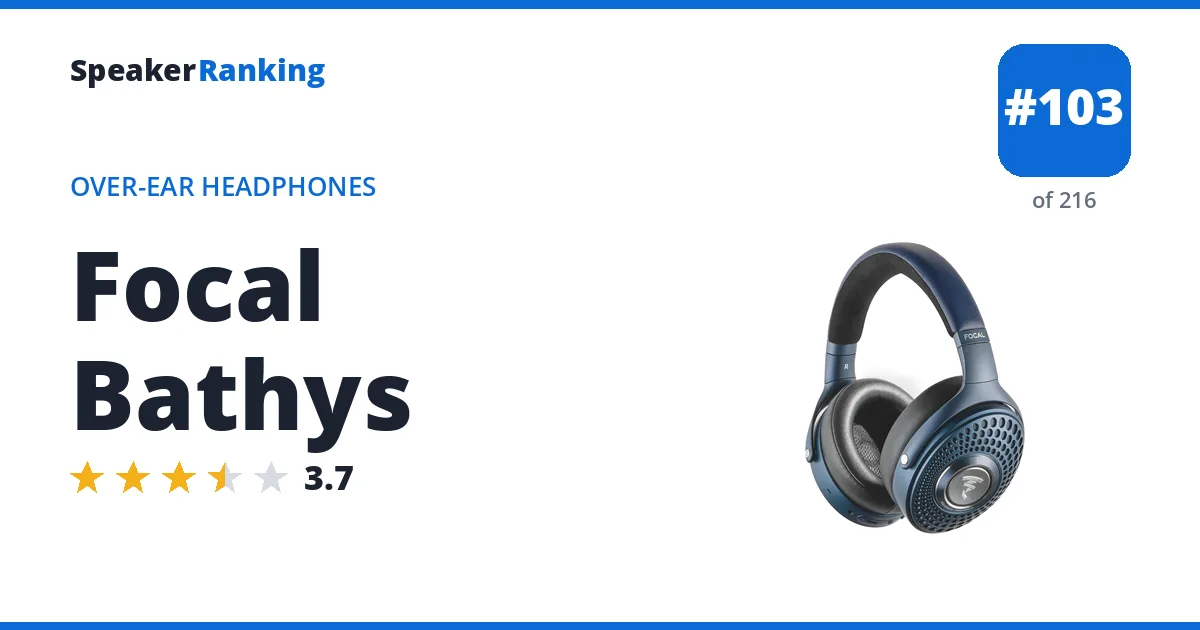
Pros: Bluetooth 5.1 with SBC, AAC, aptX and aptX Adaptive, active noise cancelling and a rated 30 hours of battery make it a full wireless travel headphone, and a wired connection is still available. Bass is slightly boosted, about 1 dB at sub-bass and 2 dB from 60 to 200 Hz, for a warm, punchy low end. The 2.0 dB deviation is smooth, and a 76 preference score is respectable for a wireless model.
Cons: A 6.3 dB dip near 9.4 kHz and mild treble reduction soften cymbals and sibilance. The tilt is on the warm side, so brightness and detail are subdued. The HIFIMAN Audivina holds a higher rating for a lower price, though the Bathys is the one with ANC and a battery.
Full Focal Bathys review and specifications →
| Released | Oct 2022 (4 years ago) |
|---|---|
| Active Noise Cancelling | Yes |
| Back | Closed |
| Battery Life | 30 hours (Manufacturer specified) |
| Bluetooth Codecs | SBC, AAC, aptX, aptX Adaptive |
| Bluetooth Version | 5.1 |
| Built-in Microphone | Yes |
| Connection | Wireless and wired |
| Deviation From Target | 2.04 dB standard deviation |
| Driver Type | Dynamic |
| Drivers | 1 x 40mm dynamic |
| Form Factor | Over-ear |
| Harman Preference Score | 76 (measured by oratory1990, via AutoEQ) |
| Impedance | 80 ohms |
| Sensitivity | 104 dB SPL/mW |
| Sub-bass Extension | Within 6 dB of target down to 20 Hz (-0.1 dB at 30 Hz) |
| Tonal Tilt | -0.84 (negative is warmer, positive brighter) |
| Weight | 0.8 lbs (350 g) |
EQ preset to match the Harman target
Set a preamp of -3.9 dB, then add these filters in any parametric equalizer (Wavelet, Equalizer APO, Peace, or a player with parametric EQ). Calculated by AutoEQ from its measured frequency response.
| Filter | Frequency | Gain | Q |
|---|---|---|---|
| Low shelf | 105 Hz | -0.3 dB | 0.70 |
| Peak | 642 Hz | -3.5 dB | 0.24 |
| Peak | 831 Hz | +7.1 dB | 1.99 |
| Peak | 4,157 Hz | +3.6 dB | 1.67 |
| Peak | 2,185 Hz | +4.3 dB | 3.03 |
| High shelf | 10,000 Hz | +0.7 dB | 0.70 |
| Peak | 86 Hz | -0.3 dB | 0.96 |
| Peak | 199 Hz | +0.5 dB | 1.78 |
| Peak | 2,995 Hz | -0.6 dB | 4.09 |
| Peak | 381 Hz | -0.4 dB | 2.53 |
- Reviews, Comparisons and Sound Samples
- Head-to-Head Comparisons
 Neumann NDH30: $699.00 B&H Photo Video eBay

Pros: In oratory1990’s measurement the bass from 60 to 200 Hz lands right on target and sub-bass stays within 6 dB down to 20 Hz, only 3.9 dB short at 30 Hz, so this open back reaches deeper than many rivals of its type. Presence tracks within 0.6 dB with no peak above 1.9 dB, so vocals sound clear without glare, for a preference score of 72. It matches the rating of the pricier Fostex TH610.
Cons: A 12.5 dB dip near 9.7 kHz leaves the treble about 5 dB and the air band about 6 dB below target, so cymbals and spatial detail sound subdued. The open back leaks sound and blocks no outside noise, and its 120 ohm load at 104 dB/V gets the most from a headphone amp or strong dongle. The Denon AH-D5200 rates slightly higher at a similar price. See headphone amps and DACs with enough power to drive it.
Full Neumann NDH30 review and specifications →
| Released | May 2022 (4 years ago) |
|---|---|
| Back | Open |
| Built-in Microphone | No |
| Connection | Wired |
| Deviation From Target | 2.43 dB standard deviation |
| Driver Type | Dynamic |
| Drivers | 1 x 38mm dynamic |
| Form Factor | Over-ear |
| Frequency Response | 12Hz - 34kHz (Manufacturer specified) |
| Harman Preference Score | 72 (measured by oratory1990, via AutoEQ) |
| Impedance | 120 ohms |
| Sensitivity | 104 dB SPL/V |
| Sub-bass Extension | Within 6 dB of target down to 20 Hz (-3.9 dB at 30 Hz) |
| Tonal Tilt | -0.78 (negative is warmer, positive brighter) |
| Weight | 0.8 lbs (352 g) |
EQ preset to match the Harman target
Set a preamp of -6.1 dB, then add these filters in any parametric equalizer (Wavelet, Equalizer APO, Peace, or a player with parametric EQ). Calculated by AutoEQ from its measured frequency response.
| Filter | Frequency | Gain | Q |
|---|---|---|---|
| Low shelf | 105 Hz | +3.7 dB | 0.70 |
| Peak | 160 Hz | -2.3 dB | 0.19 |
| Peak | 9,234 Hz | +6.1 dB | 1.00 |
| Peak | 2,262 Hz | +3.5 dB | 1.99 |
| Peak | 3,647 Hz | -3.9 dB | 3.86 |
| High shelf | 10,000 Hz | -0.0 dB | 0.70 |
| Peak | 504 Hz | +0.6 dB | 1.11 |
| Peak | 1,033 Hz | -1.2 dB | 2.73 |
| Peak | 53 Hz | -0.8 dB | 1.98 |
| Peak | 66 Hz | +0.6 dB | 4.36 |
- Reviews, Comparisons and Sound Samples
- Head-to-Head Comparisons