Short answer: a tie on sound quality. Both are rated 3.7/5 (#337 and #335 of 450 in-ear headphones), so choose on features and fit.
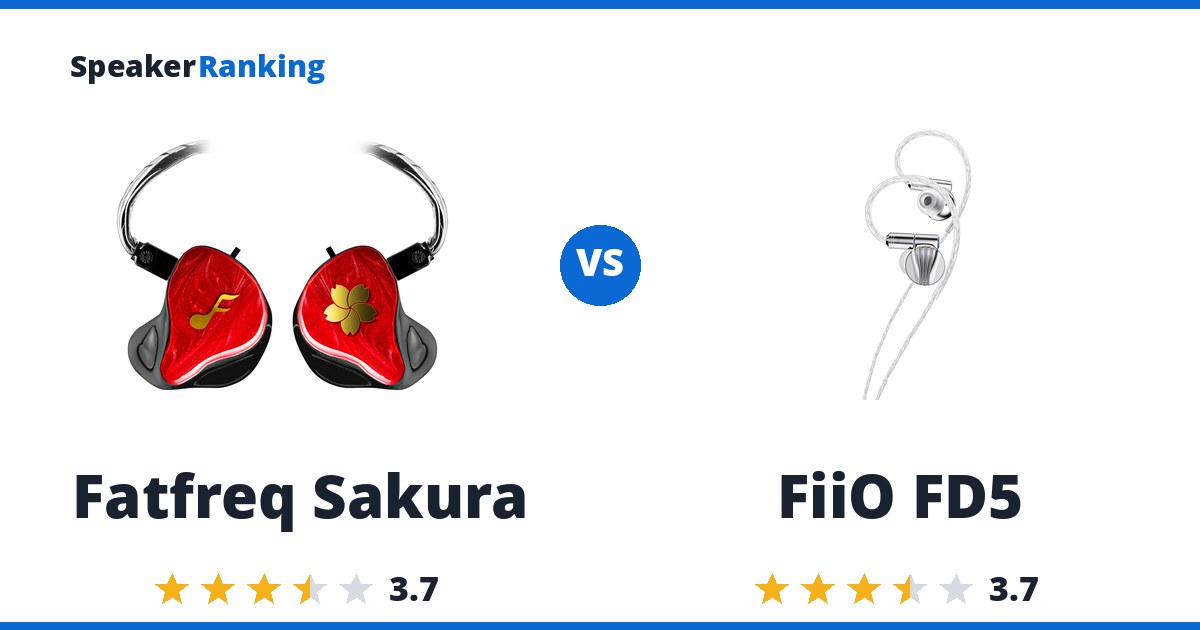
Why pick the Fatfreq Sakura: Crinacle’s measurement gives it a preference score of 70, a reasonably close match to the response most listeners prefer. The tradeoff: A 2.6 dB standard deviation from target means the response is noticeably uneven in places.
Why pick the FiiO FD5: Crinacle’s measurement gives it a preference score of 70, and across seven hobbyist measurements on squig.link bass rises about 4 dB above target with flat sub-bass extension to 20 Hz, giving bass guitar and kick drums a full, punchy body. The catch: The bass boost spills into the low mids by about 2 dB, which can thicken male vocals and make dense mixes sound slightly congested.
Buy the Fatfreq Sakura or the FiiO FD5 on features: they are rated the same for sound quality at close to the same price.
Still deciding? The full Headphones rankings cover every ranked option.
Specifications Side By Side
| Fatfreq Sakura | FiiO FD5 | |
|---|---|---|
| Price | - | $505.28 |
| Ranked | #337 of 450 in In-Ear Headphones | #335 of 450 in In-Ear Headphones |
| Form Factor | In-ear | In-ear |
| Back | Closed | Closed |
| Harman Preference Score | 70 (measured by crinacle, via AutoEQ) | 70 (measured by crinacle, via AutoEQ) |
| Deviation From Target | 2.58 dB standard deviation | 2.40 dB standard deviation |
| Tonal Tilt | -0.08 (negative is warmer, positive brighter) | -0.45 (negative is warmer, positive brighter) |
| Connection | Wired | Wired |
| Built-in Microphone | No | - |
| Driver Type | - | Dynamic |
| Drivers | - | 1 x 12mm dynamic |
| Impedance | - | 32 ohms |
| Sensitivity | - | 109 dB/mW |
| Weight | - | 0 lbs (11 g) per earbud |
| Frequency Response | - | 10Hz - 40kHz (Manufacturer specified) |
| Sub-bass Extension | - | Within 6 dB of target down to 20 Hz (-0.4 dB at 30 Hz) |
Related Headphone Comparisons
More worthwhile head-to-heads for FiiO FD5:
- FiiO FD5 vs iBasso IT04
- FiiO FD5 vs Kinera Norn
- FiiO FD5 vs Fearless Audio S8F
- CCA C10 vs Fatfreq Sakura
- Fatfreq Sakura vs KZ ZST
Prices on this page were last checked October 11, 2026 at 4:59 PM UTC. Product prices and availability are accurate as of that date/time and are subject to change; the price and availability shown on Amazon at the time of purchase will apply to the purchase of this product.
As an eBay Partner, we may be compensated if you make a purchase.
The Two Headphones In Full
 Fatfreq Sakura FATfreq eBay

Pros: Crinacle’s measurement gives it a preference score of 70, a reasonably close match to the response most listeners prefer. It is a wired, closed in-ear design, so it blocks outside noise and needs no charging.
Cons: A 2.6 dB standard deviation from target means the response is noticeably uneven in places. There is no built-in microphone for calls.
Full Fatfreq Sakura review and specifications →
| Released | May 2022 (4 years ago) |
|---|---|
| Back | Closed |
| Built-in Microphone | No |
| Connection | Wired |
| Deviation From Target | 2.58 dB standard deviation |
| Form Factor | In-ear |
| Harman Preference Score | 70 (measured by crinacle, via AutoEQ) |
| Tonal Tilt | -0.08 (negative is warmer, positive brighter) |
EQ preset to match the Harman target
Set a preamp of -6.1 dB, then add these filters in any parametric equalizer (Wavelet, Equalizer APO, Peace, or a player with parametric EQ). Calculated by AutoEQ from its measured frequency response.
| Filter | Frequency | Gain | Q |
|---|---|---|---|
| Low shelf | 105 Hz | +1.9 dB | 0.70 |
| Peak | 6,951 Hz | +5.0 dB | 0.67 |
| Peak | 1,700 Hz | -4.1 dB | 1.72 |
| Peak | 201 Hz | -1.8 dB | 0.68 |
| Peak | 70 Hz | +0.8 dB | 1.12 |
| High shelf | 10,000 Hz | -2.3 dB | 0.70 |
| Peak | 4,296 Hz | -2.6 dB | 6.00 |
| Peak | 3,478 Hz | +1.6 dB | 4.53 |
| Peak | 6,201 Hz | +1.6 dB | 5.97 |
| Peak | 818 Hz | +0.5 dB | 2.49 |
- Reviews, Comparisons and Sound Samples
- Head-to-Head Comparisons
 FiiO FD5: $505.28 Amazon eBay
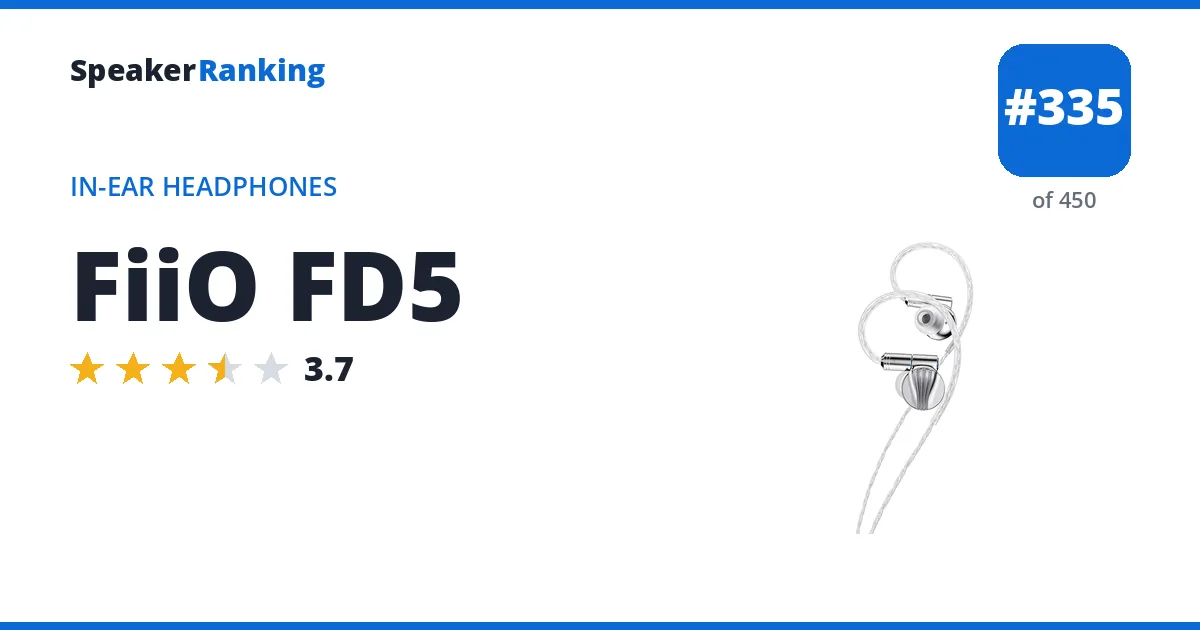
Pros: Crinacle’s measurement gives it a preference score of 70, and across seven hobbyist measurements on squig.link bass rises about 4 dB above target with flat sub-bass extension to 20 Hz, giving bass guitar and kick drums a full, punchy body. Its 109 dB/mW sensitivity and 32 ohm impedance mean a phone drives it easily. It rates higher than the similarly priced iBasso IT04, and the warm balance suits bass-leaning listeners.
Cons: The bass boost spills into the low mids by about 2 dB, which can thicken male vocals and make dense mixes sound slightly congested. Hobbyist measurements also show a 3.5 dB dip near 3.6 kHz and a 4.9 dB peak near 8.4 kHz, so vocals can sit a little back while cymbals and sibilants gain an edge.
Full FiiO FD5 review and specifications →
| Back | Closed |
|---|---|
| Connection | Wired |
| Deviation From Target | 2.40 dB standard deviation |
| Driver Type | Dynamic |
| Drivers | 1 x 12mm dynamic |
| Form Factor | In-ear |
| Frequency Response | 10Hz - 40kHz (Manufacturer specified) |
| Harman Preference Score | 70 (measured by crinacle, via AutoEQ) |
| Impedance | 32 ohms |
| Sensitivity | 109 dB/mW |
| Sub-bass Extension | Within 6 dB of target down to 20 Hz (-0.4 dB at 30 Hz) |
| Tonal Tilt | -0.45 (negative is warmer, positive brighter) |
| Weight | 0 lbs (11 g) per earbud |
EQ preset to match the Harman target
Set a preamp of -3.8 dB, then add these filters in any parametric equalizer (Wavelet, Equalizer APO, Peace, or a player with parametric EQ). Calculated by AutoEQ from its measured frequency response.
| Filter | Frequency | Gain | Q |
|---|---|---|---|
| Low shelf | 105 Hz | +1.2 dB | 0.70 |
| Peak | 155 Hz | -3.6 dB | 0.58 |
| Peak | 815 Hz | +2.7 dB | 1.04 |
| Peak | 3,920 Hz | +3.3 dB | 2.56 |
| Peak | 5,234 Hz | -3.2 dB | 5.78 |
| High shelf | 10,000 Hz | +0.4 dB | 0.70 |
| Peak | 10,000 Hz | +3.6 dB | 1.21 |
| Peak | 2,540 Hz | -1.4 dB | 4.19 |
| Peak | 40 Hz | -0.4 dB | 2.74 |
| Peak | 5,496 Hz | -1.7 dB | 6.00 |
- Reviews, Comparisons and Sound Samples
- Head-to-Head Comparisons