Short answer: the Airpulse A80. It ranks #48 of 105 powered bookshelf speakers by sound quality, rated 3.9/5, at $699.99; the ADAM Audio A44H ranks #54, rated 3.8/5, and costs $1,459.98, so there is little reason to consider the other one.

The case for the Airpulse A80: A compact AirPulse speaker with the brand’s horn-loaded aluminum ribbon tweeter and a 4.5” aluminum-cone woofer, separately amplified with 40W per woofer and 10W per tweeter. Watch for: No independent measurements yet, so its tonal balance and directivity can’t be compared directly with measured speakers; the rating is estimated from the larger Airpulse A100.
The case for the ADAM Audio A44H: A horizontal A Series monitor with two 4” mineral-composite woofers flanking the X-ART folded-ribbon tweeter in a rotatable HPS waveguide, driven by 130W. Watch for: No independent measurements yet, so its tonal balance and directivity can’t be compared directly with measured speakers; the rating is estimated from the measured ADAM Audio A4V and ADAM Audio A7V.
Buy the Airpulse A80. It is rated higher for sound quality than the ADAM Audio A44H and costs less, so it is the default pick unless a specific strength of the other one matters more to you.
About the ratings: neither speaker has been measured yet, so both ratings are estimated from measured siblings and predecessors (likely ranges: Airpulse A80 3.5 to 4.2; ADAM Audio A44H 3.4 to 4.1). Treat this verdict as provisional.
Looking for alternatives? See the complete Powered Home rankings.
Specifications Side By Side
| Airpulse A80 | ADAM Audio A44H | |
|---|---|---|
| Price | $699.99 per pair | $1,459.98 per pair |
| Ranked | #48 of 105 in Medium Size Powered Bookshelf Speakers Estimated | #54 of 105 in Medium Size Powered Bookshelf Speakers Estimated |
| Dimensions | 9.8”H x 5.5”W x 8.7”D (250 x 140 x 220 mm) | 5.3” (135 mm) H x 432mm W x 350mm D |
| Drivers | Horn-loaded aluminum ribbon tweeter, 4.5” aluminum-cone woofer | 2x 4” Multi-Layer Mineral woofers, X-ART tweeter in rotatable HPS waveguide |
| Amplifier Power | 100W total (2x 40W woofer + 2x 10W tweeter) | 130W (110W woofers + 20W tweeter) |
| Frequency Response | 52Hz - 40kHz (manufacturer specified) | 49Hz - 41kHz (-3dB, manufacturer specified) |
| Bluetooth | Yes | No |
| Subwoofer Output | Yes | - |
| Inputs | - | XLR, RCA |
| Maximum SPL | - | 103dB @ 1m (manufacturer specified) |
| XLR Input | - | Yes |
| RCA Input | - | Yes |
| TRS Input | - | No |
| Optical Input | - | No |
| Coaxial Input | - | No |
| USB Input | - | No |
| HDMI Input | - | No |
| AES Input | - | No |
| Aux Input | - | No |
| DSP | - | Yes (room adaptation EQ, SoundID Reference support) |
| Weight | - | 21.4 lbs (9.7 kg) each |
Related Speaker Comparisons
More worthwhile head-to-heads for Airpulse A80:
- IK Multimedia iLoud MTM MKII vs Airpulse A80
- KEF LSX II LT vs Airpulse A80
- KEF LSX II LT vs ADAM Audio A44H
- ADAM Audio A44H vs SVS Prime Wireless Pro
- Neumann KH120 MKII vs Dayton Audio M4
Prices on this page were last checked October 11, 2026 at 4:59 PM UTC. Product prices and availability are accurate as of that date/time and are subject to change; the price and availability shown on Amazon at the time of purchase will apply to the purchase of this product.
As an eBay Partner, we may be compensated if you make a purchase.
The Two Speakers In Full
 Airpulse A80: $699.99 per pair Estimated Amazon eBay
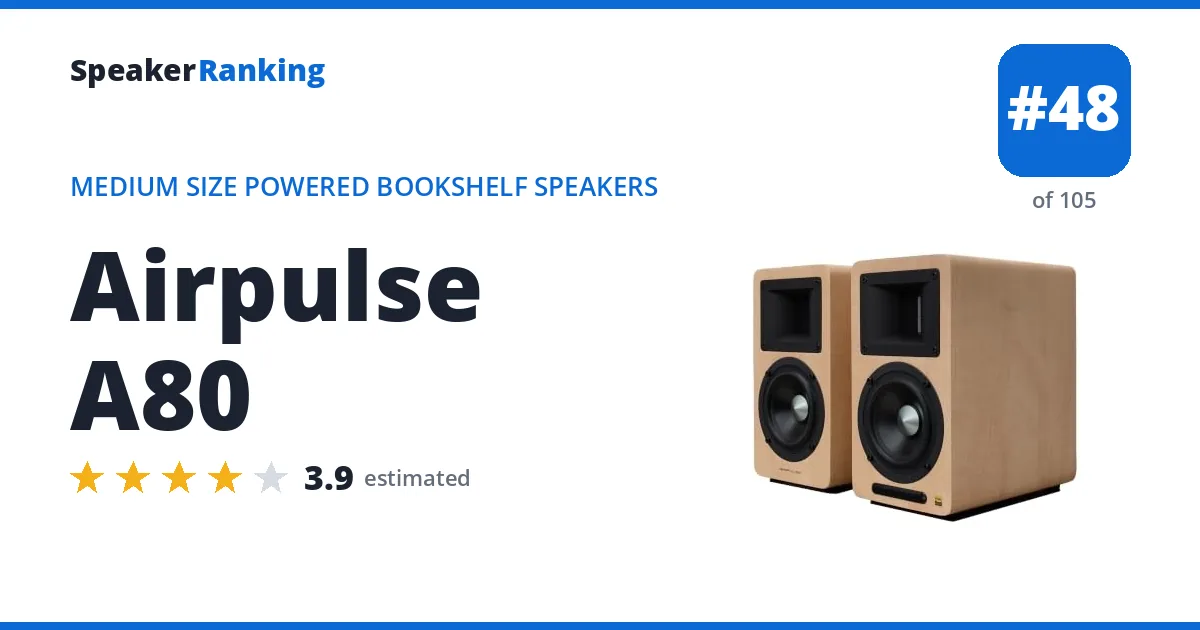
Same family: the Airpulse A60 (smaller bookshelf, estimated 3.8/5), the Airpulse A100 (larger bookshelf, ranked higher, rated 4/5) and the Airpulse A200T (larger bookshelf, ranked higher, estimated 4/5).
Pros: A compact AirPulse speaker with the brand’s horn-loaded aluminum ribbon tweeter and a 4.5” aluminum-cone woofer, separately amplified with 40W per woofer and 10W per tweeter. The specified range runs from 52Hz to 40kHz. Bluetooth 5.0 with aptX, optical, USB, PC and AUX inputs, a subwoofer output and a remote make it an all-in-one desk or bookshelf system.
Cons: No independent measurements yet, so its tonal balance and directivity can’t be compared directly with measured speakers; the rating is estimated from the larger Airpulse A100. Bass stops around 52Hz, so it benefits from a subwoofer, and the horn tweeter can narrow vertical dispersion, so keep it near ear height.
Full Airpulse A80 review and specifications →
| Released | 2020 (6 years ago) |
|---|---|
| Amplifier Power | 100W total (2x 40W woofer + 2x 10W tweeter) |
| Bluetooth | Yes |
| Dimensions | 9.8”H x 5.5”W x 8.7”D (250 x 140 x 220 mm) |
| Drivers | Horn-loaded aluminum ribbon tweeter, 4.5” aluminum-cone woofer |
| Frequency Response | 52Hz - 40kHz (manufacturer specified) |
| Subwoofer Output | Yes |
- Reviews, Comparisons and Sound Samples
- No independent measurement review is linked for this model; it is ranked from hands-on listening and comparison against similarly priced speakers.
- Head-to-Head Comparisons
 ADAM Audio A44H: $1,459.98 per pair Estimated B&H Photo Video eBay
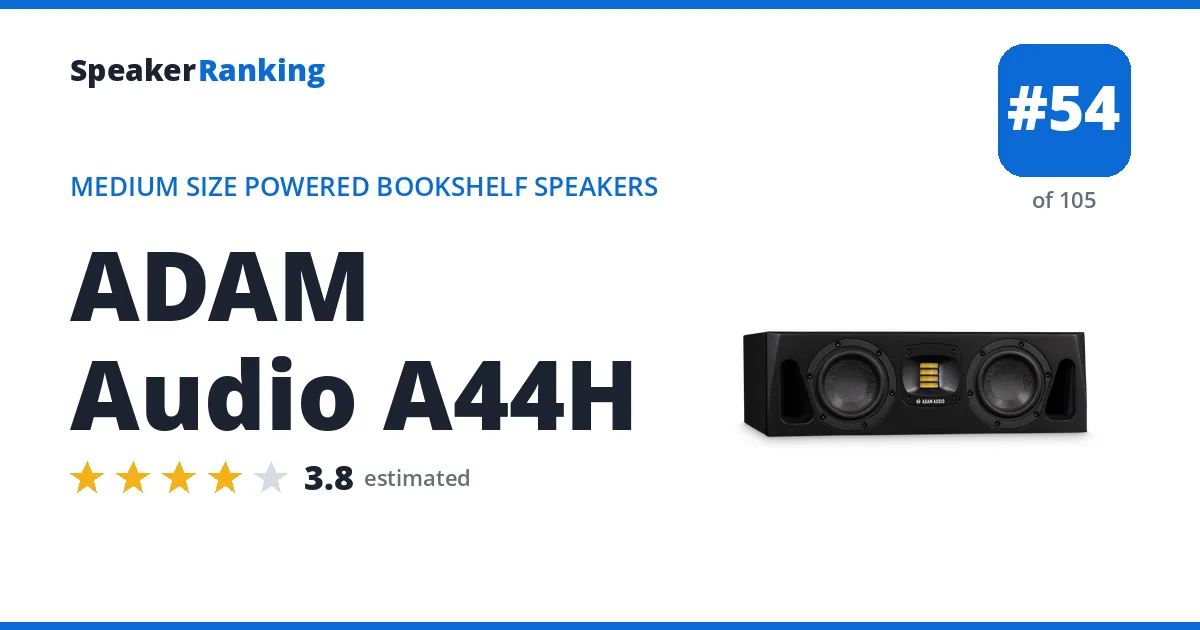
Same family: the ADAM Audio A4V (smaller bookshelf, ranked lower, rated 3.6/5), the ADAM Audio A7V (larger bookshelf, rated 4/5), the ADAM Audio A8H (larger bookshelf, estimated 4.4/5) and the ADAM Audio A77H (larger bookshelf, estimated 4.4/5). See every ADAM Audio A Series generation.
Pros: A horizontal A Series monitor with two 4” mineral-composite woofers flanking the X-ART folded-ribbon tweeter in a rotatable HPS waveguide, driven by 130W. Lying flat it fits under a screen or on a rack shelf and doubles as a center channel in surround or immersive setups. ADAM specifies 49Hz to 41kHz (-3dB), and DSP room adaptation, Sonarworks SoundID support and network control via ADAM’s software let you tune it to the room.
Cons: No independent measurements yet, so its tonal balance and directivity can’t be compared directly with measured speakers; the rating is estimated from the measured ADAM Audio A4V and ADAM Audio A7V. Horizontal two-way speakers usually have less even horizontal dispersion than vertical ones, since the woofers sit side by side, and bass stops near 49Hz, so a subwoofer still helps.
Full ADAM Audio A44H review and specifications →
| Released | May 2022 (4 years ago) |
|---|---|
| AES Input | No |
| Amplifier Power | 130W (110W woofers + 20W tweeter) |
| Aux Input | No |
| Bluetooth | No |
| Coaxial Input | No |
| DSP | Yes (room adaptation EQ, SoundID Reference support) |
| Dimensions | 5.3” (135 mm) H x 432mm W x 350mm D |
| Drivers | 2x 4” Multi-Layer Mineral woofers, X-ART tweeter in rotatable HPS waveguide |
| Frequency Response | 49Hz - 41kHz (-3dB, manufacturer specified) |
| HDMI Input | No |
| Inputs | XLR, RCA |
| Maximum SPL | 103dB @ 1m (manufacturer specified) |
| Optical Input | No |
| RCA Input | Yes |
| TRS Input | No |
| USB Input | No |
| Weight | 21.4 lbs (9.7 kg) each |
| XLR Input | Yes |
- Links
- Reviews, Comparisons and Sound Samples
- No independent measurement review is linked for this model; it is ranked from hands-on listening and comparison against similarly priced speakers.
- Head-to-Head Comparisons