Short answer: the Sony WF-1000XM5. Both are rated 4.4/5 for sound quality (#115 and #110 of 450 in-ear headphones), and the Sony WF-1000XM5 costs $198 against $214.99 for the DUNU Falcon Ultra, so with nothing between them on sound quality, price settles it.
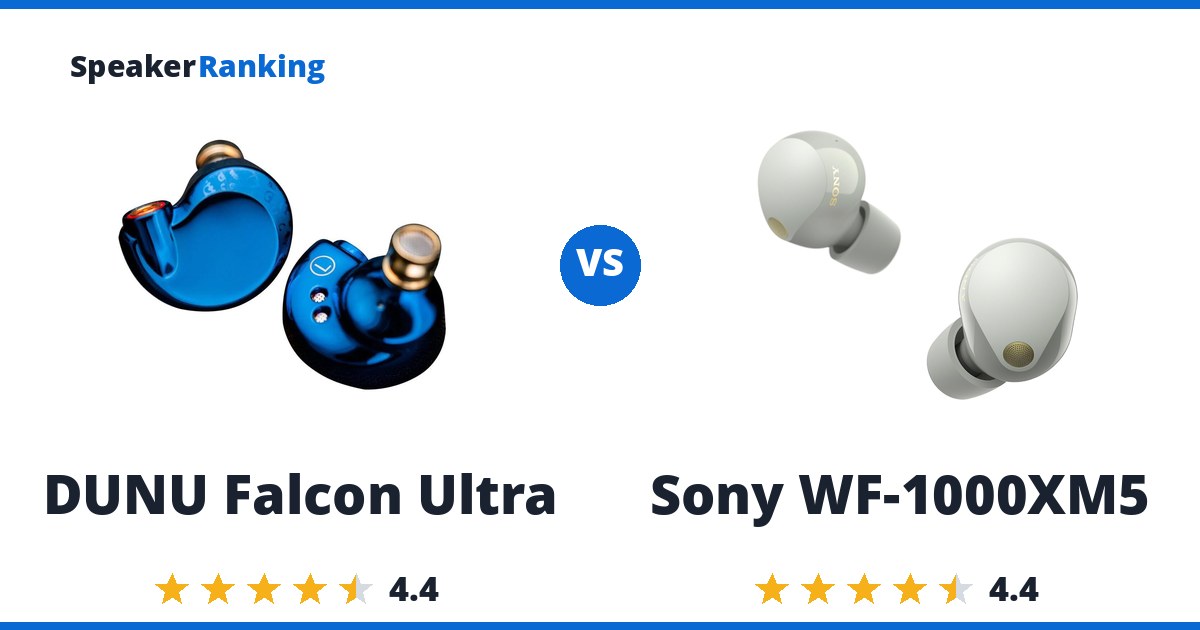
The case for the DUNU Falcon Ultra: With 21 hobbyist measurements behind it on squig.link, the Falcon Ultra has a well established preference score of 78.5 and sub-bass that sits essentially on target down to 20 Hz. The catch: The midbass lift spills slightly into the low mids, which run 1 dB high, so dense mixes can sound a little thick.
What the Sony WF-1000XM5 does well: Mild bass emphasis, about 1.9 dB above target from 60 to 200 Hz, adds warmth without muddying the midrange, which stays within 0.8 dB of the target for a preference score of 78. The tradeoff: Treble from 6 to 10 kHz runs about 2.2 dB low, with a 4.9 dB dip near 8 kHz, so cymbals and sibilance lose some bite.
Buy the Sony WF-1000XM5. Both are rated the same for sound quality, and it costs $16.99 less than the DUNU Falcon Ultra.
Still deciding? The full Headphones rankings cover every ranked option.
Specifications Side By Side
| DUNU Falcon Ultra | Sony WF-1000XM5 | |
|---|---|---|
| Price | $214.99 | $198.00 |
| Ranked | #110 of 450 in In-Ear Headphones | #115 of 450 in In-Ear Headphones |
| Form Factor | In-ear | In-ear |
| Back | Closed | Closed |
| Harman Preference Score | 79 (median of 21 squig.link measurements, calibrated to AutoEQ) | 78 (measured by oratory1990, via AutoEQ) |
| Deviation From Target | 1.55 dB standard deviation | 1.87 dB standard deviation |
| Tonal Tilt | -0.28 (negative is warmer, positive brighter) | -0.18 (negative is warmer, positive brighter) |
| Sub-bass Extension | Within 6 dB of target down to 20 Hz (-0.7 dB at 30 Hz) | Within 6 dB of target down to 20 Hz (-2.6 dB at 30 Hz) |
| Connection | Wired | True wireless |
| Driver Type | Dynamic | Dynamic |
| Drivers | 1 x 10.7mm dynamic | 1 x 8.4mm dynamic |
| Impedance | 16 ohms | - |
| Sensitivity | 108 dB | - |
| Weight | 0 lbs (10 g) per earbud | 0 lbs (5.9 g) per earbud |
| Frequency Response | 5Hz - 40kHz (Manufacturer specified) | 20Hz - 20kHz (Manufacturer specified) |
| Built-in Microphone | No | Yes |
| Active Noise Cancelling | - | Yes |
| Battery Life | - | 8 hours (24 with case, Manufacturer specified) |
| Bluetooth Version | - | 5.3 |
| Bluetooth Codecs | - | SBC, AAC, LDAC |
| IP Rating | - | IPX4 |
Related Headphone Comparisons
More top alternatives to DUNU Falcon Ultra:
- Simgot SuperMix 5 vs DUNU Falcon Ultra
- DUNU Falcon Ultra vs Queen of Audio Aviation
- DUNU Falcon Ultra vs Moondrop Kadenz
- Sony WF-1000XM5 vs Apevoix Nebula
- Queen of Audio Aviation vs Sony WF-1000XM5
Prices on this page were last checked October 11, 2026 at 4:59 PM UTC. Product prices and availability are accurate as of that date/time and are subject to change; the price and availability shown on Amazon at the time of purchase will apply to the purchase of this product.
As an eBay Partner, we may be compensated if you make a purchase.
The Two Headphones In Full
 DUNU Falcon Ultra: $214.99 HiFiGo eBay

Pros: With 21 hobbyist measurements behind it on squig.link, the Falcon Ultra has a well established preference score of 78.5 and sub-bass that sits essentially on target down to 20 Hz. Midbass about 2.7 dB above target gives drums and bass guitar a warm, punchy body, while treble stays close to neutral with no peak above 4.7 dB. Its 16 ohm, 108 dB rating makes it easy to run from a phone.
Cons: The midbass lift spills slightly into the low mids, which run 1 dB high, so dense mixes can sound a little thick. At 10 g per earbud it is heavier than many single dynamic in-ears, and it costs much more than the equally rated Kefine Quatio.
Full DUNU Falcon Ultra review and specifications →
| Released | 2023 (3 years ago) |
|---|---|
| Back | Closed |
| Built-in Microphone | No |
| Connection | Wired |
| Deviation From Target | 1.55 dB standard deviation |
| Driver Type | Dynamic |
| Drivers | 1 x 10.7mm dynamic |
| Form Factor | In-ear |
| Frequency Response | 5Hz - 40kHz (Manufacturer specified) |
| Harman Preference Score | 79 (median of 21 squig.link measurements, calibrated to AutoEQ) |
| Impedance | 16 ohms |
| Sensitivity | 108 dB |
| Sub-bass Extension | Within 6 dB of target down to 20 Hz (-0.7 dB at 30 Hz) |
| Tonal Tilt | -0.28 (negative is warmer, positive brighter) |
| Weight | 0 lbs (10 g) per earbud |
- Reviews, Comparisons and Sound Samples
- Head-to-Head Comparisons
 Sony WF-1000XM5: $198.00 TWS Amazon eBay
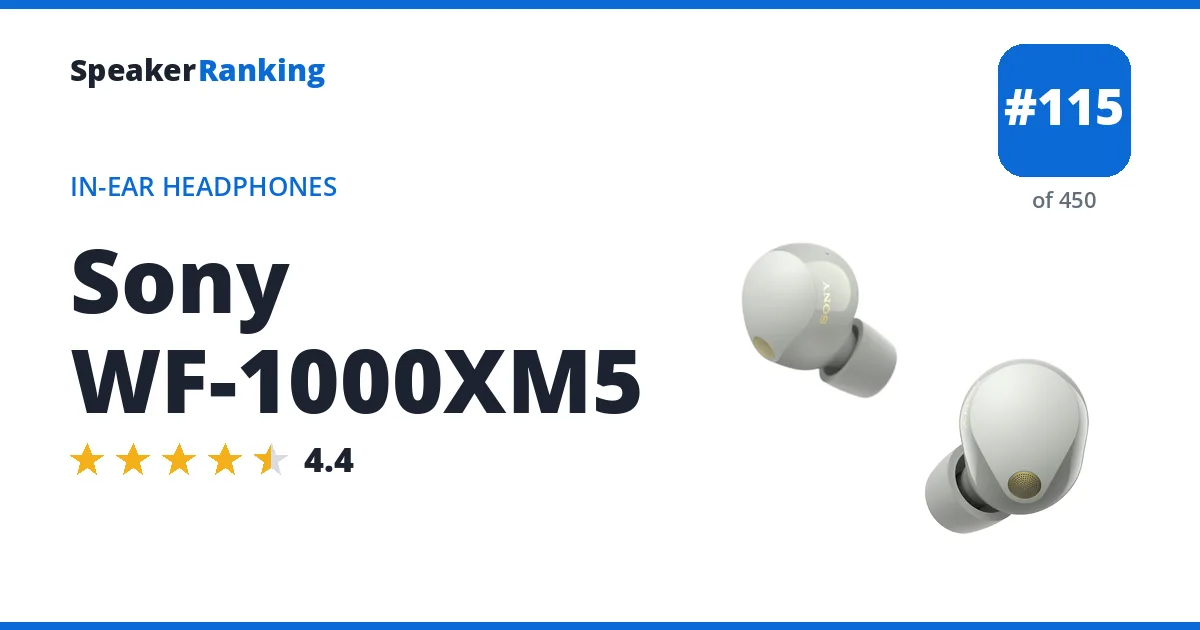
Pros: Mild bass emphasis, about 1.9 dB above target from 60 to 200 Hz, adds warmth without muddying the midrange, which stays within 0.8 dB of the target for a preference score of 78. Active noise cancelling, LDAC, AAC and SBC support, Bluetooth 5.3 and an IPX4 rating make it a full-featured true wireless set. Battery lasts about 8 hours per charge, 24 with the case, and each bud weighs 5.9 g.
Cons: Treble from 6 to 10 kHz runs about 2.2 dB low, with a 4.9 dB dip near 8 kHz, so cymbals and sibilance lose some bite. A 2.9 dB peak near 10.6 kHz can add a touch of artificial shimmer. Sub-bass sits about 1.9 dB below target, so the bass is punchy more than deep. The wired Sennheiser IE 200 matches its rating at a lower price and without charging.
Full Sony WF-1000XM5 review and specifications →
| Released | Jul 2023 (3 years ago) |
|---|---|
| Active Noise Cancelling | Yes |
| Back | Closed |
| Battery Life | 8 hours (24 with case, Manufacturer specified) |
| Bluetooth Codecs | SBC, AAC, LDAC |
| Bluetooth Version | 5.3 |
| Built-in Microphone | Yes |
| Connection | True wireless |
| Deviation From Target | 1.87 dB standard deviation |
| Driver Type | Dynamic |
| Drivers | 1 x 8.4mm dynamic |
| Form Factor | In-ear |
| Frequency Response | 20Hz - 20kHz (Manufacturer specified) |
| Harman Preference Score | 78 (measured by oratory1990, via AutoEQ) |
| IP Rating | IPX4 |
| Sub-bass Extension | Within 6 dB of target down to 20 Hz (-2.6 dB at 30 Hz) |
| Tonal Tilt | -0.18 (negative is warmer, positive brighter) |
| Weight | 0 lbs (5.9 g) per earbud |
EQ preset to match the Harman target
Set a preamp of -2.6 dB, then add these filters in any parametric equalizer (Wavelet, Equalizer APO, Peace, or a player with parametric EQ). Calculated by AutoEQ from its measured frequency response.
| Filter | Frequency | Gain | Q |
|---|---|---|---|
| Low shelf | 105 Hz | +5.4 dB | 0.70 |
| Peak | 68 Hz | -4.8 dB | 0.27 |
| Peak | 1,377 Hz | +2.6 dB | 0.31 |
| Peak | 1,806 Hz | -3.5 dB | 1.16 |
| Peak | 6,875 Hz | +1.8 dB | 3.49 |
| High shelf | 10,000 Hz | +2.3 dB | 0.70 |
| Peak | 3,757 Hz | +0.3 dB | 2.56 |
| Peak | 5,057 Hz | -0.7 dB | 5.70 |
| Peak | 449 Hz | +0.3 dB | 4.15 |
| Peak | 677 Hz | -0.2 dB | 2.75 |
- Reviews, Comparisons and Sound Samples
- Head-to-Head Comparisons