Short answer: the Denon AH-D9200. It ranks #124 of 216 over-ear headphones by sound quality, rated 3.5/5, at $1,799. The Sendy Peacock ranks #150, rated 3.3/5, at $1,499, $300 cheaper, not enough of a saving to outweigh the sound-quality gap.
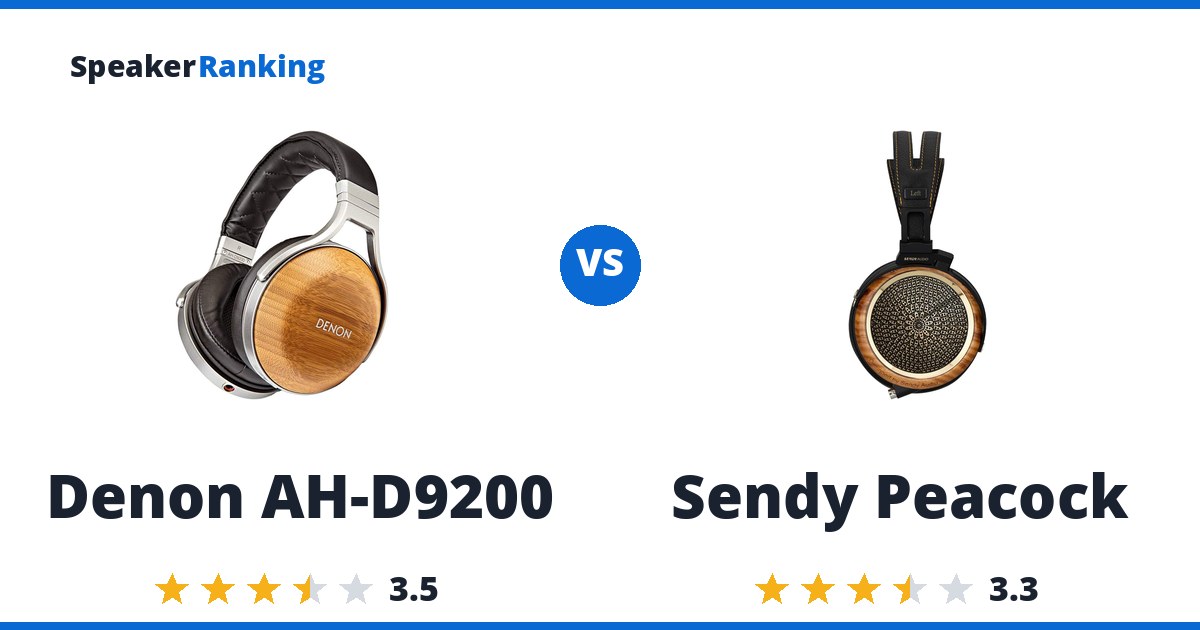
Why pick the Denon AH-D9200: The bass is well behaved, within about 1.4 dB of target through the sub-bass and about 1.2 dB over in the bass, which gives a full but controlled foundation. The catch: Upper mids are about 2.4 dB under target and a 6.1 dB dip near 2.3 kHz recesses vocals and piano.
The case for the Sendy Peacock: The open-back 88mm planar driver gives a spacious presentation, and at 50 ohms and 103 dB sensitivity it is easy enough to drive from a modest amp or dongle. The catch: Presence is about 4 dB low and a 8.7 dB dip near 9.9 kHz softens cymbals and string detail, so the top end sounds subdued.
Buy the Denon AH-D9200. It is rated higher for sound quality, and the $300 saving on the Sendy Peacock is not enough to make up the difference.
Still deciding? The full Headphones rankings cover every ranked option.
Specifications Side By Side
| Denon AH-D9200 | Sendy Peacock | |
|---|---|---|
| Price | $1,799.00 | $1,499.00 |
| Ranked | #124 of 216 in Over-Ear Headphones | #150 of 216 in Over-Ear Headphones |
| Form Factor | Over-ear | Over-ear |
| Harman Preference Score | 71 (measured by oratory1990, via AutoEQ) | 65 (measured by oratory1990, via AutoEQ) |
| Deviation From Target | 2.50 dB standard deviation | 2.78 dB standard deviation |
| Tonal Tilt | -0.80 (negative is warmer, positive brighter) | -0.90 (negative is warmer, positive brighter) |
| Sub-bass Extension | Within 6 dB of target down to 20 Hz (-1.9 dB at 30 Hz) | Falls 6 dB below target at 40 Hz (-7.1 dB at 30 Hz) |
| Connection | Wired | Wired |
| Back | Closed | Open |
| Driver Type | Dynamic | Planar magnetic |
| Drivers | 1 x 50mm dynamic | 1 x 88mm planar magnetic |
| Impedance | 24 ohms | 50 ohms |
| Sensitivity | 105 dB/mW | 103 dB |
| Weight | 0.8 lbs (375 g) | 1.3 lbs (578 g) |
| Frequency Response | 5Hz - 56kHz (Manufacturer specified) | 20Hz - 40kHz (Manufacturer specified) |
| Built-in Microphone | No | - |
Related Headphone Comparisons
How Denon AH-D9200 compares with other leading options:
- ZMF Ori 3.0 vs Denon AH-D9200
- Denon AH-D9200 vs Audeze MM-500
- Denon AH-D9200 vs Audio-Technica ATH-AWKT
- Audeze MM-500 vs Sendy Peacock
- Sendy Peacock vs Audio-Technica ATH-AWAS
Prices on this page were last checked October 11, 2026 at 4:59 PM UTC. Product prices and availability are accurate as of that date/time and are subject to change; the price and availability shown on Amazon at the time of purchase will apply to the purchase of this product.
As an eBay Partner, we may be compensated if you make a purchase.
The Two Headphones In Full
 Denon AH-D9200: $1,799.00 Amazon eBay
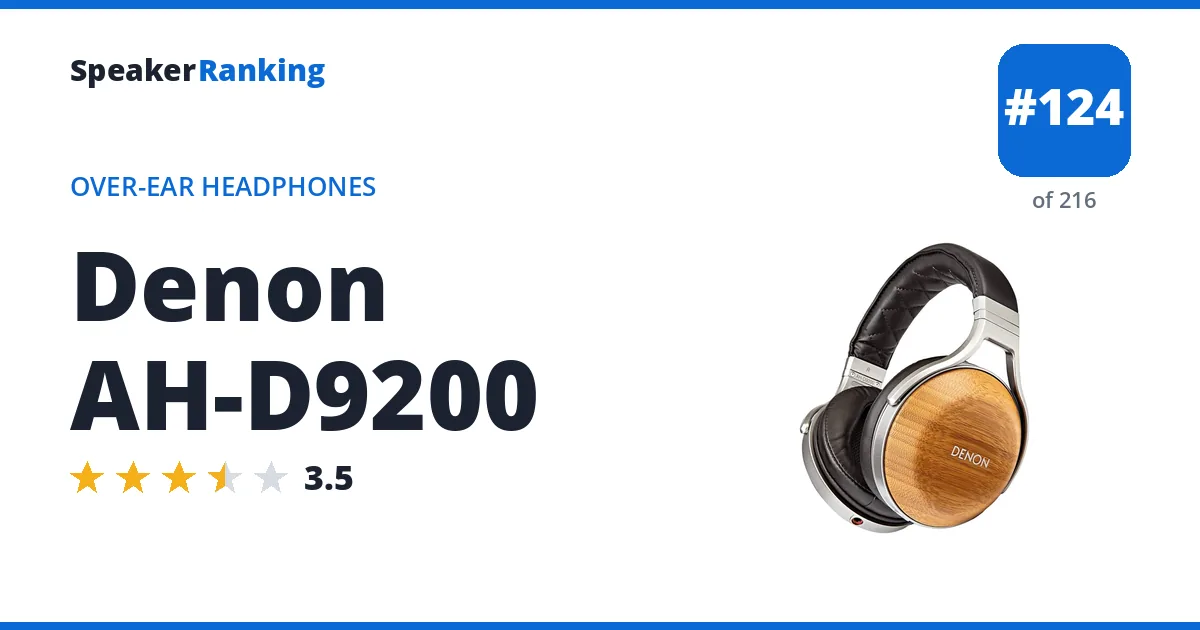
Pros: The bass is well behaved, within about 1.4 dB of target through the sub-bass and about 1.2 dB over in the bass, which gives a full but controlled foundation. A preference score of 71 and a 2.5 dB deviation show a reasonably smooth overall tune. A 24 ohm impedance and 105 dB/mW sensitivity make it easy to drive from portable sources, and the closed back isolates.
Cons: Upper mids are about 2.4 dB under target and a 6.1 dB dip near 2.3 kHz recesses vocals and piano. Treble from 6 to 10 kHz is 3.5 dB low, then a 6.4 dB peak near 11.9 kHz and 4.8 dB of excess air add a hot, uneven sheen on top. At 375 g it is a heavy headphone, and the price is far beyond what the response alone delivers compared with the Denon AH-D7200.
Full Denon AH-D9200 review and specifications →
| Released | Oct 2019 (7 years ago) |
|---|---|
| Back | Closed |
| Built-in Microphone | No |
| Connection | Wired |
| Deviation From Target | 2.50 dB standard deviation |
| Driver Type | Dynamic |
| Drivers | 1 x 50mm dynamic |
| Form Factor | Over-ear |
| Frequency Response | 5Hz - 56kHz (Manufacturer specified) |
| Harman Preference Score | 71 (measured by oratory1990, via AutoEQ) |
| Impedance | 24 ohms |
| Sensitivity | 105 dB/mW |
| Sub-bass Extension | Within 6 dB of target down to 20 Hz (-1.9 dB at 30 Hz) |
| Tonal Tilt | -0.80 (negative is warmer, positive brighter) |
| Weight | 0.8 lbs (375 g) |
EQ preset to match the Harman target
Set a preamp of -6.2 dB, then add these filters in any parametric equalizer (Wavelet, Equalizer APO, Peace, or a player with parametric EQ). Calculated by AutoEQ from its measured frequency response.
| Filter | Frequency | Gain | Q |
|---|---|---|---|
| Low shelf | 105 Hz | +1.4 dB | 0.70 |
| Peak | 190 Hz | -3.8 dB | 0.77 |
| Peak | 2,176 Hz | +6.6 dB | 1.99 |
| Peak | 1,036 Hz | -2.7 dB | 1.43 |
| Peak | 420 Hz | +2.1 dB | 2.13 |
| High shelf | 10,000 Hz | -3.4 dB | 0.70 |
| Peak | 7,028 Hz | +3.5 dB | 1.56 |
| Peak | 5,420 Hz | -6.3 dB | 3.42 |
| Peak | 4,317 Hz | +1.9 dB | 5.76 |
| Peak | 42 Hz | -0.4 dB | 2.39 |
- Reviews, Comparisons and Sound Samples
- Head-to-Head Comparisons
 Sendy Peacock: $1,499.00 Amazon eBay

Pros: The open-back 88mm planar driver gives a spacious presentation, and at 50 ohms and 103 dB sensitivity it is easy enough to drive from a modest amp or dongle. Bass from 60 to 200 Hz lands almost exactly on target, and low mids are slightly full at about 1.6 dB above it, giving a warm, smooth tone.
Cons: Presence is about 4 dB low and a 8.7 dB dip near 9.9 kHz softens cymbals and string detail, so the top end sounds subdued. Sub-bass is roughly 5 dB under target. At 578 g it is heavy, and the open back leaks sound and offers no isolation.
Full Sendy Peacock review and specifications →
| Released | Aug 2023 (3 years ago) |
|---|---|
| Back | Open |
| Connection | Wired |
| Deviation From Target | 2.78 dB standard deviation |
| Driver Type | Planar magnetic |
| Drivers | 1 x 88mm planar magnetic |
| Form Factor | Over-ear |
| Frequency Response | 20Hz - 40kHz (Manufacturer specified) |
| Harman Preference Score | 65 (measured by oratory1990, via AutoEQ) |
| Impedance | 50 ohms |
| Sensitivity | 103 dB |
| Sub-bass Extension | Falls 6 dB below target at 40 Hz (-7.1 dB at 30 Hz) |
| Tonal Tilt | -0.90 (negative is warmer, positive brighter) |
| Weight | 1.3 lbs (578 g) |
EQ preset to match the Harman target
Set a preamp of -5.7 dB, then add these filters in any parametric equalizer (Wavelet, Equalizer APO, Peace, or a player with parametric EQ). Calculated by AutoEQ from its measured frequency response.
| Filter | Frequency | Gain | Q |
|---|---|---|---|
| Low shelf | 105 Hz | +6.3 dB | 0.70 |
| Peak | 127 Hz | -3.6 dB | 0.26 |
| Peak | 4,272 Hz | +3.4 dB | 0.39 |
| Peak | 10,000 Hz | +1.2 dB | 1.54 |
| Peak | 974 Hz | -3.5 dB | 2.18 |
| High shelf | 10,000 Hz | -4.5 dB | 0.70 |
| Peak | 4,260 Hz | +2.8 dB | 3.45 |
| Peak | 2,978 Hz | -2.7 dB | 2.66 |
| Peak | 1,869 Hz | +2.6 dB | 4.50 |
| Peak | 64 Hz | -0.6 dB | 2.10 |
- Reviews, Comparisons and Sound Samples
- Head-to-Head Comparisons