Short answer: the Denon AH-D9200. It ranks #124 of 216 over-ear headphones by sound quality, rated 3.5/5, at $1,799; the Audio-Technica ATH-AWKT ranks #151, rated 3.3/5, and costs $1,999, so there is not much of a tradeoff to weigh.
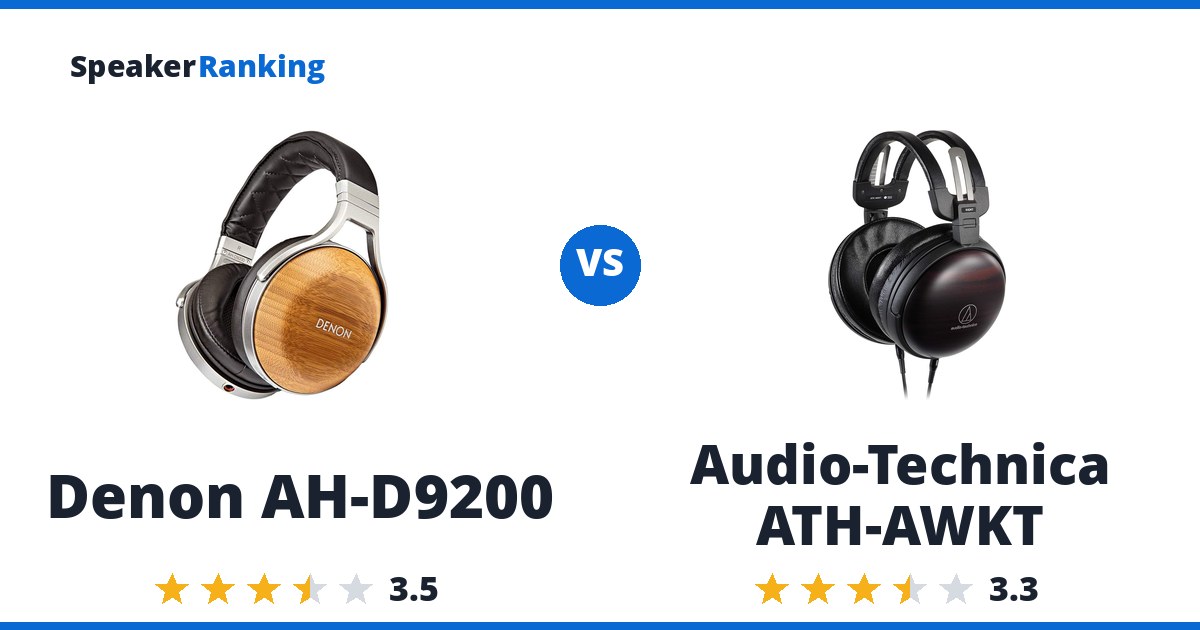
What the Denon AH-D9200 does well: The bass is well behaved, within about 1.4 dB of target through the sub-bass and about 1.2 dB over in the bass, which gives a full but controlled foundation. The catch: Upper mids are about 2.4 dB under target and a 6.1 dB dip near 2.3 kHz recesses vocals and piano.
Why pick the Audio-Technica ATH-AWKT: The closed back keeps sound in and outside noise out, and the 48 ohm, 102 dB/mW load reaches good volume straight from a phone. The tradeoff: A deep 16.9 dB dip near 6.7 kHz leaves the 6 to 10 kHz treble about 11 dB below target in oratory1990’s measurement, so cymbals, string texture and room ambience sound muted.
Buy the Denon AH-D9200. It is rated higher for sound quality than the Audio-Technica ATH-AWKT and costs less, so only choose the other one for a particular feature it does better.
Still deciding? The full Headphones rankings cover every ranked option.
Specifications Side By Side
| Denon AH-D9200 | Audio-Technica ATH-AWKT | |
|---|---|---|
| Price | $1,799.00 | $1,999.00 |
| Ranked | #124 of 216 in Over-Ear Headphones | #151 of 216 in Over-Ear Headphones |
| Form Factor | Over-ear | Over-ear |
| Harman Preference Score | 71 (measured by oratory1990, via AutoEQ) | 65 (measured by oratory1990, via AutoEQ) |
| Deviation From Target | 2.50 dB standard deviation | 3.44 dB standard deviation |
| Tonal Tilt | -0.80 (negative is warmer, positive brighter) | -0.38 (negative is warmer, positive brighter) |
| Sub-bass Extension | Within 6 dB of target down to 20 Hz (-1.9 dB at 30 Hz) | Falls 6 dB below target at 42 Hz (-9.2 dB at 30 Hz) |
| Connection | Wired | Wired |
| Back | Closed | Closed |
| Driver Type | Dynamic | Dynamic |
| Drivers | 1 x 50mm dynamic | 1 x 53mm dynamic |
| Impedance | 24 ohms | 48 ohms |
| Sensitivity | 105 dB/mW | 102 dB/mW |
| Weight | 0.8 lbs (375 g) | 0.9 lbs (405 g) |
| Frequency Response | 5Hz - 56kHz (Manufacturer specified) | 5Hz - 45kHz (Manufacturer specified) |
| Built-in Microphone | No | No |
Related Headphone Comparisons
More top alternatives to Denon AH-D9200:
- ZMF Ori 3.0 vs Denon AH-D9200
- Denon AH-D9200 vs Audeze MM-500
- Denon AH-D9200 vs Sendy Peacock
- Audio-Technica ATH-AWKT vs Fostex TH909
- Audeze MM-500 vs Audio-Technica ATH-AWKT
Prices on this page were last checked October 11, 2026 at 4:59 PM UTC. Product prices and availability are accurate as of that date/time and are subject to change; the price and availability shown on Amazon at the time of purchase will apply to the purchase of this product.
As an eBay Partner, we may be compensated if you make a purchase.
The Two Headphones In Full
 Denon AH-D9200: $1,799.00 Amazon eBay
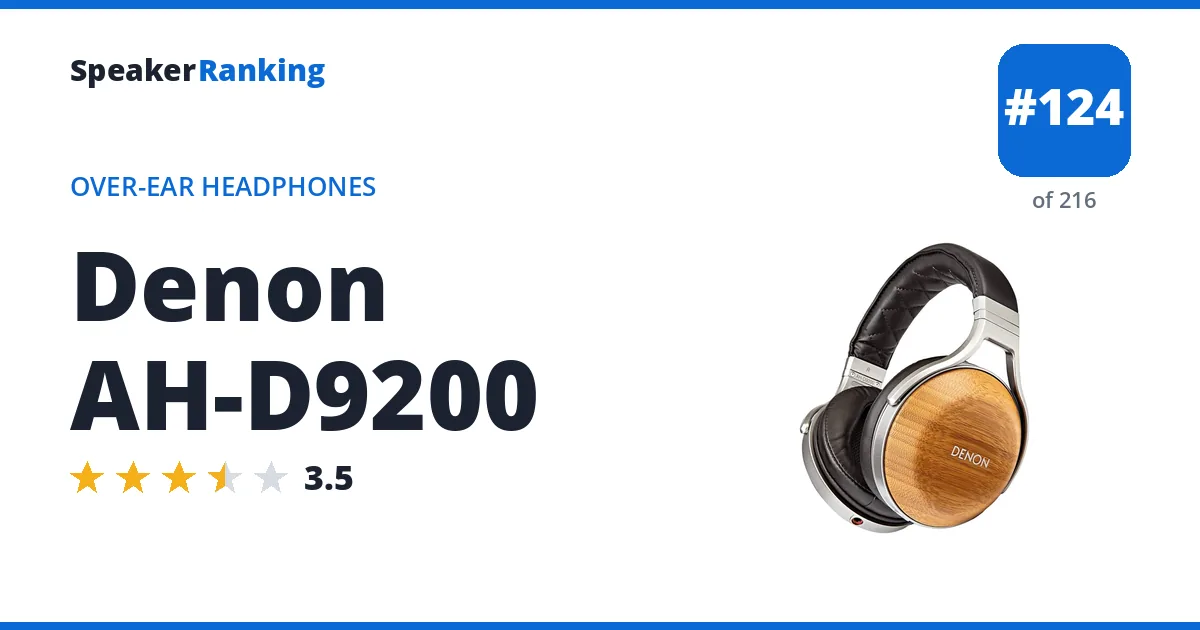
Pros: The bass is well behaved, within about 1.4 dB of target through the sub-bass and about 1.2 dB over in the bass, which gives a full but controlled foundation. A preference score of 71 and a 2.5 dB deviation show a reasonably smooth overall tune. A 24 ohm impedance and 105 dB/mW sensitivity make it easy to drive from portable sources, and the closed back isolates.
Cons: Upper mids are about 2.4 dB under target and a 6.1 dB dip near 2.3 kHz recesses vocals and piano. Treble from 6 to 10 kHz is 3.5 dB low, then a 6.4 dB peak near 11.9 kHz and 4.8 dB of excess air add a hot, uneven sheen on top. At 375 g it is a heavy headphone, and the price is far beyond what the response alone delivers compared with the Denon AH-D7200.
Full Denon AH-D9200 review and specifications →
| Released | Oct 2019 (7 years ago) |
|---|---|
| Back | Closed |
| Built-in Microphone | No |
| Connection | Wired |
| Deviation From Target | 2.50 dB standard deviation |
| Driver Type | Dynamic |
| Drivers | 1 x 50mm dynamic |
| Form Factor | Over-ear |
| Frequency Response | 5Hz - 56kHz (Manufacturer specified) |
| Harman Preference Score | 71 (measured by oratory1990, via AutoEQ) |
| Impedance | 24 ohms |
| Sensitivity | 105 dB/mW |
| Sub-bass Extension | Within 6 dB of target down to 20 Hz (-1.9 dB at 30 Hz) |
| Tonal Tilt | -0.80 (negative is warmer, positive brighter) |
| Weight | 0.8 lbs (375 g) |
EQ preset to match the Harman target
Set a preamp of -6.2 dB, then add these filters in any parametric equalizer (Wavelet, Equalizer APO, Peace, or a player with parametric EQ). Calculated by AutoEQ from its measured frequency response.
| Filter | Frequency | Gain | Q |
|---|---|---|---|
| Low shelf | 105 Hz | +1.4 dB | 0.70 |
| Peak | 190 Hz | -3.8 dB | 0.77 |
| Peak | 2,176 Hz | +6.6 dB | 1.99 |
| Peak | 1,036 Hz | -2.7 dB | 1.43 |
| Peak | 420 Hz | +2.1 dB | 2.13 |
| High shelf | 10,000 Hz | -3.4 dB | 0.70 |
| Peak | 7,028 Hz | +3.5 dB | 1.56 |
| Peak | 5,420 Hz | -6.3 dB | 3.42 |
| Peak | 4,317 Hz | +1.9 dB | 5.76 |
| Peak | 42 Hz | -0.4 dB | 2.39 |
- Reviews, Comparisons and Sound Samples
- Head-to-Head Comparisons
 Audio-Technica ATH-AWKT: $1,999.00 B&H Photo Video eBay
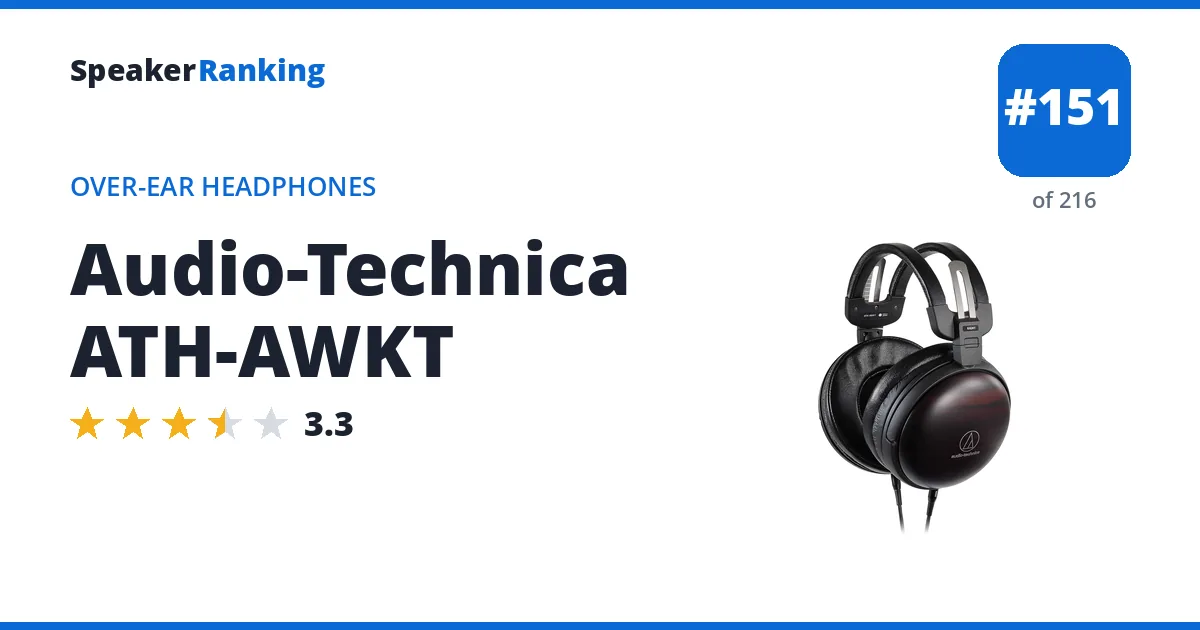
Pros: The closed back keeps sound in and outside noise out, and the 48 ohm, 102 dB/mW load reaches good volume straight from a phone. The upper midrange tracks the target within 0.6 dB and the largest peak above 1.5 kHz is only 2.3 dB, so nothing in the treble turns shrill or fatiguing. Its warm tilt suits listeners who prefer a relaxed, darker sound.
Cons: A deep 16.9 dB dip near 6.7 kHz leaves the 6 to 10 kHz treble about 11 dB below target in oratory1990’s measurement, so cymbals, string texture and room ambience sound muted. Sub-bass sits 9.5 dB under target and falls 6 dB short by 42 Hz, which thins out low bass, and at 405 g it is a heavy headphone. The Audeze MM-500 earns a higher rating at a similar price.
Full Audio-Technica ATH-AWKT review and specifications →
| Released | Nov 2019 (6 years ago) |
|---|---|
| Back | Closed |
| Built-in Microphone | No |
| Connection | Wired |
| Deviation From Target | 3.44 dB standard deviation |
| Driver Type | Dynamic |
| Drivers | 1 x 53mm dynamic |
| Form Factor | Over-ear |
| Frequency Response | 5Hz - 45kHz (Manufacturer specified) |
| Harman Preference Score | 65 (measured by oratory1990, via AutoEQ) |
| Impedance | 48 ohms |
| Sensitivity | 102 dB/mW |
| Sub-bass Extension | Falls 6 dB below target at 42 Hz (-9.2 dB at 30 Hz) |
| Tonal Tilt | -0.38 (negative is warmer, positive brighter) |
| Weight | 0.9 lbs (405 g) |
EQ preset to match the Harman target
Set a preamp of -6.2 dB, then add these filters in any parametric equalizer (Wavelet, Equalizer APO, Peace, or a player with parametric EQ). Calculated by AutoEQ from its measured frequency response.
| Filter | Frequency | Gain | Q |
|---|---|---|---|
| Low shelf | 105 Hz | +6.6 dB | 0.70 |
| Peak | 2,377 Hz | -9.1 dB | 0.50 |
| Peak | 8,032 Hz | +8.4 dB | 1.33 |
| Peak | 69 Hz | -4.4 dB | 1.18 |
| Peak | 2,675 Hz | +10.7 dB | 1.49 |
| High shelf | 10,000 Hz | -8.0 dB | 0.70 |
| Peak | 214 Hz | +3.2 dB | 2.51 |
| Peak | 125 Hz | -1.0 dB | 1.98 |
| Peak | 310 Hz | -1.2 dB | 3.63 |
| Peak | 1,384 Hz | -0.9 dB | 3.04 |
- Reviews, Comparisons and Sound Samples
- Head-to-Head Comparisons