Short answer: the dB Technologies Opera Reevo 210. It ranks #10 of 39 10-inch pa speakers by sound quality, rated 3.9/5, at $739. The Yamaha CXR10mkIII ranks #28, rated 3.5/5, at $649, $90 cheaper, a saving that is not big enough to make up the sound-quality gap.

The dB Technologies Opera Reevo 210 is the better-sounding choice. Two 10-inch neodymium woofers reach 62Hz at -3dB and about 54Hz at -10dB, deep for a 10-inch design, with a 5.45 preference score with an ideal subwoofer. The tradeoff: A 3.3dB reference band and 0.637 listening-window deviation give it a less even tonal balance than most 10-inch rivals.
Why pick the Yamaha CXR10mkIII: The passive version of the measured Yamaha DXR10mkIII, with the same 10” woofer, 1.75” voice coil compression driver, horn and port design. The catch: No independent measurements yet, so it can’t be compared with ranked PA speakers.
Buy the dB Technologies Opera Reevo 210. It is rated higher for sound quality, and saving $90 with the Yamaha CXR10mkIII does not make up for the sound-quality gap.
About the ratings: the Yamaha CXR10mkIII’s rating is estimated from measured siblings and predecessors rather than its own measurements, with a likely range of 3.1 to 3.9, so this verdict could change once it is measured.
Want more options? Browse the full PA & Live Sound rankings.
Specifications Side By Side
| dB Technologies Opera Reevo 210 | Yamaha CXR10mkIII | |
|---|---|---|
| Price | $739 | $649.00 Passive |
| Ranked | #10 of 39 in 10-Inch PA Speakers | #28 of 39 in 10-Inch PA Speakers Estimated |
| Rigging | 2 x M10 on top, 1 x M10 on back; 36mm pole mount | 2 x 35mm pole sockets; 6 x M8 and 1 x M6 inserts |
| Passive | No | Yes |
| Configuration | Active quasi 3-way coaxial PA speaker | Passive 2-way bass-reflex PA speaker |
| Drivers | 2x 10” neodymium woofers (2.5” voice coil), 1” exit compression driver (1.75” voice coil) | 10” woofer, 1.75” voice coil compression driver |
| Frequency Response | 60Hz - 19.2kHz (-6dB, manufacturer specified) | 54Hz - 20kHz (-10dB, manufacturer specified) |
| Dimensions | 23.8”H x 11.8”W x 12.8”D (604 x 300 x 324 mm) | - |
| Amplifier Power | 1,050W RMS (525W + 525W); 2,100W peak | Passive speaker; requires external amplification |
| Maximum SPL | 132.5dB (manufacturer specified) | 123dB (manufacturer specified) |
| Coverage | 100° x 90° | 90° x 60° |
| DSP | Yes, voicing presets | No (passive) |
| Weight | 37.9 lbs (17.2 kg) | 26.9 lbs (12.2 kg) |
| Bluetooth | No | No |
| XLR Input | Yes | No |
| RCA Input | No | - |
| TRS Input | Yes | - |
| Optical Input | No | - |
| Coaxial Input | No | - |
| USB Input | No | - |
| HDMI Input | No | - |
| AES Input | No | - |
| Aux Input | No | - |
| Microphone Input | No | - |
| Guitar Input | No | - |
| Bass Extension (-3dB) | 62.2Hz (measured, vendor Spinorama data) | - |
| Bass Extension (-10dB) | about 54.1Hz (measured, vendor Spinorama data) | - |
| Spinorama Preference Score | 2.88 | - |
| Spinorama Preference Score with Perfect Sub | 5.45 | - |
| Power Handling | - | 550W continuous |
| Sensitivity | - | 93dB |
| Impedance | - | 8 ohms |
Related Speaker Comparisons
More worthwhile head-to-heads for dB Technologies Opera Reevo 210:
- LD Systems Stinger 10-A-G3 vs dB Technologies Opera Reevo 210
- FBT ProMaxX 110A vs dB Technologies Opera Reevo 210
- dB Technologies Opera Reevo 210 vs RCF ART 910-A
- dB Technologies Opera Reevo 210 vs Yamaha DXR10mkIII
- dB Technologies Opera Reevo 210 vs Yamaha DXR10mkII
Prices on this page were last checked October 11, 2026 at 4:59 PM UTC. Product prices and availability are accurate as of that date/time and are subject to change; the price and availability shown on Amazon at the time of purchase will apply to the purchase of this product.
As an eBay Partner, we may be compensated if you make a purchase.
The Two Speakers In Full
 dB Technologies Opera Reevo 210: $739 Thomann eBay
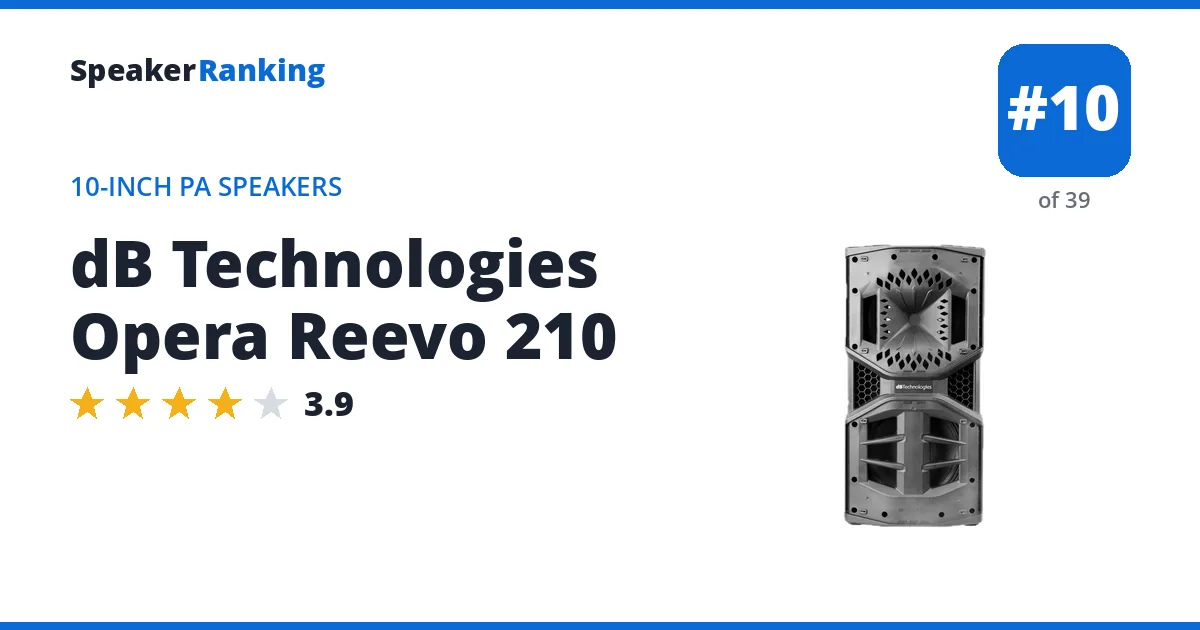
Same family: the dB Technologies Opera Reevo 212 (larger model, estimated 3.9/5).
Pros: Two 10-inch neodymium woofers reach 62Hz at -3dB and about 54Hz at -10dB, deep for a 10-inch design, with a 5.45 preference score with an ideal subwoofer. The coaxial compression driver gives wide 100° x 90° coverage, and 1,050W RMS of built-in amplification reaches a 132.5dB peak. It works as a floor wedge, on a pole or on a stand, weighs 17.2kg and comes with a cover. Measured bass extension of 62.2Hz (-3dB).
Cons: A 3.3dB reference band and 0.637 listening-window deviation give it a less even tonal balance than most 10-inch rivals. It has only one combo input with no onboard mixer. The standalone preference score is 2.88.
Full dB Technologies Opera Reevo 210 review and specifications →
| Released | 2023 (3 years ago) |
|---|---|
| AES Input | No |
| Amplifier Power | 1,050W RMS (525W + 525W); 2,100W peak |
| Aux Input | No |
| Bass Extension (-10dB) | about 54.1Hz (measured, vendor Spinorama data) |
| Bass Extension (-3dB) | 62.2Hz (measured, vendor Spinorama data) |
| Bluetooth | No |
| Coaxial Input | No |
| Configuration | Active quasi 3-way coaxial PA speaker |
| Coverage | 100° x 90° |
| DSP | Yes, voicing presets |
| Dimensions | 23.8”H x 11.8”W x 12.8”D (604 x 300 x 324 mm) |
| Drivers | 2x 10” neodymium woofers (2.5” voice coil), 1” exit compression driver (1.75” voice coil) |
| Frequency Response | 60Hz - 19.2kHz (-6dB, manufacturer specified) |
| Guitar Input | No |
| HDMI Input | No |
| Maximum SPL | 132.5dB (manufacturer specified) |
| Microphone Input | No |
| Optical Input | No |
| Passive | No |
| RCA Input | No |
| Rigging | 2 x M10 on top, 1 x M10 on back; 36mm pole mount |
| Spinorama Preference Score | 2.88 |
| Spinorama Preference Score with Perfect Sub | 5.45 |
| TRS Input | Yes |
| USB Input | No |
| Weight | 37.9 lbs (17.2 kg) |
| XLR Input | Yes |
- Links
- Reviews, Comparisons and Sound Samples
- Head-to-Head Comparisons
- dB Technologies Opera Reevo 210 vs RCF ART 910-A
- dB Technologies Opera Reevo 210 vs Yamaha DXR10mkIII
- dB Technologies Opera Reevo 210 vs Yamaha DXR10mkII
- dB Technologies Opera Reevo 210 vs FBT ProMaxX 110A
- dB Technologies Opera Reevo 210 vs LD Systems Stinger 10-A-G3
- dB Technologies Opera Reevo 210 vs dB Technologies Opera Reevo 212
 Yamaha CXR10mkIII: $649.00 Passive Estimated B&H Photo Video eBay
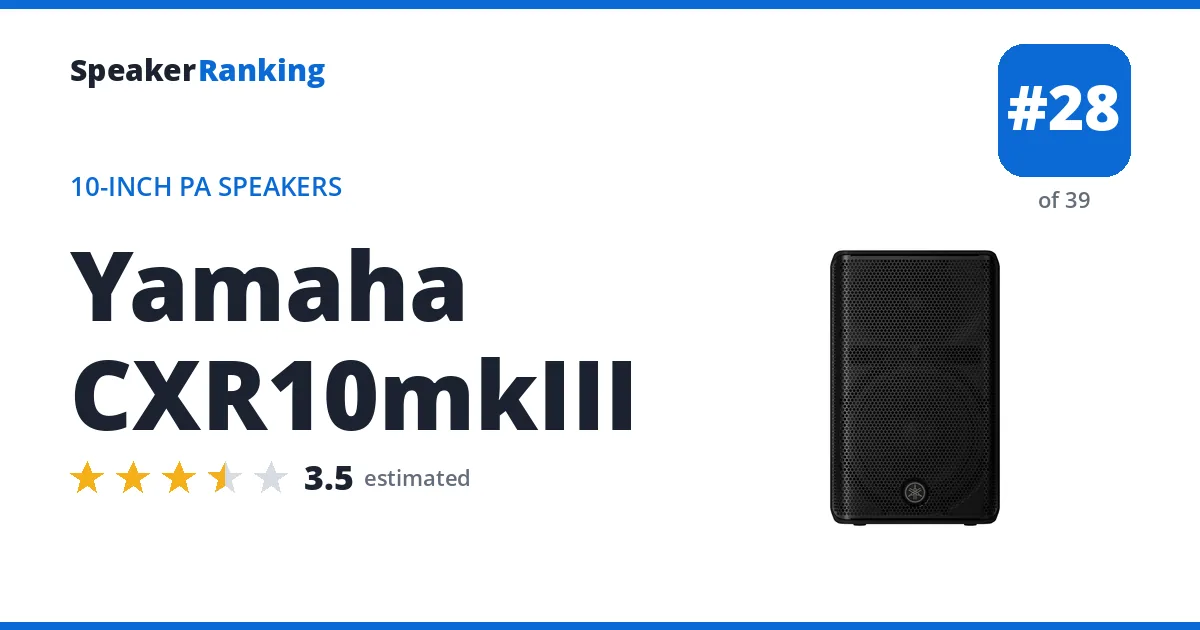
Same family: the Yamaha DXR10mkIII (smallest powered model, ranked higher, rated 3.8/5), the Yamaha DXR12mkIII (powered model, rated 4.1/5), the Yamaha DXR15mkIII (largest powered model, rated 3.8/5), the Yamaha CXR12mkIII (larger passive model, estimated 3.8/5) and the Yamaha CXR15mkIII (larger passive model, estimated 3.5/5). See every Yamaha DXR and CXR generation.
Pros: The passive version of the measured Yamaha DXR10mkIII, with the same 10” woofer, 1.75” voice coil compression driver, horn and port design. Yamaha rates it at 93dB sensitivity, 123dB maximum SPL and bass to 54Hz (-10dB) with 90° x 60° coverage, and its PX and PC-D amplifiers carry a dedicated processing preset for it.
Cons: No independent measurements yet, so it can’t be compared with ranked PA speakers. It needs an external amplifier and, for its rated response, speaker processing; the powered model has that built in. Without Yamaha’s preset its tonal balance depends on the amplifier’s EQ.
Full Yamaha CXR10mkIII review and specifications →
| Released | 2026 (this year) |
|---|---|
| Amplifier Power | Passive speaker; requires external amplification |
| Bluetooth | No |
| Configuration | Passive 2-way bass-reflex PA speaker |
| Coverage | 90° x 60° |
| DSP | No (passive) |
| Drivers | 10” woofer, 1.75” voice coil compression driver |
| Frequency Response | 54Hz - 20kHz (-10dB, manufacturer specified) |
| Impedance | 8 ohms |
| Maximum SPL | 123dB (manufacturer specified) |
| Passive | Yes |
| Power Handling | 550W continuous |
| Rigging | 2 x 35mm pole sockets; 6 x M8 and 1 x M6 inserts |
| Sensitivity | 93dB |
| Weight | 26.9 lbs (12.2 kg) |
| XLR Input | No |
- Links
- Reviews, Comparisons and Sound Samples
- No independent measurement review is linked for this model; it is ranked from hands-on listening and comparison against similarly priced speakers.
- Head-to-Head Comparisons