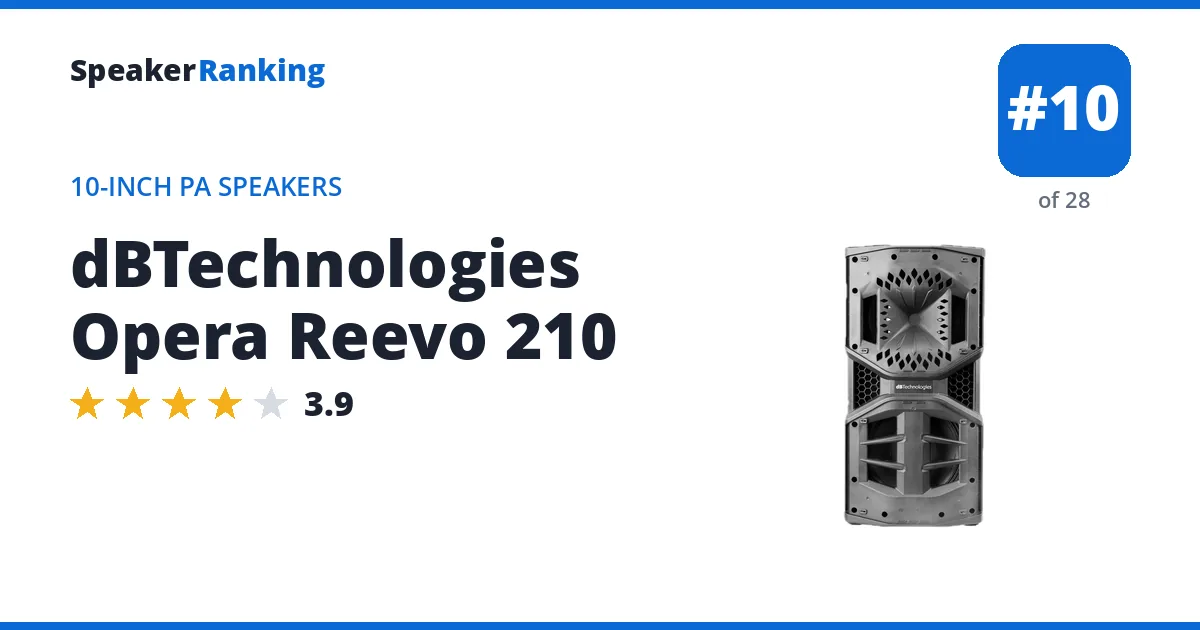
Short answer: the dBTechnologies Opera Reevo 210. It ranks #10 of 28 10-inch pa speakers by sound quality, rated 3.9/5, at $739; the Yamaha DXR10mkIII ranks #11, rated 3.8/5, and costs $899.99, which makes this an easy call rather than a real tradeoff.
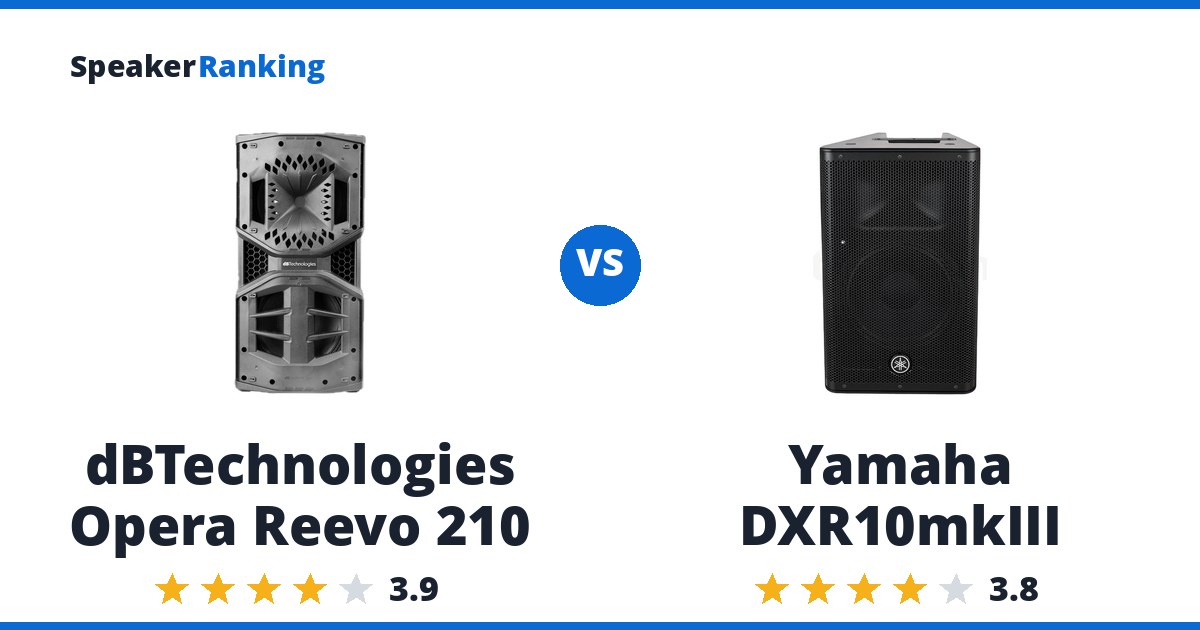
What the dBTechnologies Opera Reevo 210 does well: Two 10-inch neodymium woofers reach 62Hz at -3dB and about 54Hz at -10dB, deep for a 10-inch design, with a 5.45 preference score with an ideal subwoofer. The tradeoff: A 3.3dB reference band and 0.637 listening-window deviation give it a less even tonal balance than most 10-inch rivals.
The case for the Yamaha DXR10mkIII: The third-generation DXR10 raises claimed output to 132dB with refined porting and Yamaha’s newest onboard DSP, while staying light at 14.5kg with a familiar 90° x 60° pattern. Watch for: The low-quality local data is truncated and cannot produce a preference score, so its tonal advantage over the proven DXR10mkII is unconfirmed.
Buy the dBTechnologies Opera Reevo 210. It is rated higher for sound quality than the Yamaha DXR10mkIII and costs less, so only choose the other one for a particular feature it does better.
Looking for alternatives? See the complete PA & Live Sound rankings.
Specifications Side By Side
| dBTechnologies Opera Reevo 210 | Yamaha DXR10mkIII | |
|---|---|---|
| Price | $739 | $899.99 |
| Ranked | #10 of 28 in 10-Inch PA Speakers | #11 of 28 in 10-Inch PA Speakers |
| Configuration | Active quasi 3-way coaxial PA speaker | Active 2-way bass-reflex PA speaker |
| Drivers | 2x 10” neodymium woofers (2.5” voice coil), 1” exit compression driver (1.75” voice coil) | 10” woofer, 1” throat/1.75” diaphragm compression driver |
| Frequency Response | 60Hz - 19.2kHz (-6dB, manufacturer specified) | 53Hz - 20kHz (-10dB, manufacturer specified) |
| Dimensions | 23.8”H x 11.8”W x 12.8”D (604 x 300 x 324 mm) | 19.8”H x 12.2”W x 12.2”D (502 x 310 x 310 mm) |
| Amplifier Power | 1,050W RMS (525W + 525W); 2,100W peak | 2000W peak / 1000W RMS (1700W LF + 300W HF peak) |
| Maximum SPL | 132.5dB (manufacturer specified) | 132dB peak (manufacturer specified) |
| Coverage | 100° x 90° | 90° x 60° |
| DSP | Yes, voicing presets | Yes, FIR-X tuning, Drive Motion Calibration and D-Remote |
| Weight | 37.9 lbs (17.2 kg) | 32 lbs (14.5 kg) |
| Bluetooth | No | Bluetooth 5.0 audio streaming and D-Remote control |
| XLR Input | Yes | Yes |
| RCA Input | No | No |
| TRS Input | Yes | Yes |
| Optical Input | No | No |
| Coaxial Input | No | No |
| USB Input | No | No |
| HDMI Input | No | No |
| AES Input | No | No |
| Aux Input | No | No |
| Microphone Input | No | No |
| Guitar Input | No | No |
| Bass Extension (-3dB) | 62.2Hz (measured, vendor Spinorama data) | 61.5Hz (measured, vendor Spinorama data) |
| Bass Extension (-10dB) | about 54.1Hz (measured, vendor Spinorama data) | - |
| Spinorama Preference Score | 2.88 | - |
| Spinorama Preference Score with Perfect Sub | 5.45 | - |
| Inputs | - | 2 x XLR/TRS combo; XLR thru and DSP outputs |
| Crossover Frequency | - | 1800Hz (FIR-X) |
| Cabinet Material | - | PP plastic |
| Rigging | - | 3 x M8 points plus U-bracket points; 35mm dual-angle pole mount |
Related Speaker Comparisons
More worthwhile head-to-heads for dBTechnologies Opera Reevo 210:
- LD Systems Stinger 10-A-G3 vs dBTechnologies Opera Reevo 210
- FBT ProMaxX 110A vs dBTechnologies Opera Reevo 210
- dBTechnologies Opera Reevo 210 vs Yamaha DXR10mkII
- QSC K10.2 vs Yamaha DXR10mkIII
- Yamaha DXR10mkIII vs Yamaha DXR10mkII
Prices on this page were last checked September 26, 2026 at 11:14 PM UTC. Product prices and availability are accurate as of that date/time and are subject to change; the price and availability shown on Amazon at the time of purchase will apply to the purchase of this product.
As an eBay Partner, we may be compensated if you make a purchase.
The Two Speakers In Full
 dBTechnologies Opera Reevo 210: $739 Thomann eBay
Pros: Two 10-inch neodymium woofers reach 62Hz at -3dB and about 54Hz at -10dB, deep for a 10-inch design, with a 5.45 preference score with an ideal subwoofer. The coaxial compression driver gives wide 100° x 90° coverage, and 1,050W RMS of built-in amplification reaches a 132.5dB peak. It works as a floor wedge, on a pole or on a stand, weighs 17.2kg and comes with a cover. Measured bass extension of 62.2Hz (-3dB).
Cons: A 3.3dB reference band and 0.637 listening-window deviation give it a less even tonal balance than most 10-inch rivals. It has only one combo input with no onboard mixer. The standalone preference score is 2.88.
Full dBTechnologies Opera Reevo 210 review and specifications →
| AES Input | No |
|---|---|
| Amplifier Power | 1,050W RMS (525W + 525W); 2,100W peak |
| Aux Input | No |
| Bass Extension (-10dB) | about 54.1Hz (measured, vendor Spinorama data) |
| Bass Extension (-3dB) | 62.2Hz (measured, vendor Spinorama data) |
| Bluetooth | No |
| Coaxial Input | No |
| Configuration | Active quasi 3-way coaxial PA speaker |
| Coverage | 100° x 90° |
| DSP | Yes, voicing presets |
| Dimensions | 23.8”H x 11.8”W x 12.8”D (604 x 300 x 324 mm) |
| Drivers | 2x 10” neodymium woofers (2.5” voice coil), 1” exit compression driver (1.75” voice coil) |
| Frequency Response | 60Hz - 19.2kHz (-6dB, manufacturer specified) |
| Guitar Input | No |
| HDMI Input | No |
| Maximum SPL | 132.5dB (manufacturer specified) |
| Microphone Input | No |
| Optical Input | No |
| RCA Input | No |
| Spinorama Preference Score | 2.88 |
| Spinorama Preference Score with Perfect Sub | 5.45 |
| TRS Input | Yes |
| USB Input | No |
| Weight | 37.9 lbs (17.2 kg) |
| XLR Input | Yes |
- Links
- Reviews, Comparisons and Sound Samples
- Head-to-Head Comparisons
 Yamaha DXR10mkIII: $899.99 Amazon B&H Photo Video Guitar Center eBay
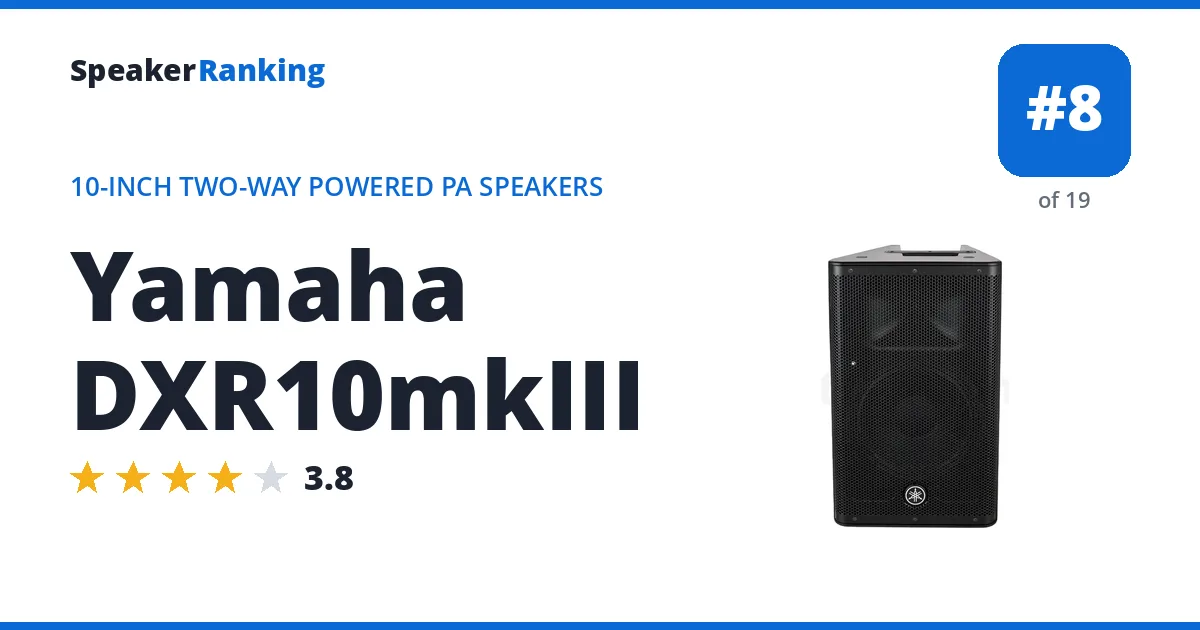
Pros: The third-generation DXR10 raises claimed output to 132dB with refined porting and Yamaha’s newest onboard DSP, while staying light at 14.5kg with a familiar 90° x 60° pattern. Measured bass extension of 61.5Hz (-3dB).
Cons: The low-quality local data is truncated and cannot produce a preference score, so its tonal advantage over the proven DXR10mkII is unconfirmed.
Full Yamaha DXR10mkIII review and specifications →
| AES Input | No |
|---|---|
| Amplifier Power | 2000W peak / 1000W RMS (1700W LF + 300W HF peak) |
| Aux Input | No |
| Bass Extension (-3dB) | 61.5Hz (measured, vendor Spinorama data) |
| Bluetooth | Bluetooth 5.0 audio streaming and D-Remote control |
| Cabinet Material | PP plastic |
| Coaxial Input | No |
| Configuration | Active 2-way bass-reflex PA speaker |
| Coverage | 90° x 60° |
| Crossover Frequency | 1800Hz (FIR-X) |
| DSP | Yes, FIR-X tuning, Drive Motion Calibration and D-Remote |
| Dimensions | 19.8”H x 12.2”W x 12.2”D (502 x 310 x 310 mm) |
| Drivers | 10” woofer, 1” throat/1.75” diaphragm compression driver |
| Frequency Response | 53Hz - 20kHz (-10dB, manufacturer specified) |
| Guitar Input | No |
| HDMI Input | No |
| Inputs | 2 x XLR/TRS combo; XLR thru and DSP outputs |
| Maximum SPL | 132dB peak (manufacturer specified) |
| Microphone Input | No |
| Optical Input | No |
| RCA Input | No |
| Rigging | 3 x M8 points plus U-bracket points; 35mm dual-angle pole mount |
| TRS Input | Yes |
| USB Input | No |
| Weight | 32 lbs (14.5 kg) |
| XLR Input | Yes |
- Links
- Reviews, Comparisons and Sound Samples
- Head-to-Head Comparisons
- Yamaha DXR10mkIII vs Yamaha DXR10mkII
- Yamaha DXR10mkIII vs Seeburg X4
- Yamaha DXR10mkIII vs RCF KX 10-A
- Yamaha DXR10mkIII vs Vue Audiotechnik A-10
- Yamaha DXR10mkIII vs Turbosound NuQ102
- Yamaha DXR10mkIII vs KV2 Audio EX10
- Yamaha DXR10mkIII vs RCF ART 710-A MK5
- Yamaha DXR10mkIII vs QSC K10.2
- See all 17 comparisons