Short answer: the Bowers & Wilkins 607 S3. It ranks #65 of 168 bookshelf speakers by sound quality, rated 3.6/5, at $1,000; the Q Acoustics 5010 ranks #71, rated 3.5/5, at $999.50. With prices this close, go by the sound-quality ranking rather than the cost.
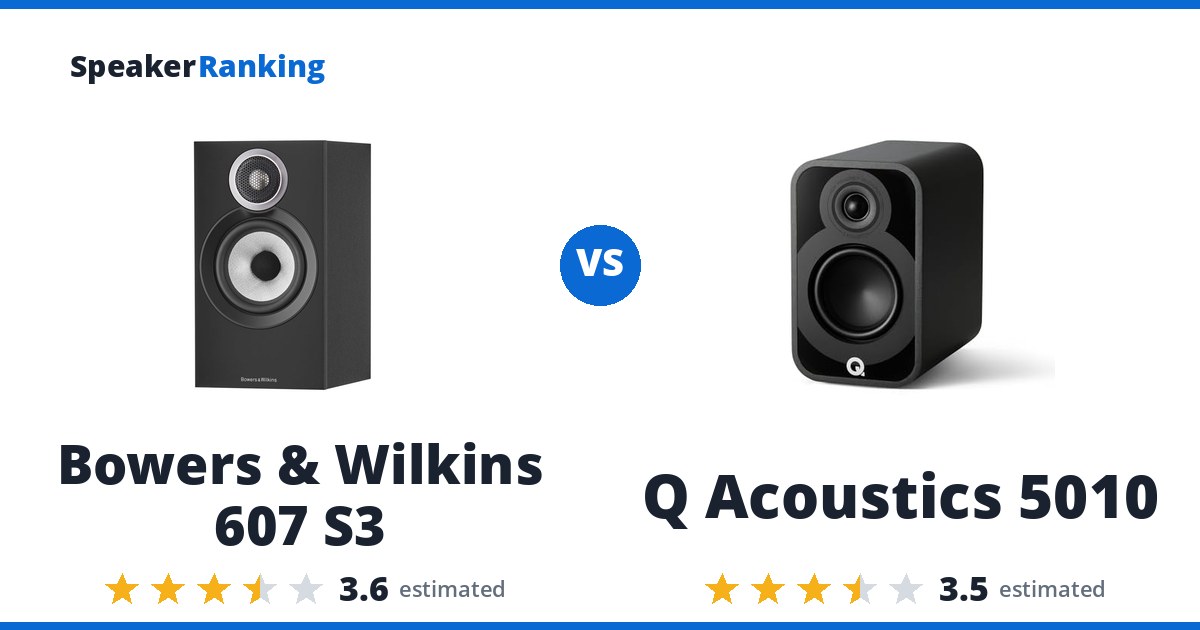
Why pick the Bowers & Wilkins 607 S3: The current smallest 600 Series speaker, with a 5” Continuum cone and a 1” decoupled double dome titanium tweeter, rated 52Hz to 28kHz. Watch for: No independent measurements yet, so its tonal balance and directivity can’t be compared directly with measured speakers; the rating is estimated from its measured predecessor.
The case for the Q Acoustics 5010: Compact 2-way standmount speaker in the 5000 Series featuring a 4.5-inch C3 Continuous Curved Cone mid/bass driver and hermetically sealed 1-inch tweeter. The tradeoff: Rating estimated based on 5000 series sibling testing.
Buy the Bowers & Wilkins 607 S3. It is rated higher for sound quality, and the $0.50 saving on the Q Acoustics 5010 is not enough to make up the difference.
About the ratings: neither speaker has been measured yet, so both ratings are estimated from measured siblings and predecessors (likely ranges: Bowers & Wilkins 607 S3 3.3 to 3.9; Q Acoustics 5010 3.3 to 3.7). Treat this verdict as provisional.
Want more options? Browse the full Passive Home rankings.
Specifications Side By Side
| Bowers & Wilkins 607 S3 | Q Acoustics 5010 | |
|---|---|---|
| Price | $1,000 per pair | $999.50 per pair |
| Ranked | #65 of 168 in Medium Size Bookshelf Speakers Estimated | #71 of 168 in Medium Size Bookshelf Speakers Estimated |
| Weight | 10.3 lbs (4.65 kg) | 12.3 lbs (5.6 kg) each |
| Bass Extension (-3dB) | 52Hz (manufacturer specified) | - |
| Drivers | 1” titanium decoupled double dome tweeter, 5” Continuum cone mid/bass | 1.0” (25mm) decoupled tweeter, 4.5” (110mm) C3 Continuous Curved Cone mid/bass |
| Frequency Response | 52Hz-28kHz (manufacturer specified) | 56Hz - 30kHz (-6dB, manufacturer specified) |
| Sensitivity | 84dB (manufacturer specified) | 86.3dB (2.83V/1m, manufacturer specified) |
| Impedance | 8 ohms nominal (manufacturer specified) | 6 ohms nominal, 3.9 ohms minimum (manufacturer specified) |
| Woofer Cabinet | ported | - |
| Dimensions | 11.8”H x 6.5”W x 8.1”D (300 x 165 x 207 mm) | 10.4”H x 6.3”W x 10.4”D (264 x 160 x 263 mm) |
| DIY Kit | No | No |
| Bass Extension (-6dB) | - | 56Hz (manufacturer specified) |
Related Speaker Comparisons
More top alternatives to Bowers & Wilkins 607 S3:
- PSB Imagine B50 vs Bowers & Wilkins 607 S3
- Bowers & Wilkins 607 S3 vs Dayton Audio OPAL1
- Q Acoustics 5010 vs Q Acoustics 5020
- Q Acoustics 5090 vs Q Acoustics 5010
- Q Acoustics 5050 vs Q Acoustics 5010
Prices on this page were last checked October 11, 2026 at 4:59 PM UTC. Product prices and availability are accurate as of that date/time and are subject to change; the price and availability shown on Amazon at the time of purchase will apply to the purchase of this product.
As an eBay Partner, we may be compensated if you make a purchase.
The Two Speakers In Full
 Bowers & Wilkins 607 S3: $1,000 per pair Estimated Audio Advisor eBay

Older models: the Bowers & Wilkins 686 S2 (ranked higher, rated 3.8/5) and the Bowers & Wilkins 607 S2 Anniversary Edition (ranked lower, rated 3.5/5). See every Bowers & Wilkins 600 Series generation.
Same family: the Bowers & Wilkins 606 S3 (larger bookshelf, estimated 3.9/5), the Bowers & Wilkins 603 S3 (floorstanding, estimated 4.1/5) and the Bowers & Wilkins HTM6 S3 (center, estimated 3.4/5).
Pros: The current smallest 600 Series speaker, with a 5” Continuum cone and a 1” decoupled double dome titanium tweeter, rated 52Hz to 28kHz.
Cons: No independent measurements yet, so its tonal balance and directivity can’t be compared directly with measured speakers; the rating is estimated from its measured predecessor. Sensitivity is a low 84dB, so it wants a reasonably powerful amplifier.
Full Bowers & Wilkins 607 S3 review and specifications →
| Released | Sep 2023 (3 years ago) |
|---|---|
| Bass Extension (-3dB) | 52Hz (manufacturer specified) |
| DIY Kit | No |
| Dimensions | 11.8”H x 6.5”W x 8.1”D (300 x 165 x 207 mm) |
| Drivers | 1” titanium decoupled double dome tweeter, 5” Continuum cone mid/bass |
| Frequency Response | 52Hz-28kHz (manufacturer specified) |
| Impedance | 8 ohms nominal (manufacturer specified) |
| Sensitivity | 84dB (manufacturer specified) |
| Weight | 10.3 lbs (4.65 kg) |
| Woofer Cabinet | ported |
- Links
- Reviews, Comparisons and Sound Samples
- No independent measurement review is linked for this model; it is ranked from hands-on listening and comparison against similarly priced speakers.
- Head-to-Head Comparisons
 Q Acoustics 5010: $999.50 per pair Estimated Amazon eBay

Same family: the Q Acoustics 5020 (larger bookshelf, ranked lower, rated 2.2/5), the Q Acoustics 5040 (smaller floorstanding, rated 4.1/5), the Q Acoustics 5050 (larger floorstanding, estimated 4.3/5) and the Q Acoustics 5090 (center, estimated 3.7/5).
Pros: Compact 2-way standmount speaker in the 5000 Series featuring a 4.5-inch C3 Continuous Curved Cone mid/bass driver and hermetically sealed 1-inch tweeter. Provides low harmonic distortion and clean off-axis directivity matching the tested Q Acoustics 5020 sibling.
Cons: Rating estimated based on 5000 series sibling testing. Modest low-frequency cutoff of 56Hz (-6dB) and 86.3dB sensitivity make it best suited for smaller listening environments or nearfield setups.
Full Q Acoustics 5010 review and specifications →
| Bass Extension (-6dB) | 56Hz (manufacturer specified) |
|---|---|
| DIY Kit | No |
| Dimensions | 10.4”H x 6.3”W x 10.4”D (264 x 160 x 263 mm) |
| Drivers | 1.0” (25mm) decoupled tweeter, 4.5” (110mm) C3 Continuous Curved Cone mid/bass |
| Frequency Response | 56Hz - 30kHz (-6dB, manufacturer specified) |
| Impedance | 6 ohms nominal, 3.9 ohms minimum (manufacturer specified) |
| Sensitivity | 86.3dB (2.83V/1m, manufacturer specified) |
| Weight | 12.3 lbs (5.6 kg) each |
- Links
- Reviews, Comparisons and Sound Samples
- No independent measurement review is linked for this model; it is ranked from hands-on listening and comparison against similarly priced speakers.
- Head-to-Head Comparisons