Short answer: the 64 Audio U12t. Both are rated 3.2/5 for sound quality (#381 and #377 of 450 in-ear headphones), and the 64 Audio U12t costs $1,999 against $2,099.99 for the SoftEars Cerberus, so with nothing between them on sound quality, price settles it.

What the 64 Audio U12t does well: Twelve balanced armatures produce a warm, smooth tuning with sub-bass right on target down to 20 Hz and about 1.6 dB of extra bass for body. Watch for: Presence sits about 5.7 dB below target from 3 to 6 kHz, with a 7.9 dB dip near 3.3 kHz, so vocals and guitars sound distant and detail is subdued.
Why pick the SoftEars Cerberus: A seven driver hybrid with a dynamic woofer, four balanced armatures and two electrostatic tweeters, tuned with a warm, relaxed balance. The catch: Treble runs about 4 to 6 dB below target from 3 to 16 kHz, with a 9.8 dB dip near 6.1 kHz, so cymbals, string texture and vocal consonants sound dim and distant.
Buy the 64 Audio U12t. Both are rated the same for sound quality, and it costs $100.99 less than the SoftEars Cerberus.
Want more options? Browse the full Headphones rankings.
Specifications Side By Side
| 64 Audio U12t | SoftEars Cerberus | |
|---|---|---|
| Price | $1,999.00 | $2,099.99 |
| Ranked | #381 of 450 in In-Ear Headphones | #377 of 450 in In-Ear Headphones |
| Form Factor | In-ear | In-ear |
| Back | Closed | Closed |
| Harman Preference Score | 64 (measured by crinacle, via AutoEQ) | 64 (measured by crinacle, via AutoEQ) |
| Deviation From Target | 2.67 dB standard deviation | 2.89 dB standard deviation |
| Tonal Tilt | -0.86 (negative is warmer, positive brighter) | -0.11 (negative is warmer, positive brighter) |
| Connection | Wired | Wired |
| Driver Type | Balanced armature | Hybrid (1 dynamic + 4 balanced armature + 2 electrostatic) |
| Drivers | 12 x balanced armature | 1 x dynamic + 4 x balanced armature + 2 x electrostatic |
| Impedance | 12.6 ohms | 5 ohms |
| Sensitivity | 108 dB/mW | 104 dB/100mV |
| Frequency Response | 10Hz - 20kHz (Manufacturer specified) | 10Hz - 80kHz (Manufacturer specified) |
| Built-in Microphone | No | No |
| Sub-bass Extension | Within 6 dB of target down to 20 Hz (-0.4 dB at 30 Hz) | Within 6 dB of target down to 20 Hz (-3.4 dB at 30 Hz) |
Related Headphone Comparisons
More worthwhile head-to-heads for SoftEars Cerberus:
- 64 Audio Tia Trio vs SoftEars Cerberus
- 64 Audio A12t vs SoftEars Cerberus
- Fir Audio e12 vs SoftEars Cerberus
- SoftEars Cerberus vs HIFIMAN RE2000 Pro
- 64 Audio U12t vs HIFIMAN RE2000 Pro
Prices on this page were last checked October 11, 2026 at 4:59 PM UTC. Product prices and availability are accurate as of that date/time and are subject to change; the price and availability shown on Amazon at the time of purchase will apply to the purchase of this product.
As an eBay Partner, we may be compensated if you make a purchase.
The Two Headphones In Full
 64 Audio U12t: $1,999.00 64 Audio eBay

Pros: Twelve balanced armatures produce a warm, smooth tuning with sub-bass right on target down to 20 Hz and about 1.6 dB of extra bass for body. In the median of 22 hobbyist measurements on squig.link, the treble never rises more than a fraction of a decibel above target between 1.5 and 12 kHz, so there is no harshness or sibilance at any volume. At 108 dB/mW it plays loud from a phone. It matches the rating of the SoftEars Cerberus for less money.
Cons: Presence sits about 5.7 dB below target from 3 to 6 kHz, with a 7.9 dB dip near 3.3 kHz, so vocals and guitars sound distant and detail is subdued. The 64 Audio A12t from the same maker rates higher at the same price, and the Fir Audio e12 matches its rating for less.
Full 64 Audio U12t review and specifications →
| Back | Closed |
|---|---|
| Built-in Microphone | No |
| Connection | Wired |
| Deviation From Target | 2.67 dB standard deviation |
| Driver Type | Balanced armature |
| Drivers | 12 x balanced armature |
| Form Factor | In-ear |
| Frequency Response | 10Hz - 20kHz (Manufacturer specified) |
| Harman Preference Score | 64 (measured by crinacle, via AutoEQ) |
| Impedance | 12.6 ohms |
| Sensitivity | 108 dB/mW |
| Sub-bass Extension | Within 6 dB of target down to 20 Hz (-0.4 dB at 30 Hz) |
| Tonal Tilt | -0.86 (negative is warmer, positive brighter) |
EQ preset to match the Harman target
Set a preamp of -5.3 dB, then add these filters in any parametric equalizer (Wavelet, Equalizer APO, Peace, or a player with parametric EQ). Calculated by AutoEQ from its measured frequency response.
| Filter | Frequency | Gain | Q |
|---|---|---|---|
| Low shelf | 105 Hz | -0.4 dB | 0.70 |
| Peak | 191 Hz | -2.3 dB | 0.44 |
| Peak | 8,941 Hz | +5.5 dB | 1.20 |
| Peak | 3,118 Hz | +5.7 dB | 2.53 |
| Peak | 2,054 Hz | -3.1 dB | 2.08 |
| High shelf | 10,000 Hz | -6.7 dB | 0.70 |
| Peak | 5,678 Hz | +3.0 dB | 5.76 |
| Peak | 4,885 Hz | -1.9 dB | 6.00 |
| Peak | 314 Hz | +0.4 dB | 3.39 |
| Peak | 540 Hz | -0.4 dB | 2.46 |
- Reviews, Comparisons and Sound Samples
- Head-to-Head Comparisons
 SoftEars Cerberus: $2,099.99 HiFiGo eBay
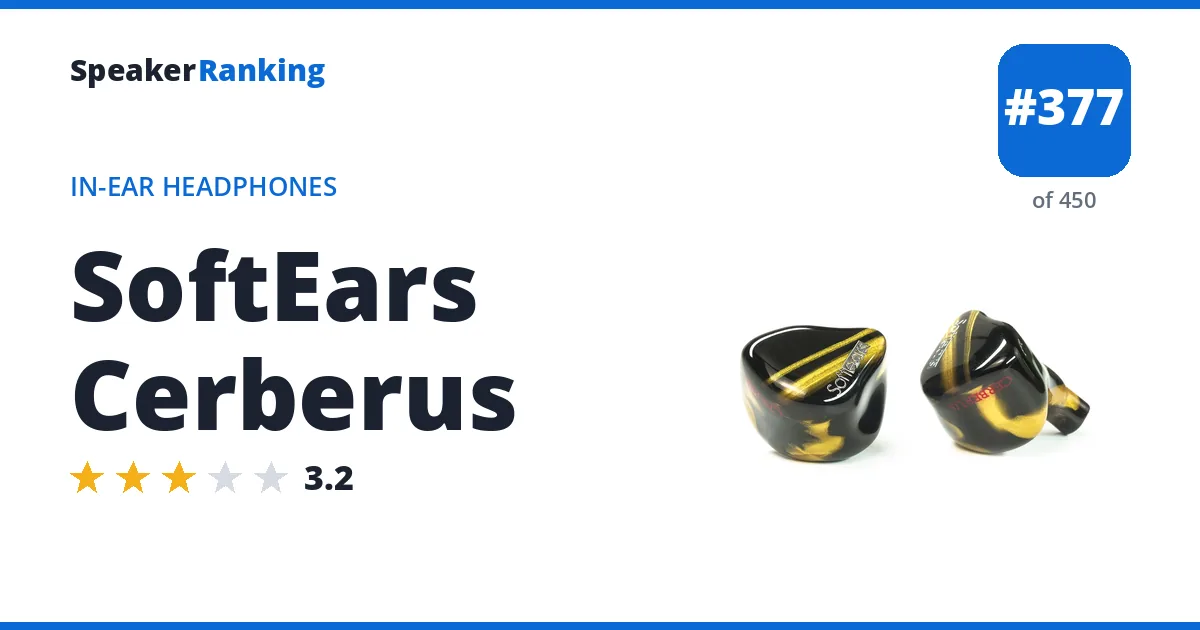
Pros: A seven driver hybrid with a dynamic woofer, four balanced armatures and two electrostatic tweeters, tuned with a warm, relaxed balance. Across seven hobbyist measurements on squig.link, bass sits within a decibel of target from 60 to 200 Hz and sub-bass stays within 6 dB down to 20 Hz, so low notes keep their weight. The subdued top end suits listeners who find most in-ears fatiguing. Its 5 ohm impedance and 104 dB per 100 mV sensitivity mean a phone drives it easily.
Cons: Treble runs about 4 to 6 dB below target from 3 to 16 kHz, with a 9.8 dB dip near 6.1 kHz, so cymbals, string texture and vocal consonants sound dim and distant. The 64 Audio A12t rates higher for slightly less money. A preference score of 64 from crinacle and a 2.9 dB standard deviation point to an uneven overall response.
Full SoftEars Cerberus review and specifications →
| Back | Closed |
|---|---|
| Built-in Microphone | No |
| Connection | Wired |
| Deviation From Target | 2.89 dB standard deviation |
| Driver Type | Hybrid (1 dynamic + 4 balanced armature + 2 electrostatic) |
| Drivers | 1 x dynamic + 4 x balanced armature + 2 x electrostatic |
| Form Factor | In-ear |
| Frequency Response | 10Hz - 80kHz (Manufacturer specified) |
| Harman Preference Score | 64 (measured by crinacle, via AutoEQ) |
| Impedance | 5 ohms |
| Sensitivity | 104 dB/100mV |
| Sub-bass Extension | Within 6 dB of target down to 20 Hz (-3.4 dB at 30 Hz) |
| Tonal Tilt | -0.11 (negative is warmer, positive brighter) |
EQ preset to match the Harman target
Set a preamp of -6.5 dB, then add these filters in any parametric equalizer (Wavelet, Equalizer APO, Peace, or a player with parametric EQ). Calculated by AutoEQ from its measured frequency response.
| Filter | Frequency | Gain | Q |
|---|---|---|---|
| Low shelf | 105 Hz | -0.1 dB | 0.70 |
| Peak | 7,728 Hz | +6.5 dB | 0.79 |
| Peak | 262 Hz | -2.4 dB | 0.44 |
| Peak | 1,896 Hz | -2.8 dB | 1.34 |
| Peak | 62 Hz | +4.2 dB | 0.67 |
| High shelf | 10,000 Hz | -0.0 dB | 0.70 |
| Peak | 4,226 Hz | -2.4 dB | 5.45 |
| Peak | 5,402 Hz | +2.0 dB | 4.97 |
| Peak | 989 Hz | +0.8 dB | 3.73 |
| Peak | 662 Hz | -0.4 dB | 2.16 |
- Reviews, Comparisons and Sound Samples
- Head-to-Head Comparisons