Coverage note. Speaker Ranking currently covers 2 RODE models across headphones and headphone amps and dacs. These are the products in our database, not a complete list of everything RODE makes.
What this page covers. The RODE models ranked here span headphones and headphone amps and dacs, including RODE NTH-100 and Rode AI-Micro. Use each model’s category position to compare it with alternatives of the same size and use case.
This page lists all 2 RODE speakers ranked on this site across headphones and headphone amps and dacs. Each model is shown in the category where it competes, with its current rank and the size of that ranking.
Use the category position rather than the brand name alone: speakers from the same manufacturer can perform very differently by size, price and product family.
Prices on this page were last checked October 11, 2026 at 4:59 PM UTC. Product prices and availability are accurate as of that date/time and are subject to change; the price and availability shown on Amazon at the time of purchase will apply to the purchase of this product.
As an eBay Partner, we may be compensated if you make a purchase.
Quick Navigation
Over-Ear Headphones
 Ranked #105 of 216 in Over-Ear Headphones - RODE NTH-100: $129.00 Amazon eBay
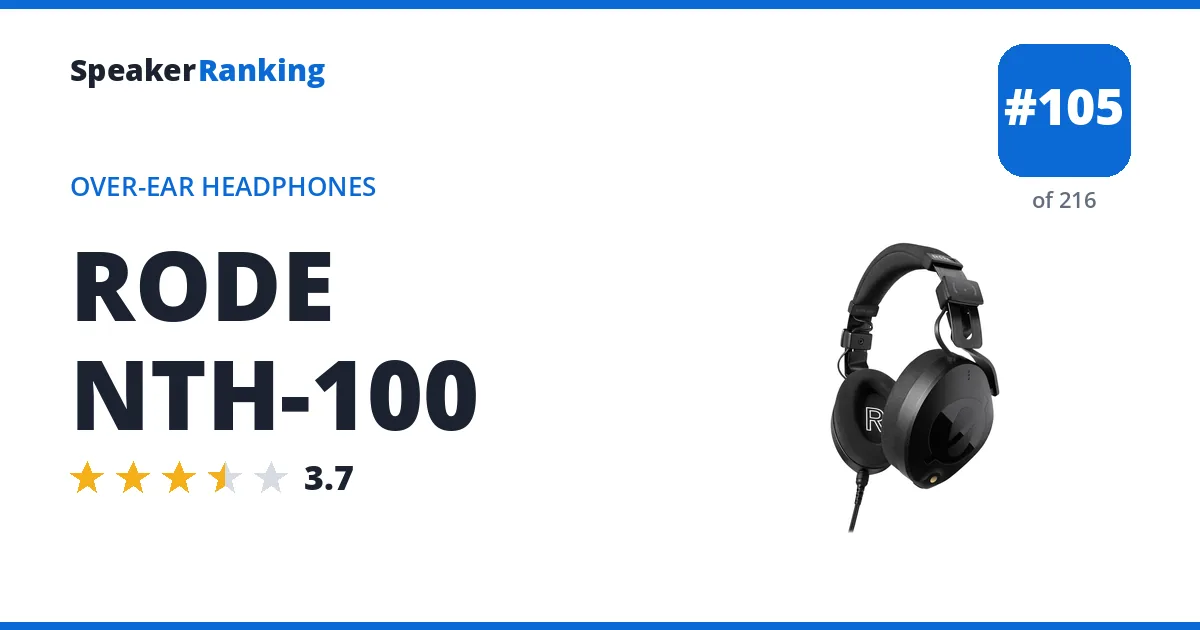
Pros: Bass from 60 to 200 Hz and the low mids are lifted about 2 dB, giving a warm, full sound with body in voices and guitars. The deviation of 2.1 dB is smooth, and 32 ohm impedance with high sensitivity runs from a laptop or audio interface. The closed back and 350 g weight suit studio and podcast monitoring.
Cons: Treble from 6 to 10 kHz is about 3.4 dB under target, with a 5.6 dB dip near 7.8 kHz, so cymbals and sibilance sound muted. Sub-bass is about 3 dB light, so the lowest notes lack rumble. The Audio-Technica ATH-M40x holds a higher rating for a lower price.
Full RODE NTH-100 review and specifications →
| Back | Closed |
|---|---|
| Connection | Wired |
| Deviation From Target | 2.10 dB standard deviation |
| Driver Type | Dynamic |
| Drivers | 1 x 40mm dynamic |
| Form Factor | Over-ear |
| Frequency Response | 5Hz - 35kHz (Manufacturer specified) |
| Harman Preference Score | 76 (measured by oratory1990, via AutoEQ) |
| Impedance | 32 ohms |
| Sensitivity | 110 dB/V |
| Sub-bass Extension | Falls 6 dB below target at 27 Hz (-5.6 dB at 30 Hz) |
| Tonal Tilt | -0.80 (negative is warmer, positive brighter) |
| Weight | 0.8 lbs (350 g) |
EQ preset to match the Harman target
Set a preamp of -6.9 dB, then add these filters in any parametric equalizer (Wavelet, Equalizer APO, Peace, or a player with parametric EQ). Calculated by AutoEQ from its measured frequency response.
| Filter | Frequency | Gain | Q |
|---|---|---|---|
| Low shelf | 105 Hz | +13.5 dB | 0.70 |
| Peak | 52 Hz | -10.9 dB | 0.36 |
| Peak | 7,684 Hz | +4.2 dB | 1.34 |
| Peak | 1,613 Hz | +2.6 dB | 1.65 |
| Peak | 5,510 Hz | -2.7 dB | 2.80 |
| High shelf | 10,000 Hz | +2.3 dB | 0.70 |
| Peak | 411 Hz | -1.4 dB | 1.68 |
| Peak | 198 Hz | +1.1 dB | 1.96 |
| Peak | 3,013 Hz | -1.2 dB | 4.00 |
| Peak | 828 Hz | +0.7 dB | 2.42 |
- Reviews, Comparisons and Sound Samples
USB-C Dongle DACs
 Ranked #13 of 14 in USB-C Dongle DACs - Rode AI-Micro: $79.00 B&H Photo eBay
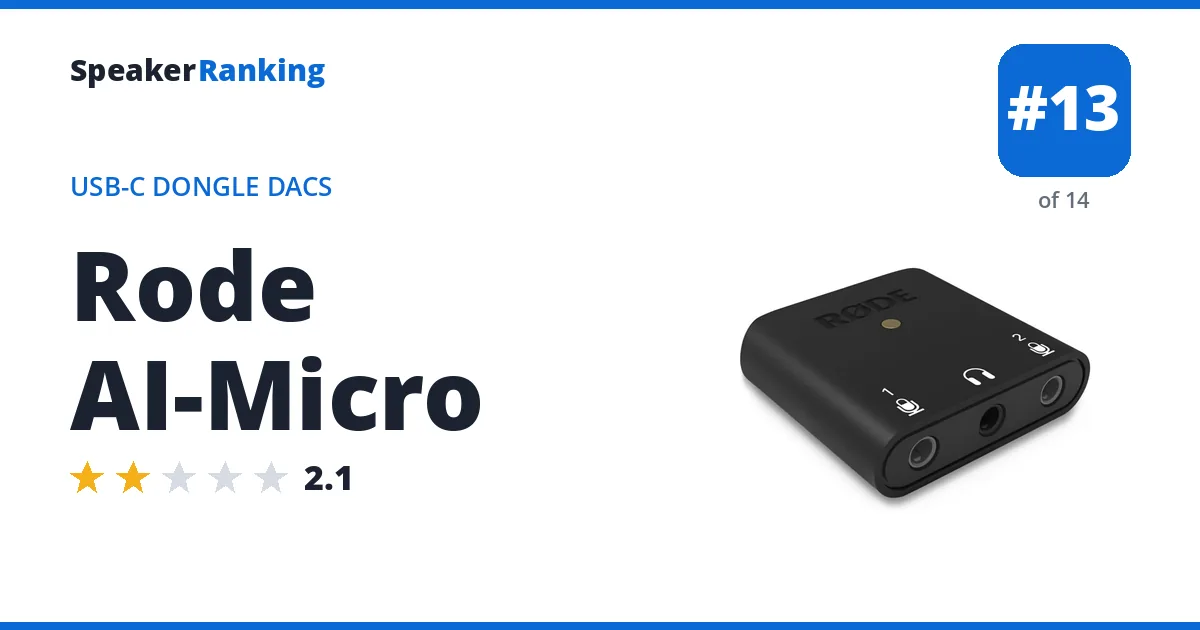
Pros: It doubles as a small audio interface, with two 3.5 mm microphone inputs alongside its headphone jack, and weighs just 13 g. A rated 125 mW into 32 ohms drives most headphones. It rates higher than the Periodic Audio Rhodium.
Cons: Audio Science Review measured only 80 dB SINAD, a level where noise and distortion can be audible, especially with sensitive in ear monitors. There is no balanced output. The FiiO KA11 rates far higher with much cleaner measurements for less.
Full Rode AI-Micro review and specifications →
| Balanced Output | No |
|---|---|
| Device Type | USB-C dongle |
| Dimensions | 1.6” x 1.5” x 0.4” (40 x 38.2 x 11.1 mm) |
| Headphone Outputs | 3.5 mm |
| Inputs | USB-C, 2 x 3.5 mm TRS/TRRS microphone |
| Output Power (32 ohms) | 125 mW (manufacturer rated) |
| SINAD | 80 dB (measured by Audio Science Review) |
| Weight | 0 lbs (13 g) |
- Reviews, Comparisons and Sound Samples
- Head-to-Head Comparisons