Coverage note. Speaker Ranking currently covers 4 Philips models across portable bluetooth speakers and headphones. These are the products in our database, not a complete list of everything Philips makes.
What this page covers. The Philips models ranked here span portable bluetooth speakers and headphones, including Philips Fidelio X2HR, Philips SHP9500 and Philips Fidelio X3. Use each model’s category position to compare it with alternatives of the same size and use case.
This page lists all 4 Philips speakers ranked on this site across portable bluetooth speakers and headphones. Each model is shown in the category where it competes, with its current rank and the size of that ranking.
Use the category position rather than the brand name alone: speakers from the same manufacturer can perform very differently by size, price and product family.
Prices on this page were last checked October 10, 2026 at 5:37 PM UTC. Product prices and availability are accurate as of that date/time and are subject to change; the price and availability shown on Amazon at the time of purchase will apply to the purchase of this product.
As an eBay Partner, we may be compensated if you make a purchase.
Quick Navigation
Over-Ear Headphones
 Ranked #53 of 134 in Over-Ear Headphones - Philips SHP9500: $94.99 Amazon eBay
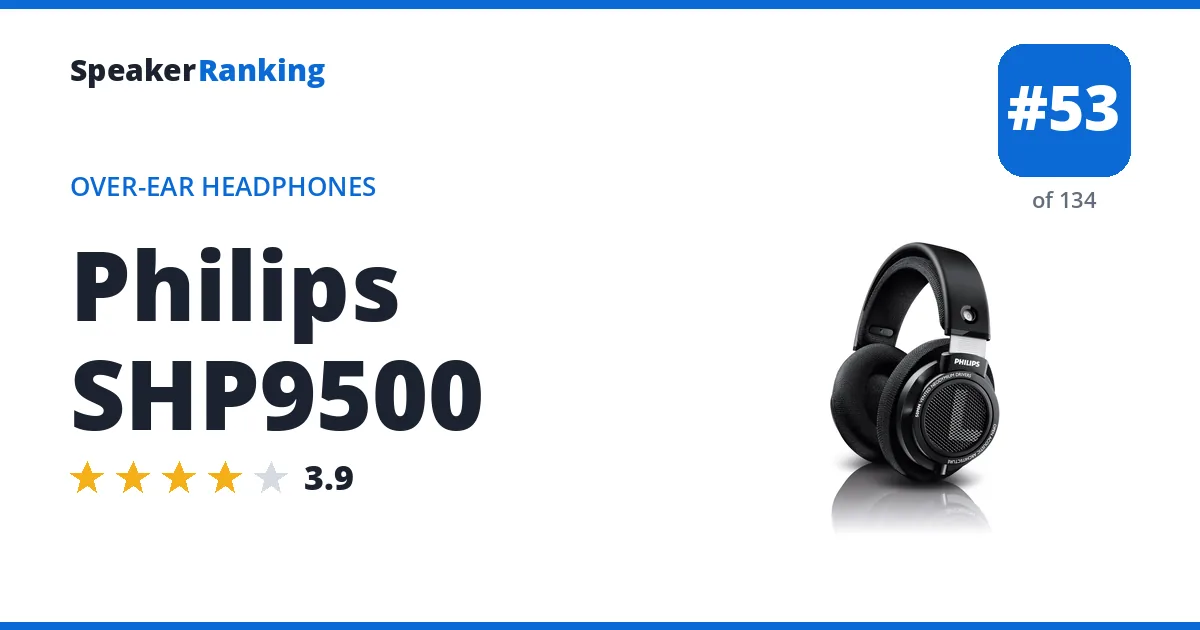
Pros: A preference score of 80 and a deviation of only 2.2 dB make the open back response smooth for the money, with bass from 60 to 200 Hz and the lower mids within half a dB of target. It is very easy to drive at 32 ohms and 101 dB sensitivity, so a phone runs it fine, and it weighs just 320 g. It costs far less than most headphones with a comparable score.
Cons: Sub-bass is about 9 dB below target under 60 Hz, so electronic and cinematic bass lacks rumble and slam. Presence is lifted about 2.3 dB, and a 6.7 dB peak near 6.2 kHz followed by a 4 dB dip near 7.7 kHz adds some edge to vocals and cymbals. The open back leaks sound and gives no isolation.
Full Philips SHP9500 review and specifications →
| Back | Open |
|---|---|
| Connection | Wired |
| Deviation From Target | 2.17 dB standard deviation |
| Driver Type | Dynamic |
| Drivers | 1 x 50mm dynamic |
| Form Factor | Over-ear |
| Frequency Response | 12Hz - 35kHz (Manufacturer specified) |
| Harman Preference Score | 80 (measured by oratory1990, via AutoEQ) |
| Impedance | 32 ohms |
| Sensitivity | 101 dB |
| Tonal Tilt | +0.47 (negative is warmer, positive brighter) |
| Weight | 0.7 lbs (320 g) |
EQ preset to match the Harman target
Set a preamp of -6.4 dB, then add these filters in any parametric equalizer (Wavelet, Equalizer APO, Peace, or a player with parametric EQ). Calculated by AutoEQ from its measured frequency response.
| Filter | Frequency | Gain | Q |
|---|---|---|---|
| Low shelf | 105 Hz | +6.5 dB | 0.70 |
| Peak | 5,734 Hz | -5.7 dB | 2.84 |
| Peak | 110 Hz | -3.0 dB | 0.81 |
| Peak | 2,130 Hz | +3.7 dB | 2.76 |
| Peak | 412 Hz | +1.0 dB | 1.39 |
| High shelf | 10,000 Hz | -2.4 dB | 0.70 |
| Peak | 1,113 Hz | -0.6 dB | 2.07 |
| Peak | 7,370 Hz | +2.1 dB | 5.98 |
| Peak | 4,477 Hz | -1.7 dB | 6.00 |
| Peak | 3,566 Hz | +1.3 dB | 6.00 |
- Reviews, Comparisons and Sound Samples
- Head-to-Head Comparisons
Discontinued Philips Models
Still ranked, and often still worth buying used, but no longer in production. Check availability before planning around one of these.
Party Size Portable Bluetooth Speakers
 Ranked #35 of 46 in Party Size Portable Bluetooth Speakers - Philips NX200: $299 Discontinued eBay
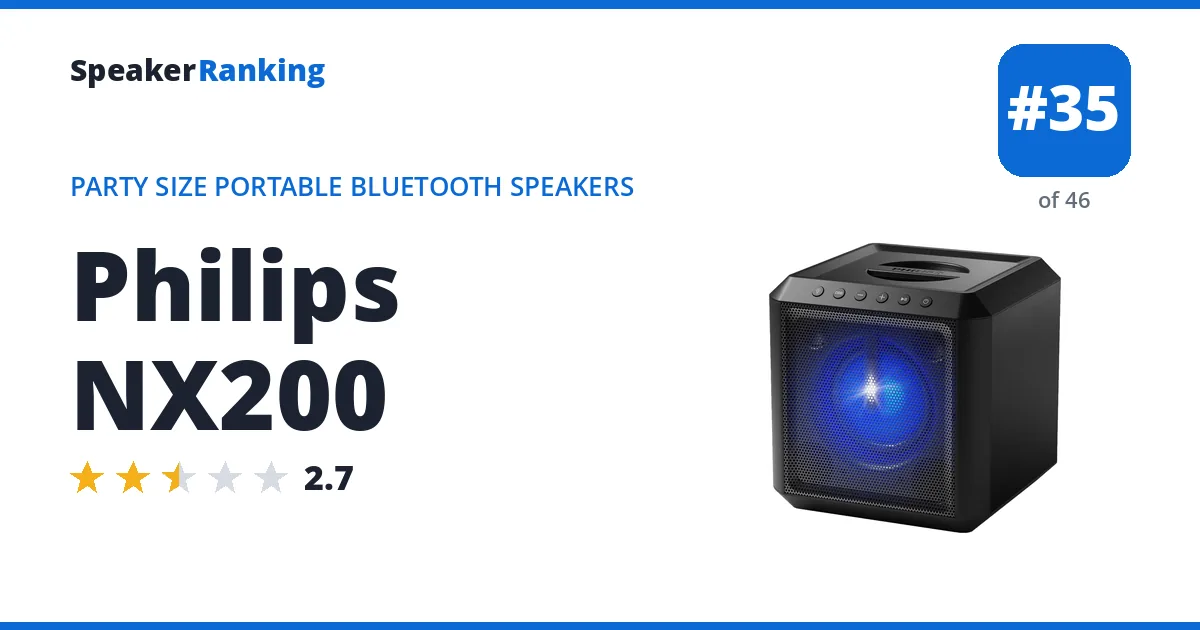
Pros: 160W maximum output (80W RMS), 2x 2” tweeters + 2x 5.25” bass drivers. Up to 14 hours playtime with built-in battery (or unlimited plugged in). Multiple color LED effects synchronized with music. Karaoke features with echo and voice switching. 2x mic inputs + 1x guitar input. Up to 10m Bluetooth range. Dual Philips speaker pairing via 3.5mm line-in. Measured bass extension of ~55Hz (-10dB).
Cons: No deep bass, mids are a little harsh. Discontinued.
Full Philips NX200 review and specifications →
| Released | Jul 2021 (5 years ago) |
|---|---|
| Amplifier Power | 80W RMS |
| App | No |
| Aux Input | Yes |
| Bass Extension (-10dB) | ~55Hz |
| Battery Life | 14 hours (Manufacturer specified) |
| Bluetooth | Yes |
| Bluetooth Codecs | SBC |
| Bluetooth Version | 5.0 |
| Digital Aux Input | No |
| Dimensions | 10.6” x 21.9” x 11.2” (268 x 556 x 285 mm) |
| Drivers | 2x 5.25” woofers, 2x 2” tweeters |
| EQ | No |
| IP Rating | None |
| Lights | Yes |
| Omnidirectional | No |
| Party Mode | No |
| Power Bank | No |
| Power Input | AC Power cord |
| Stereo | Yes |
| TWS | No |
| USB Playback | No |
| Weight | 17 lbs (7.7 kg) |
- Links
- Reviews, Comparisons and Sound Samples
- Head-to-Head Comparisons
- Philips NX200 vs Onn Large Party gen 1
- Philips NX200 vs Panasonic SC-TMAX5
- Philips NX200 vs Diamondboxx L2
- Philips NX200 vs Rockville Rock Party 6
- Philips NX200 vs Onn Large Party gen 2
- Philips NX200 vs Onn XL Wireless Party Speaker
- Philips NX200 vs JBL Partybox 110
- Philips NX200 vs JBL Partybox 130
- See all 10 comparisons
Over-Ear Headphones
 Ranked #4 of 134 in Over-Ear Headphones - Philips Fidelio X2HR: $159.95 Discontinued Amazon eBay
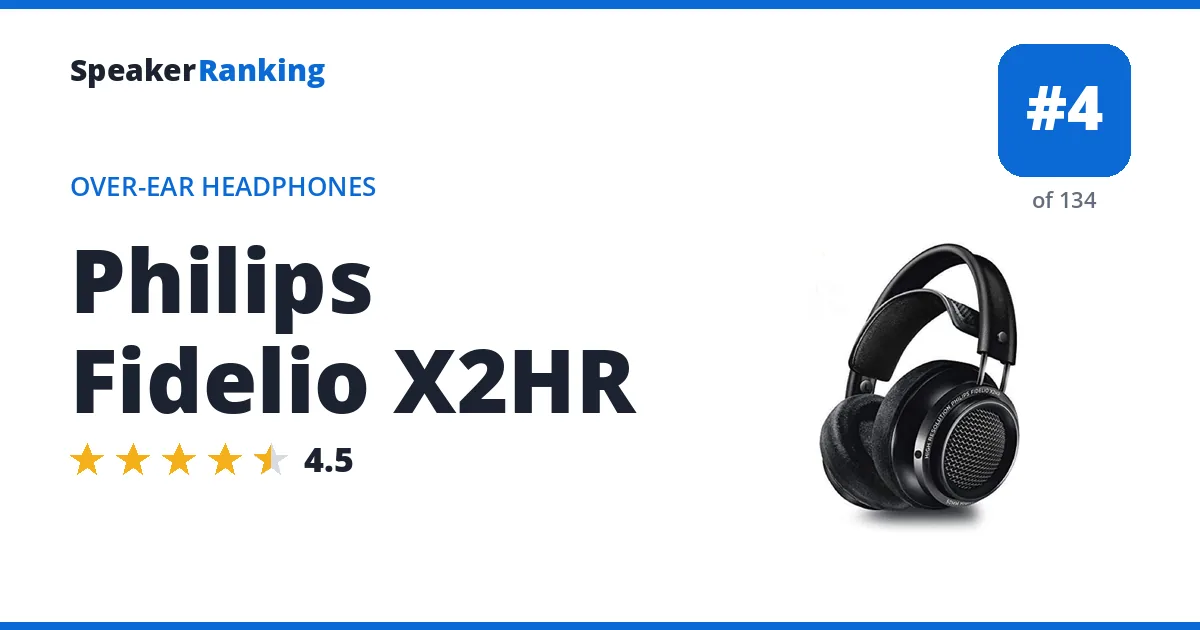
Pros: Its preference score of 94 comes from a smooth response within about 1.3 dB of the Harman target, with bass from 60 to 200 Hz and the midrange all within a dB of target. The slightly warm tilt suits listeners who find bright headphones fatiguing. At 30 ohms and 100 dB/mW it runs from a phone without a separate amp, and the 50 mm dynamic driver delivers it at a modest price compared with the Sennheiser HD 560S.
Cons: Sub-bass is about 4.6 dB below target, so the lowest notes in electronic and hip hop tracks lack impact. Treble from 6 kHz up is slightly recessed, with a 5 dB dip near 11.9 kHz, which takes some sparkle off cymbals. The open back leaks sound and offers no isolation, and at 380 g it is on the heavier side. Discontinued.
Full Philips Fidelio X2HR review and specifications →
| Back | Open |
|---|---|
| Connection | Wired |
| Deviation From Target | 1.27 dB standard deviation |
| Driver Type | Dynamic |
| Drivers | 1 x 50mm dynamic |
| Form Factor | Over-ear |
| Frequency Response | 5Hz - 40kHz (Manufacturer specified) |
| Harman Preference Score | 94 (measured by oratory1990, via AutoEQ) |
| Impedance | 30 ohms |
| Sensitivity | 100 dB/mW |
| Tonal Tilt | -0.29 (negative is warmer, positive brighter) |
| Weight | 0.8 lbs (380 g) |
EQ preset to match the Harman target
Set a preamp of -6.4 dB, then add these filters in any parametric equalizer (Wavelet, Equalizer APO, Peace, or a player with parametric EQ). Calculated by AutoEQ from its measured frequency response.
| Filter | Frequency | Gain | Q |
|---|---|---|---|
| Low shelf | 105 Hz | +7.8 dB | 0.70 |
| Peak | 64 Hz | -7.1 dB | 0.68 |
| Peak | 4,982 Hz | +4.2 dB | 0.79 |
| Peak | 5,096 Hz | -8.2 dB | 2.97 |
| Peak | 29 Hz | +1.2 dB | 4.24 |
| High shelf | 10,000 Hz | -1.2 dB | 0.70 |
| Peak | 1,660 Hz | -2.7 dB | 4.61 |
| Peak | 261 Hz | -1.0 dB | 5.02 |
| Peak | 2,026 Hz | +0.9 dB | 4.49 |
| Peak | 2,996 Hz | +1.2 dB | 6.00 |
- Reviews, Comparisons and Sound Samples
- Head-to-Head Comparisons
 Ranked #79 of 134 in Over-Ear Headphones - Philips Fidelio X3: $149.99 Discontinued Amazon eBay
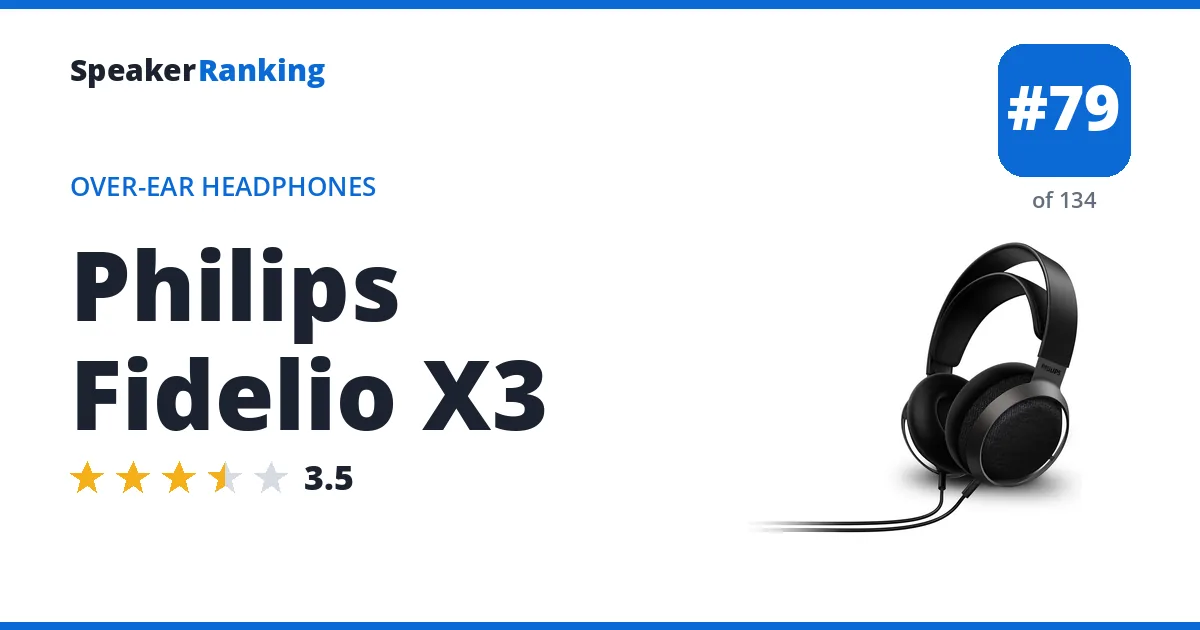
Pros: Bass is full, about 1.9 dB over target with the low mids up about 2 dB, giving a warm, weighty sound for rock and vocals. Treble from 6 to 10 kHz is about 2.8 dB over target, which adds detail and airiness. At 30 ohms and 98 dB/mW sensitivity it can be driven by a phone, and the open back gives a wide soundstage.
Cons: Sub-bass is about 5 dB under target, so the deepest rumble is missing despite the fuller bass. It has the least smooth response here at 3.0 dB deviation, with a 5.7 dB peak near 6.2 kHz and a 7.7 dB dip near 2.3 kHz that can make vocals recessed and then edgy. At 380 g the open back leaks sound and gives no isolation. Discontinued.
Full Philips Fidelio X3 review and specifications →
| Back | Open |
|---|---|
| Connection | Wired |
| Deviation From Target | 3.00 dB standard deviation |
| Driver Type | Dynamic |
| Drivers | 1 x 50mm dynamic |
| Form Factor | Over-ear |
| Frequency Response | 5Hz - 40kHz (Manufacturer specified) |
| Harman Preference Score | 70 (measured by oratory1990, via AutoEQ) |
| Impedance | 30 ohms |
| Sensitivity | 98 dB/mW |
| Tonal Tilt | -0.46 (negative is warmer, positive brighter) |
| Weight | 0.8 lbs (380 g) |
EQ preset to match the Harman target
Set a preamp of -6.9 dB, then add these filters in any parametric equalizer (Wavelet, Equalizer APO, Peace, or a player with parametric EQ). Calculated by AutoEQ from its measured frequency response.
| Filter | Frequency | Gain | Q |
|---|---|---|---|
| Low shelf | 105 Hz | +8.6 dB | 0.70 |
| Peak | 83 Hz | -6.1 dB | 0.41 |
| Peak | 2,357 Hz | +7.0 dB | 1.78 |
| Peak | 6,084 Hz | -5.7 dB | 1.84 |
| Peak | 4,444 Hz | +4.5 dB | 3.89 |
| High shelf | 10,000 Hz | -1.0 dB | 0.70 |
| Peak | 131 Hz | +0.6 dB | 1.28 |
| Peak | 62 Hz | -0.7 dB | 2.01 |
| Peak | 34 Hz | +0.9 dB | 3.36 |
| Peak | 251 Hz | -0.8 dB | 3.40 |
- Reviews, Comparisons and Sound Samples