Coverage note. Speaker Ranking currently covers 3 Astell & Kern models across headphones. These are the products in our database, not a complete list of everything Astell & Kern makes.
What this page covers. The Astell & Kern models ranked here span headphones, including Astell & Kern AURA, Astell & Kern T9iE and Astell & Kern Odyssey. Use each model’s category position to compare it with alternatives of the same size and use case.
This page lists all 3 Astell & Kern speakers ranked on this site across headphones. Each model is shown in the category where it competes, with its current rank and the size of that ranking.
Use the category position rather than the brand name alone: speakers from the same manufacturer can perform very differently by size, price and product family.
Prices on this page were last checked October 13, 2026 at 3:17 PM UTC. Product prices and availability are accurate as of that date/time and are subject to change; the price and availability shown on Amazon at the time of purchase will apply to the purchase of this product.
As an eBay Partner, we may be compensated if you make a purchase.
Quick Navigation
In-Ear Headphones
 Ranked #743 of 865 in In-Ear Headphones - Astell & Kern T9iE eBay
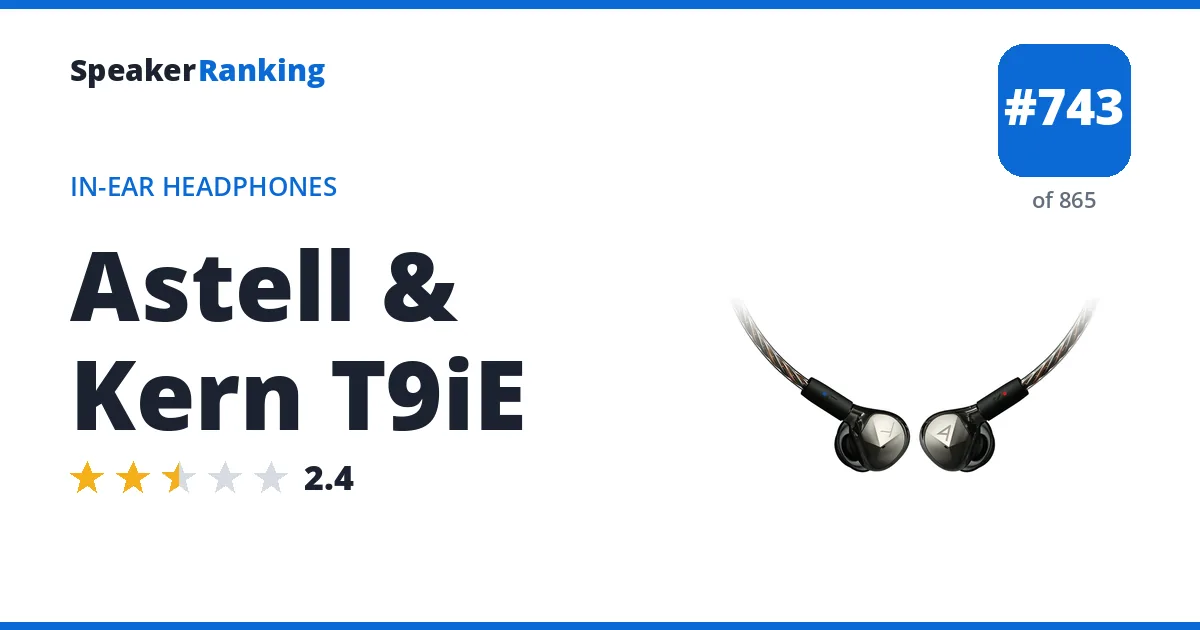
Pros: Its tuning has been measured by crinacle, so its sound can be compared directly with other measured models.
Cons: A Harman score of 54 places it in the lower part of the in-ear rankings.
Full Astell & Kern T9iE review and specifications →
| Released | Oct 2019 (7 years ago) |
|---|---|
| Connection | Wired |
| Deviation From Target | 3.32 dB standard deviation |
| Driver Type | Dynamic |
| Form Factor | In-ear |
| Frequency Response | 8Hz - 48kHz |
| Harman Preference Score | 54 (measured by crinacle, via AutoEQ) |
| Impedance | 16 ohms |
| Tonal Tilt | -1.03 (negative is warmer, positive brighter) |
EQ preset to match the Harman target
Set a preamp of -6.0 dB, then add these filters in any parametric equalizer (Wavelet, Equalizer APO, Peace, or a player with parametric EQ). Calculated by AutoEQ from its measured frequency response.
| Filter | Frequency | Gain | Q |
|---|---|---|---|
| Low shelf | 105 Hz | -3.1 dB | 0.70 |
| Peak | 233 Hz | -3.5 dB | 0.42 |
| Peak | 2,848 Hz | +6.9 dB | 0.76 |
| Peak | 68 Hz | +3.7 dB | 0.75 |
| Peak | 1,530 Hz | -3.9 dB | 1.23 |
| High shelf | 10,000 Hz | +6.0 dB | 0.70 |
| Peak | 5,108 Hz | -3.4 dB | 5.43 |
| Peak | 9,218 Hz | +1.5 dB | 5.88 |
| Peak | 3,433 Hz | +0.2 dB | 4.03 |
| Peak | 3,805 Hz | +0.8 dB | 5.99 |
- Reviews, Comparisons and Sound Samples
Discontinued Astell & Kern Models
Still ranked, and often still worth buying used, but no longer in production. Check availability before planning around one of these.
In-Ear Headphones
 Ranked #51 of 865 in In-Ear Headphones - Astell & Kern AURA Discontinued eBay
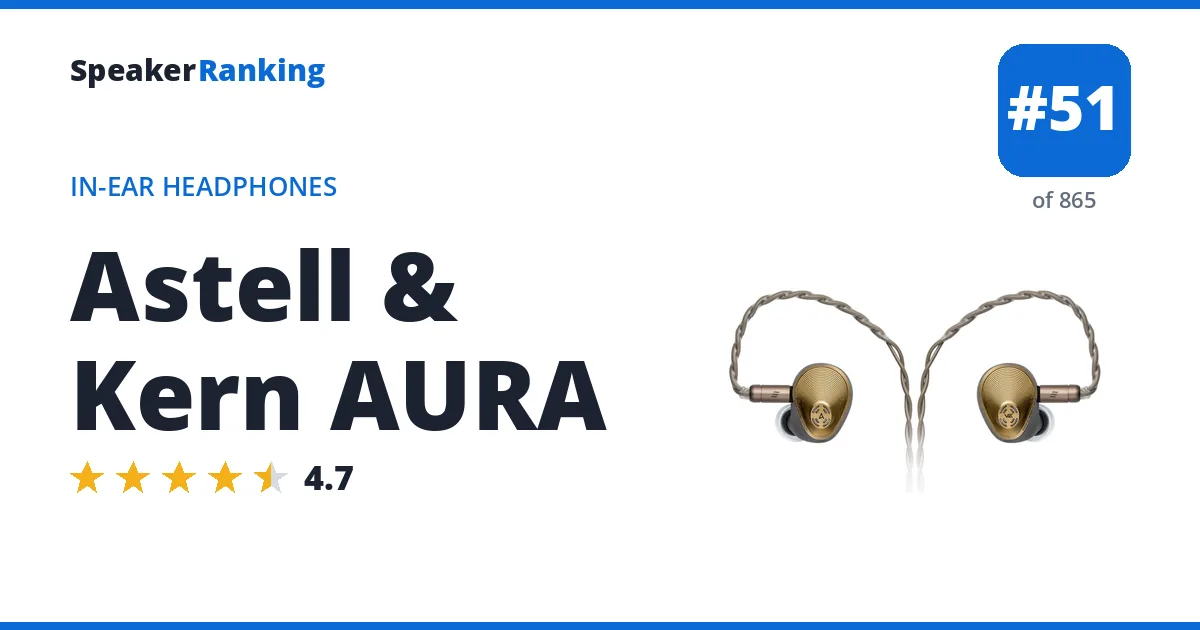
Pros: Measured response gives it an excellent Harman preference score of 82 with a 1.53 dB spread, and its mids sit within about 0.6 dB of target, so vocals and instruments sound natural. Bass is lifted about 2.6 dB with extension to 20 Hz, giving kick drums and bass lines extra weight. Upper treble lifts about 5.4 dB for extra air and sparkle. It uses 2 x 8mm dynamic + 9 x balanced armature with an easy 10.5 ohm load.
Cons: Discontinued, so it is mainly found used. A 5.9 dB peak near 8.8 kHz can make cymbals and sibilance sound sharp.
Full Astell & Kern AURA review and specifications →
| Released | May 2023 (3 years ago) |
|---|---|
| Connection | Wired |
| Deviation From Target | 1.53 dB standard deviation |
| Driver Type | Hybrid |
| Drivers | 2 x 8mm dynamic + 9 x balanced armature |
| Form Factor | In-ear |
| Frequency Response | 10Hz - 24kHz |
| Harman Preference Score | 82 (measured by HypetheSonics, via AutoEQ) |
| Impedance | 10.5 ohms |
| Sensitivity | 115 dB/mW |
| Sub-bass Extension | Within 6 dB of target down to 20 Hz (-0.5 dB at 30 Hz) |
| Tonal Tilt | +0.05 (negative is warmer, positive brighter) |
EQ preset to match the Harman target
Set a preamp of -2.6 dB, then add these filters in any parametric equalizer (Wavelet, Equalizer APO, Peace, or a player with parametric EQ). Calculated by AutoEQ from its measured frequency response.
| Filter | Frequency | Gain | Q |
|---|---|---|---|
| Low shelf | 105 Hz | +0.3 dB | 0.70 |
| Peak | 696 Hz | +2.7 dB | 0.97 |
| Peak | 164 Hz | -2.5 dB | 0.87 |
| Peak | 58 Hz | +0.9 dB | 1.03 |
| Peak | 2,154 Hz | +0.8 dB | 1.72 |
| High shelf | 10,000 Hz | -5.8 dB | 0.70 |
| Peak | 3,706 Hz | -1.1 dB | 2.16 |
| Peak | 3,099 Hz | +1.5 dB | 4.15 |
| Peak | 9,625 Hz | -0.2 dB | 5.98 |
| Peak | 5,276 Hz | -0.6 dB | 6.00 |
- Reviews, Comparisons and Sound Samples
 Ranked #763 of 865 in In-Ear Headphones - Astell & Kern Odyssey Discontinued eBay
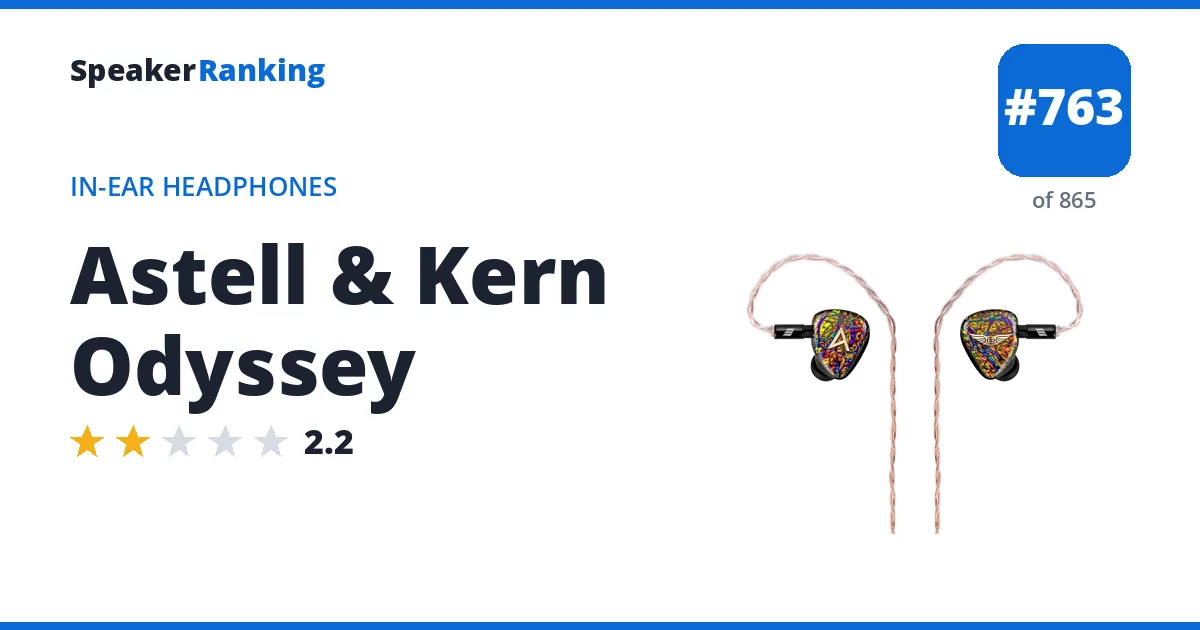
Pros: Bass is lifted about 4.5 dB with extension to 20 Hz, giving kick drums and bass lines extra weight. Lower mids sit within about 0.7 dB of target, keeping voices and guitars natural. It uses 2 x W9+ dynamic subwoofer + 5 x balanced armature + 2 x electrostatic tweeter + 1 x bone conduction with an easy 2.1 ohm load.
Cons: Discontinued, so it is mainly found used. Presence sits about 5.6 dB low with a 7.7 dB dip near 5.2 kHz, so vocals and instruments lose some bite. The 4.5 dB bass lift can sound boomy and mask midrange detail. A Harman score of 52 places it in the lower part of the in-ear rankings.
Full Astell & Kern Odyssey review and specifications →
| Released | Sep 2022 (4 years ago) |
|---|---|
| Connection | Wired |
| Deviation From Target | 3.32 dB standard deviation |
| Driver Type | Hybrid |
| Drivers | 2 x W9+ dynamic subwoofer + 5 x balanced armature + 2 x electrostatic tweeter + 1 x bone conduction |
| Form Factor | In-ear |
| Frequency Response | 5Hz - 100kHz |
| Harman Preference Score | 52 (measured by HypetheSonics, via AutoEQ) |
| Impedance | 2.1 ohms |
| Sensitivity | 100 dB/mW |
| Sub-bass Extension | Within 6 dB of target down to 20 Hz (+3.1 dB at 30 Hz) |
| Tonal Tilt | -1.43 (negative is warmer, positive brighter) |
EQ preset to match the Harman target
Set a preamp of -5.5 dB, then add these filters in any parametric equalizer (Wavelet, Equalizer APO, Peace, or a player with parametric EQ). Calculated by AutoEQ from its measured frequency response.
| Filter | Frequency | Gain | Q |
|---|---|---|---|
| Low shelf | 105 Hz | -3.8 dB | 0.70 |
| Peak | 176 Hz | -4.2 dB | 0.88 |
| Peak | 4,993 Hz | +3.7 dB | 1.35 |
| Peak | 749 Hz | +2.4 dB | 1.97 |
| Peak | 3,389 Hz | +3.9 dB | 3.43 |
| High shelf | 10,000 Hz | -2.1 dB | 0.70 |
| Peak | 9,716 Hz | +2.3 dB | 2.62 |
| Peak | 1,811 Hz | -1.4 dB | 2.52 |
| Peak | 62 Hz | +0.5 dB | 2.14 |
| Peak | 1,043 Hz | +0.4 dB | 2.29 |
- Reviews, Comparisons and Sound Samples